Intracavity Brillouin gain characterization based on cavity ringdown spectroscopy
Pith reviewed 2026-05-25 18:48 UTC · model grok-4.3
The pith
A cavity ringdown technique characterizes the Brillouin gain coefficient directly inside a laser cavity.
A machine-rendered reading of the paper's core claim, the machinery that carries it, and where it could break.
Core claim
The authors report a technique based upon the cavity ringdown method that enables characterization of the Brillouin gain coefficient directly in a laser cavity. From the measurements, material gain, optical cavity parameters, and lasing properties are all extracted within a single experiment.
What carries the argument
Intracavity cavity ringdown spectroscopy that partitions the decay signal to isolate Brillouin gain effects.
If this is right
- Brillouin gain is characterized without removing the medium from the cavity.
- Cavity parameters are determined simultaneously with the gain measurement.
- Lasing properties are obtained from the same data set.
- The method provides a direct link between gain and lasing behavior.
Where Pith is reading between the lines
- This technique could allow gain characterization during active lasing without interrupting operation.
- It may extend to other cavity-based nonlinear processes like Raman scattering.
- Researchers studying Brillouin lasers might use it for in-situ optimization of cavity design.
Load-bearing premise
The ringdown decay signal can be partitioned into Brillouin gain, cavity loss, and lasing contributions without unknown coupling terms or transient effects.
What would settle it
If the calculated gain from ringdown data does not match independent measurements of Brillouin gain under similar conditions, the method's validity would be questioned.
Figures
read the original abstract
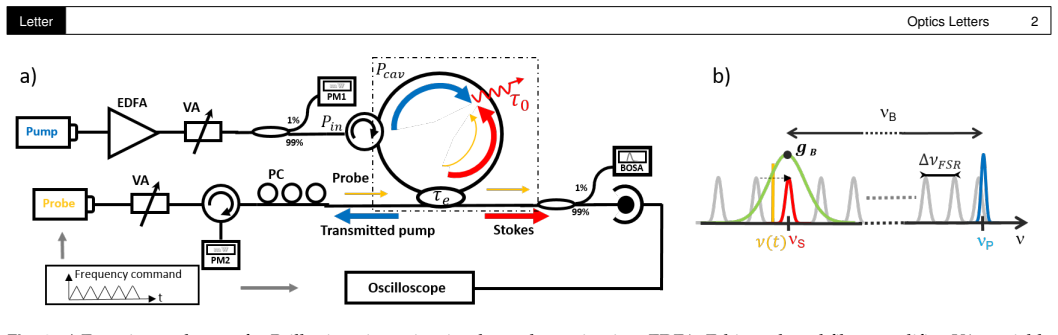
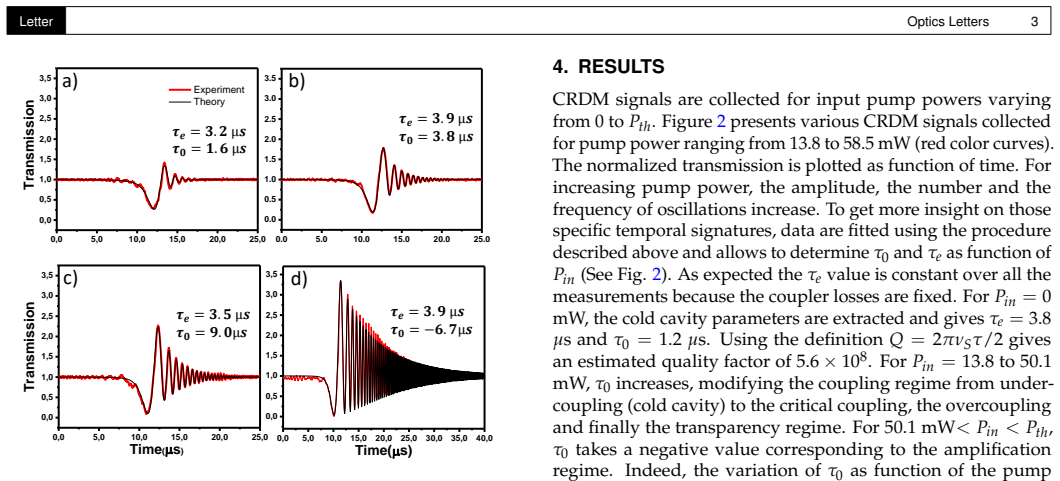
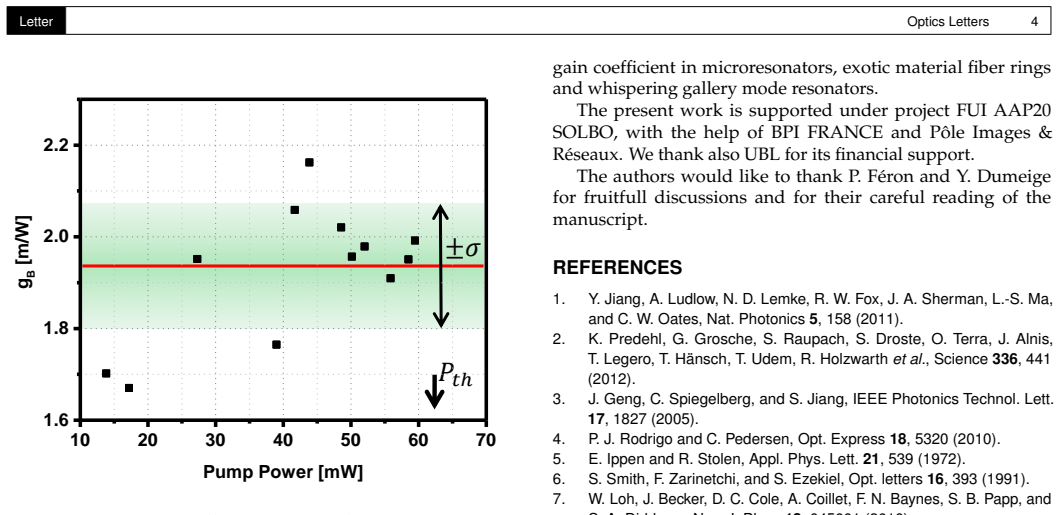
We report a technique based upon the cavity ringdown method that enables to characterize the Brillouin gain coefficient directly in a laser cavity. Material gain, optical cavity parameters and lasing properties can be extracted from measurements whithin a single experiment.
Editorial analysis
A structured set of objections, weighed in public.
Referee Report
Summary. The manuscript proposes a cavity ringdown spectroscopy technique to characterize the Brillouin gain coefficient directly inside a laser cavity. The central claim is that material gain, optical cavity parameters, and lasing properties can all be extracted from measurements within a single experiment.
Significance. If the partitioning of the ringdown signal proves robust, the approach would allow simultaneous extraction of multiple laser-relevant quantities without separate calibration runs, which could streamline intracavity gain characterization in Brillouin lasers. No machine-checked proofs or parameter-free derivations are presented.
major comments (1)
- [Abstract] Abstract: the claim that a single ringdown trace yields independent values for material gain, cavity parameters, and lasing properties rests on the unshown assumption that the observed intensity decay can be expressed as a linear combination of three contributions whose time dependences are known a priori and whose coupling coefficients are either zero or separately measurable. No rate-equation derivation, functional form for the fit, or statement addressing transient Brillouin dynamics on the ringdown timescale is supplied.
minor comments (1)
- [Abstract] Abstract: 'whithin' is a typographical error and should read 'within'.
Simulated Author's Rebuttal
We thank the referee for their careful reading of the manuscript and for highlighting the need for greater clarity regarding the model underlying our central claim. We address the single major comment below and agree that the presentation can be strengthened.
read point-by-point responses
-
Referee: [Abstract] Abstract: the claim that a single ringdown trace yields independent values for material gain, cavity parameters, and lasing properties rests on the unshown assumption that the observed intensity decay can be expressed as a linear combination of three contributions whose time dependences are known a priori and whose coupling coefficients are either zero or separately measurable. No rate-equation derivation, functional form for the fit, or statement addressing transient Brillouin dynamics on the ringdown timescale is supplied.
Authors: We agree that the abstract is concise and does not explicitly state the underlying assumptions or functional form. The manuscript derives the coupled rate equations for the intracavity optical fields and the acoustic wave, showing that the ringdown intensity can be expressed as a sum of three exponential terms whose decay rates correspond to passive cavity loss, Brillouin gain, and the effective lasing threshold dynamics. These rates are separable because the acoustic lifetime is orders of magnitude shorter than the optical ringdown time, allowing a quasi-steady-state approximation for the phonon field. The fit coefficients are obtained by independent calibration of the empty-cavity decay and the pump power. To address the referee's concern directly, we will revise the abstract to reference this multi-exponential model and add a short paragraph in the main text that states the rate equations, the resulting functional form, and the timescale justification. revision: yes
Circularity Check
No circularity: derivation relies on experimental partitioning without self-referential fits or citations
full rationale
The abstract and provided context describe an experimental cavity ringdown technique for extracting Brillouin gain, cavity parameters, and lasing properties from a single measurement set. No equations, functional forms, or self-citations are shown that would reduce any reported quantity to a fitted parameter from the same data by construction, nor is there evidence of self-definitional loops, uniqueness theorems imported from prior author work, or ansatzes smuggled via citation. The method is presented as an empirical characterization approach whose validity rests on the separability of decay contributions, which is an external modeling assumption rather than an internal definitional equivalence. This is the common case of a self-contained experimental paper with no load-bearing circular steps.
Axiom & Free-Parameter Ledger
Reference graph
Works this paper leans on
- [1]
-
[2]
K. Predehl, G. Grosche, S. Raupach, S. Droste, O. Terra, J. Alnis, T. Legero, T. Hänsch, T. Udem, R. Holzwarthet al., Science 336, 441 (2012)
work page 2012
-
[3]
J. Geng, C. Spiegelberg, and S. Jiang, IEEE Photonics Technol. Lett. 17, 1827 (2005)
work page 2005
-
[4]
P . J. Rodrigo and C. Pedersen, Opt. Express 18, 5320 (2010)
work page 2010
- [5]
- [6]
-
[7]
W. Loh, J. Becker, D. C. Cole, A. Coillet, F . N. Baynes, S. B. Papp, and S. A. Diddams, New J. Phys. 18, 045001 (2016)
work page 2016
- [8]
-
[9]
A. Sebastian, I. V. Balakireva, S. Fresnel, S. Trebaol, and P . Besnard, Opt. Express 26, 33700 (2018)
work page 2018
-
[10]
G. P . Agrawal, “Nonlinear fiber optics,” inNonlinear Science at the Dawn of the 21st Century, (Springer, 2000), pp. 195–211
work page 2000
- [11]
- [12]
- [13]
-
[14]
K. S. Abedin, Opt. Express 13, 10266 (2005)
work page 2005
-
[15]
Y . Dumeige, S. Trebaol, L. Ghi¸ sa, T. K. N. Nguyen, H. Tavernier, and P . Féron, JOSA B25, 2073 (2008)
work page 2073
-
[16]
G. N. Conti, S. Berneschi, F . Cosi, S. Pelli, S. Soria, G. C. Righini, M. Dispenza, and A. Secchi, Opt. Express 19, 3651 (2011)
work page 2011
-
[17]
R. Henriet, G. Lin, A. Coillet, M. Jacquot, L. Furfaro, L. Larger, and Y . K. Chembo, Opt. letters 40, 1567 (2015)
work page 2015
-
[18]
A. Rasoloniaina, V. Huet, T. K. N. Nguyen, E. Le Cren, M. Mortier, L. Michely, Y . Dumeige, and P . Féron, Sci. Reports4, 4023 (2014)
work page 2014
- [19]
-
[20]
A. A. Savchenkov, A. B. Matsko, M. Mohageg, and L. Maleki, Opt. Lett. 32, 497 (2007)
work page 2007
-
[21]
A. Rasoloniaina, V. Huet, M. Thual, S. Balac, P . Féron, and Y . Dumeige, JOSA B 32, 370 (2015)
work page 2015
-
[22]
H. A. Haus, Waves and fields in optoelectronics (Prentice-Hall, 1984)
work page 1984
- [23]
-
[24]
Corning smf-28 ultra optical fiber,
“Corning smf-28 ultra optical fiber,” https://www.corning.com/media/ worldwide/coc/documents/Fiber/SMF-28%20Ultra.pdf, note = Ac- cessed 24 May 2019
work page 2019
-
[25]
P . D. Dragic, J. Light. Technol. 29, 967 (2011)
work page 2011
- [26]
discussion (0)
Sign in with ORCID, Apple, or X to comment. Anyone can read and Pith papers without signing in.