Hop-by-Hop Multipath Routing: Choosing the Right Nexthop Set
Pith reviewed 2026-05-25 16:31 UTC · model grok-4.3
The pith
LFID routing selects more and shorter nexthops than DAG methods by allowing some links to be used bidirectionally per destination while remaining loop-free.
A machine-rendered reading of the paper's core claim, the machinery that carries it, and where it could break.
Core claim
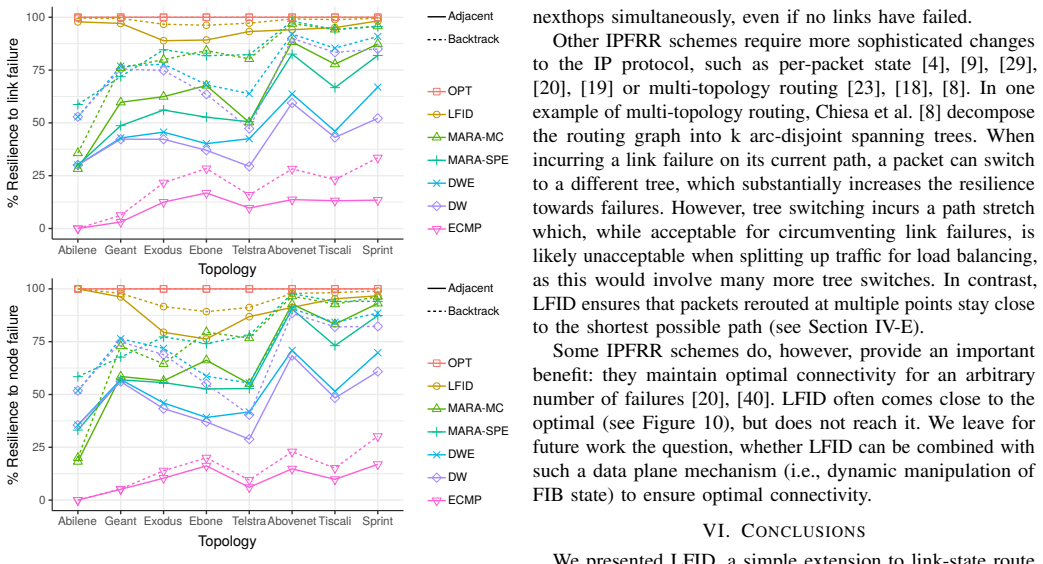
Loop-Free Inport-Dependent (LFID) routing increases the number and reduces the average length of viable paths compared with DAG-based methods by allowing bidirectional use of links for the same destination, provided the forwarding table entry is conditioned on the incoming port; this protects against a higher fraction of single and multiple failures or congestions and approaches the coverage of arbitrary source routing.
What carries the argument
Loop-Free Inport-Dependent (LFID) forwarding, which conditions each nexthop choice on the packet's incoming port to safely reuse some links in both directions for one destination.
If this is right
- A larger share of single-link and multi-link failures can be bypassed without source routing.
- Traffic can be shifted away from more congested links using only local router state.
- Average path lengths stay shorter than those produced by strict downward-only selection.
- The added computation at each router remains modest relative to the gain in path diversity.
Where Pith is reading between the lines
- Existing link-state protocols could adopt LFID by extending their next-hop computation with incoming-port awareness.
- Networks that already experience frequent localized congestion would see the largest practical benefit from the extra path options.
- Simulation on realistic ISP topologies could quantify the exact fraction of additional failures covered versus current DAG implementations.
Load-bearing premise
That conditioning the forwarding decision on the incoming port is sufficient to break all possible loops even when a link is used in both directions for the same destination.
What would settle it
A concrete network topology and traffic pattern in which packets using LFID tables enter a loop when a link is marked bidirectional for one destination.
Figures








read the original abstract
The Internet can be made more efficient and robust with hop-by-hop multipath routing: Each router on the path can split packets between multiple nexthops in order to 1) avoid failed links and 2) reduce traffic on congested links. Before deciding how to split traffic, one first needs to decide which nexthops to allow at each step. In this paper, we investigate the requirements and trade-offs for making this choice. Most related work chooses the viable nexthops by applying the "Downward Criterion", i.e., only adding nexthops that lead closer to the destination; or more generally by creating a Directed Acyclic Graph (DAG) for each destination. We show that a DAG's nexthop options are necessarily limited, and that, by using certain links in both directions (per destination), we can add further nexthops while still avoiding loops. Our solution LFID (Loop-Free Inport-Dependent) routing, though having a slightly higher time complexity, leads to both a higher number of and shorter potential paths than related work. LFID thus protects against a higher percentage of single and multiple failures (or congestions) and comes close to the performance of arbitrary source routing.
Editorial analysis
A structured set of objections, weighed in public.
Referee Report
Summary. The paper proposes LFID (Loop-Free Inport-Dependent) routing for hop-by-hop multipath routing. It argues that standard DAG or Downward-Criterion nexthop selection is limited, but inport-dependent forwarding allows some links to be used bidirectionally per destination while still avoiding loops, yielding more and shorter viable paths, higher protection against single/multiple failures or congestion, and performance approaching arbitrary source routing, at the cost of modestly higher time complexity.
Significance. If the loop-freedom invariant holds under bidirectional usage and the reported gains are reproducible across topologies, LFID would meaningfully expand the design space for robust hop-by-hop multipath routing in IP networks without requiring source routing or centralized control.
major comments (2)
- [Abstract and LFID construction] Abstract and LFID definition section: the central claim that inport-dependent forwarding permits bidirectional link use per destination while remaining loop-free lacks an explicit inductive invariant, cycle-breaking argument, or counter-example-free proof; without this, the reported increases in path count, shortness, and failure protection do not follow.
- [Evaluation and comparisons] Evaluation section (comparisons to related work): the superiority in number of paths and resilience is asserted but the manuscript must specify the exact forwarding-table construction algorithm, the topologies evaluated, and whether the bidirectional allowance is exhaustively verified to be acyclic for every destination.
minor comments (2)
- [Section 3] Notation for inport-dependent forwarding tables should be introduced with a small concrete example early in the paper to clarify how the inport field alters the allowed nexthops.
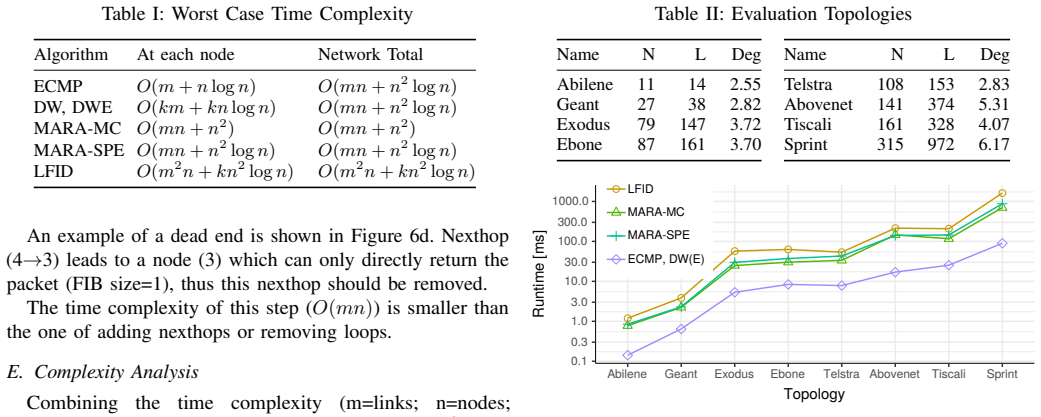
- [Complexity analysis] The time-complexity comparison is stated as 'slightly higher' but should include big-O expressions or measured runtimes on the same instances used for the path-count experiments.
Simulated Author's Rebuttal
We thank the referee for the constructive feedback and the recommendation for major revision. We address each major comment below and will incorporate clarifications and additions to strengthen the manuscript.
read point-by-point responses
-
Referee: [Abstract and LFID construction] Abstract and LFID definition section: the central claim that inport-dependent forwarding permits bidirectional link use per destination while remaining loop-free lacks an explicit inductive invariant, cycle-breaking argument, or counter-example-free proof; without this, the reported increases in path count, shortness, and failure protection do not follow.
Authors: We agree that an explicit inductive proof would make the loop-freedom argument more rigorous and self-contained. The LFID construction selects nexthops such that bidirectional use of a link for a given destination is permitted only when the inport state ensures that returning traffic cannot close a cycle (specifically, by conditioning on the incoming port to exclude the reverse direction in a way that would allow looping). In the revised manuscript we will add a dedicated subsection with an inductive invariant: for any destination d, the forwarding relation at each node maintains that every allowed next hop decreases a lexicographic potential combining distance to d and the inport identifier, guaranteeing acyclicity. We will also include a short proof sketch and note that exhaustive enumeration on small topologies confirmed absence of cycles. revision: yes
-
Referee: [Evaluation and comparisons] Evaluation section (comparisons to related work): the superiority in number of paths and resilience is asserted but the manuscript must specify the exact forwarding-table construction algorithm, the topologies evaluated, and whether the bidirectional allowance is exhaustively verified to be acyclic for every destination.
Authors: Section 3 already presents the LFID algorithm (including the inport-dependent nexthop selection procedure) with pseudocode; Section 5 lists the evaluated topologies (Rocketfuel ISP maps and synthetic random graphs with given node counts). To satisfy the request for explicitness we will (i) reproduce the algorithm pseudocode in an appendix, (ii) tabulate every topology together with its size and the number of destinations for which tables were built, and (iii) add a verification paragraph stating that, for every destination in every topology, we ran a cycle-detection pass over the resulting directed forwarding graph and confirmed acyclicity even after allowing the bidirectional links selected by LFID. revision: yes
Circularity Check
No circularity; derivation self-contained on graph properties
full rationale
The provided abstract and description define LFID via independent loop-avoidance rules on inport-dependent forwarding and bidirectional link usage per destination. No equations, fitted parameters, or self-citations are shown that reduce the central claims (more/shorter paths, failure protection) back to the inputs by construction. The loop-freedom property is asserted as following from the forwarding rule itself rather than from any result that presupposes the performance gains. This matches the default case of a self-contained construction against external graph-theoretic benchmarks.
Axiom & Free-Parameter Ledger
axioms (1)
- domain assumption Loop-free routing can be ensured by inport-dependent forwarding rules even with bidirectional link usage per destination.
invented entities (1)
-
LFID (Loop-Free Inport-Dependent) routing
no independent evidence
Reference graph
Works this paper leans on
-
[1]
https://github.com/yan-qi/k-shortest-paths-cpp-version
An implementation of the k-shortest-paths algorithm in cpp. https://github.com/yan-qi/k-shortest-paths-cpp-version
- [2]
- [3]
-
[4]
S. Antonakopoulos, Y . Bejerano, and P. Koppol. Full protection made easy: the dispath ip fast reroute scheme. IEEE/ACM ToN, 2015
work page 2015
-
[5]
A. Atlas. U-turn Alternates for IP/LDP Fast-Reroute. Internet-Draft draft-atlas-ip-local-protect-uturn-03, IETF, 2006
work page 2006
-
[6]
A. K. Atlas and A. Zinin. Basic specification for ip fast-reroute: loop-free alternates. 2008
work page 2008
- [7]
- [8]
-
[9]
T. Elhourani, A. Gopalan, and S. Ramasubramanian. Ip fast rerouting for multi-link failures. IEEE/ACM ToN, 2016
work page 2016
-
[10]
C. Filsfils, S. Previdi, L. Ginsberg, B. Decraene, S. Litkowski, and R. Shakir. Segment Routing Architecture. RFC 8402, July 2018
work page 2018
- [11]
-
[12]
B. Fortz and M. Thorup. Internet traffic engineering by optimizing ospf weights. In INFOCOM 2000, volume 2, pages 519–528. IEEE, 2000
work page 2000
-
[13]
I. Gojmerac, P. Reichl, and L. Jansen. Towards low-complexity internet te: the adaptive multi-path algorithm. Computer Networks, 2008
work page 2008
- [14]
-
[15]
G. Iannaccone, C.-N. Chuah, S. Bhattacharyya, and C. Diot. Feasibility of ip restoration in a tier 1 backbone. Ieee Network, 18(2):13–19, 2004
work page 2004
-
[16]
S. Iyer, S. Bhattacharyya, N. Taft, and C. Diot. An approach to alleviate link overload as observed on an ip backbone. In IEEE INFOCOM 2003 . Telstra Abovenet Tiscali Sprint Abilene Geant Exodus Ebone 0 1 2 3 4 5 6 7 8 9 10 0 1 2 3 4 5 6 7 8 9 10 0 1 2 3 4 5 6 7 8 9 10 0 1 2 3 4 5 6 7 8 9 10 0 25 50 75 100 0 25 50 75 100% of src-dst pairs with >= K connec...
work page 2003
-
[17]
A. Kvalbein, C. Dovrolis, and C. Muthu. Multipath load-adaptive routing: Putting the emphasis on robustness and simplicity. In ICNP 2009. IEEE
work page 2009
- [18]
-
[19]
K. Lakshminarayanan, M. Caesar, M. Rangan, T. Anderson, S. Shenker, and I. Stoica. Achieving convergence-free routing using failure-carrying packets. ACM SIGCOMM CCR , 37(4):241–252, 2007
work page 2007
-
[20]
J. Liu, A. Panda, A. Singla, B. Godfrey, M. Schapira, and S. Shenker. Ensuring connectivity via data plane mechanisms. In NSDI, 2013
work page 2013
-
[21]
R. Mahajan, N. Spring, D. Wetherall, and T. Anderson. Inferring link weights using end-to-end measurements. In IMW, 2002
work page 2002
-
[22]
N. Michael and A. Tang. Halo: Hop-by-hop adaptive link-state optimal routing. IEEE/ACM Transactions on Networking , 2015
work page 2015
-
[23]
M. Motiwala, M. Elmore, N. Feamster, and S. Vempala. Path splicing. In ACM SIGCOMM CCR . ACM, 2008
work page 2008
-
[24]
J. Moy. OSPF Version 2. RFC 2328, Apr. 1998
work page 1998
-
[25]
P. Narvaez, K.-Y . Siu, and H.-Y . Tzeng. Efficient algorithms for multi- path link-state routing. 1999
work page 1999
- [26]
-
[27]
F. Paganini and E. Mallada. A unified approach to congestion control and node-based multipath routing. IEEE/ACM ToN, 2009
work page 2009
-
[28]
G. R ´etv´ari, J. Tapolcai, G. Enyedi, and A. Cs ´asz´ar. Ip fast reroute: Loop free alternates revisited. In INFOCOM. IEEE, 2011
work page 2011
-
[29]
G. Robertson and S. Nelakuditi. Handling multiple failures in ip networks through localized on-demand link state routing. IEEE TNSM, 2012
work page 2012
- [30]
- [31]
-
[32]
C. Villamizar. OSPF Optimized Multipath (OSPF-OMP). Internet-Draft draft-ietf-ospf-omp-02, IETF, Feb. 1999. Work in Progress
work page 1999
-
[33]
A. Viswanathan, E. C. Rosen, and R. Callon. Multiprotocol Label Switching Architecture. RFC 3031, Jan. 2001
work page 2001
-
[34]
H. Q. V o, O. Lysne, and A. Kvalbein. Routing with joker links for maximized robustness. In IFIP Networking, pages 1–9. IEEE, 2013
work page 2013
-
[35]
S. Vutukury and J. Garcia-Luna-Aceves. A simple approximation to minimum-delay routing. In ACM SIGCOMM CCR . ACM, 1999
work page 1999
-
[36]
D. Xu, M. Chiang, and J. Rexford. Deft: Distributed exponentially- weighted flow splitting. In INFOCOM 2007, pages 71–79. IEEE, 2007
work page 2007
-
[37]
D. Xu, M. Chiang, and J. Rexford. Link-state routing with hop-by-hop forwarding can achieve optimal te. IEEE/ACM ToN, 2011
work page 2011
-
[38]
B. Yang, J. Liu, S. Shenker, J. Li, and K. Zheng. Keep forwarding: Towards k-link failure resilient routing. In INFOCOM. IEEE, 2014
work page 2014
-
[39]
X. Yang and D. Wetherall. Source selectable path diversity via routing deflections. In ACM SIGCOMM CCR . ACM, 2006
work page 2006
-
[40]
C. Yi, A. Afanasyev, I. Moiseenko, L. Wang, B. Zhang, and L. Zhang. A case for stateful forwarding plane. Elsevier, 2013
work page 2013
discussion (0)
Sign in with ORCID, Apple, or X to comment. Anyone can read and Pith papers without signing in.