Experimental searches for the chiral magnetic effect in heavy-ion collisions
Pith reviewed 2026-05-25 14:17 UTC · model grok-4.3
The pith
Heavy-ion collisions provide a setting to detect the chiral magnetic effect via charge separation along magnetic fields, despite dominant backgrounds in early data.
A machine-rendered reading of the paper's core claim, the machinery that carries it, and where it could break.
Core claim
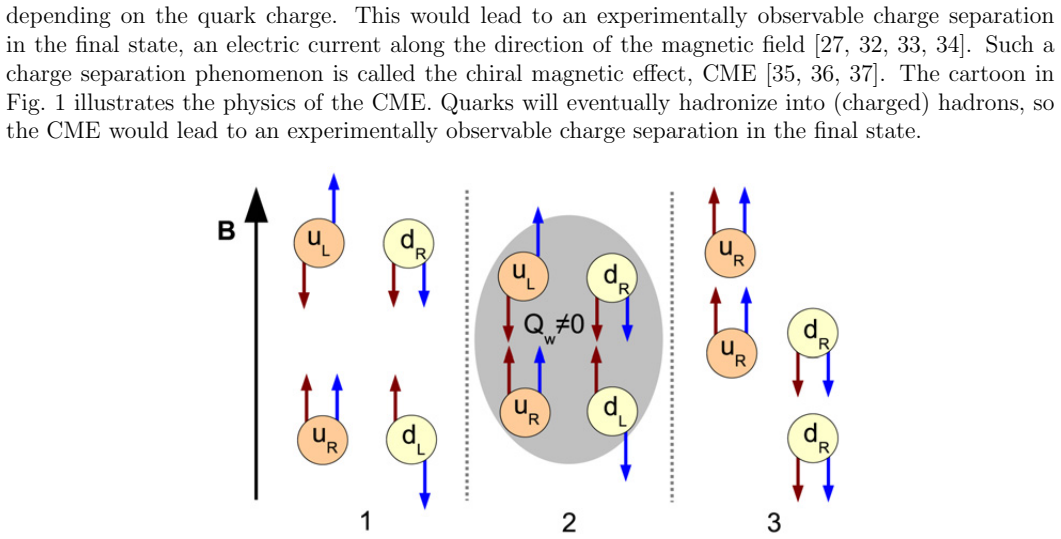
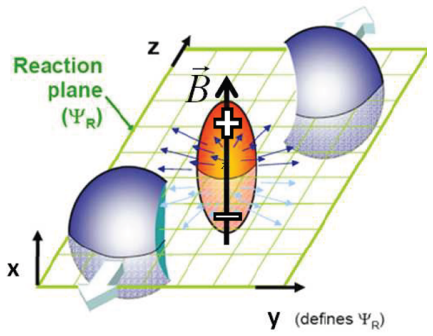
Relativistic heavy-ion collisions, with the likely creation of the high energy density quark-gluon plasma and restoration of the approximate chiral symmetry, and the possibly long-lived strong magnetic field, provide a unique opportunity to detect the chiral magnetic effect, where charge separation of chirality imbalanced quarks is generated along the magnetic field and the imbalance results from interactions of quarks with metastable local domains of gluon fields of non-zero topological charges out of QCD vacuum fluctuations.
What carries the argument
The chiral magnetic effect mechanism of charge separation along the magnetic field driven by chirality imbalance from topological gluon domains.
If this is right
- Detection would confirm local P and CP violation in strong interactions.
- It would offer a potential window on the strong CP problem and matter-antimatter asymmetry.
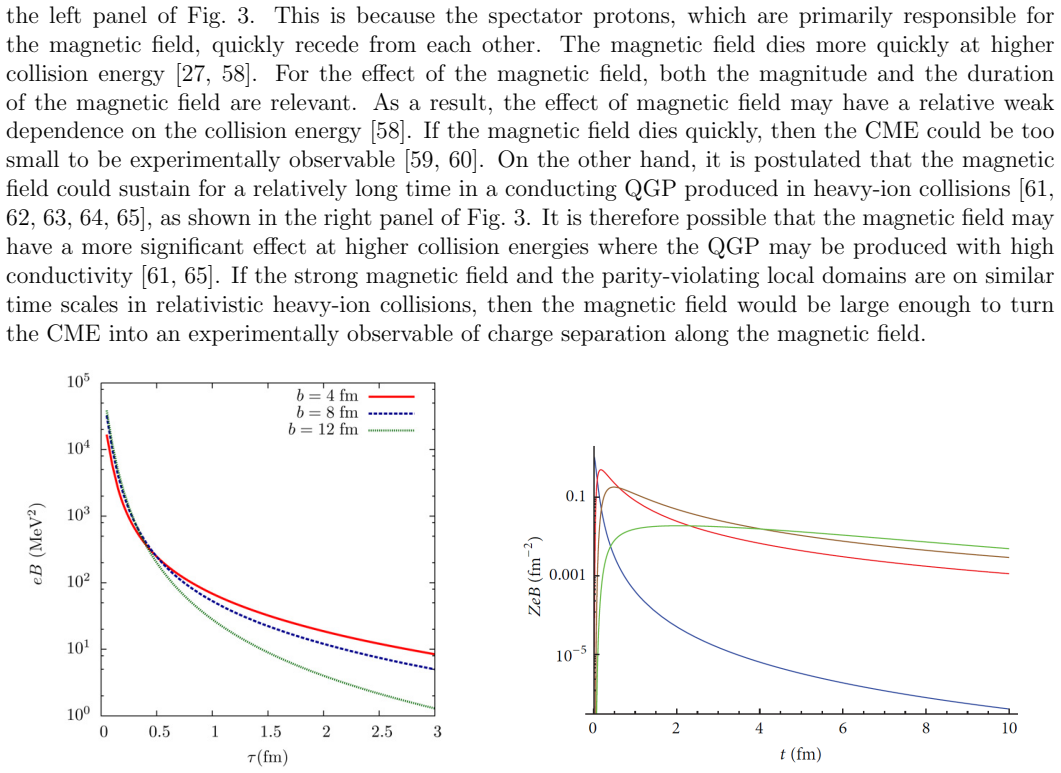
- Measurements could constrain the lifetime and strength of the magnetic field in the plasma.
- Isolated signals would enable study of QCD topological fluctuations during the collision evolution.
Where Pith is reading between the lines
- Confirmed signals could quantify the rate of topological charge transitions in the QCD vacuum.
- Background control methods developed here may transfer to searches for related anomalous transport effects.
- Data from varying beam energies could test the predicted dependence on magnetic field duration.
Load-bearing premise
The chirality imbalance results from interactions of quarks with metastable local domains of gluon fields of non-zero topological charges out of QCD vacuum fluctuations.
What would settle it
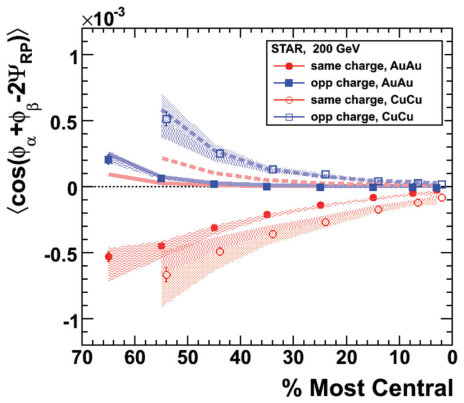
No detectable charge separation signal remaining after background subtraction in high-statistics data from multiple collision systems and centralities with varying magnetic field strengths.
Figures
read the original abstract
The chiral magnetic effect (CME) in quantum chromodynamics (QCD) refers to a charge separation (an electric current) of chirality imbalanced quarks generated along an external strong magnetic field. The chirality imbalance results from interactions of quarks, under the approximate chiral symmetry restoration, with metastable local domains of gluon fields of non-zero topological charges out of QCD vacuum fluctuations. Those local domains violate the $\mathcal{P}$ and $\mathcal{CP}$ invariance, potentially offering a solution to the strong $\mathcal{CP}$ problem in explaining the magnitude of the matter-antimatter asymmetry in today's universe. Relativistic heavy-ion collisions, with the likely creation of the high energy density quark-gluon plasma and restoration of the approximate chiral symmetry, and the possibly long-lived strong magnetic field, provide a unique opportunity to detect the CME. Early measurements of the CME-induced charge separation in heavy-ion collisions are dominated by physics backgrounds. Major efforts have been devoted to eliminate or reduce those backgrounds. We review those efforts, with a somewhat historical perspective, and focus on the recent innovative experimental undertakings in the search for the CME in heavy-ion collisions.
Editorial analysis
A structured set of objections, weighed in public.
Referee Report
Summary. The manuscript is a review summarizing the theoretical motivation for the chiral magnetic effect (CME) in QCD, where chirality imbalance from topological gluon domains leads to charge separation along strong magnetic fields in the quark-gluon plasma created in relativistic heavy-ion collisions. It notes that early experimental measurements of CME-induced charge separation are dominated by physics backgrounds and reviews the major efforts to eliminate or reduce those backgrounds, adopting a somewhat historical perspective while focusing on recent innovative experimental techniques.
Significance. If the review accurately captures the literature, it offers a consolidated reference on the experimental status of CME searches, underscoring the unique conditions provided by heavy-ion collisions for probing QCD topology and the strong CP problem. The historical framing of background mitigation progress provides context for ongoing work and may help orient new researchers in the field.
Simulated Author's Rebuttal
We thank the referee for their positive assessment of the manuscript and for recommending acceptance. The review accurately reflects the current experimental status of CME searches as described.
Circularity Check
No significant circularity in review paper
full rationale
This is a descriptive review article summarizing the theoretical motivation for the chiral magnetic effect and experimental efforts to detect it in heavy-ion collisions. No derivations, equations, predictions, or fitted parameters are introduced; the mechanism description draws from established QCD literature without internal construction or self-referential steps. The paper's purpose is to survey existing work, so no load-bearing chain reduces to its own inputs.
Axiom & Free-Parameter Ledger
Forward citations
Cited by 4 Pith papers
-
Probing the chiral magnetic effect via transverse spherocity event classification in relativistic heavy-ion collisions
Transverse spherocity classifies heavy-ion collision events to suppress backgrounds in chiral magnetic effect searches, with AMPT simulations showing higher scaled signals in isotropic events.
-
Retarded Correlators of Charge Transport in a Magnetic Field
Analytic computation via kinetic theory of retarded current-current correlators in magnetized relativistic plasma, with transverse charge diffusion scaling as 1/B0^2 while longitudinal diffusion is unaffected.
-
A higher-harmonic observable for the chiral magnetic effect in heavy-ion collisions
The hexadecapole component of Δγ(φ_pair) is proposed as a CME-sensitive and background-insensitive observable based on magnetic field fluctuations in heavy-ion collision models.
-
Plasma heating during the chiral plasma instability
During chiral plasma instability, excess energy from chiral asymmetry heats the plasma with δT ~ μ5²/T instead of fully building the helical magnetic field.
Reference graph
Works this paper leans on
-
[1]
R. A. Alpher, H. Bethe, and G. Gamow. The origin of chemical elements. Phys. Rev., 73:803–804, 1948
work page 1948
-
[2]
Matter and Antimatter in the Uni- verse
Laurent Canetti, Marco Drewes, and Mikhail Shaposhnikov. Matter and Antimatter in the Uni- verse. New J. Phys. , 14:095012, 2012. 44
work page 2012
-
[3]
A. D. Sakharov. Violation of CP Invariance, C asymmetry, and baryon asymmetry of the universe. Pisma Zh. Eksp. Teor. Fiz. , 5:32–35, 1967. [Usp. Fiz. Nauk161,no.5,61(1991)]
work page 1967
-
[4]
Origin of the matter-antimatter asymmetry
Michael Dine and Alexander Kusenko. Origin of the matter-antimatter asymmetry. Rev. Mod. Phys., 76:1–30, Dec 2003
work page 2003
-
[5]
V. A. Kuzmin, V. A. Rubakov, and M. E. Shaposhnikov. On the Anomalous Electroweak Baryon Number Nonconservation in the Early Universe. Phys. Lett., 155B:36, 1985
work page 1985
-
[6]
M. E. Shaposhnikov. Baryon Asymmetry of the Universe in Standard Electroweak Theory. Nucl. Phys., B287:757–775, 1987
work page 1987
-
[7]
Unitary Symmetry and Leptonic Decays
Nicola Cabibbo. Unitary Symmetry and Leptonic Decays. Phys. Rev. Lett., 10:531–533, 1963
work page 1963
-
[8]
CP Violation in the Renormalizable Theory of Weak Interaction
Makoto Kobayashi and Toshihide Maskawa. CP Violation in the Renormalizable Theory of Weak Interaction. Prog. Theor. Phys., 49:652–657, 1973
work page 1973
-
[9]
Theory and phenomenology of CP violation
Thomas Mannel. Theory and phenomenology of CP violation. Nucl. Phys. Proc. Suppl., 167:115– 119, 2007
work page 2007
-
[10]
Sacha Davidson, Enrico Nardi, and Yosef Nir. Leptogenesis. Phys. Rept., 466:105–177, 2008
work page 2008
-
[11]
Jihn E. Kim and Gianpaolo Carosi. Axions and the Strong CP Problem. Rev. Mod. Phys. , 82:557–602, 2010
work page 2010
-
[12]
C. A. Baker et al. An Improved experimental limit on the electric dipole moment of the neutron. Phys. Rev. Lett., 97:131801, 2006
work page 2006
-
[13]
J. M. Pendlebury et al. Revised experimental upper limit on the electric dipole moment of the neutron. Phys. Rev., D92(9):092003, 2015
work page 2015
-
[14]
R. D. Peccei and Helen R. Quinn. CP Conservation in the Presence of Instantons. Phys. Rev. Lett., 38:1440–1443, 1977
work page 1977
-
[15]
R. D. Peccei and Helen R. Quinn. Constraints Imposed by CP Conservation in the Presence of Instantons. Phys. Rev., D16:1791–1797, 1977
work page 1977
-
[16]
Computation of the Quantum Effects Due to a Four-Dimensional Pseudoparticle
Gerard ’t Hooft. Computation of the Quantum Effects Due to a Four-Dimensional Pseudoparticle. Phys. Rev., D14:3432–3450, 1976
work page 1976
-
[17]
How Instantons Solve the U(1) Problem
Gerard ’t Hooft. How Instantons Solve the U(1) Problem. Phys. Rept., 142:357–387, 1986
work page 1986
- [18]
-
[19]
Leanne D. Duffy and Karl van Bibber. Axions as Dark Matter Particles. New J. Phys., 11:105008, 2009
work page 2009
-
[20]
L. J. Rosenberg and K. A. van Bibber. Searches for invisible axions. Phys. Rept., 325:1–39, 2000
work page 2000
-
[21]
Peter W. Graham, Igor G. Irastorza, Steven K. Lamoreaux, Axel Lindner, and Karl A. van Bibber. Experimental Searches for the Axion and Axion-Like Particles. Ann. Rev. Nucl. Part. Sci., 65:485–514, 2015
work page 2015
-
[22]
William J. Marciano and Heinz Pagels. Quantum Chromodynamics: A Review. Phys. Rept. , 36:137, 1978. 45
work page 1978
-
[23]
T.D. Lee. A theory of spontaneous T violation. Phys.Rev., D8:1226–1239, 1973
work page 1973
-
[24]
T.D. Lee and G.C. Wick. Vacuum stability and vacuum excitation in a spin 0 field theory. Phys.Rev., D9:2291–2316, 1974
work page 1974
-
[25]
P. D. Morley and I. A. Schmidt. Strong P, CP, T violations in heavy ion collisions. Z. Phys. , C26:627, 1985
work page 1985
-
[26]
Dmitri Kharzeev, R.D. Pisarski, and Michel H.G. Tytgat. Possibility of spontaneous parity vio- lation in hot QCD. Phys.Rev.Lett., 81:512–515, 1998
work page 1998
-
[27]
Dmitri E. Kharzeev, Larry D. McLerran, and Harmen J. Warringa. The Effects of topological charge change in heavy ion collisions: ’Event by event P and CP violation’.Nucl.Phys., A803:227– 253, 2008
work page 2008
-
[28]
Parity violation in hot QCD: Why it can happen, and how to look for it
Dmitri Kharzeev. Parity violation in hot QCD: Why it can happen, and how to look for it. Phys.Lett., B633:260–264, 2006
work page 2006
- [29]
- [30]
-
[31]
Physics of Strongly coupled Quark-Gluon Plasma
Edward Shuryak. Physics of Strongly coupled Quark-Gluon Plasma. Prog.Part.Nucl.Phys., 62:48– 101, 2009
work page 2009
-
[32]
Kenji Fukushima, Dmitri E. Kharzeev, and Harmen J. Warringa. The chiral magnetic effect. Phys.Rev., D78:074033, 2008
work page 2008
-
[33]
Charge Fluctuations from the Chiral Magnetic Effect in Nuclear Collisions
Berndt Muller and Andreas Schafer. Charge Fluctuations from the Chiral Magnetic Effect in Nuclear Collisions. Phys.Rev., C82:057902, 2010
work page 2010
-
[34]
K.F. Liu. Charge-dependent Azimuthal Correlations in Relativistic Heavy-ion Collisions and Electromagnetic Effects. Phys.Rev., C85:014909, 2012
work page 2012
- [35]
-
[36]
D. E. Kharzeev, J. Liao, S. A. Voloshin, and G. Wang. Chiral magnetic and vortical effects in high-energy nuclear collisionsA status report. Prog. Part. Nucl. Phys. , 88:1–28, 2016
work page 2016
-
[37]
Electromagnetic fields and anomalous transports in heavy-ion collisions — A pedagogical review
Xu-Guang Huang. Electromagnetic fields and anomalous transports in heavy-ion collisions — A pedagogical review. Rept. Prog. Phys., 79(7):076302, 2016
work page 2016
-
[38]
Axial vector current conservation in weak interactions
Yoichiro Nambu. Axial vector current conservation in weak interactions. Phys. Rev. Lett., 4:380– 382, 1960
work page 1960
-
[39]
Quasiparticles and Gauge Invariance in the Theory of Superconductivity
Yoichiro Nambu. Quasiparticles and Gauge Invariance in the Theory of Superconductivity. Phys. Rev., 117:648–663, 1960
work page 1960
-
[40]
John Adams et al. Experimental and theoretical challenges in the search for the quark gluon plasma: The STAR Collaboration’s critical assessment of the evidence from RHIC collisions. Nucl.Phys., A757:102–183, 2005. 46
work page 2005
-
[41]
K. Adcox et al. Formation of dense partonic matter in relativistic nucleus-nucleus collisions at RHIC: Experimental evaluation by the PHENIX collaboration. Nucl.Phys., A757:184–283, 2005
work page 2005
-
[42]
I. Arsene et al. Quark gluon plasma and color glass condensate at RHIC? The Perspective from the BRAHMS experiment. Nucl.Phys., A757:1–27, 2005
work page 2005
-
[43]
B.B. Back et al. The PHOBOS perspective on discoveries at RHIC. Nucl.Phys., A757:28–101, 2005
work page 2005
-
[44]
First Results from Pb+Pb collisions at the LHC
Berndt Muller, Jurgen Schukraft, and Boleslaw Wyslouch. First Results from Pb+Pb collisions at the LHC. Ann.Rev.Nucl.Part.Sci., 62:361–386, 2012
work page 2012
-
[45]
D. Kharzeev and A. Zhitnitsky. Charge separation induced by P-odd bubbles in QCD matter. Nucl.Phys., A797:67–79, 2007
work page 2007
-
[46]
Hydrodynamics with chiral anomaly and charge separation in relativistic heavy ion collisions
Yi Yin and Jinfeng Liao. Hydrodynamics with chiral anomaly and charge separation in relativistic heavy ion collisions. Phys. Lett., B756:42–46, 2016
work page 2016
-
[47]
Quantifying the chiral magnetic effect from anomalous-viscous fluid dynamics
Yin Jiang, Shuzhe Shi, Yi Yin, and Jinfeng Liao. Quantifying the chiral magnetic effect from anomalous-viscous fluid dynamics. Chin. Phys., C42(1):011001, 2018
work page 2018
-
[48]
Anomalous Chiral Transport in Heavy Ion Collisions from Anomalous-Viscous Fluid Dynamics
Shuzhe Shi, Yin Jiang, Elias Lilleskov, and Jinfeng Liao. Anomalous Chiral Transport in Heavy Ion Collisions from Anomalous-Viscous Fluid Dynamics. Annals Phys., 394:50–72, 2018
work page 2018
-
[49]
Ilya V. Selyuzhenkov. Global polarization and parity violation study in Au+Au collisions. Rom. Rep. Phys., 58:049–054, 2006
work page 2006
-
[50]
Bin Zhang, C.M. Ko, Bao-An Li, and Zi-Wei Lin. A multiphase transport model for nuclear collisions at RHIC. Phys.Rev., C61:067901, 2000
work page 2000
-
[51]
Zi-Wei Lin and C.M. Ko. Partonic effects on the elliptic flow at RHIC. Phys.Rev., C65:034904, 2002
work page 2002
-
[52]
A Multi-phase transport model for relativistic heavy ion collisions
Zi-Wei Lin, Che Ming Ko, Bao-An Li, Bin Zhang, and Subrata Pal. A Multi-phase transport model for relativistic heavy ion collisions. Phys.Rev., C72:064901, 2005
work page 2005
-
[53]
Zi-Wei Lin. Evolution of transverse flow and effective temperatures in the parton phase from a multi-phase transport model. Phys.Rev., C90:014904, 2014
work page 2014
-
[54]
Effects of final state interactions on charge separation in relativistic heavy ion collisions
Guo-Liang Ma and Bin Zhang. Effects of final state interactions on charge separation in relativistic heavy ion collisions. Phys.Lett., B700:39–43, 2011
work page 2011
-
[55]
Electric Charge Separation in Strong Transient Magnetic Fields
Masayuki Asakawa, Abhijit Majumder, and Berndt Muller. Electric Charge Separation in Strong Transient Magnetic Fields. Phys.Rev., C81:064912, 2010
work page 2010
- [56]
-
[57]
Initial value problem for magnetic fields in heavy ion collisions
Kirill Tuchin. Initial value problem for magnetic fields in heavy ion collisions. Phys. Rev. , C93(1):014905, 2016
work page 2016
-
[58]
Effect of internal magnetic field on collective flow in heavy ion collisions at intermediate energies
Yuliang Sun, Yongjia Wang, Qingfeng Li, and Fuqiang Wang. Effect of internal magnetic field on collective flow in heavy ion collisions at intermediate energies. Phys. Rev., C99(6):064607, 2019. 47
work page 2019
-
[59]
Chiral magnetic effect and an experimental bound on the late time magnetic field strength
Berndt Mller and Andreas Schfer. Chiral magnetic effect and an experimental bound on the late time magnetic field strength. Phys. Rev., D98(7):071902, 2018
work page 2018
-
[60]
Chiral kinetic approach to the chiral magnetic effect in isobaric collisions
Yifeng Sun and Che Ming Ko. Chiral kinetic approach to the chiral magnetic effect in isobaric collisions. Phys. Rev., C98(1):014911, 2018
work page 2018
-
[61]
Dmitri E. Kharzeev and Harmen J. Warringa. Chiral Magnetic conductivity. Phys.Rev., D80:034028, 2009
work page 2009
-
[62]
Synchrotron radiation by fast fermions in heavy-ion collisions
Kirill Tuchin. Synchrotron radiation by fast fermions in heavy-ion collisions. Phys. Rev. , C82:034904, 2010. [Erratum: Phys. Rev.C83,039903(2011)]
work page 2010
-
[63]
Particle production in strong electromagnetic fields in relativistic heavy-ion colli- sions
Kirill Tuchin. Particle production in strong electromagnetic fields in relativistic heavy-ion colli- sions. Adv. High Energy Phys. , 2013:490495, 2013
work page 2013
-
[64]
Chiral magnetic currents with QGP medium response in heavy ion collisions at RHIC and LHC energies
Duan She, Sheng-Qin Feng, Yang Zhong, and Zhong-Bao Yin. Chiral magnetic currents with QGP medium response in heavy ion collisions at RHIC and LHC energies. Eur. Phys. J. , A54(3):48, 2018
work page 2018
-
[65]
Conductivities of magnetic quark-gluon plasma at strong coupling
Wei Li, Shu Lin, and Jiajie Mei. Conductivities of magnetic quark-gluon plasma at strong coupling. Phys. Rev., D98(11):114014, 2018
work page 2018
-
[66]
Event-by-event fluctuations of magnetic and electric fields in heavy ion collisions
Adam Bzdak and Vladimir Skokov. Event-by-event fluctuations of magnetic and electric fields in heavy ion collisions. Phys. Lett., B710:171–174, 2012
work page 2012
-
[67]
Event-by-event generation of electromagnetic fields in heavy-ion collisions
Wei-Tian Deng and Xu-Guang Huang. Event-by-event generation of electromagnetic fields in heavy-ion collisions. Phys. Rev., C85:044907, 2012
work page 2012
-
[68]
Azimuthally fluctuating magnetic field and its impacts on observables in heavy-ion collisions
John Bloczynski, Xu-Guang Huang, Xilin Zhang, and Jinfeng Liao. Azimuthally fluctuating magnetic field and its impacts on observables in heavy-ion collisions. Phys.Lett., B718:1529–1535, 2013
work page 2013
-
[69]
B. G. Zakharov. Fluctuations of electromagnetic fields in heavy ion collisions. In 52nd Rencontres de Moriond on QCD and High Energy Interactions (Moriond QCD 2017) La Thuile, Italy, March 25-April 1, 2017 , 2017. arXiv:1708.05882 [nucl-th]
work page internal anchor Pith review Pith/arXiv arXiv 2017
-
[70]
Electric fields and chiral magnetic effect in Cu+Au colli- sions
Wei-Tian Deng and Xu-Guang Huang. Electric fields and chiral magnetic effect in Cu+Au colli- sions. Phys. Lett., B742:296–302, 2015
work page 2015
-
[71]
Arthur M. Poskanzer and S.A. Voloshin. Methods for analyzing anisotropic flow in relativistic nuclear collisions. Phys.Rev., C58:1671–1678, 1998
work page 1998
-
[72]
B. Alver et al. System size, energy, pseudorapidity, and centrality dependence of elliptic flow. Phys.Rev.Lett., 98:242302, 2007
work page 2007
-
[73]
Magnetohydrodynamics, charged cur- rents and directed flow in heavy ion collisions
Umut Gursoy, Dmitri Kharzeev, and Krishna Rajagopal. Magnetohydrodynamics, charged cur- rents and directed flow in heavy ion collisions. Phys. Rev., C89(5):054905, 2014
work page 2014
-
[74]
Das, Salvatore Plumari, Sandeep Chatterjee, Jane Alam, Francesco Scardina, and Vincenzo Greco
Santosh K. Das, Salvatore Plumari, Sandeep Chatterjee, Jane Alam, Francesco Scardina, and Vincenzo Greco. Directed Flow of Charm Quarks as a Witness of the Initial Strong Magnetic Field in Ultra-Relativistic Heavy Ion Collisions. Phys. Lett., B768:260–264, 2017
work page 2017
-
[75]
Subhash Singha. Measurements of directed and elliptic flow for D0 and D0 mesons using the STAR detector at RHIC. In 27th International Conference on Ultrarelativistic Nucleus-Nucleus Collisions (Quark Matter 2018) Venice, Italy, May 14-19, 2018 , 2018. arXiv:1807.04771 [nucl-ex]. 48
work page internal anchor Pith review Pith/arXiv arXiv 2018
-
[76]
Liang He. Measurement of directed flow of D0 and ¯D0 mesons in 200 GeV Au+Au collisions at RHIC using the STAR detector. In 9th International Conference on Hard and Electromagnetic Probes of High-Energy Nuclear Collisions: Hard Probes 2018 (HP2018) Aix-Les-Bains, Savoie, France, October 1-5, 2018, 2019. arXiv:1901.05622 [nucl-ex]
work page internal anchor Pith review Pith/arXiv arXiv 2018
-
[77]
Measurement of D-meson nuclear modification factor and flow in Pb–Pb collisions with ALICE at the LHC
Fabrizio Grosa. Measurement of D-meson nuclear modification factor and flow in Pb–Pb collisions with ALICE at the LHC. In 9th International Conference on Hard and Electromagnetic Probes of High-Energy Nuclear Collisions: Hard Probes 2018 (HP2018) Aix-Les-Bains, Savoie, France, October 1-5, 2018 , 2018. arXiv:1812.06188 [nucl-ex]
-
[78]
F. Becattini, I. Karpenko, M. Lisa, I. Upsal, and S. Voloshin. Global hyperon polarization at local thermodynamic equilibrium with vorticity, magnetic field and feed-down. Phys. Rev. , C95(5):054902, 2017
work page 2017
-
[79]
Investigating different Λ and ¯Λ polarizations in relativistic heavy-ion collisions
Zhang-Zhu Han and Jun Xu. Investigating different Λ and ¯Λ polarizations in relativistic heavy-ion collisions. Phys. Lett., B786:255–259, 2018
work page 2018
-
[80]
Globally polarized quark-gluon plasma in non-central A+A collisions
Zuo-Tang Liang and Xin-Nian Wang. Globally polarized quark-gluon plasma in non-central A+A collisions. Phys. Rev. Lett., 94:102301, 2005. [Erratum: Phys. Rev. Lett.96,039901(2006)]
work page 2005
discussion (0)
Sign in with ORCID, Apple, or X to comment. Anyone can read and Pith papers without signing in.