Quantum-Assisted Genetic Algorithm
Pith reviewed 2026-05-25 17:44 UTC · model grok-4.3
The pith
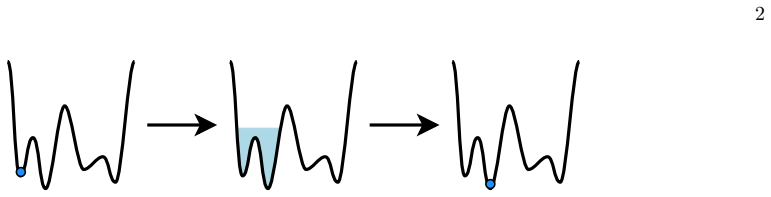
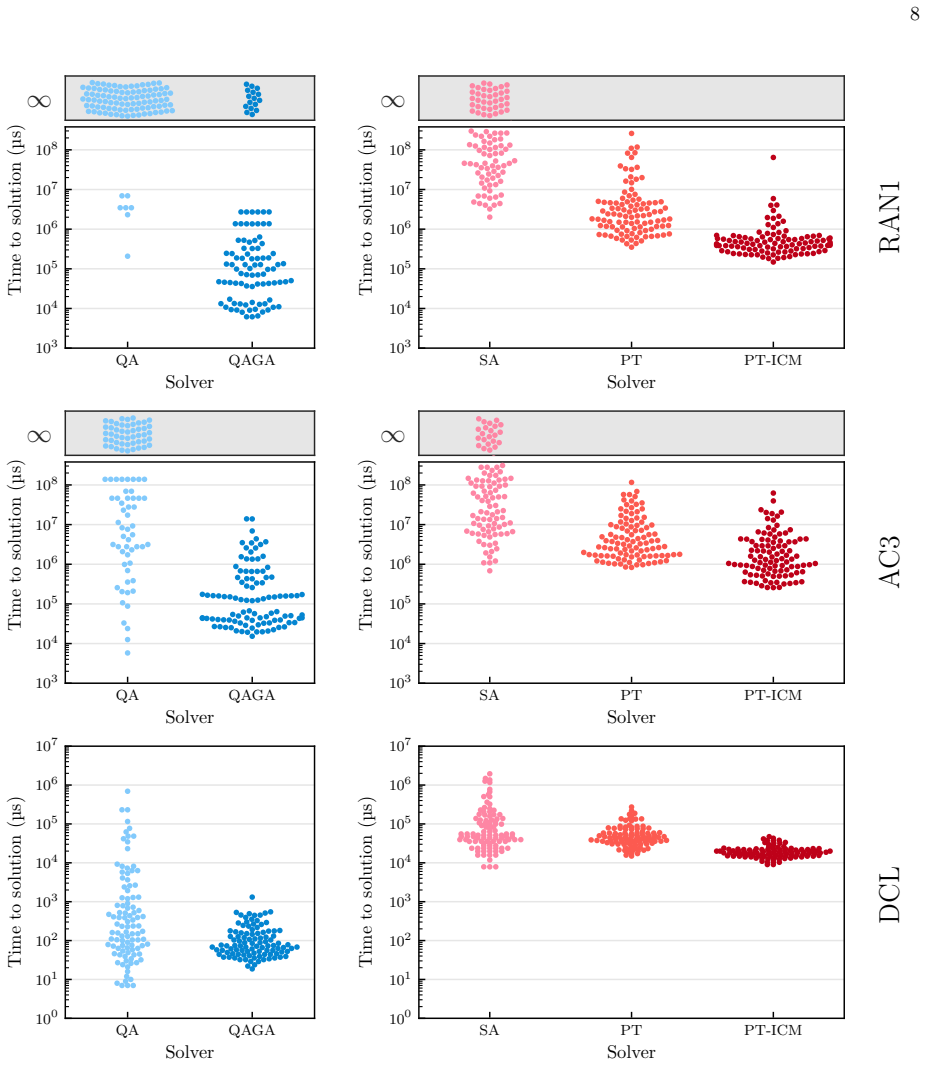
Quantum-assisted genetic algorithms using reverse annealing find global optima on spin-glass inputs where standard quantum annealing does not.
A machine-rendered reading of the paper's core claim, the machinery that carries it, and where it could break.
Core claim
By incorporating reverse quantum annealing as a novel source of mutations in a genetic algorithm, the resulting QAGA achieves effective discovery of global optima on spin-glass problems, in contrast to standard quantum annealing which finds good but not necessarily optimal solutions quickly.
What carries the argument
Reverse quantum annealing, a class of quantum evolutions that perform quasi-local or quasi-nonlocal search starting from a classical state, serving as mutation operators.
If this is right
- QAGAs can locate global optima on the tested spin-glass inputs.
- The combination of quantum fluctuations for mutations and classical crossovers improves performance over standard forward annealing.
- This interplay suggests a path for practical use of NISQ devices in heuristic optimization.
- Standard quantum annealing struggles to escape local optima on these inputs despite finding good solutions fast.
Where Pith is reading between the lines
- Hybrid quantum-classical methods like this may scale to problems where pure classical genetic algorithms require more computational resources for equivalent mutation diversity.
- Similar reverse-annealing mutations could be tested in other evolutionary algorithms beyond genetic algorithms.
- The success on spin glasses raises the question of whether the quantum advantage persists when compared to classical algorithms tuned with equivalent mutation statistics.
Load-bearing premise
That mutations generated by the specific reverse-annealing schedules provide statistical properties of search moves that classical mutation operators cannot replicate at comparable computational cost.
What would settle it
Demonstrating that a classical genetic algorithm equipped with mutation operators whose move statistics match those of the reverse annealing achieves equivalent rates of finding global optima on the same spin-glass inputs.
Figures



read the original abstract
Genetic algorithms, which mimic evolutionary processes to solve optimization problems, can be enhanced by using powerful semi-local search algorithms as mutation operators. Here, we introduce reverse quantum annealing, a class of quantum evolutions that can be used for performing families of quasi-local or quasi-nonlocal search starting from a classical state, as novel sources of mutations. Reverse annealing enables the development of genetic algorithms that use quantum fluctuation for mutations and classical mechanisms for the crossovers -- we refer to these as Quantum-Assisted Genetic Algorithms (QAGAs). We describe a QAGA and present experimental results using a D-Wave 2000Q quantum annealing processor. On a set of spin-glass inputs, standard (forward) quantum annealing finds good solutions very quickly but struggles to find global optima. In contrast, our QAGA proves effective at finding global optima for these inputs. This successful interplay of non-local classical and quantum fluctuations could provide a promising step toward practical applications of Noisy Intermediate-Scale Quantum (NISQ) devices for heuristic discrete optimization.
Editorial analysis
A structured set of objections, weighed in public.
Referee Report
Summary. The manuscript introduces Quantum-Assisted Genetic Algorithms (QAGAs) that employ reverse quantum annealing as a mutation operator within a genetic algorithm, combining it with classical crossover mechanisms. Experimental results on a D-Wave 2000Q processor for spin-glass instances show that the QAGA reaches global optima while standard forward quantum annealing does not.
Significance. If the performance difference is robust and specifically due to the quantum mutation operator rather than classical aspects of the search, the approach would illustrate a practical hybrid strategy for leveraging NISQ devices in heuristic optimization by interleaving quantum fluctuations with classical non-local moves.
major comments (2)
- [Abstract] Abstract: the claim that 'our QAGA proves effective at finding global optima for these inputs' while standard QA 'struggles to find global optima' supplies no counts of instances, success probabilities, statistical tests, or certification method for global optimality, leaving the central empirical comparison under-specified.
- [Abstract] Abstract: the attribution of the performance gain to 'quantum fluctuation for mutations' requires evidence that the statistical properties of the reverse-annealing trajectories cannot be reproduced by classical mutation operators at comparable computational cost; no such classical baseline (e.g., Monte-Carlo sampling of equivalent intermediate Hamiltonians) is presented.
minor comments (1)
- [Abstract] The abstract refers to 'a set of spin-glass inputs' without indicating the number or size of instances; adding this detail would improve reproducibility.
Simulated Author's Rebuttal
We thank the referee for their careful reading and constructive comments on the abstract. We address each major comment below and will revise the manuscript to improve precision where appropriate.
read point-by-point responses
-
Referee: [Abstract] Abstract: the claim that 'our QAGA proves effective at finding global optima for these inputs' while standard QA 'struggles to find global optima' supplies no counts of instances, success probabilities, statistical tests, or certification method for global optimality, leaving the central empirical comparison under-specified.
Authors: We agree the abstract is concise and would benefit from added quantitative detail. The full manuscript reports results across multiple spin-glass instances with global optima certified via known ground states (for small instances) or established benchmarks, along with observed success rates for QAGA versus standard QA. We will revise the abstract to incorporate representative counts, success probabilities, and a brief note on certification. revision: yes
-
Referee: [Abstract] Abstract: the attribution of the performance gain to 'quantum fluctuation for mutations' requires evidence that the statistical properties of the reverse-annealing trajectories cannot be reproduced by classical mutation operators at comparable computational cost; no such classical baseline (e.g., Monte-Carlo sampling of equivalent intermediate Hamiltonians) is presented.
Authors: The performance gains are shown using reverse annealing executed on the D-Wave 2000Q quantum processor. We acknowledge that an explicit classical baseline (such as Monte-Carlo sampling of equivalent Hamiltonians) is not presented. We will add a short discussion in the revised manuscript noting this limitation and the non-trivial nature of constructing an exact classical analog, while emphasizing that the demonstrated hybrid quantum-classical search is the core contribution. revision: partial
Circularity Check
No derivation chain present; purely experimental performance comparison
full rationale
The manuscript reports experimental runs of a hybrid genetic algorithm on D-Wave 2000Q hardware, contrasting reverse-annealing mutations against forward annealing on a fixed set of spin-glass instances. No equations, fitted parameters, or first-principles derivations are advanced whose outputs are then re-used as inputs. The central claim is an empirical observation of solution quality on those instances; it does not reduce to any self-referential definition, fitted-input prediction, or self-citation load-bearing step. Self-citations, if present, are incidental and not invoked to establish uniqueness or to close a logical loop. The result is therefore self-contained against external benchmarks and receives the default non-circularity finding.
Axiom & Free-Parameter Ledger
axioms (1)
- domain assumption Reverse quantum annealing can generate families of quasi-local or quasi-nonlocal search trajectories starting from a classical state.
invented entities (1)
-
Reverse quantum annealing
no independent evidence
Forward citations
Cited by 3 Pith papers
-
Efficient Hamiltonian Engineering for Adiabatic MIS Algorithms
Local degree-dependent controls in Rydberg adiabatic MIS algorithms accelerate convergence and reduce fidelity decay by 25% compared to global controls in numerical simulations.
-
Efficient Hamiltonian Engineering for Adiabatic MIS Algorithms
Engineered local Hamiltonian controls in Rydberg arrays accelerate adiabatic convergence to MIS solutions, raise success probabilities over global controls, and cut fidelity decay rate by 25% as graphs harden.
-
How to Build a Quantum Supercomputer: Scaling from Hundreds to Millions of Qubits
A comprehensive review of scaling paths for superconducting quantum computers, with resource and sensitivity analyses for utility-scale applications under realistic error distributions.
Reference graph
Works this paper leans on
- [1]
-
[2]
S. Kirkpatrick, C. D. Gelatt, and M. P. Vecchi, Science220, 671 (1983)
work page 1983
-
[3]
W. K. Wootters and W. H. Zurek, Nature299, 802 (1982)
work page 1982
-
[4]
Quantum assisted optimization,
V. S. Denchev, M. Mohseni, and H. Neven, “Quantum assisted optimization,” International Patent Application WO 2017/189052 Al (2017)
work page 2017
-
[5]
D-Wave Systems,Reverse Quantum Annealing for Local Refinement of Solutions, Tech. Rep. 14-1018A-A (2017)
work page 2017
-
[6]
Chancellor, New Journal of Physics19, 023024 (2017)
N. Chancellor, New Journal of Physics19, 023024 (2017)
work page 2017
- [7]
-
[8]
Barahona, Journal of Physics A: Mathematical and General15, 3241 (1982)
F. Barahona, Journal of Physics A: Mathematical and General15, 3241 (1982)
work page 1982
-
[9]
Lucas, Frontiers in Physics2 (2014), 10.3389/fphy.2014.00005, arXiv:1302.5843
A. Lucas, Frontiers in Physics2 (2014), 10.3389/fphy.2014.00005, arXiv:1302.5843
-
[10]
D-Wave QPU Architecture: Chimera,
“D-Wave QPU Architecture: Chimera,”https://docs.dwavesys.com/docs/latest/c_gs_4.html, D-Wave Sys- tem Documentation
-
[11]
Houdayer, The European Physical Journal B-Condensed Matter and Complex Systems22, 479 (2001)
J. Houdayer, The European Physical Journal B-Condensed Matter and Complex Systems22, 479 (2001)
work page 2001
-
[13]
R. E. Smith, S. Forrest, and A. S. Perelson, Evolutionary Computation1, 127 (1993)
work page 1993
-
[14]
M. Srinivas and L. M. Patnaik, IEEE Transactions on Systems, Man, and Cybernetics24, 656 (1994)
work page 1994
-
[15]
H. M. Pandey, A. Chaudhary, and D. Mehrotra, Applied Soft Computing24, 1047 (2014)
work page 2014
- [16]
-
[17]
S. V. Isakov, I. Zintchenko, and M. Troyer, (2014), arXiv:1401.1084v1
work page internal anchor Pith review Pith/arXiv arXiv 2014
-
[18]
T. F. Rønnow, Z. Wang, J. Job, S. Boixo, S. V. Isakov, D. Wecker, J. M. Martinis, D. A. Lidar, and M. Troyer, Science 345, 420 (2014), arXiv:1401.2910
work page internal anchor Pith review Pith/arXiv arXiv 2014
-
[19]
Efficient subgraph-based sampling of Ising-type models with frustration
A. Selby, arXiv:1409.3934 (2014)
work page internal anchor Pith review Pith/arXiv arXiv 2014
-
[20]
A. D. King, E. Hoskinson, T. Lanting, E. Andriyash, and M. H. Amin, Phys. Rev. A93, 52320 (2016)
work page 2016
-
[21]
J. King, S. Yarkoni, M. M. Nevisi, J. P. Hilton, and C. C. McGeoch, arXiv:1508.05087 (2015)
work page internal anchor Pith review Pith/arXiv arXiv 2015
-
[22]
D. S. Steiger, T. F. Rønnow, and M. Troyer, Physical Review Letters 115 (2015), 10.1103/Phys- RevLett.115.230501, arXiv:1504.07991
work page internal anchor Pith review Pith/arXiv arXiv doi:10.1103/phys- 2015
-
[23]
H. G. Katzgraber, F. Hamze, and R. S. Andrist, Physical Review X4, 21008 (2014)
work page 2014
-
[24]
S. Mandrà and H. G. Katzgraber, Quantum Science and Technology3, 04LT01 (2018)
work page 2018
-
[25]
J. King, S. Yarkoni, J. Raymond, I. Ozfidan, A. D. King, M. M. Nevisi, J. P. Hilton, and C. C. McGeoch, Journal of the Physical Society of Japan88, 61007 (2019)
work page 2019
-
[26]
I. Hen, J. Job, T. Albash, T. F. Rønnow, M. Troyer, and D. A. Lidar, Physical Review A - Atomic, Molecular, and Optical Physics92, 1 (2015), arXiv:1502.01663v2
work page internal anchor Pith review Pith/arXiv arXiv 2015
-
[27]
A. D. King, T. Lanting, and R. Harris, arXiv:1502.02098 (2015)
work page internal anchor Pith review Pith/arXiv arXiv 2015
-
[28]
A. Konak, D. W. Coit, and A. E. Smith, Reliability Engineering & System Safety91, 992 (2006). 11 Appendix A: Shared Ising Energy F unction Shared Ising energy.When using a high recombination rate, we use a form of implicit fitness sharing [13] to maintain population diversity. In implicit fitness sharing, each “reward” component of the fitness function is sh...
work page 2006
discussion (0)
Sign in with ORCID, Apple, or X to comment. Anyone can read and Pith papers without signing in.