Multi-TeV flaring in nearby High Energy Blazars: A photohadronic scenario
Pith reviewed 2026-05-25 11:13 UTC · model grok-4.3
The pith
The photohadronic model, corrected for EBL absorption, reproduces multi-TeV flares in nearby blazars such as Mrk 421, Mrk 501 and 1ES 1959+650.
A machine-rendered reading of the paper's core claim, the machinery that carries it, and where it could break.
Core claim
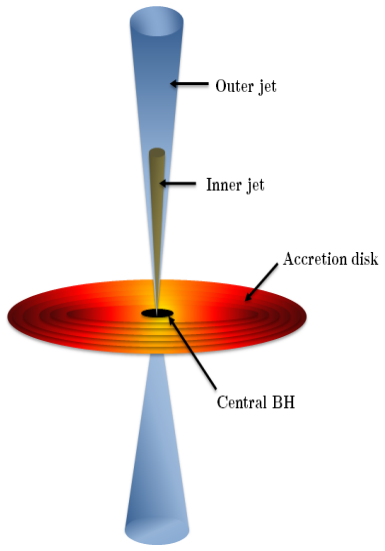
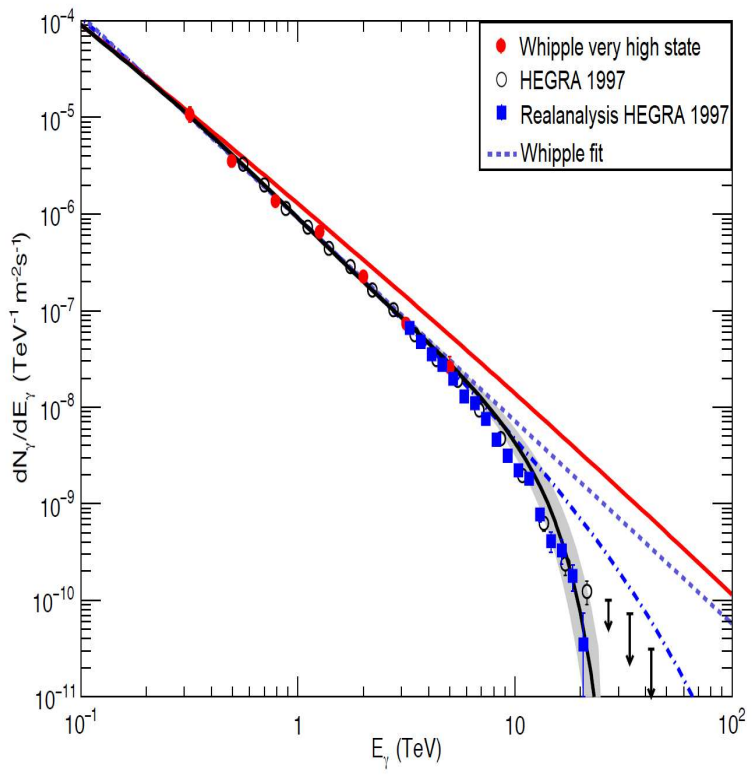
In the photohadronic model, relativistic protons interact with low-energy photons inside the jet to generate charged and neutral pions; the subsequent decay of neutral pions yields gamma-ray photons that reach multi-TeV energies. After the photons propagate through the extragalactic background light and suffer pair-production losses, the predicted flare spectra and fluxes agree with observations of Markarian 421, Markarian 501 and 1ES1959+650.
What carries the argument
Photohadronic pion production followed by neutral-pion decay, with subsequent EBL pair-production attenuation applied to the emergent gamma-ray spectrum.
If this is right
- Flares without X-ray counterparts arise naturally from the same hadronic channel that produces the gamma rays.
- The same jet proton population can account for both the gamma-ray flares and any associated high-energy neutrinos.
- Nearby high-energy blazars become calibrated laboratories for testing proton acceleration and photon field densities inside jets.
- Spectral hardening or softening during flares directly constrains the target photon spectrum in the emission region.
Where Pith is reading between the lines
- Detection of neutrinos coincident with these flares would strengthen the hadronic interpretation without requiring new multi-wavelength campaigns.
- Extending the same EBL-corrected photohadronic calculation to more distant blazars would test whether the model remains viable when absorption is stronger.
- If the required proton energies exceed those allowed by the jet magnetic field, the model would imply additional acceleration mechanisms operating on short timescales.
Load-bearing premise
The multi-TeV emission is produced by photohadronic interactions even when no simultaneous low-energy flare is detected.
What would settle it
A high-resolution multi-TeV spectrum measured during a flare that cannot be reproduced by any choice of photohadronic parameters once the known EBL absorption is subtracted.
Figures





read the original abstract
Blazars are a subclass of AGN and flaring in multi-TeV gamma-ray seems to be the major activity in high energy blazars a subgrup of blazars. Flaring is also unpredictable and switches between quiescent and active states involving different time scales and fluxes. While in some high energy blazars a strong temporal correlation between X-ray and multi-TeV gamma-ray has been observed, outbursts in some other have no low energy counterparts and explanation of such extreme activity needs to be addressed through different mechanisms as it is not understood well. The extragalactic background light (EBL) plays an important role in the observation of these high energy gamma-rays as it attenuates through pair production of electron-positron and also changes the spectral shape of the high energy photons. In the context of the photohadronic model and taking EBL correction into account, flaring can be explained very well. In a series of papers we have developed this model to explain multi-TeV flaring events form many blazars. Here in this review, the photohadronic model is discussed and applied to explain the multi-TeV flaring from nearby high energy blazars: Markarian 421, Markarian 501 and 1ES1959+650.
Editorial analysis
A structured set of objections, weighed in public.
Referee Report
Summary. This review paper presents the photohadronic model (developed across a series of prior works by the same author) as an explanation for multi-TeV flaring in high-energy blazars. It applies the model, including EBL attenuation via pair production, to account for observed flares in Mrk 421, Mrk 501, and 1ES1959+650, with emphasis on cases lacking low-energy counterparts.
Significance. If the photohadronic scenario with EBL corrections reproduces the VHE spectra without contradiction from non-detections at lower energies, it would offer a mechanism for orphan flares. The work builds on the author's earlier model applications but does not introduce new independent constraints or falsifiable predictions beyond prior fits.
major comments (3)
- [Abstract] Abstract: the assertion that 'in the context of the photohadronic model and taking EBL correction into account, flaring can be explained very well' is presented without any quantitative model fits, spectral comparisons, error bars, or goodness-of-fit metrics for the three blazars.
- [Model application sections] The application to orphan flares (e.g., in 1ES1959+650) requires that the target photon field, proton injection spectrum, and interaction optical depth can be selected to match the EBL-corrected VHE spectrum while remaining consistent with non-detections at lower energies; no demonstration is given that these parameters are fixed by observables independent of the VHE data itself.
- [Introduction and review sections] The review relies on the photohadronic model parameters from the author's prior papers without external benchmarks or direct comparisons to leptonic mechanisms at the same epochs, leaving the claim that photohadronic processes dominate unsupported by new evidence.
minor comments (2)
- [Abstract] Abstract contains typographical errors: 'subgrup' should be 'subgroup' and 'form many blazars' should be 'from many blazars'.
- [Model description] Notation for EBL attenuation and photohadronic optical depth is not defined in the provided text, making it difficult to assess the quantitative implementation.
Simulated Author's Rebuttal
We thank the referee for the careful reading and constructive comments on our review manuscript. We address each major comment point-by-point below, indicating where revisions will be incorporated.
read point-by-point responses
-
Referee: [Abstract] Abstract: the assertion that 'in the context of the photohadronic model and taking EBL correction into account, flaring can be explained very well' is presented without any quantitative model fits, spectral comparisons, error bars, or goodness-of-fit metrics for the three blazars.
Authors: The abstract serves as a high-level summary of the review's scope. The quantitative spectral fits, including comparisons, error bars, and fit metrics for Mrk 421, Mrk 501, and 1ES 1959+650, are presented in the dedicated application sections, which reference the detailed modeling from our prior publications. To address the concern, we will revise the abstract to include a brief qualifier referencing those sections and the underlying fits. revision: partial
-
Referee: [Model application sections] The application to orphan flares (e.g., in 1ES1959+650) requires that the target photon field, proton injection spectrum, and interaction optical depth can be selected to match the EBL-corrected VHE spectrum while remaining consistent with non-detections at lower energies; no demonstration is given that these parameters are fixed by observables independent of the VHE data itself.
Authors: This is a review paper that applies the photohadronic model as developed and constrained in our earlier series of works. Those prior studies used multi-wavelength observations and theoretical requirements to fix the target photon field, proton spectrum, and optical depth independently of any single VHE flare dataset. The current manuscript summarizes those applications for the three blazars. We will add a short clarifying paragraph with explicit references to the original parameter determinations to make this explicit. revision: partial
-
Referee: [Introduction and review sections] The review relies on the photohadronic model parameters from the author's prior papers without external benchmarks or direct comparisons to leptonic mechanisms at the same epochs, leaving the claim that photohadronic processes dominate unsupported by new evidence.
Authors: The manuscript is explicitly a review of the photohadronic scenario and its application to multi-TeV flares, not a comparative study. It does not introduce new data or claim that photohadronic processes dominate over leptonic ones; it demonstrates the viability of the photohadronic approach for the cited orphan-flare cases. External benchmarks and leptonic comparisons lie outside the stated scope and are addressed in the broader literature. No revision is required on this point. revision: no
Circularity Check
Photohadronic flaring explanations rest on self-developed model from author's prior papers
specific steps
-
self citation load bearing
[Abstract]
"In the context of the photohadronic model and taking EBL correction into account, flaring can be explained very well. In a series of papers we have developed this model to explain multi-TeV flaring events form many blazars. Here in this review, the photohadronic model is discussed and applied to explain the multi-TeV flaring from nearby high energy blazars: Markarian 421, Markarian 501 and 1ES1959+650."
The assertion that the model explains the observed flares is supported solely by the author's prior papers in which the model itself was constructed and tuned; no independent first-principles derivation or external constraint is supplied in the present work to break the self-reference.
full rationale
The paper is a review that applies a photohadronic model developed across a series of the author's own prior works. The central claim that this model plus EBL correction explains multi-TeV flares 'very well' is justified by reference to those self-citations rather than by an independent derivation or external benchmark performed within this manuscript. This matches self-citation load-bearing but does not reduce any specific equation to its input by construction within the present text.
Axiom & Free-Parameter Ledger
Forward citations
Cited by 1 Pith paper
-
Zooming in on the GeV $\gamma$-ray flare of the blazar PKS 1725+123 with a multimessenger lens
Multimessenger observations and one-zone leptohadronic modeling of PKS 1725+123 during a flare constrain its emission to external Compton gamma-rays, SSC X-rays, and a neutrino rate of about 0.3 events per year peakin...
Reference graph
Works this paper leans on
-
[1]
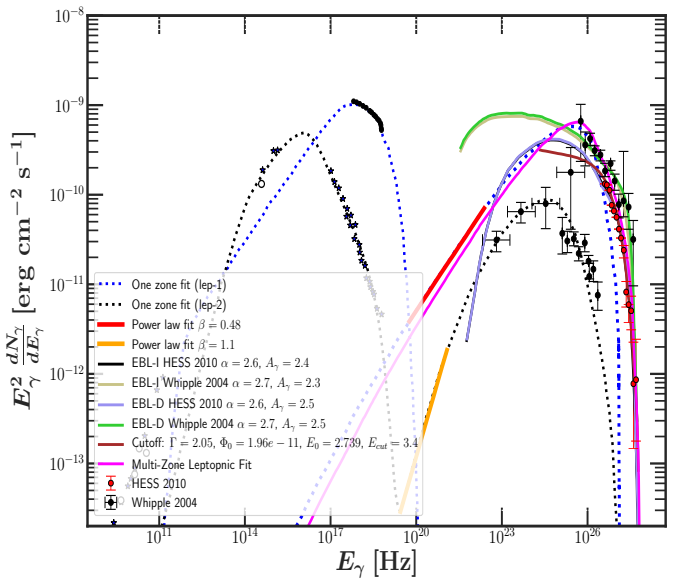
The flare of April 2004 The multi-TeV flare of April 2004 was the first flare observed in multiwavelength by the Whipple telescope in the energy range 0 .25 TeV(6.0× 1025 Hz)≤ Eγ ≤ 16.85 TeV(4.1× 1027 Hz) and it was difficult to explain by one-zone leptonic model[16]. As discussed above, the photohadronic interpretation of the flare data needs the leptonic model...
work page 2004
-
[2]
These data were taken in 11 runs with each run ∼ 28 minutes duration [61]
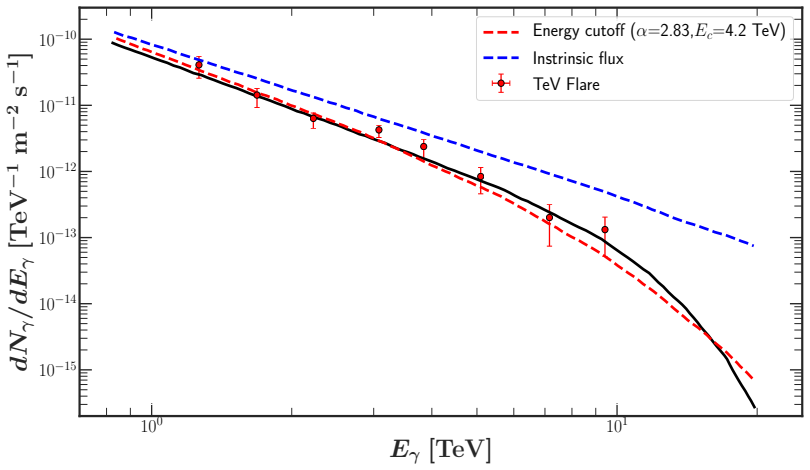
The flare of February 2010 On 16th of February 2010, a strong outburst in multi-TeV gamma-rays from Mrk 421 was observed by VERITAS telescopes and follow up observations were carried out by HESS telescopes from 17th to 20th of February a total of 6.5 h. These data were taken in 11 runs with each run ∼ 28 minutes duration [61]. The HESS telescopes observed ...
work page 2010
-
[3]
V. A. Acciari et al. [VERITAS and MAGIC Collaborations], Astrophys. J. 729, 2 (2011). doi:10.1088/0004-637X/729/1/2 [arXiv:1012.2200 [astro-ph.HE]]
work page internal anchor Pith review Pith/arXiv arXiv doi:10.1088/0004-637x/729/1/2 2011
-
[4]
C. M. Urry and P. Padovani, Publ. Astron. Soc. Pac. 107, 803 (1995) doi:10.1086/133630 [astro-ph/9506063]
work page internal anchor Pith review Pith/arXiv arXiv doi:10.1086/133630 1995
-
[5]
A. A. Abdo et al. [Fermi LAT Collaboration], Astrophys. J.700, 597 (2009) [arXiv:0902.1559 [astro-ph.HE]]
work page internal anchor Pith review Pith/arXiv arXiv 2009
-
[6]
An Exceptional VHE Gamma-Ray Flare of PKS 2155-304
F. Aharonian, Astrophys. J. 664, L71 (2007) [arXiv:0706.0797 [astro-ph]]
work page internal anchor Pith review Pith/arXiv arXiv 2007
-
[7]
C. D. Dermer and R. Schlickeiser, Astrophys. J. 416, 458 (1993)
work page 1993
- [8]
-
[9]
A simplified view of blazars: the neutrino background
P. Padovani, M. Petropoulou, P. Giommi and E. Resconi, Mon. Not. Roy. Astron. Soc. 452, no. 2, 1877 (2015) doi:10.1093/mnras/stv1467 [arXiv:1506.09135 [astro-ph.HE]]
work page internal anchor Pith review Pith/arXiv arXiv doi:10.1093/mnras/stv1467 2015
-
[10]
The Connection between X-ray- and Radio-Selected BL Lacertae Objects
P. Padovani and P. Giommi, Astrophys. J. 444, 567 (1995) [astro-ph/9412073]
work page internal anchor Pith review Pith/arXiv arXiv 1995
-
[11]
G. Fossati, L. Maraschi, A. Celotti, A. Comastri and G. Ghisellini, Mon. Not. Roy. Astron. Soc. 299, 433 (1998) doi:10.1046/j.1365-8711.1998.01828.x [astro-ph/9804103]. 30
-
[12]
G. Ghisellini, A. Celotti, G. Fossati, L. Maraschi and A. Comastri, Mon. Not. Roy. Astron. Soc. 301, 451 (1998) doi:10.1046/j.1365-8711.1998.02032.x [astro-ph/9807317]
-
[13]
A. A. Abdo et al. [Fermi LAT Collaboration], Astrophys. J. 719, 1433-1444 (2010). [arXiv:1006.5463 [astro-ph.HE]]
work page internal anchor Pith review Pith/arXiv arXiv 2010
-
[15]
Detection of TeV Gamma Rays from the BL Lac Object 1ES1959+650 with the Whipple 10m Telescope
J. Holder et al. [VERITAS Collaboration], Astrophys. J. 583, L9 (2003) [astro-ph/0212170]
work page internal anchor Pith review Pith/arXiv arXiv 2003
-
[16]
F. Aharonian et al. [HEGRA Collaboration], Astron. Astrophys. 406, L9 (2003) [astro- ph/0305275]
-
[17]
Multiwavelength Observations of Strong Flares From the TeV-Blazar 1ES 1959+650
H. Krawczynski, S. B. Hughes, D. Horan, F. Aharonian, M. F. Aller, H. Aller, P. Boltwood and J. Buckley et al., Astrophys. J. 601, 151 (2004) [astro-ph/0310158]
work page internal anchor Pith review Pith/arXiv arXiv 2004
-
[18]
M. Blazejowski et al., Astrophys. J. 630, 130 (2005) doi:10.1086/431925 [astro-ph/0505325]
work page internal anchor Pith review Pith/arXiv arXiv doi:10.1086/431925 2005
-
[19]
M. G. Aartsen et al. [IceCube Collaboration], Science 361, no. 6398, 147 (2018) doi:10.1126/science.aat2890 [arXiv:1807.08794 [astro-ph.HE]]
work page internal anchor Pith review Pith/arXiv arXiv doi:10.1126/science.aat2890 2018
-
[20]
S. Ansoldi et al. [MAGIC Collaboration], Astrophys. J. Lett. [Astrophys. J. 863, L10 (2018)] doi:10.3847/2041-8213/aad083 [arXiv:1807.04300 [astro-ph.HE]]
- [21]
- [22]
-
[23]
F. A. Aharonian, New Astron. 5, 377 (2000)
work page 2000
-
[24]
Fast TeV variability from misaligned minijets in the jet of M87
D. Giannios, D. A. Uzdensky and M. C. Begelman, Mon. Not. Roy. Astron. Soc. 402 (2010) 1649 arXiv:0907.5005 [astro-ph.HE]
work page internal anchor Pith review Pith/arXiv arXiv 2010
-
[25]
M. M. Reynoso, M. C. Medina and G. E. Romero, arXiv:1005.3025 [astro-ph.HE]
work page internal anchor Pith review Pith/arXiv arXiv
-
[26]
F. M. Rieger and F. A. Aharonian, Astron. Astrophys. 479, L5 (2008) arXiv:0712.2902 [astro-ph]
work page internal anchor Pith review Pith/arXiv arXiv 2008
-
[27]
Variable TeV emission as a manifestation of jet formation in M87?
A. Levinson and F. Rieger, Astrophys. J. 730, 123 (2011) [arXiv:1011.5319 [astro-ph.HE]]
work page internal anchor Pith review Pith/arXiv arXiv 2011
-
[28]
F. M. Rieger, Int. J. Mod. Phys. D 20, 1547 (2011) [arXiv:1107.2119 [astro-ph.CO]]
work page internal anchor Pith review Pith/arXiv arXiv 2011
- [29]
-
[30]
The many faces of blazar emission in the context of hadronic models
M. Petropoulou, S. Dimitrakoudis, P. Padovani, E. Resconi, P. Giommi and A. Mastichiadis, arXiv:1601.06010 [astro-ph.HE]
work page internal anchor Pith review Pith/arXiv arXiv
-
[31]
M. Petropoulou, K. Nalewajko, M. Hayashida and A. Mastichiadis, Mon. Not. Roy. Astron. 31 Soc. 467, no. 1, L16 (2017)
work page 2017
-
[32]
J. P. Rachen, AIP Conf. Proc. 515, no. 1, 41 (2000)
work page 2000
-
[33]
F. A. Aharonian, A. N. Timokhin and A. V. Plyasheshnikov, Astron. Astrophys. 384, 834 (2002) doi:10.1051/0004-6361:20020062 [astro-ph/0108419]
work page internal anchor Pith review Pith/arXiv arXiv doi:10.1051/0004-6361:20020062 2002
- [34]
-
[35]
Neutrino, $\gamma$-ray and cosmic ray fluxes from the core of the closest radio galaxies
N. Fraija and A. Marinelli, Astrophys. J. 830, no. 2, 81 (2016) doi:10.3847/0004- 637X/830/2/81 [arXiv:1607.04633 [astro-ph.HE]]
work page internal anchor Pith review Pith/arXiv arXiv doi:10.3847/0004- 2016
-
[36]
Time-dependent neutrino emission from Mrk 421 during flares and predictions for IceCube
M. Petropoulou, S. Coenders and S. Dimitrakoudis, Astropart. Phys. 80, 115 (2016) doi:10.1016/j.astropartphys.2016.04.001 [arXiv:1603.06954 [astro-ph.HE]]
work page internal anchor Pith review Pith/arXiv arXiv doi:10.1016/j.astropartphys.2016.04.001 2016
-
[37]
S. Sahu, A. F. O. Oliveros and J. C. Sanabria, Phys. Rev. D 87, 103015 (2013)
work page 2013
-
[38]
S. Sahu, B. Zhang and N. Fraija, Phys. Rev. D 85, 043012 (2012) [arXiv:1201.4191 [astro- ph.HE]]
work page internal anchor Pith review Pith/arXiv arXiv 2012
-
[39]
Hadronic-origin TeV flare of M87 in April 2010
S. Sahu and E. Palacios, Eur. Phys. J. C 75, no. 2, 52 (2015) doi:10.1140/epjc/s10052-015- 3286-z [arXiv:1310.1381 [astro-ph.HE]]
work page internal anchor Pith review Pith/arXiv arXiv doi:10.1140/epjc/s10052-015- 2015
-
[40]
S. Sahu, L. S. Miranda and S. Rajpoot, Eur. Phys. J. C 76, no. 3, 127 (2016) doi:10.1140/epjc/s10052-016-3975-2 [arXiv:1501.00973 [astro-ph.HE]]
work page internal anchor Pith review Pith/arXiv arXiv doi:10.1140/epjc/s10052-016-3975-2 2016
-
[41]
S. Sahu, M. V. L. Y´ a˜ nez, L. S. Miranda, A. R. de Le´ on and V. Gupta, Eur. Phys. J. C77, no. 1, 18 (2017) doi:10.1140/epjc/s10052-016-4592-9 [arXiv:1610.07533 [astro-ph.HE]]
work page internal anchor Pith review Pith/arXiv arXiv doi:10.1140/epjc/s10052-016-4592-9 2017
-
[42]
S. Sahu, A. R. de Le´ on and L. S. Miranda, Eur. Phys. J. C 77, no. 11, 741 (2017) doi:10.1140/epjc/s10052-017-5335-2 [arXiv:1610.01709 [astro-ph.HE]]
work page internal anchor Pith review Pith/arXiv arXiv doi:10.1140/epjc/s10052-017-5335-2 2017
-
[43]
S. Sahu, A. R. de Le´ on and S. Nagataki, arXiv:1801.04423 [astro-ph.HE]
work page internal anchor Pith review Pith/arXiv arXiv
-
[44]
S. Sahu, A. R. de Len, S. Nagataki and V. Gupta, Eur. Phys. J. C 78, no. 7, 557 (2018) doi:10.1140/epjc/s10052-018-6038-z [arXiv:1801.05995 [astro-ph.HE]]
work page internal anchor Pith review Pith/arXiv arXiv doi:10.1140/epjc/s10052-018-6038-z 2018
-
[45]
A. A. Abdo et al. [Fermi LAT Collaboration], Astrophys. J. 727, 129 (2011)
work page 2011
-
[46]
F. W. Stecker, O. C. de Jager and M. H. Salamon, Astrophys. J. 390, L49 (1992)
work page 1992
-
[47]
M. G. Hauser and E. Dwek, Ann. Rev. Astron. Astrophys. 39, 249 (2001)
work page 2001
-
[48]
A. Dominguez et al., Mon. Not. Roy. Astron. Soc. 410, 2556 (2011)
work page 2011
-
[49]
A. Franceschini, G. Rodighiero and M. Vaccari, Astron. Astrophys. 487, 837 (2008)
work page 2008
-
[50]
Y. Inoue, S. Inoue, M. A. R. Kobayashi, R. Makiya, Y. Niino and T. Totani, Astrophys. J. 768, 197 (2013) doi:10.1088/0004-637X/768/2/197 [arXiv:1212.1683 [astro-ph.CO]]
work page internal anchor Pith review Pith/arXiv arXiv doi:10.1088/0004-637x/768/2/197 2013
-
[51]
R. R. Chary and A. Pope, arXiv:1003.1731 [astro-ph.CO]. 32
work page internal anchor Pith review Pith/arXiv arXiv
-
[52]
P. Madau and L. Pozzetti, Mon. Not. Roy. Astron. Soc. 321, L9-L15 (2000) doi:10.1046/j.1365-8711.2000.03268.x
-
[53]
T. M. Kneiske, K. Mannheim and D. H. Hartmann, Astron. Astrophys. 386, 1 (2002) doi:10.1051/0004-6361:20020211 [astro-ph/0202104]
work page internal anchor Pith review Pith/arXiv arXiv doi:10.1051/0004-6361:20020211 2002
-
[54]
F. W. Stecker, M. A. Malkan and S. T. Scully, Astrophys. J. 648, 774 (2006) doi:10.1086/506188 [astro-ph/0510449]
work page internal anchor Pith review Pith/arXiv arXiv doi:10.1086/506188 2006
-
[55]
M. Orr, F. Krennrich and E. Dwek, Astrophys. J. 733, 77 (2011) doi:10.1088/0004- 637X/733/2/77 [arXiv:1101.3498 [astro-ph.CO]]
work page internal anchor Pith review Pith/arXiv arXiv doi:10.1088/0004- 2011
-
[56]
J. R. Primack, J. S. Bullock and R. S. Somerville, AIP Conf. Proc. 745, 23 (2005) doi:10.1063/1.1878394 [astro-ph/0502177]
work page internal anchor Pith review Pith/arXiv arXiv doi:10.1063/1.1878394 2005
-
[57]
The hadronic origin of hard gamma-ray spectrum from blazar 1ES 1101-232
G. Cao and J. Wang, Astrophys. J. 783, 108 (2014) doi:10.1088/0004-637X/783/2/108 [arXiv:1401.3970 [astro-ph.HE]]
work page internal anchor Pith review Pith/arXiv arXiv doi:10.1088/0004-637x/783/2/108 2014
-
[59]
P. W. Gorham, L. van Zee, S. C. Unwin and C. S. Jacobs, Astron. J. 119, 1677 (2000) doi:10.1086/301289 [astro-ph/9908077]
work page internal anchor Pith review Pith/arXiv arXiv doi:10.1086/301289 2000
-
[60]
M. H. Ulrich, T. D. Kinman, C. R. Lynds, G. H. Rieke, R. D. Ekers, Astrophys. J. 198, 261 (1975) doi:10.1086/153603
- [61]
-
[62]
J. F. Schanchter, J. T Stocke, E. Perlman, M. Elvis, R. Remillard, A. Granados, J. Luu, J. P. Huchra, R. Humphreys, C. M. Urry, J. Wallin, Astrophys. J. 412, 541 (1993) doi:10.1086/172942
-
[63]
H.E.S.S. Observations of strong flaring activity of Mrk421 in February 2010
M. Tluczykont [H.E.S.S. Collaboration], PoS TEXAS 2010, 197 (2010) [arXiv:1106.1035 [astro-ph.HE]]
work page internal anchor Pith review Pith/arXiv arXiv 2010
-
[64]
F. Aharonian et al. [HEGRA Collaboration], Astrophys. J. 546, 898 (2001) doi:10.1086/318321 [astro-ph/0008211]. 501
work page internal anchor Pith review Pith/arXiv arXiv doi:10.1086/318321 2001
-
[65]
Very High Energy outburst of Markarian 501 in May 2009
E. Aliu et al. [VERITAS Collaboration], Astron. Astrophys. 594, A76 (2016) doi:10.1051/0004-6361/201628744 [arXiv:1608.01569 [astro-ph.HE]]
work page internal anchor Pith review Pith/arXiv arXiv doi:10.1051/0004-6361/201628744 2016
-
[66]
P. Chandra et al. , New Astron. 54, 42 (2017) doi:10.1016/j.newast.2017.01.004 [arXiv:1701.04935 [astro-ph.IM]]. 33
work page internal anchor Pith review Pith/arXiv arXiv doi:10.1016/j.newast.2017.01.004 2017
-
[67]
Santander [VERITAS Collaboration], PoS ICRC 2017, 622 (2017) [arXiv:1709.02365 [astro-ph.HE]]
M. Santander [VERITAS Collaboration], PoS ICRC 2017, 622 (2017) [arXiv:1709.02365 [astro-ph.HE]]
-
[68]
Dissipation of jet bulk kinetic energy in powerful blazars
K. Katarzynski and G. Ghisellini, Astron. Astrophys. 463, 529 (2007) doi:10.1051/0004- 6361:20066448 [astro-ph/0610801]
work page internal anchor Pith review Pith/arXiv arXiv doi:10.1051/0004- 2007
-
[69]
On photohadronic processes in astrophysical environments
A. Mucke, J. P. Rachen, R. Engel, R. J. Protheroe and T. Stanev, Publ. Astron. Soc. Austral. 16, 160 (1999) doi:10.1071/AS99160 [astro-ph/9808279]
work page internal anchor Pith review Pith/arXiv arXiv doi:10.1071/as99160 1999
-
[70]
A Proton Synchrotron Blazar Model for Flaring in Markarian~501
A. Mucke and R. J. Protheroe, Astropart. Phys. 15, 121 (2001) doi:10.1016/S0927- 6505(00)00141-9 [astro-ph/0004052]
work page internal anchor Pith review Pith/arXiv arXiv doi:10.1016/s0927- 2001
-
[71]
W. Essey, O. Kalashev, A. Kusenko and J. F. Beacom, Astrophys. J. 731, 51 (2011) doi:10.1088/0004-637X/731/1/51 [arXiv:1011.6340 [astro-ph.HE]]
work page internal anchor Pith review Pith/arXiv arXiv doi:10.1088/0004-637x/731/1/51 2011
-
[72]
Structured jets in TeV BL Lac objects and radiogalaxies
G. Ghisellini, F. Tavecchio and M. Chiaberge, Astron. Astrophys. 432, 401 (2005) doi:10.1051/0004-6361:20041404 [astro-ph/0406093]
work page internal anchor Pith review Pith/arXiv arXiv doi:10.1051/0004-6361:20041404 2005
-
[73]
F. Tavecchio and G. Ghisellini, Mon. Not. Roy. Astron. Soc. 385, 98 (2008) doi:10.1111/j.1745-3933.2008.00441.x [arXiv:0801.0593 [astro-ph]]
-
[74]
Punch et al., Nature 358, 477 (1992)
M. Punch et al., Nature 358, 477 (1992). doi:10.1038/358477a0
-
[75]
A. A. Abdo et al. [MAGIC Collaboration], Astrophys. J. 736, 131 (2011)
work page 2011
-
[76]
Observation of gamma-rays greater than 10 TeV from Markarian 421
K. Okumura et al., Astrophys. J. 579, L9 (2002) doi:10.1086/344831 [astro-ph/0209487]
work page internal anchor Pith review Pith/arXiv arXiv doi:10.1086/344831 2002
-
[77]
M. Amenomori et al. [Tibet AS Gamma Collaboration], Astrophys. J. [Astrophys. J. 598, 242 (2003)] doi:10.1086/378350 [astro-ph/0304241]
work page internal anchor Pith review Pith/arXiv arXiv doi:10.1086/378350 2003
-
[78]
G. Fossati et al., Astrophys. J. 677, 906 (2008) doi:10.1086/527311 [arXiv:0710.4138 [astro- ph]]
work page internal anchor Pith review Pith/arXiv arXiv doi:10.1086/527311 2008
-
[79]
W. Cui et al. [VERITAS Collaboration], AIP Conf. Proc. 745, 455 (2005) doi:10.1063/1.1878445 [astro-ph/0410160]
-
[80]
A. U. Abeysekara et al. [VERITAS and MAGIC Collaborations], Astrophys. J. 834, no. 1, 2 (2017)
work page 2017
-
[81]
M. Balokovi´ cet al. [VERITAS and MAGIC Collaborations and NuSTAR Team], Astrophys. J. 819, 156 (2016) doi:10.3847/0004-637X/819/2/156 [arXiv:1512.02235 [astro-ph.HE]]
work page internal anchor Pith review Pith/arXiv arXiv doi:10.3847/0004-637x/819/2/156 2016
- [82]
discussion (0)
Sign in with ORCID, Apple, or X to comment. Anyone can read and Pith papers without signing in.