Impacts of radiative corrections on measurements of lepton flavour universality in B to D ell ν_(ell) decays
Pith reviewed 2026-05-25 10:29 UTC · model grok-4.3
The pith
High-energy photon emission biases R(D) measurements by up to 7% in LHCb-like conditions.
A machine-rendered reading of the paper's core claim, the machinery that carries it, and where it could break.
Core claim
When high-energy photon emission is included through pseudo-experiments that mimic an LHCb environment, the measured lepton flavour universality ratio R(D) shifts by as much as 7 percent relative to the case without such radiation.
What carries the argument
Pseudo-experiments that embed high-energy photon emission, detector response, and reconstruction efficiencies to quantify bias on R(D).
If this is right
- Measurements of R(D) must incorporate hard-photon radiation beyond soft-photon approximations to avoid systematic shifts.
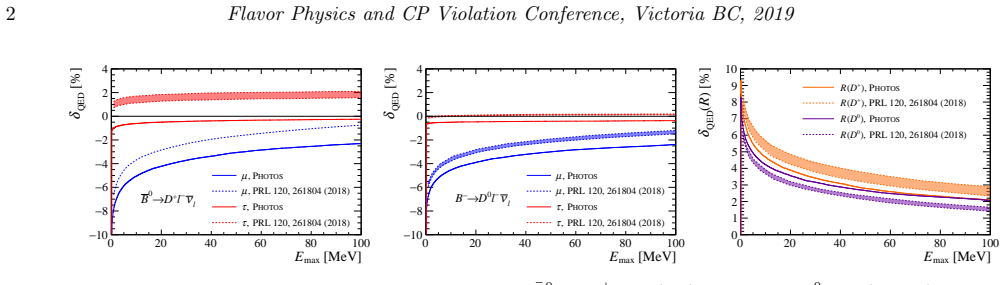
- Differences appear between analytic soft-photon corrections and the PHOTOS simulation for the ratios R(D+) and R(D0).
- Coulomb interactions, omitted from PHOTOS, produce additional modifications to the predicted ratios.
- The size of the bias depends on the kinematic acceptance and photon reconstruction efficiency of the experiment.
Where Pith is reading between the lines
- Correcting for the bias could alter the apparent size of any tension between measured R(D) and Standard Model predictions.
- Analogous hard-photon effects may appear in other B-decay channels used to test lepton flavour universality.
- Future analyses could reduce the bias by tightening photon-veto requirements or by adding explicit photon reconstruction.
Load-bearing premise
The pseudo-experiments accurately capture the detector response, reconstruction efficiencies, and photon emission kinematics relevant to real LHCb data taking.
What would settle it
Extract R(D) from real LHCb data once with and once without explicit reconstruction of high-energy photons and compare the two results for a shift near 7%.
Figures


read the original abstract
Radiative corrections to $B \to D \ell \nu_{\ell}$ decays can have an impact on predictions and measurements of the lepton universality ratios $\mathcal{R}(D^+)$ and $\mathcal{R}(D^0)$. These proceedings summarise a study on the comparison between recent calculations of soft-photon corrections on these ratios and the corrections simulated by the PHOTOS package. Also the impact of Coulomb interactions, not simulated in PHOTOS, is discussed. Using pseudo-experiments, the effect of high-energy photon emission is studied in an LHCb-like environment, showing a bias of up to 7\% on measurements of $\mathcal{R}(D)$.
Editorial analysis
A structured set of objections, weighed in public.
Referee Report
Summary. The manuscript compares recent calculations of soft-photon corrections to B → D ℓ ν_ℓ decays against the PHOTOS package, discusses Coulomb interactions not included in PHOTOS, and reports pseudo-experiment results in an LHCb-like environment indicating that high-energy photon emission can introduce a bias of up to 7% on measurements of R(D).
Significance. If the pseudo-experiment methodology is shown to be reliable, the reported bias would underscore the importance of including radiative effects in experimental analyses of lepton flavour universality ratios at LHCb, providing a concrete estimate of a potential systematic that could affect interpretations of R(D) measurements.
major comments (2)
- [pseudo-experiment study / abstract] The headline claim of a bias up to 7% on R(D) (stated in the abstract and the pseudo-experiment discussion) rests entirely on an LHCb-like simulation whose setup, photon-emission kinematics, reconstruction efficiencies, and selection cuts are not described quantitatively; no efficiency tables, closure tests, or comparison to full detector simulation are supplied, leaving the result without visible support.
- [comparison of calculations] The comparison between external soft-photon calculations and PHOTOS, as well as the discussion of Coulomb corrections, is presented without explicit numerical results, equations, or tables showing the size of the differences on R(D) or R(D*), preventing assessment of whether these corrections are the dominant effect or sub-dominant to the 7% bias.
minor comments (1)
- The manuscript is a proceedings contribution; expanding the pseudo-experiment description with at least one table of efficiencies or a brief validation statement would make the central claim evaluable.
Simulated Author's Rebuttal
We thank the referee for the careful reading of the manuscript and the constructive comments. We address each major comment below and indicate where revisions will be made to improve clarity and support for the results.
read point-by-point responses
-
Referee: [pseudo-experiment study / abstract] The headline claim of a bias up to 7% on R(D) (stated in the abstract and the pseudo-experiment discussion) rests entirely on an LHCb-like simulation whose setup, photon-emission kinematics, reconstruction efficiencies, and selection cuts are not described quantitatively; no efficiency tables, closure tests, or comparison to full detector simulation are supplied, leaving the result without visible support.
Authors: We agree that the pseudo-experiment methodology requires more quantitative support to substantiate the 7% bias claim. The current proceedings format limits the level of detail, but we will revise the text to include a more explicit description of the photon-emission kinematics, key simulation parameters, reconstruction efficiencies, and selection cuts used in the LHCb-like setup. We will also add any available closure-test results. A direct comparison to full detector simulation is outside the scope of this pseudo-experiment study, which was designed to isolate the effect of high-energy photon emission; this limitation will be stated more clearly. revision: partial
-
Referee: [comparison of calculations] The comparison between external soft-photon calculations and PHOTOS, as well as the discussion of Coulomb corrections, is presented without explicit numerical results, equations, or tables showing the size of the differences on R(D) or R(D*), preventing assessment of whether these corrections are the dominant effect or sub-dominant to the 7% bias.
Authors: We acknowledge that the comparisons are currently described at a qualitative level. To enable a clearer assessment of the relative importance of the corrections, we will revise the manuscript to include explicit numerical results for the differences between the external soft-photon calculations and PHOTOS on R(D) and R(D*), along with the estimated impact of the Coulomb corrections not included in PHOTOS. Where appropriate, we will add a short table or equations summarizing these differences. revision: yes
Circularity Check
No circularity: direct simulation comparison with no fitted predictions or self-referential derivations
full rationale
The paper is a proceedings-style numerical study that compares existing soft-photon calculations to the PHOTOS package, discusses Coulomb effects, and reports bias estimates from pseudo-experiments in an LHCb-like setup. No equations are derived, no parameters are fitted to data and then re-predicted, and no load-bearing claims rest on self-citations or imported uniqueness theorems. The reported 7% bias is an output of the described simulation chain rather than a quantity forced by construction from the inputs.
Axiom & Free-Parameter Ledger
Reference graph
Works this paper leans on
-
[1]
J. P. Lees et al. (BaBar), Phys. Rev. Lett.109, 101802 (2012), 1205.5442
work page internal anchor Pith review Pith/arXiv arXiv 2012
-
[2]
M. Huschle et al. (Belle), Phys. Rev. D92, 072014 (2015), 1507.03233
work page internal anchor Pith review Pith/arXiv arXiv 2015
-
[3]
Measurement of $\mathcal{R}(D)$ and $\mathcal{R}(D^{\ast})$ with a semileptonic tagging method
A. Abdesselam et al. (Belle) (2019), 1904.08794
work page internal anchor Pith review Pith/arXiv arXiv 2019
-
[4]
D. Bigi and P. Gambino, Phys. Rev. D94, 094008 (2016), 1606.08030
work page internal anchor Pith review Pith/arXiv arXiv 2016
-
[5]
F. U. Bernlochner, Z. Ligeti, M. Papucci, and D. J. Robinson, Phys. Rev. D95, 115008 (2017), 1703.05330
work page internal anchor Pith review Pith/arXiv arXiv 2017
-
[6]
S. Jaiswal, S. Nandi, and S. K. Patra, JHEP 12, 060 (2017), 1707.09977
work page internal anchor Pith review Pith/arXiv arXiv 2017
- [7]
-
[8]
Averages of $b$-hadron, $c$-hadron, and $\tau$-lepton properties as of summer 2016
Y. Amhis et al. (Heavy Flavor Averaging Group), Eur. Phys. J. C77, 895 (2017), updated results and plots available at https://hflav.web.cern.ch, 1612.07233
work page internal anchor Pith review Pith/arXiv arXiv 2017
-
[9]
S. de Boer, T. Kitahara, and I. Nisandzic, Phys. Rev. Lett. 120, 261804 (2018), 1803.05881
work page internal anchor Pith review Pith/arXiv arXiv 2018
-
[10]
PHOTOS Monte Carlo: a precision tool for QED corrections in Z and W decays
P. Golonka and Z. Was, Eur. Phys. J. C45, 97 (2006), hep-ph/0506026
work page internal anchor Pith review Pith/arXiv arXiv 2006
- [11]
- [12]
-
[13]
T. Sj¨ ostrand, S. Mrenna, and P. Skands, JHEP 05, 026 (2006), hep-ph/0603175
work page internal anchor Pith review Pith/arXiv arXiv 2006
-
[14]
A Brief Introduction to PYTHIA 8.1
T. Sj¨ ostrand, S. Mrenna, and P. Skands, Comput. Phys. Commun. 178, 852 (2008), 0710.3820
work page internal anchor Pith review Pith/arXiv arXiv 2008
-
[15]
D. J. Lange, Nucl. Instrum. Meth. A462, 152 (2001)
work page 2001
- [16]
-
[17]
R. Aaij et al. (LHCb), Phys. Rev. Lett. 115, 111803 (2015), [Erratum: Phys. Rev. Lett.115,no.15,159901(2015)], 1506.08614
-
[18]
Reconstruction of semileptonically decaying beauty hadrons produced in high energy pp collisions
G. Ciezarek, A. Lupato, M. Rotondo, and M. Vester- inen, JHEP 02, 021 (2017), 1611.08522
work page internal anchor Pith review Pith/arXiv arXiv 2017
- [19]
discussion (0)
Sign in with ORCID, Apple, or X to comment. Anyone can read and Pith papers without signing in.