Evaluation on asymptotic distribution of particle systems expressed by probabilistic cellular automata
Pith reviewed 2026-05-25 12:15 UTC · model grok-4.3
The pith
Assuming convergence to a unique steady state, the asymptotic probabilities of particle configurations in the probabilistic Burgers cellular automaton are expressed by the GKZ hypergeometric function.
A machine-rendered reading of the paper's core claim, the machinery that carries it, and where it could break.
Core claim
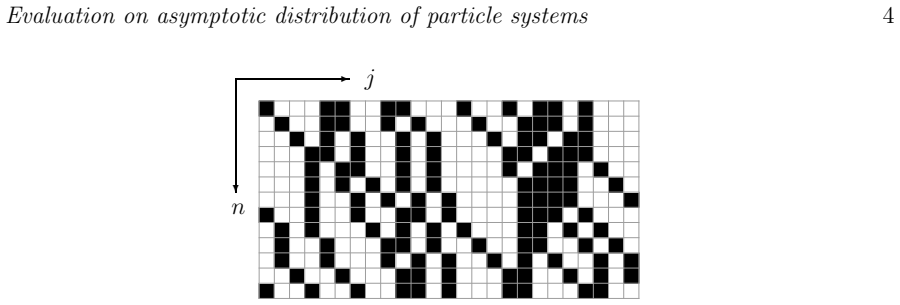
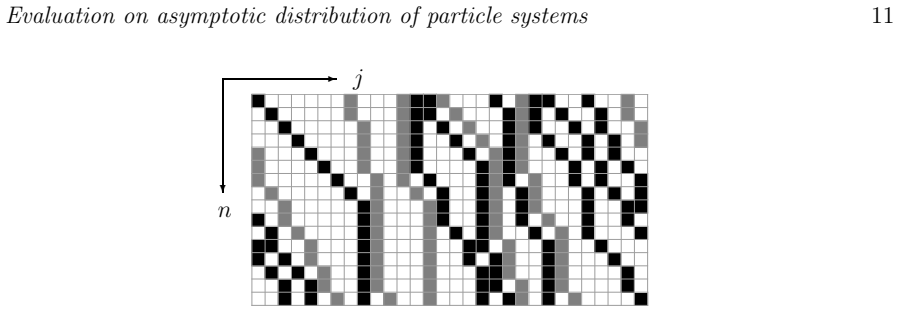
We propose some conjectures for asymptotic distribution of probabilistic Burgers cellular automaton (PBCA) which is defined by a simple motion rule of particles including a probabilistic parameter. Asymptotic distribution of configurations converges to a unique steady state for PBCA. We assume some conjecture on the distribution and derive the asymptotic probability expressed by GKZ hypergeometric function. If we take a limit of space size to infinity, a relation between density and flux of particles for infinite space size can be evaluated. Moreover, we propose two extended systems of PBCA of which asymptotic behavior can be analyzed as PBCA.
What carries the argument
The GKZ hypergeometric function, used to express the asymptotic probability of each configuration once the steady-state conjecture is assumed.
If this is right
- The probability of any configuration in the PBCA is given explicitly by the GKZ hypergeometric function under the steady-state conjecture.
- In the infinite-space limit a concrete algebraic relation holds between particle density and flux.
- Two extended versions of the PBCA admit the same style of asymptotic analysis.
Where Pith is reading between the lines
- The same conjecture-plus-hypergeometric approach could be tried on other one-dimensional probabilistic automata whose update rules preserve a similar local conservation law.
- The derived density-flux relation might be compared directly with the hydrodynamic limit of the deterministic Burgers cellular automaton to see how the probabilistic parameter modifies the macroscopic flux function.
- Finite-size corrections to the GKZ expression could be extracted by keeping the next terms in the space-size expansion before the infinite limit is taken.
Load-bearing premise
The asymptotic distribution of configurations converges to a unique steady state for the PBCA.
What would settle it
A direct enumeration or long-time Monte Carlo sampling of configuration probabilities on a modest finite lattice that deviates from the GKZ hypergeometric formula would falsify the claimed expression.
Figures




read the original abstract
We propose some conjectures for asymptotic distribution of probabilistic Burgers cellular automaton (PBCA) which is defined by a simple motion rule of particles including a probabilistic parameter. Asymptotic distribution of configurations converges to a unique steady state for PBCA. We assume some conjecture on the distribution and derive the asymptotic probability expressed by GKZ hypergeometric function. If we take a limit of space size to infinity, a relation between density and flux of particles for infinite space size can be evaluated. Moreover, we propose two extended systems of PBCA of which asymptotic behavior can be analyzed as PBCA.
Editorial analysis
A structured set of objections, weighed in public.
Referee Report
Summary. The manuscript proposes conjectures on the asymptotic distribution of configurations for the probabilistic Burgers cellular automaton (PBCA) and its extensions. It assumes a conjecture that the Markov chain converges to a unique steady-state distribution independent of initial conditions, then derives an expression for the stationary probability in terms of the GKZ hypergeometric function. In the infinite-space-size limit this yields an explicit density-flux relation; analogous results are stated for two extended PBCA systems.
Significance. If the central conjecture were independently established, the closed-form GKZ expression would constitute a concrete advance in the exact solvability of probabilistic cellular automata, supplying a parameter-dependent stationary measure and a hydrodynamic relation that could be tested against simulations or other models. The technical link to GKZ hypergeometric series is a distinctive feature that might connect the work to algebraic combinatorics or integrable systems. At present, however, the results remain conditional on an unverified assumption, limiting their immediate applicability.
major comments (2)
- [Abstract and the section deriving the asymptotic probability] The derivation of the GKZ hypergeometric form (following the statement of the conjecture on unique steady-state convergence) is obtained only after assuming the conjecture; no ergodicity proof, spectral-gap bound, or even Monte-Carlo histogram comparison is supplied to justify that the stationary measure is unique and independent of initial data. Consequently every subsequent formula, including the infinite-size density-flux relation, inherits the same unverified premise.
- [Section on extended systems] The analysis of the two extended PBCA systems is presented as proceeding analogously to the original case, yet it likewise invokes the identical unproven convergence conjecture without additional justification or verification.
minor comments (2)
- The probabilistic update rule and the precise definition of the parameter should be stated explicitly with an equation number at the first appearance rather than left implicit.
- A brief comparison table or plot contrasting the conjectured stationary measure against direct simulation for small lattices would strengthen readability even if the conjecture itself remains open.
Simulated Author's Rebuttal
We thank the referee for the careful reading and for highlighting the conditional nature of the results. We respond to each major comment below, clarifying that the manuscript presents derivations under explicitly stated conjectures rather than proven theorems.
read point-by-point responses
-
Referee: [Abstract and the section deriving the asymptotic probability] The derivation of the GKZ hypergeometric form (following the statement of the conjecture on unique steady-state convergence) is obtained only after assuming the conjecture; no ergodicity proof, spectral-gap bound, or even Monte-Carlo histogram comparison is supplied to justify that the stationary measure is unique and independent of initial data. Consequently every subsequent formula, including the infinite-size density-flux relation, inherits the same unverified premise.
Authors: The manuscript explicitly states the assumption of unique steady-state convergence as a conjecture (see abstract and the relevant section). All subsequent expressions, including the GKZ form and the density-flux relation, are derived under this hypothesis and are themselves presented as conjectures. No ergodicity proof or numerical verification is supplied because the work focuses on the formal derivation conditional on the assumption rather than on establishing the assumption itself. We can revise the text to add further explicit reminders of this conditional status at key points. revision: partial
-
Referee: [Section on extended systems] The analysis of the two extended PBCA systems is presented as proceeding analogously to the original case, yet it likewise invokes the identical unproven convergence conjecture without additional justification or verification.
Authors: The two extended systems are treated by direct analogy, invoking the same convergence conjecture without additional justification. This is consistent with the overall scope of the paper, which proposes the extensions and derives the corresponding expressions under the shared hypothesis rather than proving the hypothesis for any of the models. revision: no
- Independent proof of convergence to a unique steady-state distribution independent of initial conditions
Circularity Check
No significant circularity; results explicitly conditional on proposed conjectures with no reduction by construction.
full rationale
The manuscript states it proposes conjectures on the asymptotic distribution of PBCA configurations and assumes them to obtain the GKZ hypergeometric form and density-flux relation. No quoted step shows a self-definitional loop (e.g., X defined via Y then Y derived from X), a fitted parameter renamed as prediction, or a load-bearing self-citation chain. The derivation chain is presented as conditional on the conjectures rather than claiming first-principles derivation that secretly equals its inputs. This is the normal, non-circular case of transparent assumption-based analysis.
Axiom & Free-Parameter Ledger
axioms (1)
- domain assumption Asymptotic distribution of configurations converges to a unique steady state for PBCA.
Lean theorems connected to this paper
-
IndisputableMonolith/Cost/FunctionalEquation.leanwashburn_uniqueness_aczel unclear?
unclearRelation between the paper passage and the cited Recognition theorem.
We assume some conjecture on the distribution and derive the asymptotic probability expressed by GKZ hypergeometric function... Conjecture: For any x ∈ Ω, we have p(x) = C (1−α)^#10(x)
-
IndisputableMonolith/Foundation/DimensionForcing.leanreality_from_one_distinction unclear?
unclearRelation between the paper passage and the cited Recognition theorem.
If we take a limit of space size to infinity, a relation between density and flux of particles for infinite space size can be evaluated.
What do these tags mean?
- matches
- The paper's claim is directly supported by a theorem in the formal canon.
- supports
- The theorem supports part of the paper's argument, but the paper may add assumptions or extra steps.
- extends
- The paper goes beyond the formal theorem; the theorem is a base layer rather than the whole result.
- uses
- The paper appears to rely on the theorem as machinery.
- contradicts
- The paper's claim conflicts with a theorem or certificate in the canon.
- unclear
- Pith found a possible connection, but the passage is too broad, indirect, or ambiguous to say the theorem truly supports the claim.
Reference graph
Works this paper leans on
-
[1]
Wolfram S 2002 A New Kind of Science (Champaign: Wolfram Media)
work page 2002
-
[2]
Nishinari K and Takahashi D 1998 J. Phys. A: Math. Gen. 31 5439
work page 1998
-
[3]
Sasamoto T 1999 J. Phys. A: Math. Gen. 32 7109
work page 1999
-
[4]
Schreckenberg M, Schadschneider A, Nagel K and Ito N 1995 Phys. Rev. E 51 2939
work page 1995
-
[5]
Nagel K and Schadschneider A 1992 J. Phys. l France. 2 2221
work page 1992
-
[6]
Kuwabara H, Ikegami T and Takahashi T 2013 Japan. J. Indust. Appl. Math. 23 1
work page 2013
-
[7]
Endo K, Takahashi T and Matsukidaira J 2016 NOLTA. 7 313
work page 2016
-
[8]
Derrida B, Domany E and Mukamel E 1992 J. Stat. Phys. 69 667
work page 1992
-
[9]
Derrida B, Evans M R, Hakim V and Pasquier V 1993 J. Phys. A: Math. Gen. 26 1493
work page 1993
-
[10]
Kanai M, Nishinari K and Tokihiro T 2006 J. Phys. A: Math. Gen. 39 9071
work page 2006
-
[11]
Gelfand I, Kapranov M and Zelevinsky A 1990 Adv. Math. 84 255
work page 1990
-
[12]
Private communication with Kakei S
discussion (0)
Sign in with ORCID, Apple, or X to comment. Anyone can read and Pith papers without signing in.