Mask Embedding in conditional GAN for Guided Synthesis of High Resolution Images
Pith reviewed 2026-05-25 10:55 UTC · model grok-4.3
The pith
Mask embedding in conditional GAN generators resolves feature incompatibility to enable high-resolution mask-guided image synthesis.
A machine-rendered reading of the paper's core claim, the machinery that carries it, and where it could break.
Core claim
The incompatibility of features from mask images and latent vectors causes reduced variability and quality when semantic masks are directly incorporated as constraints in cGANs; the mask embedding mechanism allows for more efficient initial feature projection in the generator, enabling realistic high resolution synthesis with mask guidance.
What carries the argument
mask embedding mechanism that projects semantic mask information into a compatible feature space for efficient initial projection in the generator
If this is right
- Generates realistic high resolution facial images up to 512x512 with mask guidance.
- Maintains variability and quality of synthesized results with semantic mask constraints.
- Validated on CELEBA-HQ dataset for face generation.
Where Pith is reading between the lines
- The embedding approach may apply to other conditioning signals like edge maps or text descriptions in image synthesis tasks.
- It could help stabilize training in other multi-input GAN setups by aligning features early.
- Testing on non-face image domains would show if the benefit generalizes beyond faces.
Load-bearing premise
The reduced variability and quality when directly incorporating semantic masks is caused by the incompatibility of features from different inputs such as the mask image and latent vector.
What would settle it
A direct comparison of image quality metrics and variability between a cGAN with direct mask input and one with the proposed mask embedding on the CelebA-HQ dataset would test if the embedding is necessary.
Figures


read the original abstract
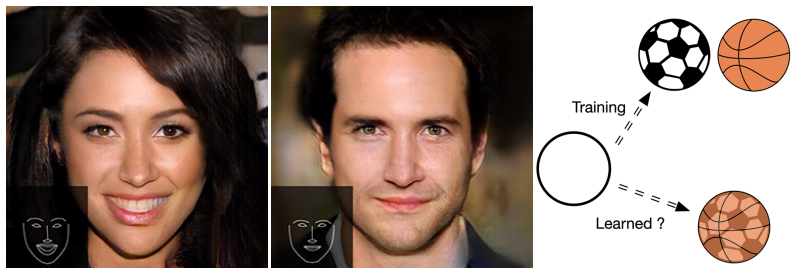
Recent advancements in conditional Generative Adversarial Networks (cGANs) have shown promises in label guided image synthesis. Semantic masks, such as sketches and label maps, are another intuitive and effective form of guidance in image synthesis. Directly incorporating the semantic masks as constraints dramatically reduces the variability and quality of the synthesized results. We observe this is caused by the incompatibility of features from different inputs (such as mask image and latent vector) of the generator. To use semantic masks as guidance whilst providing realistic synthesized results with fine details, we propose to use mask embedding mechanism to allow for a more efficient initial feature projection in the generator. We validate the effectiveness of our approach by training a mask guided face generator using CELEBA-HQ dataset. We can generate realistic and high resolution facial images up to the resolution of 512*512 with a mask guidance. Our code is publicly available.
Editorial analysis
A structured set of objections, weighed in public.
Referee Report
Summary. The manuscript proposes a mask embedding mechanism within conditional GANs to enable high-resolution (up to 512x512) image synthesis guided by semantic masks. The authors observe that directly feeding semantic masks into the generator reduces output variability and quality due to feature incompatibility between inputs such as the mask and latent vector; the embedding is introduced to achieve more efficient initial feature projection. Effectiveness is validated by training a mask-guided face generator on the CELEBA-HQ dataset, with code released publicly.
Significance. If the empirical results hold, the mask embedding offers a targeted architectural adjustment that could improve the practicality of mask-guided cGAN synthesis for tasks requiring both semantic control and high visual fidelity. The public code release is a clear strength supporting reproducibility.
minor comments (2)
- [Abstract] Abstract: the claim of reduced variability and quality when directly incorporating masks is presented as an observation but is not accompanied by any quantitative metrics, baseline comparisons, or ablation results; adding these (even summarized) would make the motivation more concrete.
- [Abstract] Abstract: the description of the mask embedding mechanism is high-level; a brief statement of its implementation (e.g., how the embedding is computed or injected) would improve clarity without requiring full architectural diagrams.
Simulated Author's Rebuttal
We thank the referee for the constructive review and the recommendation of minor revision. The report provides a positive summary of the work but does not list any specific major comments requiring point-by-point response.
Circularity Check
No significant circularity; architectural proposal is self-contained
full rationale
The paper proposes an architectural change (mask embedding) to address an observed empirical issue in cGAN generators when directly feeding semantic masks alongside latent vectors. No mathematical derivation chain, fitted parameters renamed as predictions, or self-referential definitions are present. The claim rests on the proposed generator modification and its validation via training on CELEBA-HQ, which is externally falsifiable and does not reduce to any input by construction. This is the expected outcome for an engineering/architectural contribution rather than a theorem or predictive model.
Axiom & Free-Parameter Ledger
axioms (1)
- domain assumption Standard assumptions of adversarial training in conditional GANs leading to realistic image distributions
invented entities (1)
-
mask embedding mechanism
no independent evidence
Reference graph
Works this paper leans on
-
[1]
High-resolution image synthesis and semantic manipulation with conditional gans
Ting-Chun Wang, Ming-Yu Liu, Jun-Yan Zhu, Andrew Tao, Jan Kautz, and Bryan Catan- zaro. High-resolution image synthesis and semantic manipulation with conditional gans. In Proceedings of the IEEE Conference on Computer Vision and Pattern Recognition , 2018
work page 2018
-
[2]
Photographic image synthesis with cascaded refinement networks
Qifeng Chen and Vladlen Koltun. Photographic image synthesis with cascaded refinement networks. In IEEE International Conference on Computer Vision, ICCV 2017, V enice, Italy, October 22-29, 2017, pages 1520–1529, 2017
work page 2017
-
[3]
Stackgan: Text to photo-realistic image synthesis with stacked generative adversarial networks
Han Zhang, Tao Xu, Hongsheng Li, Shaoting Zhang, Xiaogang Wang, Xiaolei Huang, and Dimitris Metaxas. Stackgan: Text to photo-realistic image synthesis with stacked generative adversarial networks. In ICCV, 2017
work page 2017
-
[4]
Wasserstein generative adversarial networks
Martin Arjovsky, Soumith Chintala, and Léon Bottou. Wasserstein generative adversarial networks. In Doina Precup and Yee Whye Teh, editors, Proceedings of the 34th International Conference on Machine Learning, volume 70 of Proceedings of Machine Learning Research, pages 214–223, International Convention Centre, Sydney, Australia, 06–11 Aug 2017. PMLR
work page 2017
-
[5]
Improved training of wasserstein gans
Ishaan Gulrajani, Faruk Ahmed, Martin Arjovsky, Vincent Dumoulin, and Aaron C Courville. Improved training of wasserstein gans. In I. Guyon, U. V . Luxburg, S. Bengio, H. Wallach, R. Fergus, S. Vishwanathan, and R. Garnett, editors,Advances in Neural Information Processing Systems 30, pages 5767–5777. Curran Associates, Inc., 2017
work page 2017
-
[6]
Image-to-image translation with conditional adversarial networks
Phillip Isola, Jun-Yan Zhu, Tinghui Zhou, and Alexei A Efros. Image-to-image translation with conditional adversarial networks. arxiv, 2016
work page 2016
-
[7]
U-net: Convolutional networks for biomedical image segmentation
Olaf Ronneberger, Philipp Fischer, and Thomas Brox. U-net: Convolutional networks for biomedical image segmentation. In MICCAI, 2015
work page 2015
-
[8]
Synthesizing retinal and neuronal images with generative adversarial nets
He Zhao, Huiqi Li, Sebastian Maurer-Stroh, and Li Cheng. Synthesizing retinal and neuronal images with generative adversarial nets. Medical Image Analysis, 49:14 – 26, 2018
work page 2018
-
[9]
Conditional Generative Adversarial Nets
Mehdi Mirza and Simon Osindero. Conditional generative adversarial nets. CoRR, abs/1411.1784, 2014
work page internal anchor Pith review Pith/arXiv arXiv 2014
-
[10]
Conditional generative adversarial nets for convolutional face generation
Jon Gauthier. Conditional generative adversarial nets for convolutional face generation. 2015
work page 2015
-
[11]
Facial expression synthesis by u-net conditional generative adversarial networks
Xueping Wang, Weixin Li, Guodong Mu, Di Huang, and Yunhong Wang. Facial expression synthesis by u-net conditional generative adversarial networks. In Proceedings of the 2018 ACM on International Conference on Multimedia Retrieval , ICMR ’18, pages 283–290, New York, NY , USA, 2018. ACM
work page 2018
-
[12]
G. Antipov, M. Baccouche, and J. Dugelay. Face aging with conditional generative adversarial networks. In 2017 IEEE International Conference on Image Processing (ICIP) , pages 2089– 2093, Sep. 2017
work page 2017
-
[13]
N. Bayramoglu, M. Kaakinen, L. Eklund, and J. Heikkilä. Towards virtual h e staining of hyperspectral lung histology images using conditional generative adversarial networks. In 2017 IEEE International Conference on Computer Vision Workshops (ICCVW) , pages 64–71, Oct 2017
work page 2017
-
[14]
A conditional adversarial network for semantic segmentation of brain tumor
Mina Rezaei, Konstantin Harmuth, Willi Gierke, Thomas Kellermeier, Martin Fischer, Haojin Yang, and Christoph Meinel. A conditional adversarial network for semantic segmentation of brain tumor. In Alessandro Crimi, Spyridon Bakas, Hugo Kuijf, Bjoern Menze, and Mauricio Reyes, editors, Brainlesion: Glioma, Multiple Sclerosis, Stroke and Traumatic Brain Inj...
work page 2018
-
[15]
S. U. Dar, M. Yurt, L. Karacan, A. Erdem, E. Erdem, and T. Çukur. Image synthesis in multi- contrast mri with conditional generative adversarial networks. IEEE Transactions on Medical Imaging, pages 1–1, 2019
work page 2019
-
[16]
X. Liu, G. Meng, S. Xiang, and C. Pan. Semantic image synthesis via conditional cycle- generative adversarial networks. In 2018 24th International Conference on Pattern Recognition (ICPR), pages 988–993, Aug 2018
work page 2018
-
[17]
Disentangling Multiple Conditional Inputs in GANs
Gökhan Yildirim, Calvin Seward, and Urs Bergmann. Disentangling Multiple Conditional Inputs in GANs. arXiv e-prints, page arXiv:1806.07819, Jun 2018
work page internal anchor Pith review Pith/arXiv arXiv 2018
-
[18]
Matching Thermal to Visible Face Images Using a Semantic-Guided Generative Adversarial Network
Cunjian Chen and Arun Ross. Matching Thermal to Visible Face Images Using a Semantic- Guided Generative Adversarial Network. arXiv e-prints, page arXiv:1903.00963, Mar 2019. 10
work page internal anchor Pith review Pith/arXiv arXiv 1903
- [19]
-
[20]
Progressive growing of GANs for improved quality, stability, and variation
Tero Karras, Timo Aila, Samuli Laine, and Jaakko Lehtinen. Progressive growing of GANs for improved quality, stability, and variation. In International Conference on Learning Representa- tions, 2018
work page 2018
-
[21]
Joachim D. Curtó, Irene C. Zarza, Fernando De La Torre, Irwin King, and Michael R. Lyu. High- resolution deep convolutional generative adversarial networks, 2017. cite arxiv:1711.06491
-
[22]
SinGAN: Learning a Generative Model from a Single Natural Image
Tamar Rott Shaham, Tali Dekel, and Tomer Michaeli. SinGAN: Learning a Generative Model from a Single Natural Image. arXiv e-prints, page arXiv:1905.01164, May 2019
-
[23]
Data augmentation generative adversarial networks, 2018
Anthreas Antoniou, Amos Storkey, and Harrison Edwards. Data augmentation generative adversarial networks, 2018
work page 2018
-
[24]
High-Resolution Mammogram Synthesis using Progressive Generative Adversarial Networks
Dimitrios Korkinof, Tobias Rijken, Michael O’Neill, Joseph Yearsley, Hugh Harvey, and Ben Glocker. High-Resolution Mammogram Synthesis using Progressive Generative Adversarial Networks. arXiv e-prints, page arXiv:1807.03401, Jul 2018
-
[25]
Deep learning face attributes in the wild
Ziwei Liu, Ping Luo, Xiaogang Wang, and Xiaoou Tang. Deep learning face attributes in the wild. In Proceedings of International Conference on Computer Vision (ICCV) , December 2015
work page 2015
-
[26]
Davis E. King. Dlib-ml: A machine learning toolkit. Journal of Machine Learning Research, 10:1755–1758, 2009
work page 2009
-
[27]
Wasserstein Barycenter and its Application to Texture Mixing
Rabin Julien, Gabriel Peyré, Julie Delon, and Bernot Marc. Wasserstein Barycenter and its Application to Texture Mixing. In SSVM’11, pages 435–446, Israel, 2011. Springer. 11
work page 2011
discussion (0)
Sign in with ORCID, Apple, or X to comment. Anyone can read and Pith papers without signing in.