Option pricing in fractional Heston-type model
Pith reviewed 2026-05-25 10:00 UTC · model grok-4.3
The pith
Discretization schemes for the fractional Heston model converge in expectation to the true option price at a specific rate.
A machine-rendered reading of the paper's core claim, the machinery that carries it, and where it could break.
Core claim
In the fractional Heston-type model with H > 1/2, discretization schemes Ŷ^n and Ŝ^n for the volatility and price processes satisfy E f(Ŝ^n_T) → E f(S_T) as the mesh tends to zero, with a calculable rate of convergence; additionally, Malliavin calculus supplies an alternative formula for E f(S_T) where the functional under the expectation is smooth even when the payoff f has discontinuities.
What carries the argument
The discretization schemes Ŷ^n and Ŝ^n together with Malliavin calculus techniques to smooth the payoff functional.
If this is right
- Monte Carlo simulation using the discrete schemes yields accurate option prices with known error bounds.
- The rate of convergence informs how fine the partition must be for a desired precision.
- The smoothed Malliavin formula enables efficient computation for payoffs with jumps without direct simulation bias.
- Option pricing becomes feasible in this non-Markovian fractional setting without closed forms.
Where Pith is reading between the lines
- Similar discretization and Malliavin approaches could extend to other fractional stochastic volatility models.
- Testing the convergence rate in numerical experiments would validate the theoretical bounds.
- The method might apply to risk management calculations beyond simple option payoffs.
Load-bearing premise
The fractional Heston-type model with H > 1/2 has sufficient path regularity so that discretization errors can be controlled and Malliavin calculus applies to the payoff.
What would settle it
Numerical simulations showing that the observed convergence rate of E f(Ŝ^n_T) to E f(S_T) differs from the calculated rate as mesh size decreases would falsify the convergence claim.
Figures
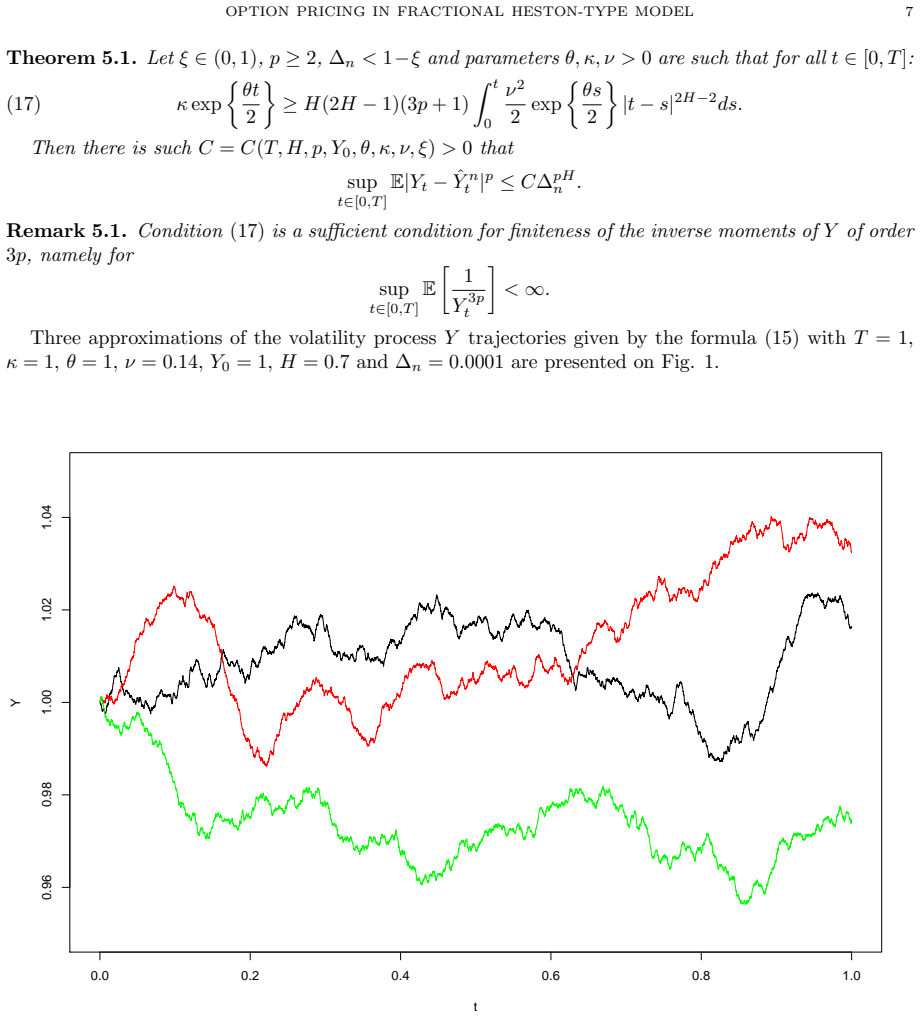


read the original abstract
In this paper, we consider option pricing in a framework of the fractional Heston-type model with $H>1/2$. As it is impossible to obtain an explicit formula for the expectation $\mathbb E f(S_T)$ in this case, where $S_T$ is the asset price at maturity time and $f$ is a payoff function, we provide a discretization schemes $\hat Y^n$ and $\hat S^n$ for volatility and price processes correspondingly and study convergence $\mathbb E f(\hat S^n_T) \to \mathbb E f(S_T)$ as the mesh of the partition tends to zero. The rate of convergence is calculated. As we allow $f$ to have discontinuities of the first kind which can cause errors in straightforward Monte-Carlo estimation of the expectation, we use Malliavin calculus techniques to provide an alternative formula for $\mathbb E f(S_T)$ with smooth functional under the expectation.
Editorial analysis
A structured set of objections, weighed in public.
Referee Report
Summary. The paper considers option pricing in a fractional Heston-type model with Hurst parameter H > 1/2. It introduces discretization schemes Ŷ^n and Ŝ^n for the volatility and asset-price processes, establishes convergence of E[f(Ŝ^n_T)] to E[f(S_T)] as the mesh of the time partition tends to zero together with an explicit rate, and derives via Malliavin calculus an alternative representation of E[f(S_T)] in which the payoff functional is replaced by a smooth integrand.
Significance. If the convergence statement and rate are rigorously justified, the discretization result supplies a theoretically controlled numerical method for pricing in fractional-volatility models where closed-form expressions are unavailable. The Malliavin representation would additionally allow Monte-Carlo evaluation of expectations involving discontinuous payoffs without the usual bias from indicator functions.
major comments (2)
- [Model setup] Model-setup paragraph (and subsequent sections on well-posedness): existence and uniqueness of strong solutions to the fractional Heston SDE, non-negativity of the volatility process, and the precise Hölder regularity (at least >1/2) needed for both the discretization error bound and Malliavin differentiability are asserted without an explicit theorem, reference, or verification that the fractional-Brownian driver enters the volatility equation in a manner preserving these properties when H > 1/2.
- [Convergence analysis] Convergence theorem (presumably §3 or §4): the proof that E[f(Ŝ^n_T)] → E[f(S_T)] with a stated rate relies on the path-regularity and Malliavin-differentiability assumptions identified above; without an independent justification of those assumptions the error estimate cannot be closed.
minor comments (2)
- The precise form of the discretization (Euler, Milstein, or other) and the definition of the partition mesh should be stated explicitly before the convergence statement.
- Notation for the payoff f and the Malliavin weight should be introduced once and used consistently; the abstract mentions “smooth functional under the expectation” but the precise integration-by-parts formula is not previewed.
Simulated Author's Rebuttal
We thank the referee for the careful reading and constructive comments on the well-posedness and convergence analysis. We address each major comment below and will revise the manuscript to supply the requested justifications and references.
read point-by-point responses
-
Referee: [Model setup] Model-setup paragraph (and subsequent sections on well-posedness): existence and uniqueness of strong solutions to the fractional Heston SDE, non-negativity of the volatility process, and the precise Hölder regularity (at least >1/2) needed for both the discretization error bound and Malliavin differentiability are asserted without an explicit theorem, reference, or verification that the fractional-Brownian driver enters the volatility equation in a manner preserving these properties when H > 1/2.
Authors: We agree that the model-setup section requires explicit support. In the revised manuscript we will insert a dedicated well-posedness subsection that (i) cites standard existence-uniqueness results for SDEs driven by fractional Brownian motion with Hurst index H>1/2, (ii) verifies that the volatility process remains non-negative under the chosen drift and diffusion coefficients, and (iii) recalls the Hölder regularity of the solution paths (which follows from the Hölder continuity of the driving fBM and standard estimates for such equations). These additions will also confirm that the Malliavin differentiability needed later is compatible with the same regularity. revision: yes
-
Referee: [Convergence analysis] Convergence theorem (presumably §3 or §4): the proof that E[f(Ŝ^n_T)] → E[f(S_T)] with a stated rate relies on the path-regularity and Malliavin-differentiability assumptions identified above; without an independent justification of those assumptions the error estimate cannot be closed.
Authors: The convergence result in Section 3 is indeed conditional on the path-regularity and Malliavin-differentiability properties. Once the well-posedness subsection supplies the missing references and verifications, the assumptions become rigorously justified and the error bound can be closed. In the revision we will add explicit cross-references from the convergence proof back to the new well-posedness statements. revision: yes
Circularity Check
No circularity; standard convergence and representation results for an externally defined model.
full rationale
The paper defines discretization schemes Ŷ^n and Ŝ^n for the volatility and price processes in the fractional Heston model (H>1/2) and derives the convergence E f(Ŝ^n_T) → E f(S_T) together with a Malliavin integration-by-parts formula. These steps are mathematical derivations from the assumed SDE dynamics and path regularity; they do not reduce by construction to fitted parameters, self-definitions, or load-bearing self-citations. The model framework is taken as given without internal redefinition of its outputs, so the claims remain independent of the inputs.
Axiom & Free-Parameter Ledger
axioms (2)
- domain assumption The fractional Heston-type model with Hurst index H > 1/2 exists and possesses the path regularity needed for discretization error bounds.
- domain assumption Malliavin calculus applies to the payoff functional and yields an equivalent smooth representation.
Reference graph
Works this paper leans on
-
[1]
M. Altmayer & A. Neuenkirch (2015) Multilevel Monte Carlo quadrature of discontinuous payoffs in the generalized Heston model using Malliavin integration by parts, SIAM J Financial Math 6 (1), 22–52
work page 2015
-
[2]
L.B.G. Andersen & V.V. Piterbarg (2006) Moment explosions in stochastic volatility models, Finance Stoch. 11, 29–50
work page 2006
-
[3]
V. Anh & A. Inoue (2005) Financial markets with memory I: Dynamic models, Stoch. Anal. Appl. 23 (2), 275–300
work page 2005
-
[4]
O. E. Barndorff-Nielsen & N. Shephard (2001) Non-Gaussian Ornstein-Uhlenbeck-based models and some of their uses in financial economics, J R Stat Soc Ser B Stat Methodol 63 (2),167–241
work page 2001
-
[5]
O. E. Barndorff-Nielsen & N. Shephard (2002) Econometric analysis of realized volatility and its use in estimating stochastic volatility models, J R Stat Soc Ser B Stat Methodol 64 (2), 253–280
work page 2002
-
[6]
V. Bezborodov, L. Di Persio & Yu. Mishura (2019) Option pricing with fractional stochastic volatility and discontinuous payoff function of polynomial growth, Methodol Comput Appl Probab 21 (1), 331–366
work page 2019
-
[7]
T. Bollerslev & H. O. Mikkelsen (1996) Modeling and pricing long memory in stock market volatility, J Econ 73 (1), 151–184
work page 1996
-
[8]
M. Carrasco & X. Chen (2002) Mixing and moment properties of various GARCH and stochastic volatility models, Economet Theor 18 (1), 17–39
work page 2002
-
[9]
A. Chronopoulou & F. G. Viens (2012) Estimation and pricing under long-memory stochastic volatility, Ann Finance 8 (2-3), 379–403
work page 2012
- [10]
- [11]
- [12]
-
[13]
Fernique (1975) Regularit´ e des trajectoires des fonctions al´ eatoires gaussiennes
X. Fernique (1975) Regularit´ e des trajectoires des fonctions al´ eatoires gaussiennes. In:Ecole d’ ´Et´ e de Probabilit´ es de Saint-Flour, IV-1974 (P.-L. Hennequin, ed.), 1–96. Springer, Berlin
work page 1975
-
[14]
J. Gatheral, T. Jaisson & M. Rosenbaum (2018) Volatility is rough, Quantitative Finance, 18 (6), 933–949
work page 2018
-
[15]
S. L. Heston (1993) A closed-form solution for options with stochastic volatility with applications to bond and currency options, Rev Financ Stud 6 (2), 327–343
work page 1993
- [16]
-
[17]
J. C. Hull & A. White (1987) The pricing of options on assets with stochastic volatilities, J Financ 42 (2), 281–300
work page 1987
-
[18]
A. E. Kyprianou & W. Schoutens (eds) (2005) Exotic option pricing and advanced L´ evy models. Wiley, Chichester
work page 2005
-
[19]
E. Neuman & M. Rosenbaum (2018) Fractional Brownian motion with zero Hurst parameter: a rough volatility viewpoint, Electronic Communications in Probability, 23
work page 2018
-
[20]
E. Nicolato & E. Venardos (2003) Option pricing in stochastic volatility models of the Ornstein-Uhlenbeck type, Math Financ 13 (4), 445–466
work page 2003
- [21]
-
[22]
Nualart (2006) The Malliavin calculus and related topics , second edition
D. Nualart (2006) The Malliavin calculus and related topics , second edition. Berlin: Springer-Verlag
work page 2006
-
[23]
D. Nualart & E. Pardoux (1988) Stochastic calculus with anticipating integrands, Probab. Theory Related Fields, 78 (4), 535–581
work page 1988
-
[24]
Mishura (2008) Stochastic calculus for fractional Brownian motion and related processes
Yu. Mishura (2008) Stochastic calculus for fractional Brownian motion and related processes . Berlin: Springer-Verlag
work page 2008
-
[25]
Yu. Mishura, V. Piterbarg, K. Ralchenko & A. Yurchenko-Tytarenko (2018) Stochastic representation and path prop- erties of a fractional Cox–Ingersoll–Ross process, Theor. Probability and Math. Statist. 97, 167–182
work page 2018
-
[26]
Yu. Mishura & A. Yurchenko-Tytarenko (2018) Fractional Cox-Ingersoll-Ross process with non-zero “mean”, Modern Stochastics: Theory and Applications 5 (1), 99–111
work page 2018
-
[27]
Yu. Mishura & A. Yurchenko-Tytarenko (2019) Fractional Cox-Ingersoll-Ross process with small Hurst indices,Modern Stochastics: Theory and Applications 6 (1), 13–39
work page 2019
-
[28]
D. Nualart & Y. Ouknine (2002) Regularization of differential equations by fractional noise, Stoch. Process. Appl. 102, 103–116
work page 2002
-
[29]
N. Shephard (1996) Statistical aspects of ARCH and stochastic volatility, Monographs on Statistics and Applied Probability 65, 1–68
work page 1996
-
[30]
Moments and Absolute Moments of the Normal Distribution
A. Winkelbauer (2012) Moments and Absolute Moments of the Normal Distribution. arXiv:1209.4340
work page internal anchor Pith review Pith/arXiv arXiv 2012
-
[31]
K. Yamasaki, L. Muchnik, S. Havlin, A. Bunde & H.E. Stanley (2005) Scaling and memory in volatility return intervals in financial markets, Proc. Natl. Acad. Sci. USA 102 (26), 9424–9428
work page 2005
-
[32]
Z¨ ahle (1998) Integration with respect to fractal functions and stochastic calculus I
M. Z¨ ahle (1998) Integration with respect to fractal functions and stochastic calculus I. Probab. Theory Relat. Fields 111, 333–374
work page 1998
discussion (0)
Sign in with ORCID, Apple, or X to comment. Anyone can read and Pith papers without signing in.