TinySDR: Low-Power SDR Platform for Over-the-Air Programmable IoT Testbeds
Pith reviewed 2026-05-25 09:26 UTC · model grok-4.3
The pith
TinySDR delivers the first fully programmable low-power SDR that duty-cycles like a real IoT endpoint and accepts over-the-air updates.
A machine-rendered reading of the paper's core claim, the machinery that carries it, and where it could break.
Core claim
We introduce tinySDR, the first software-defined radio platform tailored to the needs of power-constrained IoT endpoints. TinySDR provides a standalone, fully programmable low power software-defined radio solution that can be duty cycled for battery operation like a real IoT endpoint, and more importantly, can be programmed over the air to allow for large scale deployment. We present extensive evaluation of our platform showing it consumes as little as 30 uW of power in sleep mode, which is 10,000x lower than existing SDR platforms.
What carries the argument
The tinySDR hardware platform, which integrates low-power components to reach 30 uW sleep mode while supporting FPGA signal processing and over-the-air firmware updates.
If this is right
- Protocol designers can run tests on hardware whose power draw matches actual IoT endpoints rather than laboratory equipment.
- Hundreds or thousands of nodes can receive code updates without physical access, enabling experiments at true deployment scale.
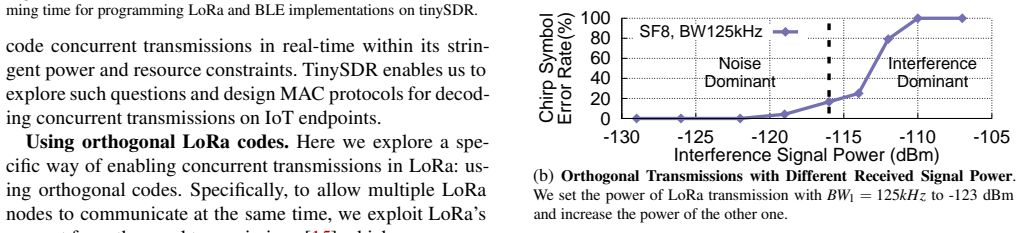
- Questions about real-time handling of concurrent transmissions can be answered directly on power-constrained devices.
- Low FPGA usage leaves headroom for adding custom protocol features without redesigning the platform.
Where Pith is reading between the lines
- Testbeds built on this platform could shift IoT research from small-lab setups to city-scale energy-aware trials.
- The over-the-air update feature opens the possibility of protocols that adapt their own code in the field based on observed conditions.
- Success with concurrent LoRa demodulation would encourage similar work on other dense wireless standards under the same power limits.
Load-bearing premise
The hardware design can keep full SDR programmability while achieving the stated sleep power and reliable wireless updates when operated as a battery-powered IoT node.
What would settle it
A side-by-side measurement showing that any existing SDR platform reaches 30 uW or lower sleep power while still supporting over-the-air programming and duty-cycled battery operation at the same sensitivities.
Figures






read the original abstract
Wireless protocol design for IoT networks is an active area of research which has seen significant interest and developments in recent years. The research community is however handicapped by the lack of a flexible, easily deployable platform for prototyping IoT endpoints that would allow for ground up protocol development and investigation of how such protocols perform at scale. We introduce tinySDR, the first software-defined radio platform tailored to the needs of power-constrained IoT endpoints. TinySDR provides a standalone, fully programmable low power software-defined radio solution that can be duty cycled for battery operation like a real IoT endpoint, and more importantly, can be programmed over the air to allow for large scale deployment. We present extensive evaluation of our platform showing it consumes as little as 30 uW of power in sleep mode, which is 10,000x lower than existing SDR platforms. We present two case studies by implementing LoRa and BLE beacons on the platform and achieve sensitivities of -126 dBm and -94 dBm respectively while consuming 11% and 3% of the FPGA resources. Finally, using tinySDR, we explore the research question of whether an IoT device can demodulate concurrent LoRa transmissions in real-time, within its power and computing constraints.
Editorial analysis
A structured set of objections, weighed in public.
Referee Report
Summary. The paper introduces tinySDR as the first SDR platform tailored for power-constrained IoT endpoints, supporting duty-cycling for battery operation and over-the-air programming for large-scale deployment. It reports a sleep-mode power consumption of 30 μW (claimed 10,000x lower than existing SDR platforms), demonstrates LoRa and BLE beacon implementations achieving sensitivities of -126 dBm and -94 dBm while using 11% and 3% of FPGA resources, and explores whether concurrent LoRa transmissions can be demodulated in real time within the platform's power and compute limits.
Significance. If the power figures and OTA functionality are substantiated with reproducible measurements, the platform would address a key gap by enabling ground-up protocol development and large-scale IoT testbeds that were previously impractical due to power and deployment constraints.
major comments (2)
- [Abstract] Abstract: the claim of 30 μW sleep power and the 10,000x reduction lacks any description of measurement methods, conditions, error bars, or confirmation that the mode preserves the always-on receiver needed for OTA wake-up; this is load-bearing for the central positioning as a practical IoT testbed.
- [Evaluation] Evaluation section: the comparison to 'existing SDR platforms' for the 10,000x factor does not specify the baseline platforms, their reported power modes, or whether those baselines include equivalent OTA capability, undermining the multiplier's relevance to duty-cycled IoT use.
minor comments (1)
- [Abstract] Abstract: the phrase 'extensive evaluation' is used without summarizing the measurement protocols or hardware configurations employed for the reported power and sensitivity numbers.
Simulated Author's Rebuttal
We thank the referee for the constructive comments highlighting areas where additional detail would strengthen the paper. We address each major comment below and will revise the manuscript accordingly.
read point-by-point responses
-
Referee: [Abstract] Abstract: the claim of 30 μW sleep power and the 10,000x reduction lacks any description of measurement methods, conditions, error bars, or confirmation that the mode preserves the always-on receiver needed for OTA wake-up; this is load-bearing for the central positioning as a practical IoT testbed.
Authors: We agree that the abstract would benefit from a concise reference to the measurement approach. In the revised version we will add one sentence noting that the 30 μW figure was obtained with the always-on receiver enabled (to support OTA wake-up) under the conditions detailed in Section V, including use of a precision source meter and reported standard deviation across multiple boards. This keeps the abstract concise while directing readers to the full methodology, error bars, and OTA-preserving conditions already present in the evaluation. revision: yes
-
Referee: [Evaluation] Evaluation section: the comparison to 'existing SDR platforms' for the 10,000x factor does not specify the baseline platforms, their reported power modes, or whether those baselines include equivalent OTA capability, undermining the multiplier's relevance to duty-cycled IoT use.
Authors: The referee correctly identifies that explicit baselines improve interpretability. We will revise the Evaluation section to add a short table (or expanded paragraph) listing the specific platforms used for the comparison (USRP B200, HackRF One, LimeSDR, and Ettus E310), their datasheet-reported sleep or low-power-mode consumption (typically 100–300 mW), and a note that none of these platforms support OTA programming or are designed for battery duty-cycled IoT endpoints. The 10,000× multiplier is therefore presented strictly as a sleep-power comparison for the duty-cycled IoT use case. revision: yes
Circularity Check
No circularity: hardware platform description with empirical measurements
full rationale
This paper presents the design, implementation, and evaluation of a hardware SDR platform for IoT, including power measurements (e.g., 30 μW sleep mode) and case studies (LoRa/BLE implementations). It contains no mathematical derivations, equations, predictions from first principles, fitted parameters, or ansatzes. All claims rest on direct hardware measurements, resource usage reports, and external comparisons rather than any self-referential chain that reduces to its own inputs. No load-bearing steps match the enumerated circularity patterns.
Axiom & Free-Parameter Ledger
Reference graph
Works this paper leans on
-
[1]
https://www.nuand.com/ bladeRF_2_micro-brief.pdf
bladerf 2.0 micro. https://www.nuand.com/ bladeRF_2_micro-brief.pdf
- [2]
-
[3]
https://wiki.myriadrf.org/ LimeSDR-Mini
Limesdr-mini. https://wiki.myriadrf.org/ LimeSDR-Mini
-
[4]
An overview of lvds technology. http://www.ti. com/lit/an/snla165/snla165.pdf
-
[5]
Rtlsdr rtl2832u dvb-t tuner dongles. https://www. rtl-sdr.com/buy-rtl-sdr-dvb-t-dongles/
-
[6]
https://www.ettus.com/content/ files/USRP_B200mini_Data_Sheet.pdf
Usrp b200mini. https://www.ettus.com/content/ files/USRP_B200mini_Data_Sheet.pdf
-
[7]
https://www.ettus.com/content/ files/USRP_E310_Datasheet.pdf
Usrp e310. https://www.ettus.com/content/ files/USRP_E310_Datasheet.pdf
-
[8]
https:// www.mouser.com/datasheet/2/611/JTI_ Balun-Filter-2450FB15A050_2006-09-242325
2.45 ghz balun, filter combination, 2003. https:// www.mouser.com/datasheet/2/611/JTI_ Balun-Filter-2450FB15A050_2006-09-242325. pdf
work page 2003
-
[9]
Max5189 datasheet, 2003. https://datasheets. maximintegrated.com/en/ds/MAX5186-MAX5189. pdf
work page 2003
-
[10]
Max2831 datasheet, 2011. https://datasheets. maximintegrated.com/en/ds/MAX2831-MAX2832. pdf
work page 2011
-
[11]
http:// www.testequipmenthq.com/datasheets/ TEKTRONIX-MDO4104B-6-Datasheet.pdf
Mdo4000b series datasheet, 2013. http:// www.testequipmenthq.com/datasheets/ TEKTRONIX-MDO4104B-6-Datasheet.pdf
work page 2013
-
[12]
https://www.analog.com/media/en/ technical-documentation/data-sheets/AD9364
Ad9364 transceiver datasheet, 2014. https://www.analog.com/media/en/ technical-documentation/data-sheets/AD9364. pdf
work page 2014
-
[13]
https:// support.smartthings.com/hc/en-us/articles/ 203040294-SmartSense-Temperature-Humidity-Sensor
Smartsense temp/humidity manual, 2014. https:// support.smartthings.com/hc/en-us/articles/ 203040294-SmartSense-Temperature-Humidity-Sensor
work page 2014
-
[14]
https://www.semtech.com/uploads/ documents/sc195.pdf
3.5mhz, 500ma synchronous step down dc-dc regu- lator, 2015. https://www.semtech.com/uploads/ documents/sc195.pdf
work page 2015
-
[15]
Lora modulation basics, 2015. https://www. semtech.com/uploads/documents/an1200.22. pdf
work page 2015
-
[16]
https://www.analog.com/media/en/ technical-documentation/data-sheets/AD9361
Ad9361 transceiver datasheet, 2016. https://www.analog.com/media/en/ technical-documentation/data-sheets/AD9361. pdf
work page 2016
-
[17]
https://www.analog.com/media/en/ technical-documentation/data-sheets/AD9363
Ad9363 transceiver datasheet, 2016. https://www.analog.com/media/en/ technical-documentation/data-sheets/AD9363. pdf . 13
work page 2016
-
[18]
Adg904 datasheet by analog devices,
-
[19]
http://www.analog.com/media/en/ technical-documentation/data-sheets/ADG904. pdf
-
[20]
At86rf215 datasheet, 2016
work page 2016
-
[21]
Cc2650 simplelink datasheet by ti, 2016. http://www. ti.com/lit/ds/symlink/cc2650.pdf
work page 2016
- [22]
-
[23]
Se2435l power amplifier datasheet, 2016. http://www. skyworksinc.com/uploads/documents/SE2435L_ 202412I.pdf
work page 2016
-
[24]
Sx1276 datasheet by semtech, 2016. https://www. semtech.com/uploads/documents/sx1276.pdf
work page 2016
-
[25]
https:// limemicro.com/app/uploads/2017/07/ LMS7002M-Data-Sheet-v3.1r00.pdf
Lms7002m datasheet, 2017. https:// limemicro.com/app/uploads/2017/07/ LMS7002M-Data-Sheet-v3.1r00.pdf
work page 2017
-
[26]
Lora alliance, 2017. https://lora-alliance. org/sites/default/files/2018-04/lorawantm_ specification_-v1.1.pdf
work page 2017
-
[27]
Msp432p401r, msp432p401m simplelink mixed-signal microcontrollers datasheet, 2017. http://www.ti. com/lit/ds/symlink/msp432p401r.pdf
work page 2017
-
[28]
http:// www.skyworksinc.com/uploads/documents/ SKY66112_11_203225L.pdf
Sky66112 power amplifier datasheet, 2017. http:// www.skyworksinc.com/uploads/documents/ SKY66112_11_203225L.pdf
work page 2017
-
[29]
Sx1308 datasheet by semtech, 2017. https://www. semtech.com/uploads/documents/sx1308.pdf
work page 2017
-
[30]
Ad9228 datasheet, 2018. https://www.analog. com/media/en/technical-documentation/ data-sheets/ad9228.pdf
work page 2018
-
[31]
Adalm-pluto overview, 2018. https://wiki.analog. com/university/tools/pluto
work page 2018
-
[32]
https://www.mouser.com/ datasheet/2/611/0896BM15E0025-1518705.pdf
Atmel at86rf215 868/915/928 mhz impedance matched balun + lpf, 2018. https://www.mouser.com/ datasheet/2/611/0896BM15E0025-1518705.pdf
work page 2018
-
[33]
Lfe5u fpga family datasheet, 2018. http://www. latticesemi.com/view_document?document_ id=50461
work page 2018
-
[34]
minilzo implementation, 2018. http://www. oberhumer.com/opensource/lzo/#abstract
work page 2018
-
[35]
Sx1257 datasheet by semtech, 2018. https://www. semtech.com/uploads/documents/DS_SX1257_V1. 2.pdf
work page 2018
-
[36]
https://www.ettus.com/ product/details/X300-KIT
Usrp x-300, 2018. https://www.ettus.com/ product/details/X300-KIT
work page 2018
-
[37]
Bluetooth core specification v5.1, Jan. 2019. https://www.bluetooth.com/specifications/ bluetooth-core-specification
work page 2019
- [38]
-
[39]
https://github.com/TheThingsNetwork/ arduino-device-lib
The things network arduino library, 2019. https://github.com/TheThingsNetwork/ arduino-device-lib
work page 2019
- [40]
- [41]
-
[42]
J. Chan, A. Wang, A. Krishnamurthy, and S. Gol- lakota. Deepsense: Enabling carrier sense in low- power wide area networks using deep learning. CoRR, abs/1904.10607, 2019
work page internal anchor Pith review Pith/arXiv arXiv 1904
-
[43]
P . Dutta, Y .-S. Kuo, A. Ledeczi, T. Schmid, and P . V ol- gyesi. Putting the software radio on a low-calorie diet. In Proceedings of the 9th ACM SIGCOMM W orkshop on Hot T opics in Networks, page 20. ACM, 2010
work page 2010
-
[44]
R. Eletreby, D. Zhang, S. Kumar, and O. Y a ˘gan. Em- powering low-power wide area networks in urban set- tings. SIGCOMM ’17
-
[45]
S. Gollakota and D. Katabi. Zigzag decoding: Combat- ing hidden terminals in wireless networks. In Proceed- ings of the ACM SIGCOMM 2008 Conference on Data Communication, SIGCOMM ’08, 2008
work page 2008
-
[46]
Y . Guddeti, R. Subbaraman, M. Khazraee, A. Schul- man, and D. Bharadia. Sweepsense: Sensing 5 ghz in 5 milliseconds with low-cost radios. In 16th {USENIX} Symposium on Networked Systems Design and Imple- mentation ({NSDI} 19), pages 317–330, 2019
work page 2019
- [47]
- [48]
-
[49]
V . Iyer, J. Chan, I. Culhane, J. Mankoff, and S. Gol- lakota. Wireless analytics for 3d printed objects. In Pro- ceedings of the 31st Annual ACM Symposium on User Interface Software and T echnology , UIST ’18, pages 141–152, New Y ork, NY , USA, 2018. ACM
work page 2018
-
[50]
V . Iyer, J. Chan, and S. Gollakota. 3d printing wire- less connected objects. ACM Trans. Graph., 36(6), Nov. 2017
work page 2017
-
[51]
V . Iyer, V . Talla, B. Kellogg, S. Gollakota, and J. Smith. Inter-technology backscatter: Towards internet connec- tivity for implanted devices. In Proceedings of the 2016 ACM SIGCOMM Conference
work page 2016
- [52]
-
[53]
B. Kellogg, A. Parks, S. Gollakota, J. R. Smith, and D. Wetherall. Wi-fi backscatter: Internet connectivity for rf-powered devices. In Proceedings of the 2014 ACM Conference on SIGCOMM
work page 2014
-
[54]
B. Kellogg, V . Talla, S. Gollakota, and J. R. Smith. Pas- sive wi-fi: Bringing low power to wi-fi transmissions. In NSDI 16
-
[55]
A. Khattab, J. Camp, C. Hunter, P . Murphy, A. Sabhar- wal, and E. W . Knightly. Warp: a flexible platform for clean-slate wireless medium access protocol design. ACM SIGMOBILE Mobile Computing and Communi- cations Review, 12(1):56–58, 2008
work page 2008
-
[56]
Y .-S. Kuo, P . Pannuto, T. Schmid, and P . Dutta. Re- configuring the software radio to improve power, price, and portability. In Proceedings of the 10th ACM Con- ference on Embedded Network Sensor Systems , pages 267–280. ACM, 2012
work page 2012
-
[57]
Y .-S. Kuo, T. Schmid, and P . Dutta. A compact, in- expensive, and battery-powered software-defined radio platform. In Proceedings of the 11th international con- ference on Information Processing in Sensor Networks , pages 137–138. ACM, 2012
work page 2012
-
[58]
Y . Lin, H. Lee, M. Woh, Y . Harel, S. Mahlke, T. Mudge, C. Chakrabarti, and K. Flautner. Soda: A low-power architecture for software radio. ACM SIGARCH Com- puter Architecture News, 34(2):89–101, 2006
work page 2006
-
[59]
V . Liu, A. Parks, V . Talla, S. Gollakota, D. Wetherall, and J. R. Smith. Ambient backscatter: Wireless com- munication out of thin air. SIGCOMM ’13
-
[60]
G. J. Minden, J. B. Evans, L. Searl, D. DePardo, V . R. Petty, R. Rajbanshi, T. Newman, Q. Chen, F. Weidling, J. Guffey, et al. Kuar: A flexible software-defined radio development platform. In 2007 2nd IEEE International Symposium on New Frontiers in Dynamic Spectrum Ac- cess Networks, pages 428–439. IEEE, 2007
work page 2007
-
[61]
S. Naderiparizi, M. Hessar, V . Talla, S. Gollakota, and J. R. Smith. Towards battery-free hd video streaming. In 15th USENIX Symposium on Networked Systems De- sign and Implementation (NSDI 18) , 2018
work page 2018
-
[62]
R. Nandakumar, V . Iyer, and S. Gollakota. 3d localiza- tion for sub-centimeter sized devices. In Proceedings of the 16th ACM Conference on Embedded Networked Sensor Systems, SenSys ’18, 2018
work page 2018
-
[63]
R. Narayanan and S. Kumar. Revisiting software de- fined radios in the iot era. In Proceedings of the 17th ACM W orkshop on Hot T opics in Networks. ACM, 2018
work page 2018
-
[64]
M. C. Ng, K. E. Fleming, M. Vutukuru, S. Gross, H. Balakrishnan, et al. Airblue: A system for cross- layer wireless protocol development. In Proceedings of the 6th ACM/IEEE Symposium on Architectures for Net- working and Communications Systems , page 4. ACM, 2010
work page 2010
-
[65]
C. Shepard, A. Javed, and L. Zhong. Control channel design for many-antenna mu-mimo. In Proceedings of the 21st Annual International Conference on Mobile Computing and Networking , MobiCom ’15
-
[66]
C. Shepard, H. Y u, N. Anand, E. Li, T. Marzetta, R. Y ang, and L. Zhong. Argos: Practical many-antenna base stations. In Proceedings of the 18th Annual In- ternational Conference on Mobile Computing and Net- working, Mobicom ’12
-
[67]
P . D. Sutton, J. Lotze, H. Lahlou, S. A. Fahmy, K. E. Nolan, B. Ozgul, T. W . Rondeau, J. Noguera, and L. E. Doyle. Iris: an architecture for cognitive radio net- working testbeds. IEEE communications magazine , 48(9):114–122, 2010
work page 2010
- [68]
-
[69]
K. Tan, H. Liu, J. Zhang, Y . Zhang, J. Fang, and G. M. V oelker. Sora: high-performance software radio us- ing general-purpose multi-core processors. In 6th {USENIX} Symposium on Networked Systems Design and Implementation ( {NSDI} 09), 2009. 15
work page 2009
-
[70]
A. Wang, V . Iyer, V . Talla, J. R. Smith, and S. Gollakota. FM backscatter: Enabling connected cities and smart fabrics. In 14th USENIX Symposium on Networked Sys- tems Design and Implementation (NSDI 17)
-
[71]
H. Wu, T. Wang, Z. Y uan, C. Peng, Z. Li, Z. Tan, B. Ding, X. Li, Y . Li, J. Liu, et al. The tick pro- grammable low-latency sdr system. In Proceedings of the 23rd Annual International Conference on Mo- bile Computing and Networking, pages 101–113. ACM, 2017
work page 2017
- [72]
discussion (0)
Sign in with ORCID, Apple, or X to comment. Anyone can read and Pith papers without signing in.