REVIEW 2 major objections 1 minor 27 references
A new hybrid genetic algorithm for protein structure prediction on the 2D triangular lattice
T0 review · 2 major / 1 minor · reviewed 2026-05-25 · grok-4.3
Pith's one-line read A hybrid of genetic algorithm, tabu search and local search produces higher-quality solutions for protein structure prediction on the 2D triangular lattice.
desk verdict The paper combines GA, tabu search, and local search for 2D triangular-lattice HP folding but supplies no numbers or controls to show any real gain. read the letter →
The pith
A machine-rendered reading of the paper's core claim, the machinery that carries it, and where it could break.
The reading
What carries the argument
The hybrid algorithm that combines genetic algorithm, tabu search strategy, and local search algorithm.
What would settle it
If the hybrid algorithm produces worse solution quality than the compared state-of-the-art methods on any of the benchmark instances, the assessment of its advantage would not hold.
Extended reading notes
Core claim
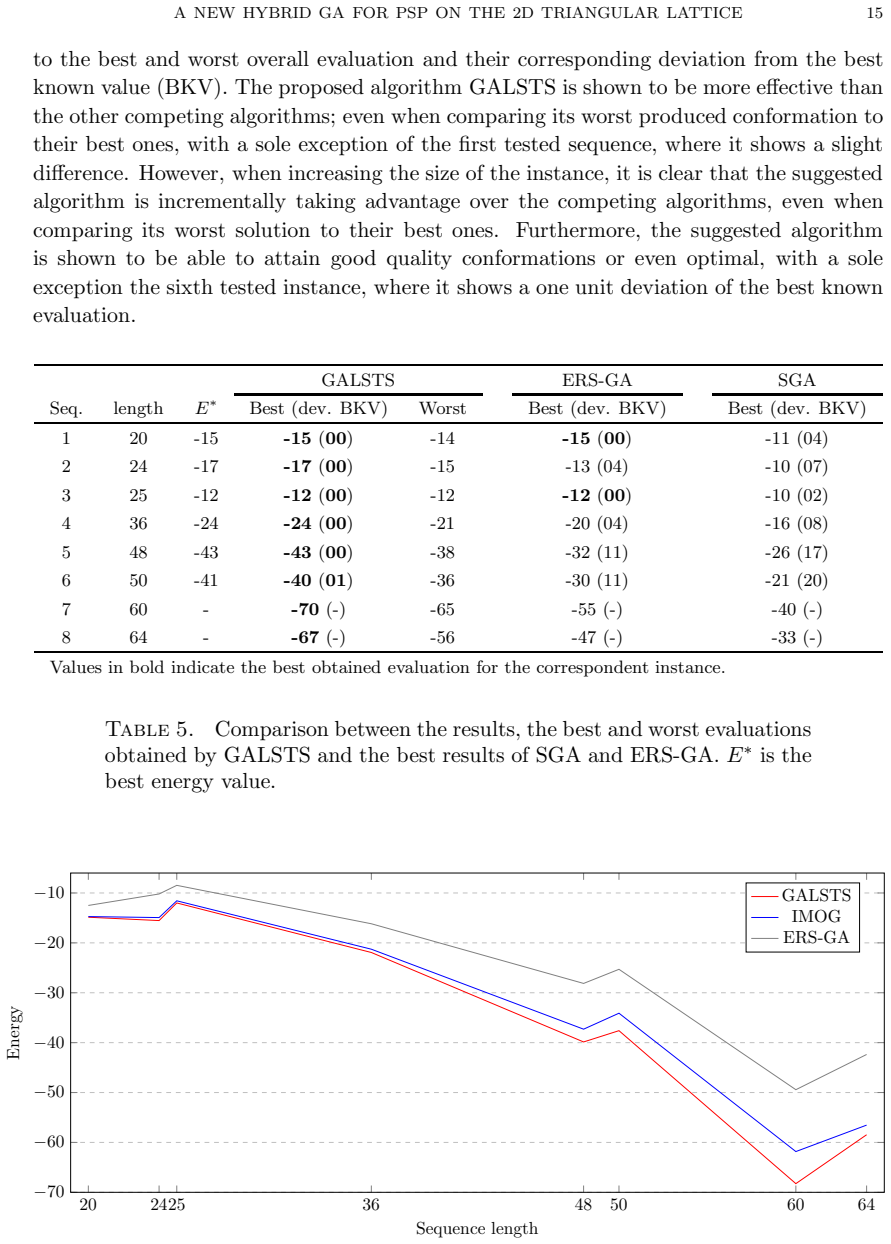
The suggested hybrid algorithm is assessed on the quality of produced solutions and compared with state-of-the-art algorithms on well-studied benchmark instances for the PSP problem.
Load-bearing premise
That the selected benchmark instances and quality criterion (solution quality) are sufficient to demonstrate the hybrid algorithm's advantage over existing methods without additional controls for runtime or parameter sensitivity.
Editorial extensions
If this is right
- The combination of the three heuristics yields conformations whose energies can be directly compared to prior results on the same instances.
- Tabu search and local search components are used to guide and refine the genetic search toward lower-energy states.
- Solution quality on the chosen benchmarks serves as the primary evidence that the hybrid approach is competitive.
Reading between the lines
- Because only solution quality is reported, it remains open whether the method scales favorably in computation time for larger sequences.
- The same hybrid structure might be applied to other lattice geometries or to the three-dimensional case without changing the core components.
- Success on the triangular lattice raises the question of whether similar hybrids would transfer to off-lattice or more detailed energy models.
Editorial analysis
A structured set of objections, weighed in public.
Referee Report
Summary. The manuscript proposes a new hybrid algorithm that combines a genetic algorithm, tabu search strategy, and local search to solve the protein structure prediction (PSP) problem on the 2D triangular lattice under the hydrophobic-polar (HP) model. It evaluates the approach via an experimental study that assesses solution quality on a selection of well-studied benchmark instances and compares results against state-of-the-art algorithms.
Significance. If the hybrid method produces measurably higher-quality folds than prior heuristics under matched computational budgets, the work would add a practical heuristic combination to the lattice PSP literature. The choice of established benchmark instances is a methodological strength that facilitates direct comparison.
major comments (2)
- [Abstract] Abstract: the central claim that the hybrid produces superior solution quality rests on an 'experimental study' and 'comparison with state-of-the-art algorithms,' yet the abstract supplies no numerical results, tables, error bars, or implementation details, leaving the claim without visible empirical grounding.
- [Experimental study] Experimental study section: solution quality is the sole reported criterion, but no information is given on whether runtimes were equalized, whether parameter budgets were matched across algorithms, or whether differences were tested for statistical significance; without these controls the observed quality edge cannot be attributed to the hybrid design rather than extra search effort.
minor comments (1)
- [Abstract] Abstract: the sentence 'The flawless functioning of a protein is essentially linked to its own three-dimensional structure' is imprecise; proteins can tolerate some structural variation while remaining functional.
Simulated Author's Rebuttal
We thank the referee for the detailed and constructive comments. We address each major comment point by point below, indicating where revisions will be made to the manuscript.
read point-by-point responses
-
Referee: [Abstract] Abstract: the central claim that the hybrid produces superior solution quality rests on an 'experimental study' and 'comparison with state-of-the-art algorithms,' yet the abstract supplies no numerical results, tables, error bars, or implementation details, leaving the claim without visible empirical grounding.
Authors: We agree that the abstract would benefit from more concrete grounding. In the revised version we will expand the abstract to report key numerical outcomes from the experimental study, including the best energies achieved on the benchmark instances and the specific improvements relative to the compared state-of-the-art algorithms. revision: yes
-
Referee: [Experimental study] Experimental study section: solution quality is the sole reported criterion, but no information is given on whether runtimes were equalized, whether parameter budgets were matched across algorithms, or whether differences were tested for statistical significance; without these controls the observed quality edge cannot be attributed to the hybrid design rather than extra search effort.
Authors: The observation is correct; the current manuscript reports only solution quality and does not explicitly document runtime equalization, matched parameter budgets, or statistical testing. We will revise the experimental section to clarify the computational budgets employed, note that comparisons followed the standard benchmark protocol used in the PSP literature, and add statistical significance analysis of the quality differences where the data permit. revision: yes
Circularity Check
No circularity: empirical evaluation on external benchmarks
full rationale
The paper proposes a hybrid GA+tabu+local-search algorithm for the PSP problem on 2D triangular lattice and evaluates it solely via empirical solution-quality comparisons against prior methods on well-studied external benchmark instances. No mathematical derivation, first-principles prediction, or parameter-fitting step is present that could reduce to its own inputs. The assessment criterion (solution quality) and the benchmark set are independent of the algorithm's internal construction, satisfying the self-contained empirical case with no load-bearing self-citation or self-definitional reduction.
Assumptions & free parameters
Cite this review
Pith. "Pith review of A new hybrid genetic algorithm for protein structure prediction on the 2D triangular lattice." pith.science (2026). https://pith.science/paper/7NCFIL4X
@misc{pith2026190704190,
  author       = {Pith},
  title        = {Pith review of: A new hybrid genetic algorithm for protein structure prediction on the 2D triangular lattice},
  year         = {2026},
  howpublished = {\url{https://pith.science/paper/7NCFIL4X}},
  note         = {Machine review of arXiv:1907.04190}
}
read the original abstract
The flawless functioning of a protein is essentially linked to its own three-dimensional structure. Therefore, the prediction of a protein structure from its amino acid sequence is a fundamental problem in many fields that draws researchers attention. This problem can be formulated as a combinatorial optimization problem based on simplified lattice models such as the hydrophobic-polar model. In this paper, we propose a new hybrid algorithm combining three different well-known heuristic algorithms: genetic algorithm, tabu search strategy and local search algorithm in order to solve the PSP problem. Regarding the assessment of suggested algorithm, an experimental study is included, where we considered the quality of the produced solution as the main quality criterion. Furthermore, we compared the suggested algorithm with state-of-the-art algorithms using a selection of well-studied benchmark instances.
Figures


Figures from the paper (6 more)




Lean theorems connected to this paper
-
IndisputableMonolith/Cost/FunctionalEquation.leanwashburn_uniqueness_aczel unclear?
unclearRelation between the paper passage and the cited Recognition theorem.
energy function E(s) = −∑ δij xij where δij=1 iff both hydrophobic and xij=1 for topological contact
-
IndisputableMonolith/Foundation/RealityFromDistinction.leanreality_from_one_distinction unclear?
unclearRelation between the paper passage and the cited Recognition theorem.
hybrid GALSTS combining GA, tabu list on crossover points, local search via random direction mutation
What do these tags mean?
- matches
- The paper's claim is directly supported by a theorem in the formal canon.
- supports
- The theorem supports part of the paper's argument, but the paper may add assumptions or extra steps.
- extends
- The paper goes beyond the formal theorem; the theorem is a base layer rather than the whole result.
- uses
- The paper appears to rely on the theorem as machinery.
- contradicts
- The paper's claim conflicts with a theorem or certificate in the canon.
- unclear
- Pith found a possible connection, but the passage is too broad, indirect, or ambiguous to say the theorem truly supports the claim.
Reference graph
Works this paper leans on
-
[1]
E., Hannenhalli, S., F arach, M., Muthukrishnan, S., and Skiena, S
Agarw ala, R., Batzoglou, S., Dan ˇcik, V., Decatur, S. E., Hannenhalli, S., F arach, M., Muthukrishnan, S., and Skiena, S. Local rules for protein folding on a triangular lattice and generalized hydrophobicity in the HP model. Journal of Computational Biology 4 , 3 (1997), 275–296
work page 1997
-
[2]
B¨ockenhauer, H.-J., Ullah, A. Z. M. D., Kapsokalivas, L., and Steinh¨ofel, K. A local move set for protein folding in triangular lattice models. I n International Workshop on Algorithms in Bioinformatics (2008), Springer, pp. 369–381
work page 2008
-
[3]
Protein folding in the hydrophobic-hydrophilic (HP) model is NP- complete
Berger, B., and Leighton, T. Protein folding in the hydrophobic-hydrophilic (HP) model is NP- complete. Journal of Computational Biology 5 , 1 (1998), 27–40
work page 1998
-
[4]
Metaheuristics in combinatorial optimization: Overview a nd conceptual comparison
Blum, C., and Roli, A. Metaheuristics in combinatorial optimization: Overview a nd conceptual comparison. ACM computing surveys (CSUR) 35 , 3 (2003), 268–308
work page 2003
-
[5]
Protein structure prediction in lattice models with partic le swarm optimization
B˘autu, A., and Luchian, H. Protein structure prediction in lattice models with partic le swarm optimization. In International Conference on Swarm Intelligence (2010), Springer, pp. 512–519
work page 2010
-
[6]
Cutello, V., Morelli, G., Nicosia, G., and P avone, M. Immune algorithms with aging op- erators for the string folding problem and the protein foldi ng problem. In European Conference on Evolutionary Computation in Combinatorial Optimization (2005), Springer, pp. 80–90
work page 2005
-
[7]
An immune algorithm for protein structure prediction on lattice models
Cutello, V., Nicosia, G., P avone, M., and Timmis, J. An immune algorithm for protein structure prediction on lattice models. IEEE transactions on evolutionary computation 11 , 1 (2007), 101–117
work page 2007
-
[8]
Folding the main chain of small proteins with the genetic alg orithm
Dandekar, T., and Argos, P. Folding the main chain of small proteins with the genetic alg orithm. Journal of Molecular Biology 236 , 3 (1994), 844–861
work page 1994
Show all 27 references
-
[9]
Dill, K. A. Theory for the folding and stability of globular proteins. Biochemistry 24 , 6 (1985), 1501–1509
1985
-
[10]
T., Chetty, M., and Dooley, L
Hoque, M. T., Chetty, M., and Dooley, L. S. A hybrid genetic algorithm for 2d FCC hydrophobic-hydrophilic lattice model to predict protein folding. In Australasian Joint Conference on Artificial Intelligence (2006), Springer, pp. 867–876
2006
-
[11]
K., and Chetty, M
Islam, M. K., and Chetty, M. Clustered memetic algorithm with local heuristics for ab in itio protein structure prediction. IEEE Transactions on Evolutionary Computation 17 , 4 (2013), 558–576
2013
-
[12]
Protein folding simulations of the hydrophobic–hydrophil ic model by combining tabu search with genetic algorithms
Jiang, T., Cui, Q., Shi, G., and Ma, S. Protein folding simulations of the hydrophobic–hydrophil ic model by combining tabu search with genetic algorithms. The Journal of chemical physics 119 , 8 (2003), 4592–4596
2003
-
[13]
Improving genetic algorithms for protein folding simulati ons by systematic crossover
K¨onig, R., and Dandekar, T. Improving genetic algorithms for protein folding simulati ons by systematic crossover. BioSystems 50 , 1 (1999), 17–25
1999
-
[14]
P., Burke, E
Krasnogor, N., Blackburne, B. P., Burke, E. K., and Hirst, J. D. Multimeme algorithms for protein structure prediction. In International Conference on Parallel Problem Solving from Nature (2002), Springer, pp. 769–778
2002
-
[15]
E., Smith, J., and Pelta, D
Krasnogor, N., Hart, W. E., Smith, J., and Pelta, D. A. Protein structure prediction with evolutionary algorithms. In Proceedings of the 1st Annual Conference on Genetic and Evol utionary Computation-Volume 2 (1999), Morgan Kaufmann Publishers Inc., pp. 1596–1601
1999
-
[16]
F., and Dill, K
Lau, K. F., and Dill, K. A. A lattice statistical mechanics model of the conformationa l and sequence spaces of proteins. Macromolecules 22, 10 (1989), 3986–3997
1989
-
[17]
An efficient hybrid Taguchi-genetic algorithm for protein fo lding simulation
Lin, C.-J., and Hsieh, M.-H. An efficient hybrid Taguchi-genetic algorithm for protein fo lding simulation. Expert systems with applications 36 , 10 (2009), 12446–12453
2009
-
[18]
A., and Krasnogor, N
Pelta, D. A., and Krasnogor, N. Multimeme algorithms using fuzzy logic based memes for prot ein structure prediction. In Recent advances in memetic algorithms . Springer, 2005, pp. 49–64
2005
-
[19]
R., Puchinger, J., and Blum, C
Raidl, G. R., Puchinger, J., and Blum, C. Metaheuristic hybrids. In Handbook of metaheuristics . Springer, 2010, pp. 469–496
2010
-
[20]
Shmygelska, A., Aguirre-Hernandez, R., and Hoos, H. H. An ant colony optimization algorithm for the 2d HP protein folding problem. In International Workshop on Ant Algorithms (2002), Springer, pp. 40–52
2002
-
[21]
Shmygelska, A., and Hoos, H. H. An improved ant colony optimisation algorithm for the 2d HP protein folding problem. In Conference of the Canadian Society for Computational Studi es of Intelligence (2003), Springer, pp. 400–417. A NEW HYBRID GA FOR PSP ON THE 2D TRIANGULAR LATTICE 19
2003
-
[22]
Shmygelska, A., and Hoos, H. H. An ant colony optimisation algorithm for the 2d and 3d hy- drophobic polar protein folding problem. BMC bioinformatics 6 , 1 (2005), 30
2005
-
[23]
An efficient hybrid of hill-climbing and genetic algorithm fo r 2d triangular protein structure prediction
Su, S.-C., Lin, C.-J., and Ting, C.-K. An efficient hybrid of hill-climbing and genetic algorithm fo r 2d triangular protein structure prediction. In 2010 IEEE International Conference on Bioinformatics and Biomedicine Workshops (BIBMW) (2010), IEEE, pp. 51–56
2010
-
[24]
Metaheuristics: from design to implementation , vol
Talbi, E.-G. Metaheuristics: from design to implementation , vol. 74. John Wiley & Sons, 2009
2009
-
[25]
Genetic algorithms for protein folding simulations
Unger, R., and Moult, J. Genetic algorithms for protein folding simulations. Journal of molecular biology 231 , 1 (1993), 75–81
1993
-
[26]
Protein folding predic- tion in the HP model using ions motion optimization with a gre edy algorithm
Yang, C.-H., Wu, K.-C., Lin, Y.-S., Chuang, L.-Y., and Chang , H.-W. Protein folding predic- tion in the HP model using ions motion optimization with a gre edy algorithm. BioData mining 11 , 1 (2018), 17
2018
-
[27]
Advances on protein folding simulations based on the lattic e HP models with natural computing
Zhao, X. Advances on protein folding simulations based on the lattic e HP models with natural computing. Applied Soft Computing 8 , 2 (2008), 1029–1040
2008
Reviewed May 25, 2026 · model on record in the stance chip above.
Discussion (0). Continue with ORCID to comment.