On the Performance of Renewable Energy-Powered UAV-Assisted Wireless Communications
Pith reviewed 2026-05-24 20:25 UTC · model grok-4.3
The pith
Statistical models of solar and wind harvesting yield closed-form outage expressions and optimization solutions for UAV-assisted wireless links.
A machine-rendered reading of the paper's core claim, the machinery that carries it, and where it could break.
Core claim
The paper establishes closed-form expressions for the PDF and CDF of harvested solar and wind power, their moment generating functions, and the moments of those powers. It applies Gil-Pelaez inversion to compute energy outage at the UAV and SNR outage at ground users, then obtains closed-form solutions for transmit power and flight time that minimize the SNR outage. Additional metrics such as battery charging probability within flight time, average charging time, and eventual energy outage probability over finite duration are also derived from the same statistical models.
What carries the argument
Moment generating functions of harvested solar and wind power together with Gil-Pelaez inversion applied to the harvest-store-consume architecture.
If this is right
- Energy and SNR outage probabilities can be evaluated in closed form for any given solar irradiance and wind-speed statistics.
- Optimal UAV transmit power and flight duration that minimize SNR outage follow directly from the derived expressions.
- Moments of harvested power supply explicit formulas for battery charging time and charging success probability.
- Eventual energy outage probability over any finite interval can be computed without Monte-Carlo simulation.
Where Pith is reading between the lines
- The same MGF framework could be reused to incorporate additional renewable sources such as vibration or thermal harvesting.
- The closed-form outage expressions enable rapid sensitivity analysis of network coverage to seasonal weather statistics.
- Embedding the derived charging-time metric into trajectory planners could reduce the frequency of forced landings.
- The optimization solutions suggest that hybrid solar-wind UAVs may sustain longer continuous service than single-source designs under the same average power.
Load-bearing premise
The chosen statistical distributions for solar irradiance, wind speed, and UAV energy consumption accurately capture real variability without significant unmodeled losses or hardware constraints.
What would settle it
Comparison of the derived PDF of harvested power and the resulting energy-outage probability against direct long-term measurements from a UAV operating under measured solar and wind conditions.
Figures


read the original abstract
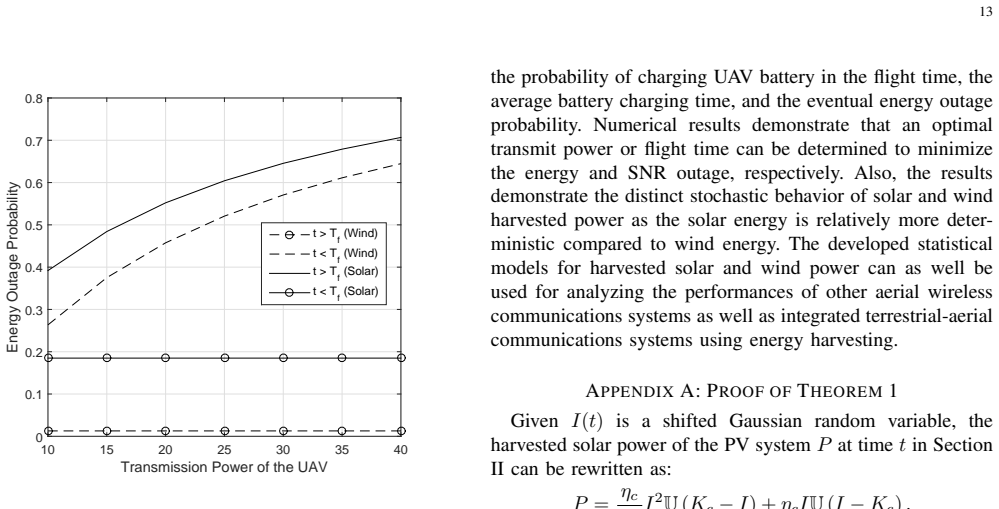
We develop novel statistical models of the harvested energy from renewable energy sources (such as solar and wind energy) considering harvest-store-consume (HSC) architecture. We consider three renewable energy harvesting scenarios, i.e. (i) harvesting from the solar power, (ii) harvesting from the wind power, and (iii) hybrid solar and wind power. In this context, we first derive the closed-form expressions for the probability density function (PDF) and cumulative density function (CDF) of the harvested power from the solar and wind energy sources. Based on the derived expressions, we calculate the probability of energy outage at UAVs and signal-to-noise ratio (SNR) outage at ground cellular users. We derive novel closed-form expressions for the moment generating function (MGF) of the harvested solar power and wind power. Then, we apply Gil-Pelaez inversion to evaluate the energy outage at the UAV and signal-to-noise-ratio (SNR) outage at the ground users. We formulate the SNR outage minimization problem and obtain closed-form solutions for the transmit power and flight time of the UAV. In addition, we derive novel closed-form expressions for the moments of the solar power and wind power and demonstrate their applications in computing novel performance metrics considering the stochastic nature of the amount of harvested energy as well as energy arrival time. These performance metrics include the probability of charging the UAV battery within the flight time, average UAV battery charging time, probability of energy outage at UAVs, and the probability of eventual energy outage (i.e. the probability of energy outage in a finite duration of time) at UAVs.
Editorial analysis
A structured set of objections, weighed in public.
Referee Report
Summary. The paper develops statistical models for harvested energy from solar, wind, and hybrid sources under a harvest-store-consume architecture for UAV-assisted wireless communications. It derives closed-form PDF and CDF expressions for the harvested power, novel MGF expressions, applies Gil-Pelaez inversion to obtain energy outage at the UAV and SNR outage at ground users, formulates and solves an SNR outage minimization problem yielding closed-form solutions for UAV transmit power and flight time, and derives moments of the harvested power to evaluate metrics including battery charging probability within flight time, average charging time, and probabilities of energy outage and eventual energy outage.
Significance. If the derivations hold, the closed-form expressions and optimization solutions provide useful analytical tools for performance evaluation and design in renewable-energy UAV systems, explicitly accounting for stochastic energy arrival. The application of standard MGF and inversion techniques to the HSC model, combined with the optimization results, represents a solid contribution to energy-harvesting wireless networks.
minor comments (2)
- The abstract and introduction would benefit from explicit statements of the underlying channel model (e.g., path-loss exponent, fading distribution) used when deriving the SNR outage expressions, as this is central to interpreting the closed-form solutions.
- Notation for the random variables representing harvested solar and wind power (and their hybrid combination) should be introduced consistently and early to avoid ambiguity when moving between PDF/CDF, MGF, and moment derivations.
Simulated Author's Rebuttal
We thank the referee for the positive review, accurate summary of our contributions on statistical modeling of renewable energy harvesting under the HSC architecture, and recommendation for minor revision. No specific major comments were raised.
Circularity Check
No significant circularity identified
full rationale
The paper's derivation chain consists of standard statistical modeling steps: deriving closed-form PDF and CDF expressions for harvested solar/wind power under the HSC architecture from assumed distributions, computing the MGF from those expressions, applying the Gil-Pelaez inversion theorem to obtain outage probabilities, and solving the resulting SNR outage minimization problem to yield closed-form expressions for transmit power and flight time. These steps are mathematically independent and do not reduce to fitted parameters, self-definitions, or self-citation chains; the models are taken as inputs and the outputs follow directly from them without circular equivalence. No load-bearing uniqueness theorems or ansatzes imported via self-citation are present.
Axiom & Free-Parameter Ledger
axioms (1)
- standard math Standard mathematical techniques such as deriving PDFs/CDFs from energy models and applying Gil-Pelaez inversion for outage probabilities hold without additional constraints.
Reference graph
Works this paper leans on
-
[1]
Drone small cells in the clouds: Design, deployment and performance analysis,
M. Mozaffari, W. Saad, M. Bennis, and M. Debbah, “Drone small cells in the clouds: Design, deployment and performance analysis,” IEEE Global Communications Conference (GLOBECOM), San Diego, CA, pp. 1–6, 2015
work page 2015
-
[2]
Wireless communications with unmanned aerial vehicles: opportunities and challenges,
Y . Zeng, R. Zhang, and T. J. Lim, “Wireless communications with unmanned aerial vehicles: opportunities and challenges,” IEEE Com- munications Magazine, vol. 54, no. 5, pp. 36–42, May 2016
work page 2016
-
[3]
Advances in energy harvesting communications: Past, present, and future challenges,
M. Ku, W. Li, Y . Chen, and K. J. Ray Liu, “Advances in energy harvesting communications: Past, present, and future challenges,” IEEE Communications Surveys & Tutorials , vol. 18, no. 2, pp. 1384–1412, 2016
work page 2016
-
[4]
Optimal trans- port theory for power-efficient deployment of unmanned aerial vehi- cles,
M. Mozaffari, W. Saad, M. Bennis, and M. Debbah, “Optimal trans- port theory for power-efficient deployment of unmanned aerial vehi- cles,” IEEE International Conference on Communications (ICC), Kuala Lumpur, pp. 1–6, 2016
work page 2016
-
[5]
Mobile internet of things: Can UA Vs provide an energy- efficient mobile architecture?
——, “Mobile internet of things: Can UA Vs provide an energy- efficient mobile architecture?” IEEE Global Communications Confer- ence (GLOBECOM), pp. 1–6, Dec. 2016
work page 2016
-
[6]
M. Alzenad, A. El-Keyi, F. Lagum, and H. Yanikomeroglu, “3-d place- ment of an unmanned aerial vehicle base station (uav-bs) for energy- efficient maximal coverage,” IEEE Wireless Communications Letters , vol. 6, no. 4, pp. 434–437, 2017
work page 2017
-
[7]
Energy-efficient multi-uav coverage deployment in uav net- works: A game-theoretic framework,
L. Ruan, J. Wang, J. Chen, Y . Xu, Y . Yang, H. Jiang, Y . Zhang, and Y . Xu, “Energy-efficient multi-uav coverage deployment in uav net- works: A game-theoretic framework,” China Communications, vol. 15, no. 10, pp. 194–209, Oct 2018
work page 2018
-
[8]
Energy neutral internet of drones,
T. Long, M. Ozger, O. Cetinkaya, and O. B. Akan, “Energy neutral internet of drones,” IEEE Communications Magazine , vol. 56, no. 1, pp. 22–28, 2018
work page 2018
-
[9]
Y . Dong, J. Cheng, M. J. Hossain, and V . C. M. Leung, “Extracting the most weighted throughput in uav empowered wireless systems with non- linear energy harvester,” 29th Biennial Symposium on Communications (BSC), pp. 1–5, June 2018
work page 2018
-
[10]
Outage performance of uav-assisted relaying systems with rf energy harvesting,
L. Yang, J. Chen, M. O. Hasna, and H. Yang, “Outage performance of uav-assisted relaying systems with rf energy harvesting,” IEEE Communications Letters, vol. 22, no. 12, pp. 2471–2474, Dec 2018
work page 2018
-
[11]
H. Wang, J. Wang, G. Ding, L. Wang, T. A. Tsiftsis, and P. K. Sharma, “Resource allocation for energy harvesting-powered d2d communica- tion underlaying uav-assisted networks,” IEEE Transactions on Green Communications and Networking, vol. 2, no. 1, pp. 14–24, March 2018
work page 2018
-
[12]
Uav-enabled wireless power trans- fer: Trajectory design and energy region characterization,
J. Xu, Y . Zeng, and R. Zhang, “Uav-enabled wireless power trans- fer: Trajectory design and energy region characterization,” 2017 IEEE Globecom Workshops (GC Wkshps) , pp. 1–7, Dec 2017
work page 2017
-
[13]
Uav-enabled multiuser wireless power transfer: Trajectory design and energy optimization,
——, “Uav-enabled multiuser wireless power transfer: Trajectory design and energy optimization,” pp. 1–6, Dec 2017
work page 2017
-
[14]
Optimal 3d-trajectory design and resource allocation for solar-powered uav communication systems,
Y . Sun, D. Xu, D. W. K. Ng, L. Dai, and R. Schober, “Optimal 3d-trajectory design and resource allocation for solar-powered uav communication systems,” IEEE Transactions on Communications , pp. 1–1, 2019
work page 2019
-
[15]
Spatial and temporal management of cellular hetnets with multiple solar powered drones,
A. Alsharoa, H. Ghazzai, A. Kadri, and A. E. Kamal, “Spatial and temporal management of cellular hetnets with multiple solar powered drones,” IEEE Transactions on Mobile Computing , pp. 1–1, 2019
work page 2019
-
[16]
Energy Management in Cellular HetNets Assisted by Solar Powered Drone Small Cells,
Alsharoa, H. Ghazzai, A. Kadri and A. E. Kamal, “Energy Management in Cellular HetNets Assisted by Solar Powered Drone Small Cells,” IEEE Wireless Communications and Networking Conference (WCNC), San Francisco, CA , 2017
work page 2017
-
[17]
Harvesting solar energy for limited-energy problem in wireless sensor networks,
S. Kosunalp and A. Cihan, “Harvesting solar energy for limited-energy problem in wireless sensor networks,” 2017 25th Signal Processing and Communications Applications Conference (SIU) , pp. 1–4, May 2018
work page 2017
-
[18]
Combining solar energy harvesting with wireless charging for hybrid wireless sensor networks,
C. Wang, J. Li, Y . Yang, and F. Ye, “Combining solar energy harvesting with wireless charging for hybrid wireless sensor networks,” IEEE Transactions on Mobile Computing , vol. 17, no. 3, pp. 560–576, March 2017
work page 2017
-
[19]
Solar harvested energy prediction algorithm for wireless sensors,
M. Hassan and A. Bermak, “Solar harvested energy prediction algorithm for wireless sensors,” 2012 4th Asia Symposium on Quality Electronic Design (ASQED), pp. 178–181, July 2012
work page 2012
-
[20]
Table of Integrals, Series, and Products, seventh edition,
I.S. Gradshteyn and I.M. Ryzhik, “Table of Integrals, Series, and Products, seventh edition,” Academic Press, 1943
work page 1943
-
[21]
Modeling air-to-ground path loss for low altitude platforms in urban environments,
A. Hourani, S. Kandeepan, and A. Jamalipour, “Modeling air-to-ground path loss for low altitude platforms in urban environments,”IEEE Global Telecommunications Conference, , Austin, Tx, USA , Dec. 2014
work page 2014
-
[22]
Optimal LAP altitude for maximum coverage,
A. Al-Hourani, S. Kandeepan, and S. Lardner, “Optimal LAP altitude for maximum coverage,” IEEE Wireless Communications Letters, vol. 3, no. 6, pp. 569–572, Dec. 2014
work page 2014
-
[23]
“ ITU-R Rec. P.1410-2 Propagation Data and Prediction Methods for The Design of Terrestrial Broadband Millimetric Aadio Access Systems,” P Series, Radiowave propagation , 2003
work page 2003
-
[24]
Efficient 3-D Placement of an Aerial Base Station in Next Generation Cellular Networks
R. I. Bor-Yaliniz, A. El-Keyi, and H. Yanikomeroglu, “Efficient 3-d placement of an aerial base station in next generation cellular networks,” IEEE International Conference on communications (ICC), [Online]. Available: https://arxiv.org/abs/1603.00300, May. 2016
work page internal anchor Pith review Pith/arXiv arXiv 2016
-
[25]
Unmanned aerial vehicle with underlaid device-to-device communications: Performance and tradeoffs,
M. Mozaffari, W. Saad, M. Bennis, and M. Debbah, “Unmanned aerial vehicle with underlaid device-to-device communications: Performance and tradeoffs,” IEEE Transactions on Wireless Communications, vol. 15, no. 6, pp. 3949–3963, June 2016
work page 2016
-
[26]
Reliability evaluation of distribution system containing microgrid,
Liang, Huishi and Su, Jian and Liu, Sige, “Reliability evaluation of distribution system containing microgrid,” Electricity Distribution (CICED), China International Conference , pp. 1–7, 2010
work page 2010
-
[27]
Reliability evaluation of distribution system containing microgrid,
H. Liang, J. Su, and S. Liu, “Reliability evaluation of distribution system containing microgrid,” CICED 2010 Proceedings , pp. 1–7, Sep
work page 2010
-
[28]
Available online: https://www.raeng.org.uk/publications/other/23-wind- turbine
“Available online: https://www.raeng.org.uk/publications/other/23-wind- turbine.”
-
[29]
Energy-efficient management of unmanned aerial vehicles for underlay cognitive radio systems,
H. Ghazzai, M. Ben Ghorbel, A. Kadri, M. J. Hossain, and H. Menouar, “Energy-efficient management of unmanned aerial vehicles for underlay cognitive radio systems,” IEEE Transactions on Green Communications and Networking, vol. 1, no. 4, pp. 434–443, Dec 2017
work page 2017
-
[30]
Downlink coverage analysis for a finite 3-d wireless network of unmanned aerial vehicles,
V . V . Chetlur and H. S. Dhillon, “Downlink coverage analysis for a finite 3-d wireless network of unmanned aerial vehicles,” IEEE Transactions on Communications, vol. 65, no. 10, pp. 4543–4558, Oct 2017
work page 2017
-
[31]
Self-sustainability of energy harvesting systems: Concept, analysis, and design,
S. Guruacharya and E. Hossain, “Self-sustainability of energy harvesting systems: Concept, analysis, and design,” IEEE Transactions on Green Communications and Networking , vol. 2, no. 1, pp. 175–192, March 2018
work page 2018
discussion (0)
Sign in with ORCID, Apple, or X to comment. Anyone can read and Pith papers without signing in.