Extra dimensions' influence on the equilibrium and radial stability of strange quark stars
Pith reviewed 2026-05-24 20:13 UTC · model grok-4.3
The pith
Strange quark stars gain more radial stability as spacetime dimensions increase for fixed normalized mass and density ranges.
A machine-rendered reading of the paper's core claim, the machinery that carries it, and where it could break.
Core claim
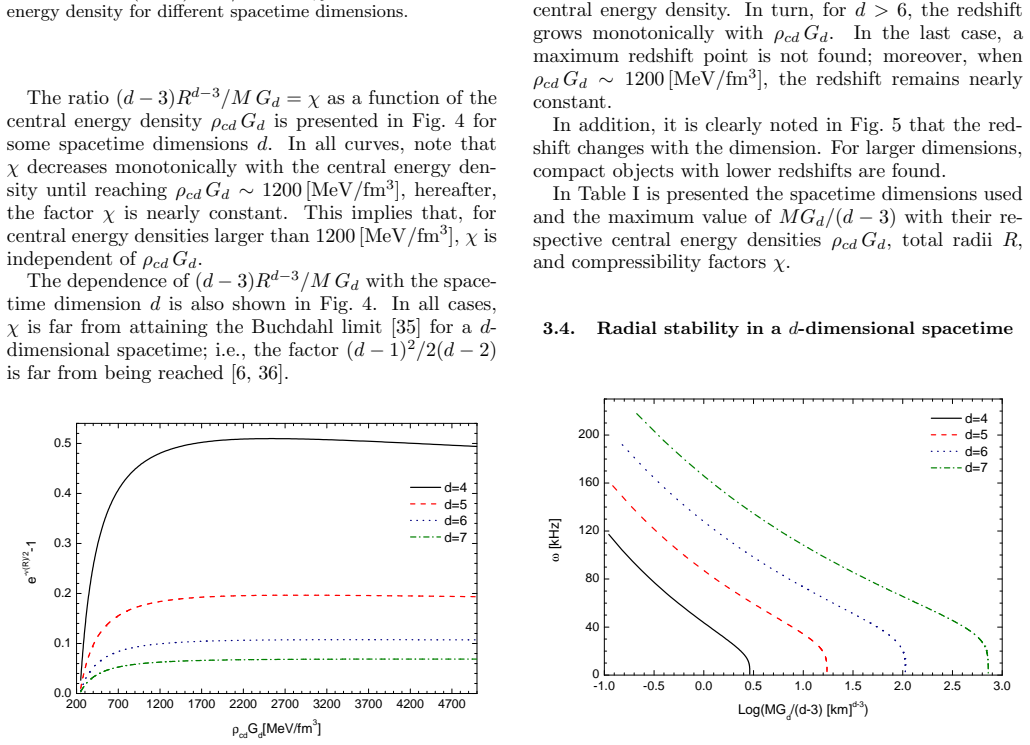
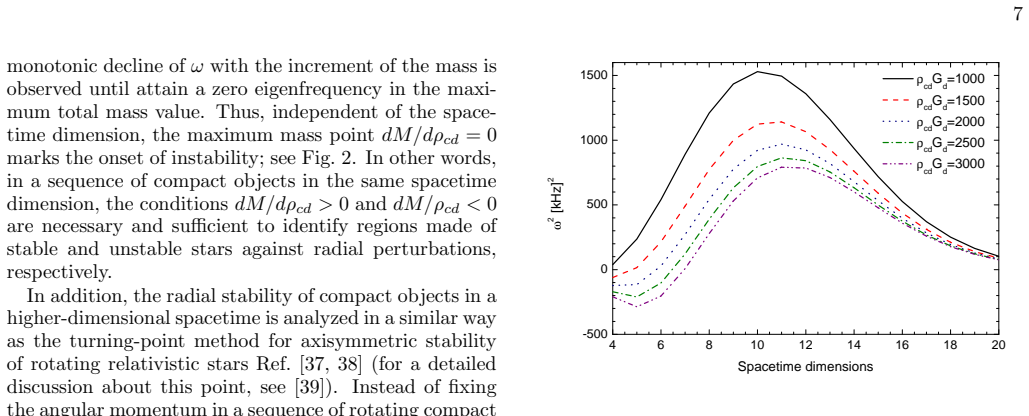
For an interval of central energy densities ρ_cd G_d and total masses M G_d/(d-3), the stars gain more stability when the dimension is increased. The maximum value of M G_d/(d-3) and the zero eigenfrequency of oscillation are found with the same value of ρ_cd G_d; the peak value of M G_d/(d-3) marks the onset of instability. This indicates that the necessary and sufficient conditions to recognize regions constructed by stable and unstable equilibrium configurations against radial perturbations are, respectively, dM/dρ_cd>0 and dM/dρ_cd<0. Some physical parameters of the compact object depend on the normalization. Within the Newtonian framework, compact objects with adiabatic index Γ1 ≥ 2(d-2
What carries the argument
d-dimensional stellar structure and radial perturbation equations integrated with the MIT bag model equation of state and Schwarzschild-Tangherlini exterior metric.
If this is right
- The turning-point criterion dM/dρ_cd >0 for stability remains valid for all d greater than or equal to 4.
- Stable configurations exist at higher values of the normalized mass M G_d/(d-3) when d is increased.
- The Newtonian stability bound on the adiabatic index rises with dimension as 2(d-2)/(d-1).
- Both radius and total mass of equilibrium models depend on the normalization chosen for G_d and other constants.
Where Pith is reading between the lines
- If the normalization dependence persists in other equations of state, direct comparison of masses across dimensions would require a consistent choice of units before observational constraints on extra dimensions can be drawn.
- The result suggests that searches for stable compact objects above the four-dimensional maximum mass could be reinterpreted as possible signatures of higher-dimensional effects rather than new physics in four dimensions.
- The same numerical setup could be applied to rotating or magnetized models to test whether the dimension dependence of the stability boundary survives those extensions.
Load-bearing premise
The MIT bag equation of state retains its functional form when extended to d greater than or equal to 4 and the exterior geometry is exactly the Schwarzschild-Tangherlini metric for every d.
What would settle it
A numerical integration showing that the fundamental radial frequency does not reach zero at the central density where M G_d/(d-3) reaches its maximum would falsify the claimed coincidence of turning point and stability boundary.
Figures


read the original abstract
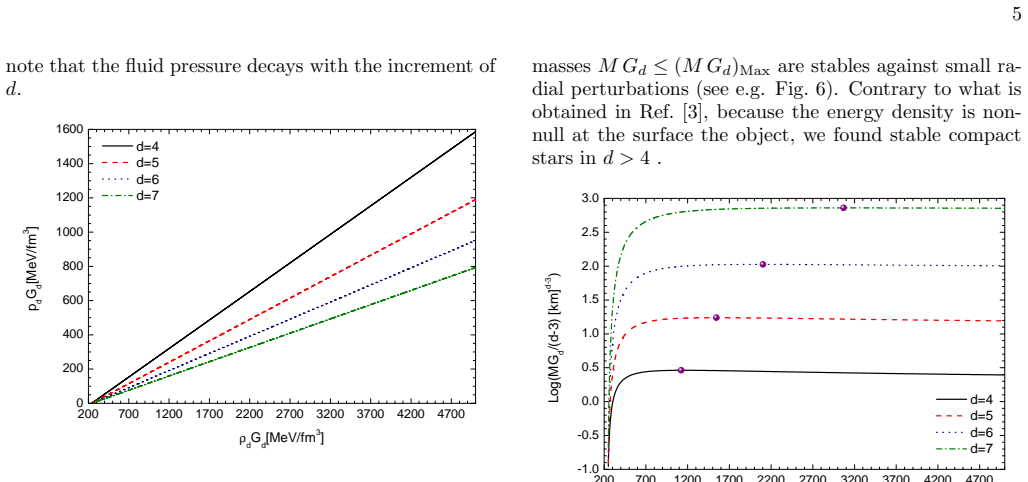
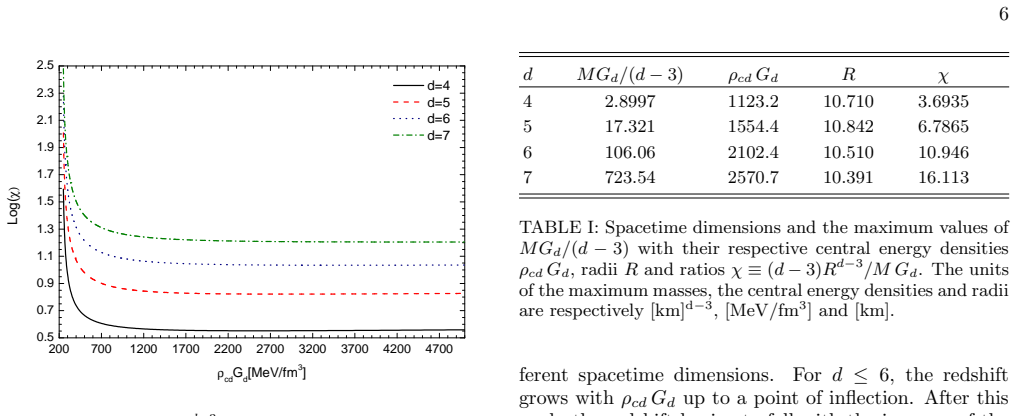
We analyze the influence of extra dimensions on the static equilibrium configurations and stability against radial perturbations. For this purpose, we solve stellar structure equations and radial perturbation equations, both modified for a $d$-dimensional spacetime ($d\geq4$) considering that spacetime outside the object is described by a Schwarzschild-Tangherlini metric. These equations are integrated considering a MIT bag model equation of state extended for $d\geq4$. We show that the spacetime dimension influences both the structure and stability of compact objects. For an interval of central energy densities $\rho_{cd}\,G_d$ and total masses $MG_d/(d-3)$, we show that the stars gain more stability when the dimension is increased. In addition, the maximum value of $M{G_d}/(d-3)$ and the zero eigenfrequency of oscillation are found with the same value of $\rho_{cd}\,G_d$; i.e., the peak value of $M{G_d}/(d-3)$ marks the onset of instability. This indicates that the necessary and sufficient conditions to recognize regions constructed by stable and unstable equilibrium configurations against radial perturbations are, respectively, $dM/d\rho_{cd}>0$ and $dM/d\rho_{cd}<0$. We obtain that some physical parameter of the compact object in a $d$-dimensional spacetime, such as the radius and the mass, depend of the normalization. Finally, within the Newtonian framework, the results show that compact objects with adiabatic index $\Gamma_1\geq2(d-2)/(d-1)$ are stable against small radial perturbations.
Editorial analysis
A structured set of objections, weighed in public.
Referee Report
Summary. The paper solves the d-dimensional stellar structure equations and radial perturbation equations for strange quark stars with an extended MIT bag EOS P=(ρ-4B)/3, assuming a Schwarzschild-Tangherlini exterior metric. It reports that, in normalized variables ρ_cd G_d and M G_d/(d-3), the range of stable configurations widens with increasing d, that the maximum mass coincides with the zero-eigenfrequency point, and that dM/dρ_cd>0 (respectively <0) is necessary and sufficient for stability against radial perturbations. A separate Newtonian analysis yields a d-dependent adiabatic-index stability bound.
Significance. If the EOS extension and metric assumptions are valid, the work supplies a concrete extension of the turning-point criterion to d>4 and quantifies how dimensionality enlarges the stable domain in normalized mass-central-density space. The independent integration of the perturbation equations (rather than assuming the turning-point result a priori) is a methodological strength that allows the coincidence of mass maximum and zero frequency to be an output.
major comments (3)
- [stellar structure equations / EOS paragraph] Section on stellar structure equations and the paragraph introducing the EOS: the MIT bag model is extended to d≥4 by retaining the identical linear form P=(ρ-4B)/3 without d-dependent corrections arising from higher-dimensional Fermi-gas thermodynamics or bag energy density. Because the reported gain in stability interval with d and the location of the mass peak rest directly on the slope and adiabatic index implied by this EOS, any d-dependent modification would shift both the turning-point location and the eigenfrequency zero-crossing, undermining the central claim.
- [results / normalization discussion] Results section (normalized quantities): the stability conclusions are presented in terms of ρ_cd G_d and M G_d/(d-3), yet the manuscript states that radius and mass themselves depend on the choice of normalization. It is not shown whether the reported widening of the stable interval with d survives a change in normalization convention or is an artifact of the particular scaling adopted.
- [Newtonian framework paragraph] Newtonian framework paragraph: the derived bound Γ_1 ≥ 2(d-2)/(d-1) is stated without explicit derivation or connection to the relativistic eigenfrequency calculation; for d=4 it recovers the familiar Γ_1≥4/3, but the consistency of this Newtonian limit with the relativistic d-dimensional perturbation equations is not demonstrated.
minor comments (2)
- [stellar structure equations] Notation for the gravitational constant is written G_d; its explicit d-dependence and relation to the usual 4D G should be stated once in the stellar-structure section.
- [abstract / stability discussion] The abstract claims the turning-point criterion is 'necessary and sufficient'; the text shows only that the two diagnostics coincide numerically, which is weaker than a general proof.
Simulated Author's Rebuttal
We thank the referee for the careful reading and constructive comments. We address each major comment below and indicate where revisions will be made.
read point-by-point responses
-
Referee: Section on stellar structure equations and the paragraph introducing the EOS: the MIT bag model is extended to d≥4 by retaining the identical linear form P=(ρ-4B)/3 without d-dependent corrections arising from higher-dimensional Fermi-gas thermodynamics or bag energy density. Because the reported gain in stability interval with d and the location of the mass peak rest directly on the slope and adiabatic index implied by this EOS, any d-dependent modification would shift both the turning-point location and the eigenfrequency zero-crossing, undermining the central claim.
Authors: We agree that the MIT bag EOS is extended phenomenologically by retaining P=(ρ-4B)/3 without incorporating d-dependent corrections from higher-dimensional Fermi-gas thermodynamics. This choice isolates the geometric effects of extra dimensions on equilibrium and stability while treating the EOS as an effective model. The reported trends hold specifically for this EOS; we will add an explicit statement of this assumption and its implications in the revised manuscript. revision: partial
-
Referee: Results section (normalized quantities): the stability conclusions are presented in terms of ρ_cd G_d and M G_d/(d-3), yet the manuscript states that radius and mass themselves depend on the choice of normalization. It is not shown whether the reported widening of the stable interval with d survives a change in normalization convention or is an artifact of the particular scaling adopted.
Authors: The normalization ρ_cd G_d and M G_d/(d-3) is the natural one arising from the d-dimensional Einstein equations and the Schwarzschild-Tangherlini metric, where the mass parameter scales as G_d M/(d-3). The manuscript already notes that physical parameters such as radius and mass depend on normalization. The widening of the stable interval with d originates from the explicit d-dependence in the hydrostatic equilibrium and perturbation equations; we will add a short discussion confirming that the qualitative trend persists under alternative scalings. revision: yes
-
Referee: Newtonian framework paragraph: the derived bound Γ_1 ≥ 2(d-2)/(d-1) is stated without explicit derivation or connection to the relativistic eigenfrequency calculation; for d=4 it recovers the familiar Γ_1≥4/3, but the consistency of this Newtonian limit with the relativistic d-dimensional perturbation equations is not demonstrated.
Authors: We will include an explicit derivation of the Newtonian bound Γ_1 ≥ 2(d-2)/(d-1) in an appendix of the revised manuscript, obtained from the d-dimensional Newtonian hydrostatic equilibrium and the condition for marginal stability against radial perturbations. We will also note its consistency with the relativistic d-dimensional equations, recovering the standard Γ_1 ≥ 4/3 result for d=4. revision: yes
Circularity Check
No significant circularity in derivation chain
full rationale
The paper numerically integrates the d-dimensional hydrostatic equilibrium and radial perturbation equations using the MIT bag EOS extended by direct substitution of the same linear form. The reported coincidence between the maximum of M G_d/(d-3) and the zero eigenfrequency is an output of that independent integration, not an input definition or fitted parameter renamed as a prediction. The turning-point criterion (dM/dρ_cd >0 for stability) is verified rather than presupposed. No self-citation load-bearing steps, ansatz smuggling, or self-definitional reductions appear in the derivation. The result is self-contained against the solved differential equations.
Axiom & Free-Parameter Ledger
axioms (2)
- domain assumption Exterior spacetime is described by the Schwarzschild-Tangherlini metric for d≥4
- domain assumption MIT bag model equation of state extends to d-dimensional spacetime with the same functional form
Lean theorems connected to this paper
-
IndisputableMonolith/Foundation/AlexanderDuality.leanalexander_duality_circle_linking contradicts?
contradictsCONTRADICTS: the theorem conflicts with this paper passage, or marks a claim that would need revision before publication.
We solve stellar structure equations and radial perturbation equations, both modified for a d-dimensional spacetime (d≥4) considering that spacetime outside the object is described by a Schwarzschild-Tangherlini metric. These equations are integrated considering a MIT bag model equation of state extended for d≥4.
-
IndisputableMonolith/Foundation/AlexanderDuality.leanSphereAdmitsCircleLinking D ↔ D = 3 contradicts?
contradictsCONTRADICTS: the theorem conflicts with this paper passage, or marks a claim that would need revision before publication.
For an interval of central energy densities ρ_cd G_d and total masses M G_d/(d-3), the stars gain more stability when the dimension is increased.
What do these tags mean?
- matches
- The paper's claim is directly supported by a theorem in the formal canon.
- supports
- The theorem supports part of the paper's argument, but the paper may add assumptions or extra steps.
- extends
- The paper goes beyond the formal theorem; the theorem is a base layer rather than the whole result.
- uses
- The paper appears to rely on the theorem as machinery.
- contradicts
- The paper's claim conflicts with a theorem or certificate in the canon.
- unclear
- Pith found a possible connection, but the passage is too broad, indirect, or ambiguous to say the theorem truly supports the claim.
Reference graph
Works this paper leans on
-
[1]
Extra dimensions' influence on the equilibrium and radial stability of strange quark stars
INTRODUCTION In recent decades, as a direct consequence of Kaluza- Klein theory [1, 2] and some other theory on supergravity, the idea that spacetime may have extra dimensions, as yet undetected by experiment, has become accepted. Mo- tivated by this idea, the implications of the extra dimen- sions on some physical phenomena arising in the study of compac...
work page internal anchor Pith review Pith/arXiv arXiv 1907
-
[2]
GENERAL RELATIVISTIC FORMULATION IN d DIMENSIONS 2.1. Einstein field equation The properties of compact objects in higher dimensions are analyzed as a description of the Einstein equation in d dimensions,d≥ 4. For that purpose, the field equation in d spacetime dimensions is assumed to be of the form [18] Gµν = d− 2 d− 3Sd−2GdTµν, (1) with Gµν =Rµν− 1 2gµνR...
-
[3]
= 1. On the other hand, the object’s surface ( r =R) is attained when pdGd→ 0 and, consequently, (∆pdGd)surface = 0. (23) 2.5. Equation of state For the strange quark matter contained in the object, we consider the pressure pd and energy density ρd are connected through a generalization of the MIT bag model EOS in d-dimensions: pd = 1 d− 1 (ρd−dBd), (24) ...
-
[4]
INFLUENCE OF THE DIMENSION IN THE EQUILIBRIUM AND STABILITY OF COMPACT OBJECTS 3.1. Numerical method To investigate the extra dimensions influence on the static equilibrium configurations and radial stability, the stellar structure and radial oscillation equations are, re- spectively, resolved. These equations are integrated from the center toward the surfa...
work page 2001
-
[5]
CONCLUSIONS The influence of the spacetime dimension in the equi- librium and radial stability of compact objects is inves- tigated in this work. To this aim, the stellar structure equations and the Chandrasekhar radial pulsation equa- tion are modified to include the extra dimensions ef- fects. Moreover, it a linear relation between the pres- sure and ener...
work page 2013
-
[6]
JDVA thanks Vilson T. Zanchin for the en- riching discussions about the influence of higher di- mensions in the configuration of some compact ob- jects. GAC and RVL thank Coordena¸ c˜ ao de Aper- fei¸ coamento de Pessoal de N´ ıvel Superior-CAPES for the Grants No. CAPES/PDSE/88881 .188302/2018− 01 and CAPES/PDSE/88881.134089/2016− 01, respec- tively. RVL a...
-
[7]
On the unification problem in physics
T. Kaluza, “On the unification problem in physics”, Int. J. Mode. Phys. D 27 1870001 (2018)
work page 2018
-
[8]
Quantum theory and five-dimensional theory of relativity
O. Klein, “Quantum theory and five-dimensional theory of relativity”, Zeitschrift f¨ ur Physik37 895 (1926)
work page 1926
-
[9]
White dwarf stars in D dimen- sions
P.-H. Chavanis, “White dwarf stars in D dimen- sions”, Phys. Rev. D 76, 023004 (2007); arXiv:astro- ph/0604012
-
[10]
On the fate of stars in high spatial dimensions
J. Bechhoefer and G. Chabrier, “On the fate of stars in high spatial dimensions”, Am. J. Phys. 61, 460 (1993)
work page 1993
-
[11]
Anisotropic charged fluid spheres in D space-time dimensions
T. Harko and M. Mak, “Anisotropic charged fluid spheres in D space-time dimensions”, J. Math. Phys. 41, 4752 (2000)
work page 2000
-
[12]
J. Ponce de Leon and N. Cruz, “Hydrostatic Equilib- rium of a Perfect Fluid Sphere with Exterior Higher- Dimensional Schwarzschild Spacetime”, Gen. Relativ. Gravit. 32, 1207 (2000); arXiv:gr-qc/0207050
work page internal anchor Pith review Pith/arXiv arXiv 2000
-
[13]
Higher dimensional inhomogeneous dust collapse and cosmic censorship
S. G. Ghosh and A. Beesham, “Higher dimensional inho- mogeneous dust collapse and cosmic censorship”, Phys. Rev. D 64, 124005 (2001); arXiv:gr-qc/0108011
work page internal anchor Pith review Pith/arXiv arXiv 2001
-
[14]
Naked singularities in higher dimensional inhomogeneous dust collapse
S. G. Ghosh and A. Beesham, “Naked singularities in higher dimensional inhomogeneous dust collapse”, Class. Quant. Grav. 17, 4959 (2000); arXiv:gr-qc/0003109
work page internal anchor Pith review Pith/arXiv arXiv 2000
-
[15]
On naked singularities in higher dimensional Vaidya space-times
S. G. Ghosh and N. Dadhich, “Naked singularities in higher dimensional Vaidya space-times”, Phys. Rev. D 64, 047501 (2001); arXiv:gr-qc/0105085
work page internal anchor Pith review Pith/arXiv arXiv 2001
-
[16]
Black Holes in Higher Di- mensional Space-Times
R. C. Myers and M. J. Perry, “Black Holes in Higher Di- mensional Space-Times”, Annals Phys. 172, 304 (1986)
work page 1986
-
[17]
Black Holes in Higher Dimensions
R. Emparan and H. S. Reall, “Black Holes in Higher Dimensions”, Living Rev. Relativity 11, 6 (2008); arXiv:0801.3471 [hep-th]
work page internal anchor Pith review Pith/arXiv arXiv 2008
-
[18]
Uniqueness and non-uniqueness of static black holes in higher dimensions
G. W. Gibbons, D. Ida and T. Shiromizu, “Unique- ness and Nonuniqueness of Static Black Holes in Higher Dimensions”, Phys. Rev. Lett. 89, 041101 (2002); [arXiv:hep-th/0206049]
work page internal anchor Pith review Pith/arXiv arXiv 2002
-
[19]
The highly collapsed configurations of a stellar mass (second paper)
S. Chandrasekhar, “The highly collapsed configurations of a stellar mass (second paper)”, Mon. Not. R. Astron. Soc. 95, 207 (1935)
work page 1935
-
[20]
Static solution of Einstein’s field equation for spheres of fluid
R. C. Tolman, “Static solution of Einstein’s field equation for spheres of fluid”, Phys. Rev. D 55, 364 (1939)
work page 1939
-
[21]
J. R. Oppenheimer and G. Volkoff, “On massive neutron cores”, Phys. Rev. D 55, 374 (1939)
work page 1939
-
[22]
S. Chandrasekhar, “The dynamical instability of gaseous masses approaching the Schwarzschild limit in general relativity”, Astrophys. J. 140, 417 (1964)
work page 1964
-
[23]
Dynamical instability of gaseous masses approaching the Schwarzschild limit in general relativity
S. Chandrasekhar, “Dynamical instability of gaseous masses approaching the Schwarzschild limit in general relativity”, Phys. Rev. Lett. 12, 114 (1964)
work page 1964
-
[24]
Bonnor stars in d spacetime dimensions
J. P. S. Lemos and V. T. Zanchin, “Bonnor stars in d spacetime dimensions”, Phys. Rev. D 77, 064003 (2008); arXiv:0802.0530 [gr-qc]
work page internal anchor Pith review Pith/arXiv arXiv 2008
-
[25]
J. P. S. Lemos and V. T. Zanchin, “Electrically charged fluids with pressure in Newtonian gravitation and gen- eral relativity in d spacetime dimensions: Theorems and results for Weyl type systems”, Phys. Rev. D 80, 024010 (2009); arXiv:0905.3553 [gr-qc]
work page internal anchor Pith review Pith/arXiv arXiv 2009
-
[26]
Schwarzschild field in n dimensions and the dimensionality of space problem
F. L. Tangherlini, “Schwarzschild field in n dimensions and the dimensionality of space problem”, Nuovo Ci- mento 27, 636 (1963). 10
work page 1963
-
[27]
Radial pul- sations and stability of protoneutron stars
D. Gondek, P. Haensel, and J. L. Zdunik, “Radial pul- sations and stability of protoneutron stars”, Astron. As- trophys. 325, 217 (1997)
work page 1997
-
[28]
Radial oscillations of color superconducting self-bound quark stars
C. V´ asquez Flores and G. Lugones, “Radial oscilla- tions of color superconducting self-bound quark stars”, Phys. Rev. D 82, 063006 (2010); arXiv:1008.4882 [astro- ph.HE]
work page internal anchor Pith review Pith/arXiv arXiv 2010
-
[29]
E. Witten, “Cosmic separation of phases”, Phys. Rev. D 30, 272 (1984)
work page 1984
-
[30]
E. Farhi and R. L. Jaffe, “Strange matter”, Phys. Rev. D 30, 2379 (1984)
work page 1984
-
[31]
Avoided crossings in radial pulsations of neutron and strange stars
D. Gondek and J. L. Zdunik, “Avoided crossing in radial pulsations of neutron and strange stars”, Astron. Astro- phys. 344, 117 (1999); arXiv:astro-ph/9901167
work page internal anchor Pith review Pith/arXiv arXiv 1999
-
[32]
Radial oscillations of neutron stars and strange stars
H. M. V¨ ath and G. Chanmugam, “Radial oscillations of neutron stars and strange stars”, Astron. Astrophys. 260, 250 (1992)
work page 1992
-
[33]
Radial pulsations of strange stars and the internal composition of pulsars
O. G. Benvenuto and J. E. Horvath, “Radial pulsations of strange stars and the internal composition of pulsars”, Mon. Not. R. Astr. Soc. 250, 679 (1991)
work page 1991
-
[34]
Equilibrium and stability of charged strange quark stars
J. D. V. Arba˜ nil and M. Malheiro, “Equilibrium and sta- bility of charged strange quark stars”, Phys. Rev. D 92, 084009 (2015); arXiv:1509.07692 [astro-ph.SR]
work page internal anchor Pith review Pith/arXiv arXiv 2015
-
[35]
Radial stability of anisotropic strange quark stars
J. D. V. Arba˜ nil and M. Malheiro, “Radial stability of anisotropic strange quark stars”, J. Cosmol. Astropart. Phys. 11, 012 (2016); arXiv:1607.03984 [astro-ph.HE]
work page internal anchor Pith review Pith/arXiv arXiv 2016
-
[36]
Stability of thin-shell interfaces inside compact stars
J. P. Pereira, J. G. Coelho, and J. A. Rueda, “Stability of thin-shell interfaces inside compact stars”, Phys. Rev. D 90, 123011 (2014); arXiv:1412.1848 [gr-qc]
work page internal anchor Pith review Pith/arXiv arXiv 2014
-
[37]
Radial stability in stratified stars
J. P. Pereira and J. A. Rueda, “Radial stability in stratified stars”, Astrophys. J. 801, 19 (2015); arXiv:1501.02621 [gr-qc]
work page internal anchor Pith review Pith/arXiv arXiv 2015
-
[38]
Phase transition effects on the dynamical stability of hybrid neutron stars
J. P. Pereira, C. V´ asquez Flores and G. Lugones, “Phase transition effects on the dynamical of hybrid neutron stars”, Astrophys. J. 860, 12 (2018); arXiv:1706.09371 [gr-qc]
work page internal anchor Pith review Pith/arXiv arXiv 2018
-
[39]
String and D-brane Physics at Low Energy
I. Antoniadis, “String and D-brane physics at low- energy”, arXiv:hep-th/0102202
work page internal anchor Pith review Pith/arXiv arXiv
-
[40]
Compact stars in the braneworld: a new branch of stellar configurations with arbitrarily large mass
G. Lugones and J. D. V. Arba˜ nil, “Compact stars in the braneworld: A new branch of stellar configurations with arbitrarily large mass”, Phys. Rev. D 95, 064022 (2017); arXiv:1702.07824 [gr-qc]
work page internal anchor Pith review Pith/arXiv arXiv 2017
-
[41]
General relativistic fluid spheres
H. A. Buchdahl, “General relativistic fluid spheres”, Phys. Rev. 116, 1027 (1959)
work page 1959
-
[42]
Buchdahl compactness limit for a pure Lovelock static fluid star
N. Dadhich and S. Chakraborty, “Buchdahl compactness limit for a pure Lovelock static fluid star”, Phys. Rev. D 95, 064059 (2017); arXiv:1606.01330 [gr-qc]
work page internal anchor Pith review Pith/arXiv arXiv 2017
-
[43]
Turning- point method for axisymmetric of rotating relativistic stars
J. L. Friedman, J. R. Ipser and R. D. Sorkin, “Turning- point method for axisymmetric of rotating relativistic stars”, Astrophys. J 325, 722 (1988)
work page 1988
-
[44]
A stability criterion for many-parameter equilibrium families
R. D. Sorkin, “A stability criterion for many-parameter equilibrium families”, Astrophys. J 257, 847 (1982)
work page 1982
-
[45]
A quasi-radial stability criterion for rotating relativistic stars
K. Takami, L. Rezzolla, S. Yoshida, “A quasiradial sta- bility criterion for rotating relativistic stars”, Mon. Not. R. Astron. Soc. 416, L1 (2011); arXiv:1105.3069 [gr-qc]
work page internal anchor Pith review Pith/arXiv arXiv 2011
-
[46]
S. Shapiro and S. Teukolsky, Black Holes, White Dwarfs and Neutron Stars: The Physics of Compact Objects , Wi- ley Interscience, New York (2008)
work page 2008
-
[47]
First M87 event horizon telescope results I: The shadow of the supermassive black hole
The Event Horizon Telescope Collaboration 2019, “First M87 event horizon telescope results I: The shadow of the supermassive black hole”, Astrophys. J. Lett. 875, L1 (2019)
work page 2019
-
[48]
General Relativistic effects in the structure of massive white dwarfs
G. A. Carvalho, R. M. Marinho Jr., M. Malheiro, “General relativistic effects in the structure of massive white dwarfs”, Gen. Relativ. Gravit. 50, 38 (2018); arXiv:1709.01635 [gr-qc]
work page internal anchor Pith review Pith/arXiv arXiv 2018
discussion (0)
Sign in with ORCID, Apple, or X to comment. Anyone can read and Pith papers without signing in.