Low power (mW) nonlinearities of polarization maintaining fibers
Pith reviewed 2026-05-24 19:22 UTC · model grok-4.3
The pith
Polarization monitoring detects nonlinear transmission in PM fibers at milliwatt powers
A machine-rendered reading of the paper's core claim, the machinery that carries it, and where it could break.
Core claim
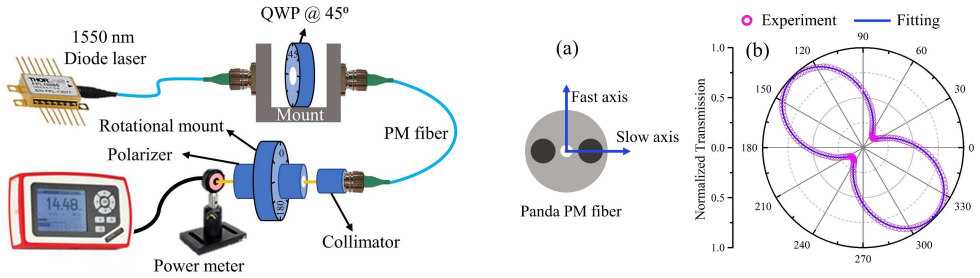
A PM fiber can be seen as the fiber version of a very high order waveplate, designed with different refractive indices along two orthogonal axes. Monitoring the polarization of initially circularly polarized light sent through a PM fiber leads not only to new sensing methods, but also to power control, saturable absorption, and optical path stabilization. Even at peak power levels not exceeding a few mW, nonlinear transmission is detected, with time constants in the microsecond range.
What carries the argument
Polarization monitoring of initially circularly polarized light transmitted through the PM fiber
If this is right
- New sensing methods are enabled by the polarization changes
- Power control becomes possible through the nonlinear response
- Saturable absorption occurs at milliwatt power levels
- Optical path length can be stabilized
- Nonlinear transmission with microsecond dynamics can be harnessed
Where Pith is reading between the lines
- The microsecond time scale points toward possible thermal or electrostrictive mechanisms that could be modeled separately
- Similar low-power effects might appear in other birefringent waveguide structures
- The stabilization property could reduce the need for active feedback in fiber interferometers
- Low-power saturable absorption might allow passive pulse shaping in fiber lasers without high-intensity requirements
Load-bearing premise
The observed polarization and transmission changes are caused by intrinsic nonlinear properties of the PM fiber rather than experimental artifacts, temperature drifts, or linear birefringence effects.
What would settle it
Repeating the experiment while holding temperature fixed and showing no change in output polarization or transmission when input power varies between 1 and 10 mW for circular input would indicate the nonlinear effects are absent.
Figures


read the original abstract
Polarization maintaining (PM) fibers are meant to maintain linear polarization along a preferred axis. A PM fiber can be seen as the fiber version of a very high order waveplate, designed with different refractive indices along two orthogonal axes. It is shown that monitoring the polarization of initially circularly polarized light sent through a PM fiber, leads not only to new sensing methods, but also to power control, saturable absorption, and optical path stabilization. Even at peak power levels not exceeding a few mW, nonlinear transmission is detected, with time constants in the microsecond range.
Editorial analysis
A structured set of objections, weighed in public.
Referee Report
Summary. The manuscript reports experimental observations that monitoring the polarization of initially circularly polarized light through a polarization-maintaining (PM) fiber reveals nonlinear transmission changes at peak powers of only a few mW, with time constants in the microsecond range. These effects are claimed to enable applications including power control, saturable absorption, optical path stabilization, and new sensing methods.
Significance. If verified as intrinsic fiber nonlinearities rather than artifacts, the result would indicate unexpected low-power behavior in standard PM fibers, with potential utility for fiber-based sensing and control devices. The work is an experimental observation report with no derivations, fitted parameters, or code; its value rests entirely on the quality of the supporting data and controls.
major comments (2)
- [Abstract] Abstract: The central claim of nonlinear transmission at mW levels with μs timescales is stated without any quantitative data, error bars, methods details, or figures. This prevents verification that the measurements support the stated observations rather than linear drifts or instabilities.
- [Abstract / Results] The distinction between intrinsic nonlinear response and experimental artifacts (temperature-induced index changes, mechanical instabilities, or linear birefringence) is load-bearing for the central claim, yet no specific controls, stability measurements, or comparative data are referenced to address the weakest assumption.
Simulated Author's Rebuttal
We thank the referee for their careful review and constructive comments. The points raised about the abstract and artifact controls are valid and we have revised the manuscript to address them directly.
read point-by-point responses
-
Referee: [Abstract] Abstract: The central claim of nonlinear transmission at mW levels with μs timescales is stated without any quantitative data, error bars, methods details, or figures. This prevents verification that the measurements support the stated observations rather than linear drifts or instabilities.
Authors: We agree that the abstract as submitted is too qualitative and omits the quantitative details needed for verification. This was an oversight in prioritizing brevity. In the revised manuscript we have expanded the abstract to include specific measured values (peak powers of a few mW, microsecond time constants, observed transmission changes), references to the supporting figures, and a brief indication of the methods used. These additions allow direct assessment of the data quality. revision: yes
-
Referee: [Abstract / Results] The distinction between intrinsic nonlinear response and experimental artifacts (temperature-induced index changes, mechanical instabilities, or linear birefringence) is load-bearing for the central claim, yet no specific controls, stability measurements, or comparative data are referenced to address the weakest assumption.
Authors: The referee correctly identifies this as a critical point. While the full manuscript contains the raw data and setup description, we acknowledge that explicit controls against artifacts were not sufficiently referenced or highlighted in the abstract and results overview. We have added a dedicated paragraph in the revised results section that explicitly describes the stability measurements performed, temperature monitoring, mechanical isolation tests, and timescale comparisons used to distinguish the observed effects from linear drifts or instabilities. These revisions make the controls visible at the level requested. revision: yes
Circularity Check
No significant circularity
full rationale
This is an experimental observation paper reporting polarization-dependent transmission changes in PM fibers at mW powers with microsecond timescales. The abstract and described content contain no mathematical derivation, fitted parameters, ansatz, uniqueness theorem, or self-citation chain that could reduce a claimed result to its inputs by construction. The central claims are direct statements of measured behavior (e.g., power control and saturable absorption via polarization monitoring), which are falsifiable through experimental controls rather than derived from prior equations or self-referential definitions. No load-bearing step reduces to a fit or citation; the work is self-contained as an empirical report.
Axiom & Free-Parameter Ledger
axioms (1)
- domain assumption PM fibers function as high-order waveplates with distinct refractive indices along orthogonal axes
Reference graph
Works this paper leans on
-
[1]
A flexible fi- brescope, using static scanning,
H. H. Hopkins and N. S. Kapany, “A flexible fi- brescope, using static scanning,” Nature 173, 39–41 (1954)
work page 1954
-
[2]
A review of the development in the field of fiber optic communication systems,
P . Sharma, S. R. Pardeshi, R. K. Arora, and M. S. J. Singh, “A review of the development in the field of fiber optic communication systems,” (2013)
work page 2013
-
[3]
Biomedical application of optical fibre sensors,
R. Correia, S. James, S.-W . Lee, S. P . Morgan, and S. Korposh, “Biomedical application of optical fibre sensors,” Journal of Optics 20, 073003 (2018)
work page 2018
-
[4]
Controlling group and phase velocities in bidirectional mode- locked fiber lasers,
H. Afkhamiardakani and J.-C. Diels, “Controlling group and phase velocities in bidirectional mode- locked fiber lasers,” Opt. Lett. 44, 2903–2906 (2019)
work page 2019
-
[5]
Magnetic field sensor based on microfiber sagnac loop interfer- ometer and ferrofluid,
F. Lv, C. Han, H. Ding, Z. Wu, and X. Li, “Magnetic field sensor based on microfiber sagnac loop interfer- ometer and ferrofluid,” IEEE Photonics Technology Letters 27, 2327–2330 (2015)
work page 2015
-
[6]
Optical fiber tempera- ture and torsion sensor based on lyot-sagnac interfer- ometer,
L.-Y . Shao, X. Zhang, H. He, Z. Zhang, X. Zou, B. Luo, W . Pan, and L. Y an, “Optical fiber tempera- ture and torsion sensor based on lyot-sagnac interfer- ometer,” Sensors 16 (2016)
work page 2016
-
[7]
Temperature- insensitive refractive index sensor based on in-fiber michelson interferometer,
Z. Li, Y . Wang, C. Liao, S. Liu, J. Zhou, X. Zhong, Y . Liu, K. Y ang, Q. Wang, and G. Yin, “Temperature- insensitive refractive index sensor based on in-fiber michelson interferometer,” Sensors and Actuators B: Chemical 199, 31–35 (2014)
work page 2014
-
[8]
H. Y u, Y . Wang, J. Ma, Z. Zheng, Z. Luo, and Y . Zheng, “Fabry-perot interferometric high- temperature sensing up to 1200 c based on a silica glass photonic crystal fiber,” Sensors 18 (2018)
work page 2018
-
[9]
Optical microfibre based photonic compo- nents and their applications in label-free biosensing,
P . Wang, L. Bo, Y . Semenova, G. Farrell, and G. Bram- billa, “Optical microfibre based photonic compo- nents and their applications in label-free biosensing,” Biosensors 5, 471–499 (2015)
work page 2015
-
[10]
X. Dong, H. Y . Tam, and P . Shum, “Temperature- insensitive strain sensor with polarization-maintaining photonic crystal fiber based sagnac interferometer,” Applied Physics Letters 90, 151113 (2007)
work page 2007
-
[11]
V . J. Matsas, T. P . Newson, D. J. Richardson, and D. N. Payne, “Self-starting passively mode-locked fi- bre ring soliton laser exploiting nonlinear polarisation rotation,” Electron. Lett. 28, 1391–1393 (1992)
work page 1992
-
[12]
Carbon nanotubes for mode-locking: po- larization study,
H. Afkhamiardakani, B. Kamer, J. C. Diels, and L. Arissian, “Carbon nanotubes for mode-locking: po- larization study,” in Proceedings of Photonics W est, Conference 9746-19,, , vol. 9746 (SPIE, San Fran- cisco, 2016)
work page 2016
-
[13]
Temperature and strain sensitivity measurements of high-birefringent polarization-maintaining fibers,
F. Zhang and J. W . Y . Lit, “Temperature and strain sensitivity measurements of high-birefringent polarization-maintaining fibers,” Appl. Opt. 32, 2213– 2218 (1993)
work page 1993
-
[14]
Temperature sensing by mode–mode in- terference in birefringent optical fibers,
W . Eickhoff, “Temperature sensing by mode–mode in- terference in birefringent optical fibers,” Opt. Lett. 6, 204–206 (1981). 5
work page 1981
discussion (0)
Sign in with ORCID, Apple, or X to comment. Anyone can read and Pith papers without signing in.