A lattice model for active--passive pedestrian dynamics: a quest for drafting effects
Pith reviewed 2026-05-24 19:01 UTC · model grok-4.3
The pith
Adding a fraction of aware pedestrians speeds up escape for everyone in a lattice corridor model
A machine-rendered reading of the paper's core claim, the machinery that carries it, and where it could break.
Core claim
In the two-species lattice gas model, passive particles perform symmetric random walks and active particles experience a guiding drift toward the exit. Hard-core exclusion prevents site overlap. Numerical evidence establishes that introducing a fraction of active particles increases the evacuation rate of the full population and augments the outgoing flux in the steady state induced by an external reservoir. The effect is interpreted as the lattice counterpart to aerodynamic drafting in continuum cyclist pelotons.
What carries the argument
Two-species lattice gas model with hard-core exclusion and a directional drift applied only to the active species.
If this is right
- Evacuation rate for the entire population rises when active particles are added.
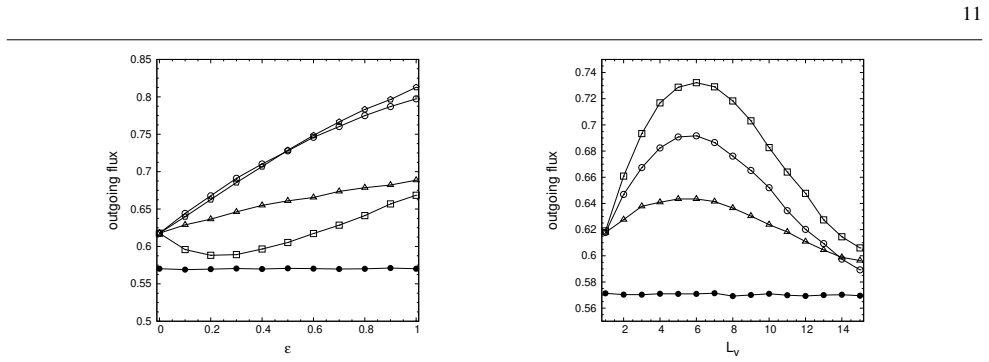
- Outgoing flux increases in the steady state maintained by an external particle reservoir.
- The enhancement persists under hard-core exclusion.
- The observed speedup is presented as the discrete analog of drafting in cyclist groups.
Where Pith is reading between the lines
- In real crowds a small number of informed people could accelerate group exit without needing explicit coordination.
- The same mechanism might appear in other lattice or agent systems such as traffic lanes or animal groups where a few knowledgeable agents aid the rest.
- Varying drift strength or adding obstacles could identify the minimal fraction of active particles needed for measurable gain.
Load-bearing premise
The drift term for active particles accurately represents their awareness of corridor geometry and exit location without any further interactions or behavioral rules.
What would settle it
Simulations in which the fraction of active particles is varied from zero upward while holding all other parameters fixed; if evacuation times or fluxes show no systematic improvement, the central claim is falsified.
Figures
read the original abstract
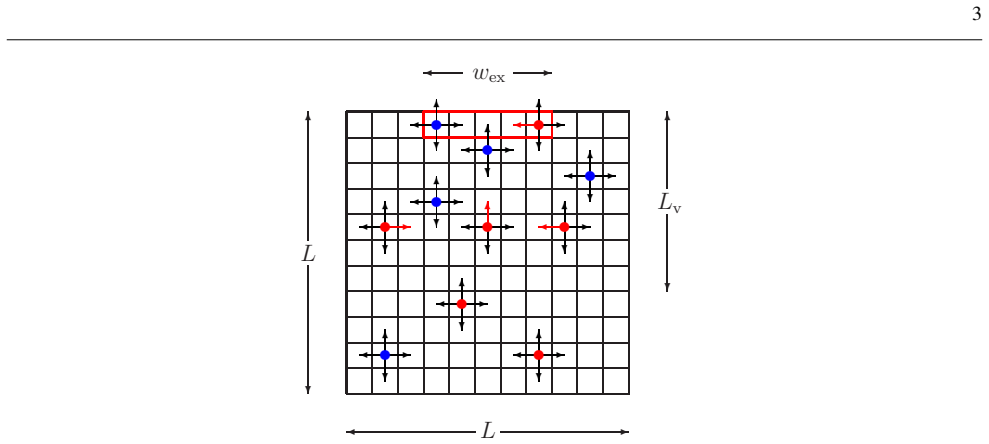
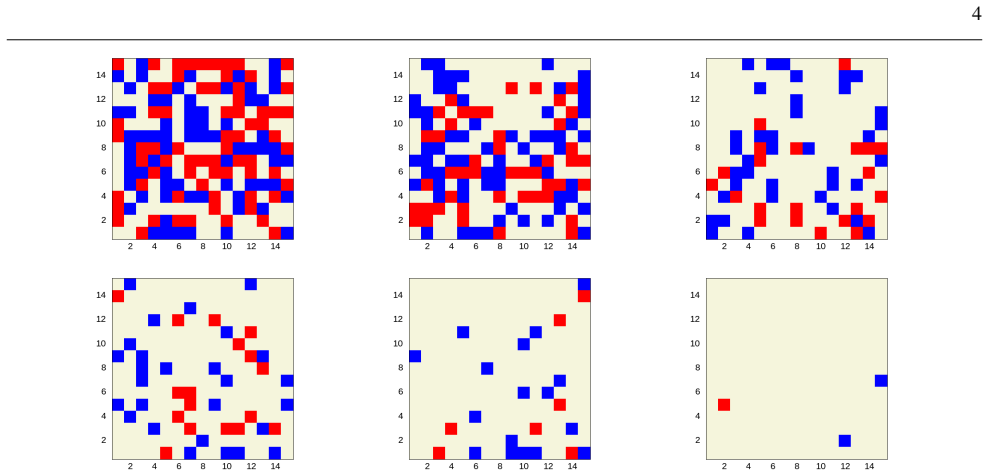
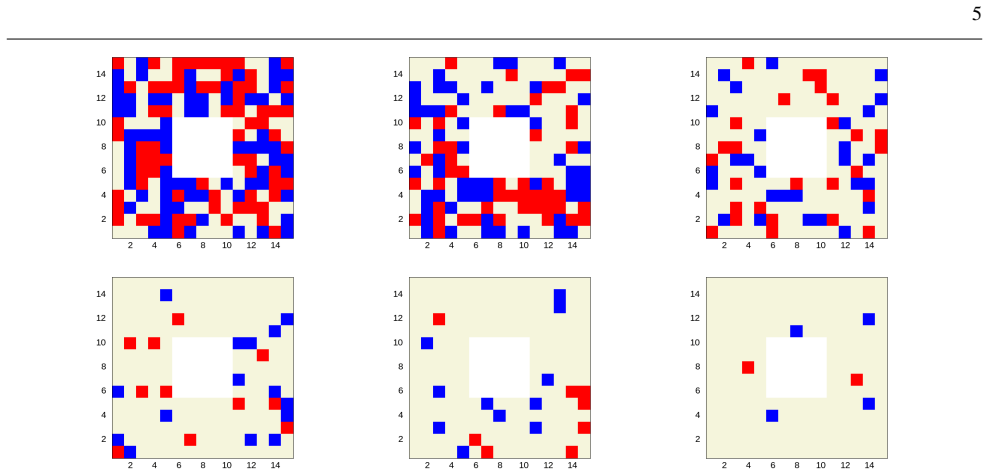
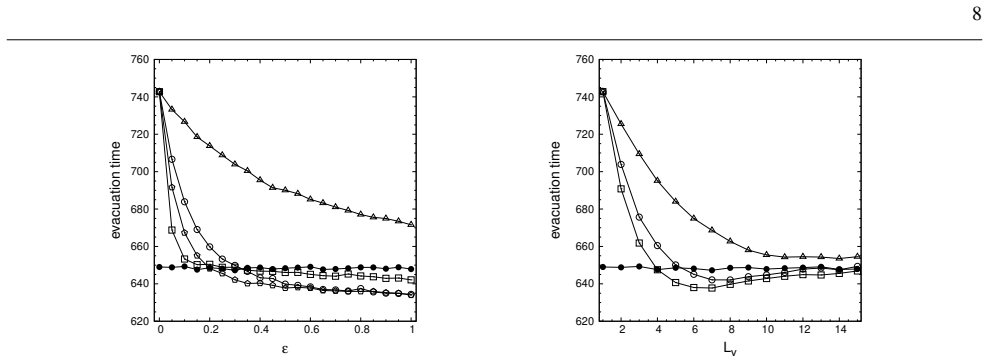
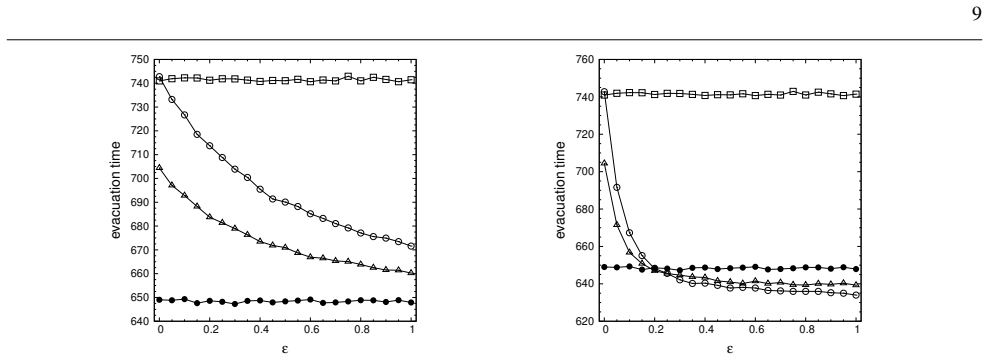
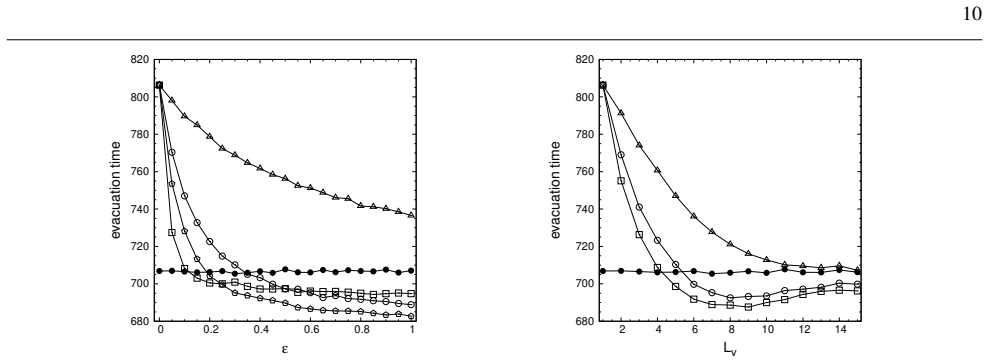
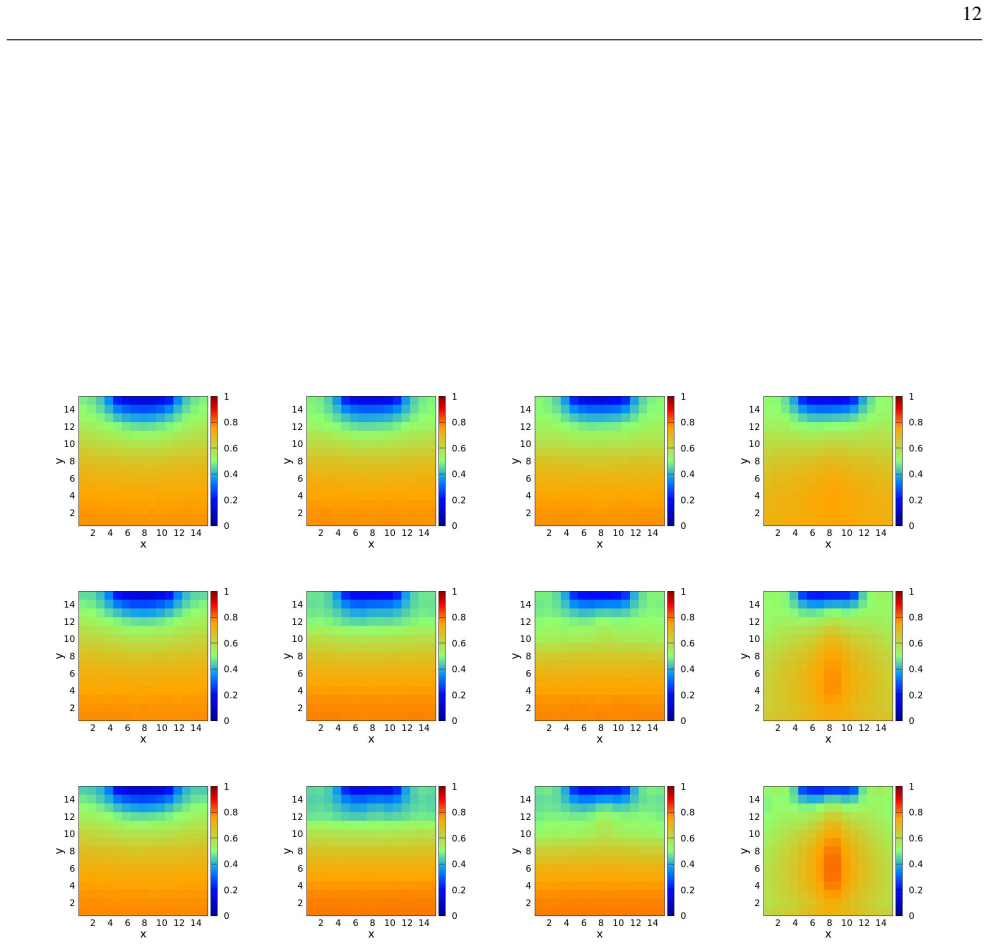
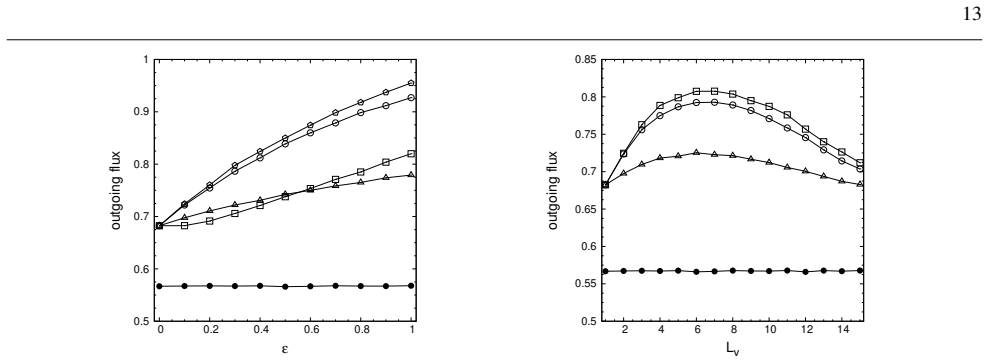
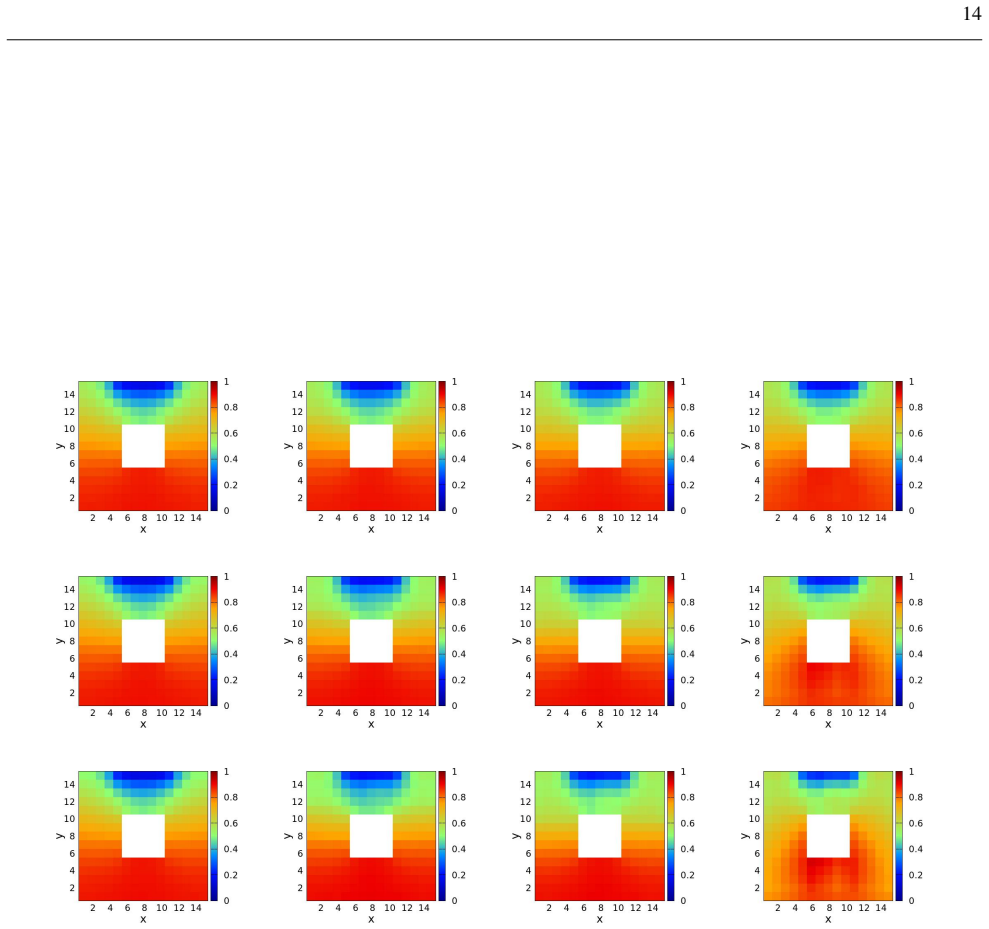
We study the pedestrian escape from an obscure corridor using a lattice gas model with two species of particles. One species, called passive, performs a symmetric random walk on the lattice, whereas the second species, called active, is subject to a drift guiding the particles towards the exit. The drift mimics the awareness of some pedestrians of the geometry of the corridor and of the location of the exit. We provide numerical evidence that, in spite of the hard core interaction between particles -- namely, there can be at most one particle of any species per site, -- adding a fraction of active particles in the system enhances the evacuation rate of all particles from the corridor. A similar effect is also observed when looking at the outgoing particle flux, when the system is in contact with an external particle reservoir that induces the onset of a steady state. We interpret this phenomenon as a discrete space counterpart of the drafting effect typically observed in a continuum set--up as the aerodynamic drag experienced by pelotons of competing cyclists.
Editorial analysis
A structured set of objections, weighed in public.
Referee Report
Summary. The manuscript studies pedestrian evacuation from a corridor using a two-species lattice gas model with hard-core exclusion. Passive particles execute unbiased random walks; active particles receive an additional directional bias toward the exit. Numerical simulations show that introducing a nonzero fraction of active particles increases both the overall evacuation rate (all particles) and the steady-state outgoing flux (when coupled to a reservoir), an effect interpreted as a discrete-space analog of aerodynamic drafting.
Significance. If the reported enhancement is robust, the work supplies a minimal, internally consistent lattice model in which a cooperative effect emerges purely from the combination of biased and unbiased motion under exclusion. This offers a clean, falsifiable discrete counterpart to continuum drafting phenomena and could be useful for testing hypotheses about mixed-population crowd dynamics without invoking additional behavioral rules.
minor comments (3)
- The abstract and introduction should state the lattice dimensions, total particle numbers, and number of independent runs used to obtain the reported evacuation times and fluxes, together with any error estimation procedure.
- Figure captions (or a dedicated methods subsection) should indicate whether the bias strength for active particles is held fixed across all simulations or varied, and how the steady-state flux is measured once the reservoir is introduced.
- A brief comparison with the all-passive and all-active limits, including quantitative ratios of evacuation times, would strengthen the central claim that the mixed case is strictly faster.
Simulated Author's Rebuttal
We thank the referee for the positive summary and significance assessment of our manuscript, as well as the recommendation for minor revision. We appreciate the recognition of the model as a minimal discrete-space framework for cooperative evacuation effects.
Circularity Check
No significant circularity identified
full rationale
The paper defines a two-species lattice gas model with explicit rules (symmetric random walk for passive particles, directional bias for active particles, hard-core exclusion) and reports results from direct numerical simulation of evacuation times and steady-state fluxes. No derivation chain exists that reduces a claimed result to a fitted parameter, self-citation, or ansatz by construction; the enhancement effect is an observed outcome of the stated dynamics rather than an algebraic identity or renamed input.
Axiom & Free-Parameter Ledger
Lean theorems connected to this paper
-
IndisputableMonolith/Cost/FunctionalEquation.leanwashburn_uniqueness_aczel unclear?
unclearRelation between the paper passage and the cited Recognition theorem.
passive particles perform a symmetric simple exclusion dynamics... active particles... experience a drift pushing them towards the exit
-
IndisputableMonolith/Foundation/AbsoluteFloorClosure.leanabsolute_floor_iff_bare_distinguishability unclear?
unclearRelation between the paper passage and the cited Recognition theorem.
hard core interaction... at most one particle of any species per site
What do these tags mean?
- matches
- The paper's claim is directly supported by a theorem in the formal canon.
- supports
- The theorem supports part of the paper's argument, but the paper may add assumptions or extra steps.
- extends
- The paper goes beyond the formal theorem; the theorem is a base layer rather than the whole result.
- uses
- The paper appears to rely on the theorem as machinery.
- contradicts
- The paper's claim conflicts with a theorem or certificate in the canon.
- unclear
- Pith found a possible connection, but the passage is too broad, indirect, or ambiguous to say the theorem truly supports the claim.
Reference graph
Works this paper leans on
-
[1]
J.P. Agnelli, F. Colasuonno, D. Knopo ff, A kinetic theory approach to the dynamics of crowd evacuation from bounded domains. Mathematical Models and Methods in Applied Sciences 25, 109–129 (2015)
work page 2015
-
[2]
G. Albi, M. Bongini, E. Cristiani, D. Kalise, Invisible control of self–organizing agents leaving unknown environments. SIAM J. Appl. Math. 76, 1683–1710 (2016)
work page 2016
-
[3]
D. Andreucci, D. Bellaveglia, E.N.M. Cirillo, S. Marconi, Monte Carlo study of gating and selec- tion in potassium channels. Physical Review E 84, 021920 (2011). , 16
work page 2011
-
[4]
D. Andreucci, D. Bellaveglia, E.N.M. Cirillo, A model for enhanced and selective transport through biological membranes with alternating pores. Mathematical Biosciences 257, 42–49 (2014)
work page 2014
- [5]
-
[6]
B. Blocken,T. van Druenen, Y . Toparlar, F. Malizia, P. Mannion, T. Andrianne, T. Marchal, G.J. Maas, J. Diepens, Aerodynamic drag in cycling pelotons: new insights by CFD simulation and wind tunnel testing.Journal of Wind Engineering& Industrial Aerodynamics179 319–337 (2018)
work page 2018
-
[7]
B. Blocken, Y . Toparlar, T. van Druenen, T. Andrianne, Aerodynamic drag in cycling team time trials. Journal of Wind Engineering & Industrial Aerodynamics 182 128–145 (2018)
work page 2018
-
[8]
A. Ciallella, E.N.M. Cirillo, P. Curseu, A. Muntean, Free to move or trapped in your group: Mathe- matical modeling of information overload and coordination in crowded populations.Mathematical Models and Methods in Applied Sciences 28, 1831–1856 (2018)
work page 2018
-
[9]
A. Ciallella, E.N.M. Cirillo, Linear Boltzmann dynamics in a strip with large reflective obstacles: stationary state and residence time. Kinetic & Related Models 11 1475–1501 (2018)
work page 2018
-
[10]
A. Ciallella, E.N.M. Cirillo, J. Sohier, Residence time of symmetric random walkers in a strip with large reflective obstacles. Physical Review E 97 052116 (2018)
work page 2018
-
[11]
E.N.M. Cirillo, A. Muntean, Can cooperation slow down emergency evacuations? Comptes Ren- dus Macanique 340, 626–628 (2012)
work page 2012
-
[12]
E.N.M. Cirillo, A. Muntean, Dynamics of pedestrians in regions with no visibility – a lattice model without exclusion. Physica A 392, 3578–3588 (2013)
work page 2013
-
[13]
E.N.M. Cirillo, M. Colangeli, and A. Muntean. E ffects of communication e fficiency and exit capacity on fundamental diagrams for pedestrian motion in an obscure tunnel - a particle system approach Multiscale Modeling & Simulation 14, 906–922 (2016)
work page 2016
-
[14]
E.N.M. Cirillo, M. Colangeli, and A. Muntean. Does communication enhance pedestrian transport in the dark? Comptes Rendus Mecanique 344, 19–23 (2016)
work page 2016
-
[15]
E.N.M. Cirillo, O. Krehel, A. Muntean, and R. van Santen. Lattice model of reduced jamming by a barrier. Phys. Rev. E, 94:042115, Oct 2016
work page 2016
-
[16]
E.N.M. Cirillo, O. Krehel, A. Muntean, R. van Santen, and Aditya S. Residence time estimates for asymmetric simple exclusion dynamics on strips. Physica A: Statistical Mechanics and its Applications, 442:436 – 457, 2016
work page 2016
-
[17]
M. Colangeli, A. Muntean, O. Richardson, T. K. T. Thieu, Modelling interactions between active and passive agents moving through heterogeneous environments, in G. Libelli, N. Bellomo (Eds), Crowd Dynamics, vol. 1: Theory, Models and Safety Problems (pp. 211– 254). Modeling and Simulation in Science, Engineering and Technology, Boston, Birkh¨auser, 2019
work page 2019
-
[18]
M. Colangeli, A. De Masi, E. Presutti, Latent Heat and the Fourier Law, Phys. Lett. A 380, 1710 (2016)
work page 2016
-
[19]
M. Colangeli, A. De Masi, E. Presutti, Particle Models with Self Sustained Current, J. Stat. Phys. 167, 1081–1111 (2017). , 17
work page 2017
-
[20]
M. Colangeli, A. De Masi, E. Presutti, Microscopic models for uphill diffusion, J. Phys. A: Math. Theor. 50, 435002 (2017)
work page 2017
-
[21]
M. Colangeli, C. Giardin `a, C. Giberti, C. Vernia, Nonequilibrium two-dimensional Ising model with stationary uphill diffusion, Phys. Rev. E 97, 030103(R) (2018)
work page 2018
-
[22]
M. Colangeli, C. Giberti, C. Vernia, M. Kr ¨oger, Emergence of stationary uphill currents in 2D Ising models: the role of reservoirs and boundary conditions , Eur. Phys. J. Special Topics 228, 69–91 (2019)
work page 2019
- [23]
-
[24]
E. Cristiani and D. Peri. Handling obstacles in pedestrian simulations: Models and optimization. Applied Mathematical Modelling 45 285–302 (2017)
work page 2017
-
[25]
E. Cristiani, B. Piccoli, A. Tosin, Multiscale Modeling of Pedestrian Dynamics, Series in Model- ing, Simulation and Applications, vol. 12, Springer, 2014
work page 2014
-
[26]
P.L. Curs ¸eu, O. Krehel, J.H. Evers, A. Muntean, Cognitive distance, absorptive capacity and group rationality: A simulation study. PloS One 9, e109359 (2014)
work page 2014
-
[27]
K. Fridolf, E. Ronchi, D. Nilsson, H. Frantzich, Movement speed and exit choice in smoke-filled rail tunnels. Fire Safety Journal 59 8–21 (2013)
work page 2013
-
[28]
F. M ¨uller, O. Wohak, A. Schadschneider, Study of influence of groups on evacuation dynamics using a cellular automaton model. Transportation Research Procedia2, 168–176 (2014)
work page 2014
-
[29]
A. Muntean, E.N.M. Cirillo, O. Krehel, M. B ¨ohm, Pedestrians moving in the dark: Balancing measures and playing games on lattices. In Collective Dynamics from Bacteria to Crowds: An Excursion Through Modeling, Analysis and Simulation, CISM Lectures 553, Springer, 2014
work page 2014
-
[30]
G. A. Pavliotis, Stochastic Processes and Applications: Di ffusion Processes, the Fokker-Planck and Langevin Equations. Texts in Applied Mathematics, vol. 60, Springer Verlag, Berlin, 2014
work page 2014
-
[31]
O. Richardson, A. Jalba, A. Muntean, The e ffect of environment knowledge in evacuation scenar- ios involving fire and smoke – a multiscale modelling and simulation approach, inFire Technology 55 2, 415-436 (2019)
work page 2019
-
[32]
Spohn, Large Scale Dynamics of Interacting Particles, Springer-Verlag Berlin Heidelberg, 1991
H. Spohn, Large Scale Dynamics of Interacting Particles, Springer-Verlag Berlin Heidelberg, 1991
work page 1991
-
[33]
J.–H. Wang, J.–H. Sun. Principal aspects regarding to the emergency evacuation of large–scale crowds: A brief review of literatures until 2010. Procedia Engineering 71, 1–6 (2014)
work page 2010
-
[34]
S. Xue, B. Jia, R. Jiang, J. Shan, Pedestrian evacuation in view and hearing limited condition: The impact of communication and memory. Physics Letters A 380, 3029–3035 (2016). ,
work page 2016
discussion (0)
Sign in with ORCID, Apple, or X to comment. Anyone can read and Pith papers without signing in.