Towards Secure IoT: Securing Messages Dissemination in Intelligent Traffic Systems
Pith reviewed 2026-05-24 17:54 UTC · model grok-4.3
The pith
A sensor network security protocol can be inherited across VANET zones via base stations to enable secure low-overhead message dissemination in intelligent traffic systems.
A machine-rendered reading of the paper's core claim, the machinery that carries it, and where it could break.
Core claim
By inheriting a sensor network security protocol through base station gateways, VANETs achieve secure practical communication that can be passed to other sub VANETs, with reduced cryptography computation overhead suitable for high mobility and using security primitives that guarantee security while permitting fast authentication as vehicles move between zones based on direction.
What carries the argument
Inheritance of the sensor network security protocol across sub-VANET zones via base station gateways, relying on security primitives for fast direction-dependent authentication.
If this is right
- Secure practical communication is achieved in VANETs for message dissemination.
- The protocol can be inherited to other sub VANETs without full re-initialization.
- Cryptography computation overhead stays low enough for high-mobility vehicle networks.
- Fast authentication occurs during zone transitions depending on vehicle direction.
Where Pith is reading between the lines
- The inheritance approach could extend to other zone-structured mobile IoT networks beyond traffic systems.
- Integration with existing traffic sensors might allow direction data to further optimize authentication timing.
- Physical deployment tests would be needed to check performance against variable real-world interference and attack patterns.
Load-bearing premise
That a security protocol from sensor networks can be directly inherited across VANET zones via base stations without introducing new vulnerabilities or unacceptable delays under real high-mobility conditions.
What would settle it
A simulation or field measurement showing that authentication time exceeds acceptable limits or that attacks succeed when vehicles cross base station boundaries at highway speeds under the paper's attack models.
Figures



read the original abstract
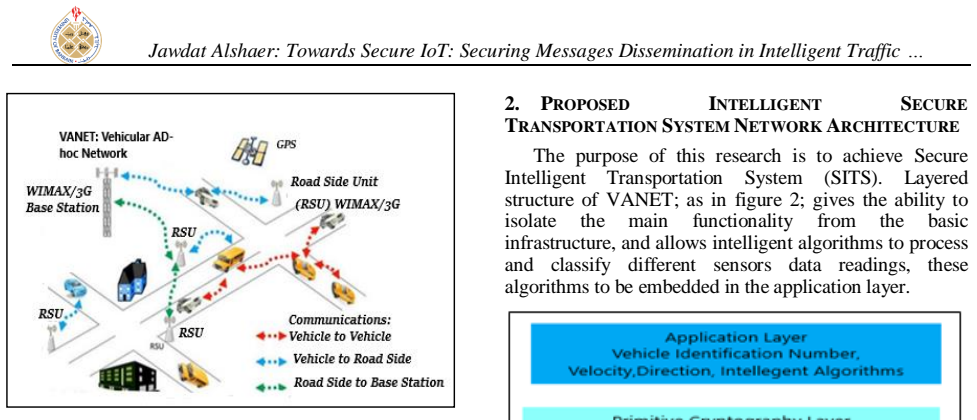
A few years ago, Automotive area in the IoT was seen as theoretical concept and today we are already seeing the possibilities of not only driverless cars, but applications of IoT in the intelligent vehicles including parking, maintaining environment, protecting lives and smoothing the flow vehicle movements. We have realized the urgent need of using simple and efficient secure protocol in Vehicular Ad Hoc Network (VANET) to be practical in the fast mobility of the network nodes, and taking advantage of the existence of base stations gateways along the road to inherit the protocol to different VANETs, this will reduce the initialization of communication overhead time and the security keys initialization each time a node passes to new base station zone. In this research, we applied security protocol used in sensor networks to achieve security in VANET, the simulation analysis shows that secure practical communication is achieved which can be inherited to other sub VANETs. The contribution of this article is enhancing proposed protocols with as less cryptography computation overhead as possible to make it applicable in the high mobility nature of VANET using security primitives; which guarantees security while allowing fast authenticating during vehicle passing one VANET to the next one depending on its direction in the transportation networks.
Editorial analysis
A structured set of objections, weighed in public.
Referee Report
Summary. The manuscript proposes inheriting a sensor-network security protocol to VANETs in intelligent traffic systems. Base stations act as gateways to propagate the protocol across sub-VANET zones, reducing per-zone initialization and crypto overhead while enabling fast directional authentication during handoffs. The central claim is that simulation results demonstrate secure, practical communication that can be inherited without compromising the high-mobility requirements of VANETs.
Significance. If the simulation evidence were provided and shown to address VANET-specific mobility and attack conditions, the work could offer a low-overhead path for securing IoT message dissemination in traffic networks by reusing existing sensor protocols. The approach of directional handoff inheritance is a potentially practical contribution, but the absence of inspectable methods, metrics, or attack models prevents any assessment of whether the result actually holds.
major comments (3)
- [Abstract] Abstract: the assertion that 'simulation analysis shows that secure practical communication is achieved' supplies no simulation setup, node density, mobility model, performance metrics (delay, packet delivery ratio, authentication latency), baselines, or attack models. Without these, the central empirical claim cannot be evaluated.
- [Abstract / Introduction] The manuscript's core assumption—that a sensor-network protocol can be directly inherited across VANET sub-zones via base stations without introducing replay, Sybil, or handoff-specific vulnerabilities—is stated but not tested. No section analyzes key freshness, authentication steps, or measured delays under topology changes every few seconds at vehicular speeds.
- [Abstract] The claim of 'as less cryptography computation overhead as possible' and 'fast authenticating during vehicle passing' is not supported by any quantitative comparison or timing analysis that accounts for base-station coverage boundaries and directional movement.
minor comments (1)
- [Abstract] Abstract contains minor grammatical issues (e.g., 'a few years ago, Automotive area in the IoT was seen as theoretical concept') and inconsistent capitalization that should be cleaned for readability.
Simulated Author's Rebuttal
We thank the referee for the constructive comments. We address each major comment below and indicate planned revisions.
read point-by-point responses
-
Referee: [Abstract] Abstract: the assertion that 'simulation analysis shows that secure practical communication is achieved' supplies no simulation setup, node density, mobility model, performance metrics (delay, packet delivery ratio, authentication latency), baselines, or attack models. Without these, the central empirical claim cannot be evaluated.
Authors: The referee is correct that the current manuscript does not supply the requested simulation details in the abstract or main text. We will revise by adding a dedicated simulation section that specifies node density, mobility model, performance metrics (delay, packet delivery ratio, authentication latency), baselines, and attack models to support the empirical claims. revision: yes
-
Referee: [Abstract / Introduction] The manuscript's core assumption—that a sensor-network protocol can be directly inherited across VANET sub-zones via base stations without introducing replay, Sybil, or handoff-specific vulnerabilities—is stated but not tested. No section analyzes key freshness, authentication steps, or measured delays under topology changes every few seconds at vehicular speeds.
Authors: We agree the inheritance approach is presented at a conceptual level without explicit testing of the listed vulnerabilities or performance under rapid topology changes. We will add a security analysis section addressing replay, Sybil, and handoff vulnerabilities along with key freshness and authentication steps, plus new simulations reporting measured delays at vehicular speeds. revision: yes
-
Referee: [Abstract] The claim of 'as less cryptography computation overhead as possible' and 'fast authenticating during vehicle passing' is not supported by any quantitative comparison or timing analysis that accounts for base-station coverage boundaries and directional movement.
Authors: The claims rest on the reduced initialization from protocol inheritance, but the manuscript lacks quantitative comparisons and timing analysis. We will revise to include direct comparisons against baseline protocols and timing measurements that incorporate base-station coverage boundaries and directional handoffs. revision: yes
Circularity Check
Application of sensor-network protocol to VANET via simulation shows no definitional or self-citation circularity
full rationale
The paper frames its contribution as applying an existing security protocol from sensor networks to VANETs, with simulation used to verify secure communication and inheritance across sub-zones. The abstract states: 'we applied security protocol used in sensor networks to achieve security in VANET, the simulation analysis shows that secure practical communication is achieved which can be inherited to other sub VANETs.' No equations, fitted parameters, or derivations are presented that reduce by construction to inputs. The central claim relies on the applicability of the prior protocol under VANET conditions, but this is presented as an engineering application rather than a mathematical derivation or uniqueness theorem justified solely by overlapping-author citations. Simulation results serve as an external benchmark, rendering the analysis self-contained with no load-bearing circular steps matching the enumerated patterns.
Axiom & Free-Parameter Ledger
Lean theorems connected to this paper
-
IndisputableMonolith/Foundation/RealityFromDistinction.leanreality_from_one_distinction unclear?
unclearRelation between the paper passage and the cited Recognition theorem.
simulation analysis shows that secure practical communication is achieved which can be inherited to other sub VANETs
What do these tags mean?
- matches
- The paper's claim is directly supported by a theorem in the formal canon.
- supports
- The theorem supports part of the paper's argument, but the paper may add assumptions or extra steps.
- extends
- The paper goes beyond the formal theorem; the theorem is a base layer rather than the whole result.
- uses
- The paper appears to rely on the theorem as machinery.
- contradicts
- The paper's claim conflicts with a theorem or certificate in the canon.
- unclear
- Pith found a possible connection, but the passage is too broad, indirect, or ambiguous to say the theorem truly supports the claim.
Reference graph
Works this paper leans on
-
[1]
Abdelhamid S., Hassanein H.S., Takahara G. Vehicle as a Mobile Sensor. Procedia Comput. Sci. 2014;34:286–295. doi: 10.1016/j.procs.2014.07.025. [CrossRef] [Google Scholar]
-
[2]
Mobile Object -Tracking Approach using a Combination of Fuzzy Logic and Neural Networks
Alshaer, J.J. Mobile Object -Tracking Approach using a Combination of Fuzzy Logic and Neural Networks. Glob. J. Comput. Sci. Technol. E Netw. Web Secur., 15, 13 –19, 2015
work page 2015
-
[3]
Challenges of Internet of Things and Big Data Integration
Z. Alansari, N. B. Anuar, A. Kamsin, S. Soomro, M. R. Belgaum, M. H. Miraz, Jawdat Alshaer., "Challenges of Internet of Things and Big Data Integration," arXiv preprint arXiv:1806.08953, 2018
work page internal anchor Pith review Pith/arXiv arXiv 2018
-
[4]
Zainab Alansari, Mohammad Riyaz Belgaum, Jawdat Alshaer, Safeeullah Soomro, Mahdi H. Miraz et al.,”Internet of ThingsInfrastructure, Architecture, Security and Privacy”, in the proceedings of IEEE iCCECE '18, Southend, UK, August 2018
work page 2018
-
[5]
Intelligent traffic management system,
J. J. Alshaer and V. V. Gubarev, "Intelligent traffic management system," in Control and Communications, 2009. SIBCON 2009. International Siberian Conference on, 2009, pp. 15 -20
work page 2009
-
[6]
Threshold Anonymous Announcement in VANETs,
Chen, L., Ng, S., and Wang, G., “Threshold Anonymous Announcement in VANETs, ” in IEEE Journal on Selected Areas in Communications, vol. 29, pp. 605 -615, 2011
work page 2011
-
[7]
Proving Reliability of Anonymous Information in VANETs,
Kounga, G., Walter, T., and Lachmund, S., “Proving Reliability of Anonymous Information in VANETs, ” in IEEE Transactions on Vehicular Technology, vol. 58, no. 6, pp. 2977 -2989, 2009
work page 2009
-
[8]
Enhancing Identity Based Batch Verification Scheme for Security and Privacy in VANET,
Mahapatra, P., and Naveena, A., “Enhancing Identity Based Batch Verification Scheme for Security and Privacy in VANET, ” in IEEE 7th InternationalAdvance Computing Conference, IACC, pp. 391-396, January 2017
work page 2017
- [9]
-
[10]
Security challenges, issues and their solutions for VANET,
Raw, R . S., Kumar, M., and Singh, N., “Security challenges, issues and their solutions for VANET, ” in International Journal of Network Security & Its Applications, vol. 5, issue 5, pp. 95 –105, 2013
work page 2013
-
[11]
Security in vehicular ad hoc network byusing multiple operating channels,
Shukla, N., Dinker, A. G., Srivastava, N., and Singh, A., “Security in vehicular ad hoc network byusing multiple operating channels, ” in IEEE 3rd International Conference on Computing for Sustainable Global Development, INDIACom, pp. 3064 -3068, March 2016
work page 2016
-
[12]
Certificate revocation in vehicular Ad Hoc network s: a novel approach,
Islam, N., “Certificate revocation in vehicular Ad Hoc network s: a novel approach, ” in IEEE International Conference on Networking Systems and Security, NSysS, pp. 1 -5, January 2016
work page 2016
-
[13]
PPAS: A Privacy Preservation Authentication Scheme for Vehicular Communication Networks
Ming-Chin Chuang and Chao-Lin Chen, “PPAS: A Privacy Preservation Authentication Scheme for Vehicular Communication Networks” International Journal of Innovations in Engineering and Technology (IJIET), vol.12, no.3, pp. 45-51, Feb. 2019
work page 2019
-
[14]
TEAM: Trust-Extended Authentication Mechanism for Vehicular Ad Hoc Networks,
Ming-Chin Chuang and Jeng-Farn Lee, “TEAM: Trust-Extended Authentication Mechanism for Vehicular Ad Hoc Networks,” IEEE Systems Journal, vol. 8, no. 3, pp. 749-758, September 2014
work page 2014
-
[15]
Mansour , Cherif Salama , Hoda K
Marvy B. Mansour , Cherif Salama , Hoda K. Mohamed and Sherif A. Hammad,VANET SECURITY AND PRIVACY – AN OVERVIEW,International Journal of Network Security & Its Applications (IJNSA) Vol. 10, No.2, pp 13 -34,2018 0 100 200 300 400 500 600 0 10 20 30 40 50 60 70 80 Time (ms) Number Of Nodess Proposed Protocol BMFR GPSR DSDV Int. J. Com. Dig. Sys. 8, No.4, ....
work page 2018
-
[16]
U. S. National Institute of Standards and Technology (NIST).DES model of operation. Federal Information ProcessingStandards Publication 81 (FIPS PUB 81)
-
[17]
Adrian Perrig, Ran Canetti, J.D. Tygar, and Dawn Song. Efficient authentication and signing of multicast streams ove r lossy channels. In IEEE Symposium on Security and Privacy, May 2000
work page 2000
-
[18]
R. L. Rivest. The RC5 encryption algorithm. Proc. 1 st Workshop on Fast Software Encryption, pages 86–96, 1995
work page 1995
-
[19]
Highly Dynamic Destination - Sequenced Dista nce-Vector (DSDV) for Mobile Computers,
C. E. Perkins and P. Bhagwat, “Highly Dynamic Destination - Sequenced Dista nce-Vector (DSDV) for Mobile Computers,” “Proc. ACM Conf. Communications Architectures and Protocols”, London, UK, August 1994, pp. 234 -244
work page 1994
-
[20]
GPSR: greedy perimeter stateless routing for wireless networks,
B. Karp and H. T. Kung, “GPSR: greedy perimeter stateless routing for wireless networks,” in Proceedings of the 6th Annual International Conference on Mobile Computing and Networking (MOBICOM '00), pp. 243–254, August 2000
work page 2000
-
[21]
A Review on Routing Protocols used in VANET
Priyanka Goyal, Anish Soni, Ashu Dalal & Arun Jain, “ A Review on Routing Protocols used in VANET”, IJARCS Volume 5, No. 6, July-August 2014. Jawdat Jamil Alshaer: Received the BSc degree from the Department of Computer Science, Mu’ta University, Jordan, in 1993, MSc degree from the Department of Computer Science, Wichita State University, USA, in 2003, a...
work page 2014
discussion (0)
Sign in with ORCID, Apple, or X to comment. Anyone can read and Pith papers without signing in.