Fast Steerable Wireless Backhaul Reconfiguration
Pith reviewed 2026-05-24 17:08 UTC · model grok-4.3
The pith
Greedy-based heuristics solve the steerable mmWave backhaul reconfiguration problem with near-optimal quality in much less time.
A machine-rendered reading of the paper's core claim, the machinery that carries it, and where it could break.
Core claim
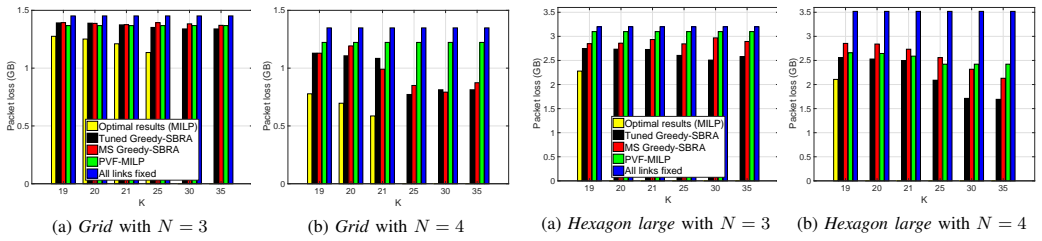
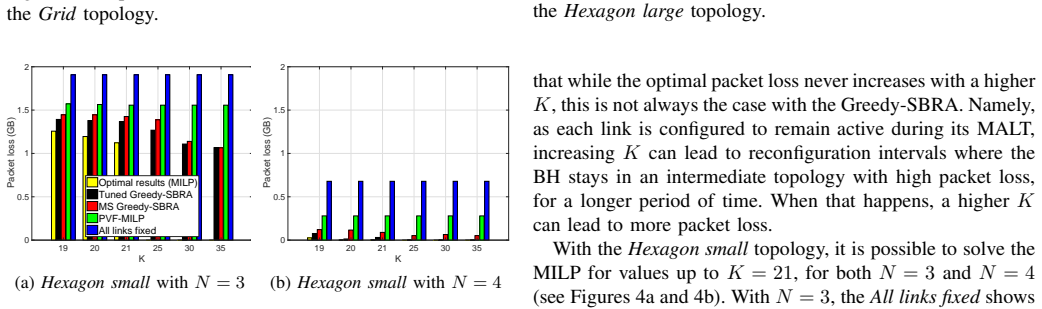
The paper claims that its greedy-based heuristic algorithms achieve good quality solutions with significantly decreased execution time for the backhaul reconfiguration problem, as shown by comparisons to optimal MILP solutions on small instances and reduced MILP on larger ones.
What carries the argument
Greedy-based heuristic algorithms that iteratively select antenna steering moves, link setups, and routing changes to minimize reconfiguration cost.
If this is right
- Reconfiguration of directional backhaul becomes practical for dynamic small-cell networks.
- Networks can adapt topology and routing without long service interruptions.
- The approach extends to instances too large for exact MILP solvers.
Where Pith is reading between the lines
- The heuristics might integrate with traffic prediction to trigger reconfigurations proactively.
- Physical testbed measurements of actual steering delays could test whether the model assumptions hold.
Load-bearing premise
The network model with its link capacities, steering times, and routing constraints accurately captures real mmWave behavior.
What would settle it
Running the greedy algorithms on larger instances and finding that their solution cost exceeds the reduced MILP cost by a large margin or that run times are not substantially lower would falsify the performance claim.
Figures
read the original abstract
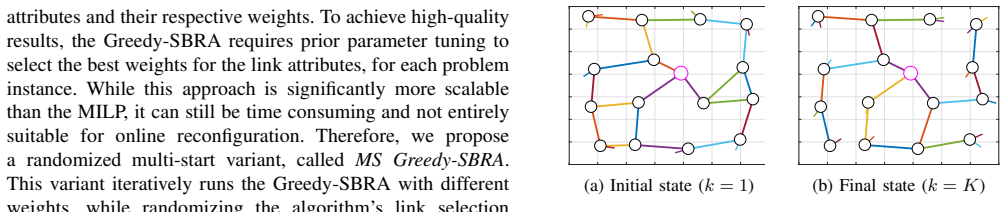
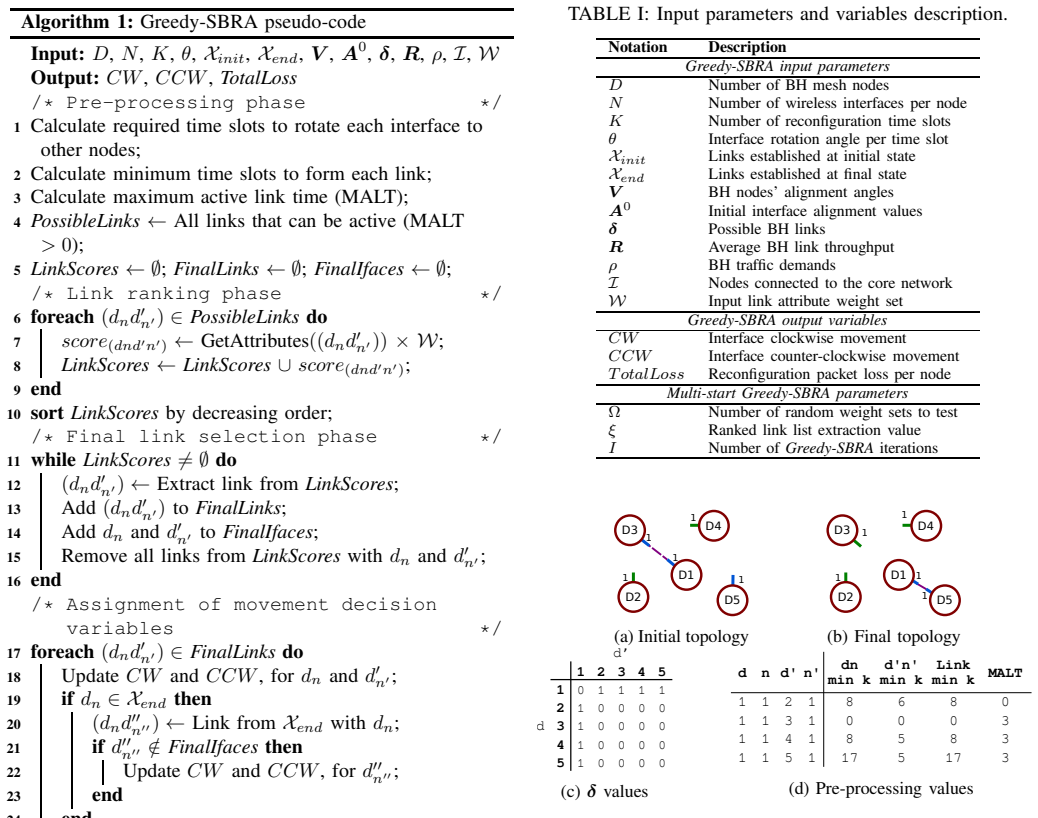
Future mobile traffic growth will require 5G cellular networks to densify the deployment of small cell base stations (BS). As it is not feasible to form a backhaul (BH) by wiring all BSs to the core network, directional mmWave links can be an attractive solution to form BH links, due to their large available capacity. When small cells are powered on/off or traffic demands change, the BH may require reconfiguration, leading to topology and traffic routing changes. Ideally, such reconfiguration should be seamless and should not impact existing traffic. However, when using highly directional BH antennas which can be dynamically rotated to form new links, this can become time-consuming, requiring the coordination of BH interface movements, link establishment and traffic routing. In this paper, we propose greedy-based heuristic algorithms to solve the BH reconfiguration problem in real-time. We numerically compare the proposed algorithms with the optimal solution obtained by solving a mixed integer linear program (MILP) for smaller instances, and with a sub-optimal reduced MILP for larger instances. The obtained results indicate that the greedy-based algorithms achieve good quality solutions with significantly decreased execution time.
Editorial analysis
A structured set of objections, weighed in public.
Referee Report
Summary. The paper proposes greedy-based heuristic algorithms to solve the wireless backhaul reconfiguration problem for directional mmWave links in 5G small-cell networks. It claims these algorithms produce good-quality solutions with significantly lower execution times than an exact MILP formulation (used for small instances) or a sub-optimal reduced MILP (used for large instances).
Significance. If the quality claims can be verified with explicit optimality gaps or bounds, the work would supply practical real-time methods for an operationally relevant reconfiguration task. The comparison to an independent MILP solver is a positive feature, but the absence of quality metrics for the large-instance regime limits the result's immediate utility.
major comments (2)
- [Abstract] Abstract: the assertion that the greedy algorithms 'achieve good quality solutions' for larger instances rests on comparison to a 'sub-optimal reduced MILP' with no reported optimality gap, lower bound, or other quality metric for that reduced formulation. This directly undermines the central performance claim in the regime where the full MILP is intractable.
- [Numerical evaluation] Numerical evaluation section (implied by the abstract's description of results): without any measure of solution quality relative to a known bound or the full MILP, the statement that the heuristics perform well cannot be verified for the large-instance cases that motivate the runtime advantage.
minor comments (1)
- [Abstract] Abstract: no quantitative gaps, error bars, or description of the solution-quality metric (e.g., objective-value ratio, feasibility rate) is supplied even for the small-instance MILP comparisons.
Simulated Author's Rebuttal
We thank the referee for the constructive feedback highlighting the need for clearer quality assessment in the large-instance regime. We address each major comment below and will revise the manuscript accordingly to avoid overstating the results.
read point-by-point responses
-
Referee: [Abstract] Abstract: the assertion that the greedy algorithms 'achieve good quality solutions' for larger instances rests on comparison to a 'sub-optimal reduced MILP' with no reported optimality gap, lower bound, or other quality metric for that reduced formulation. This directly undermines the central performance claim in the regime where the full MILP is intractable.
Authors: We agree that the comparison to the sub-optimal reduced MILP provides only a relative benchmark and does not include an optimality gap or bound. This limits the strength of the absolute quality claim for large instances. We will revise the abstract to state that the greedy algorithms produce solutions comparable to the reduced MILP (used as a practical benchmark) with significantly lower execution times, removing the phrase 'achieve good quality solutions' for the large-instance case. revision: yes
-
Referee: [Numerical evaluation] Numerical evaluation section (implied by the abstract's description of results): without any measure of solution quality relative to a known bound or the full MILP, the statement that the heuristics perform well cannot be verified for the large-instance cases that motivate the runtime advantage.
Authors: We concur that the current presentation does not allow verification of absolute solution quality for large instances. In the revised manuscript we will update the numerical evaluation section to explicitly describe the reduced MILP construction, emphasize that it serves only as a runtime benchmark rather than an optimality reference, and qualify all performance statements for large instances as relative to this benchmark. We will also add a limitations paragraph noting the absence of bounds. revision: yes
- Providing explicit optimality gaps, lower bounds, or other absolute quality metrics for the large-instance regime is not feasible within the current work, as the full MILP is intractable and the manuscript does not develop new bounding techniques.
Circularity Check
No significant circularity detected in derivation or claims.
full rationale
The paper proposes greedy heuristic algorithms for mmWave backhaul reconfiguration and supports performance claims via direct numerical comparison to an independent MILP formulation (optimal for small instances, reduced for large). No equations or steps reduce by construction to fitted inputs, self-definitions, or self-citation chains; the central results rest on external solver outputs rather than internal renaming or ansatz smuggling. The derivation chain is therefore self-contained against the stated benchmarks.
Axiom & Free-Parameter Ledger
Reference graph
Works this paper leans on
-
[1]
Cisco visual networking index: global mobile data traffic forecast, 2016–2021,
C. Cisco, “Cisco visual networking index: global mobile data traffic forecast, 2016–2021,” Cisco white paper , 2017
work page 2016
-
[2]
5G Backhaul Challenges and Emerging Res earch Directions: A Survey,
M. Jaber et al., “5G Backhaul Challenges and Emerging Res earch Directions: A Survey,” IEEE Access , vol. 4, 2016
work page 2016
-
[3]
Millimeter Wave Mobile Communic ations for 5G Cellular: It Will Work!
T. S. Rappaport et al., “Millimeter Wave Mobile Communic ations for 5G Cellular: It Will Work!” IEEE Access , vol. 1, 2013
work page 2013
-
[4]
Survey of beam steering techn iques avail- able for millimeter wave applications,
I. Uchendu and J. R. Kelly, “Survey of beam steering techn iques avail- able for millimeter wave applications,” Progress In Electromagnetics Research, vol. 68, 2016
work page 2016
-
[5]
mmWave Backhaul Testbed Configurabilit y Using Software-Defined Networking,
R. Santos et al, “mmWave Backhaul Testbed Configurabilit y Using Software-Defined Networking,” in Wireless Communications and Mobile Computing, vol. 2019, April 2019
work page 2019
-
[6]
On the benefits of wireless SDN in netwo rks of constrained edge devices,
A. Betzler et al., “On the benefits of wireless SDN in netwo rks of constrained edge devices,” in 2016 European Conference on Networks and Communications (EuCNC) , June 2016
work page 2016
-
[7]
D5.3 Demonstration and Evaluation of the 5G- XHaul Integrated Prototype,
K. Choumas et al., “D5.3 Demonstration and Evaluation of the 5G- XHaul Integrated Prototype,” 5G-XHaul Project, Tech. Rep. , 2018
work page 2018
-
[8]
Dynamic cell activation and user assoc iation for green 5G heterogeneous cellular networks
G. K. Tran et al., “Dynamic cell activation and user assoc iation for green 5G heterogeneous cellular networks.” in PIMRC, 2015
work page 2015
-
[9]
Joint user asso ciation and backhaul routing for green 5g mesh millimeter wave backhaul networks,
A. Mesodiakaki, E. Zola, and A. Kassler, “Joint user asso ciation and backhaul routing for green 5g mesh millimeter wave backhaul networks,” in 20th ACM MSWiM . ACM, 2017
work page 2017
-
[10]
Traffic adaptive formation of mmwave me shed backhaul networks,
H. Ogawa et al., “Traffic adaptive formation of mmwave me shed backhaul networks,” in 2017 IEEE International Conference on Com- munications W orkshops (ICC W orkshops). IEEE, 2017
work page 2017
-
[11]
Optimal Steerab le mmWave Mesh Backhaul Reconfiguration,
R. Santos, H. Ghazzai, and A. Kassler, “Optimal Steerab le mmWave Mesh Backhaul Reconfiguration,” in 2018 IEEE Global Communications Conference (GLOBECOM) , Dec 2018
work page 2018
-
[12]
Energy efficient line-of-sight millimeter wave small cell backhaul: 60, 70, 80 or 140 GHz?
A. Mesodiakaki et al., “Energy efficient line-of-sight millimeter wave small cell backhaul: 60, 70, 80 or 140 GHz?” in IEEE 17th International Symposium on A W orld of Wireless, Mobile and Multimedia Netw orks (W oWMoM), June 2016
work page 2016
-
[13]
Study on Small Cell enhancements for E- UTRA and E-UTRAN; Higher layer aspects,
3GPP TR 36.842, “Study on Small Cell enhancements for E- UTRA and E-UTRAN; Higher layer aspects,” vol. v. 12.0.0, Rel.12, Dec . 2013
work page 2013
-
[14]
Gurobi optimizer reference m anual,
L. Gurobi Optimization, “Gurobi optimizer reference m anual,” 2019. [Online]. Available: http://www.gurobi.com
work page 2019
discussion (0)
Sign in with ORCID, Apple, or X to comment. Anyone can read and Pith papers without signing in.