Morphological properties of 2D symmetric Airy beams extracted from the stationary wave approximation
Pith reviewed 2026-05-24 16:43 UTC · model grok-4.3
The pith
Stationary phase approximation locates and classifies phase singularities in symmetric Airy beams.
A machine-rendered reading of the paper's core claim, the machinery that carries it, and where it could break.
Core claim
The stationary wave approximation, built on critical points from caustics, yields conditions to identify the number of waves interfering constructively or destructively at key positions in 2D symmetric Airy beams. This enables distinguishing and classifying phase singularities like optical vortices and dislocations in both paraxial and nonparaxial regimes, as verified by numerical simulations.
What carries the argument
Stationary phase approximation applied to the light field at critical points identified by geometrical optics caustics.
Load-bearing premise
The stationary phase approximation remains accurate for locating and classifying morphological features even when the nonparaxial regime produces roots up to order 6 and when a longitudinal electric-field component is included.
What would settle it
Numerical integration of the nonparaxial Airy beam field including the longitudinal component showing phase singularity types or locations that differ from stationary phase predictions at the critical points.
Figures

read the original abstract
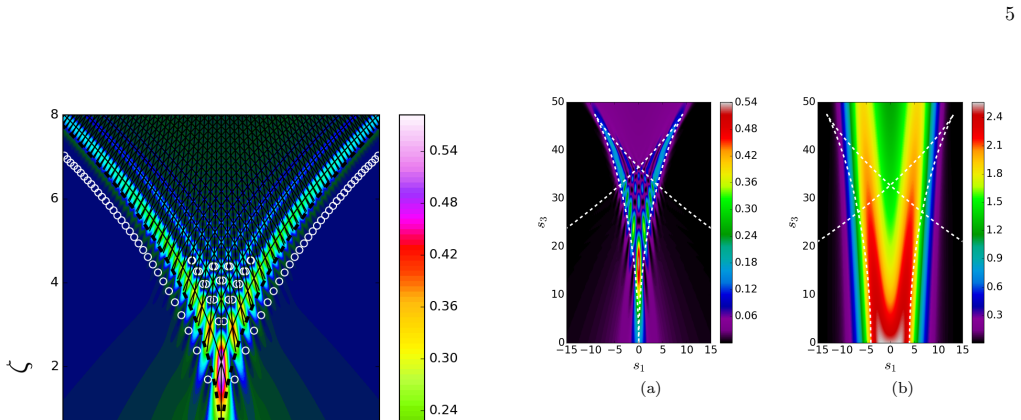
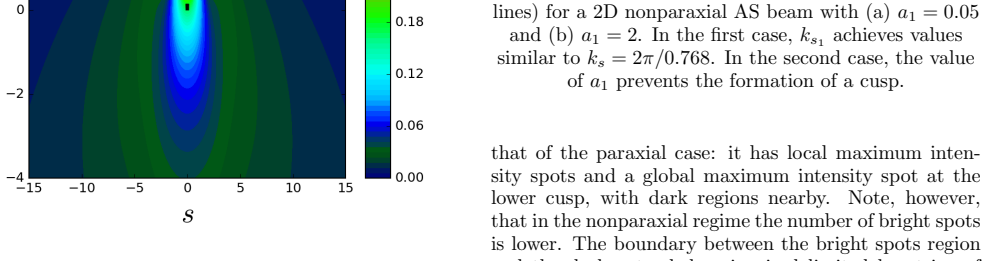
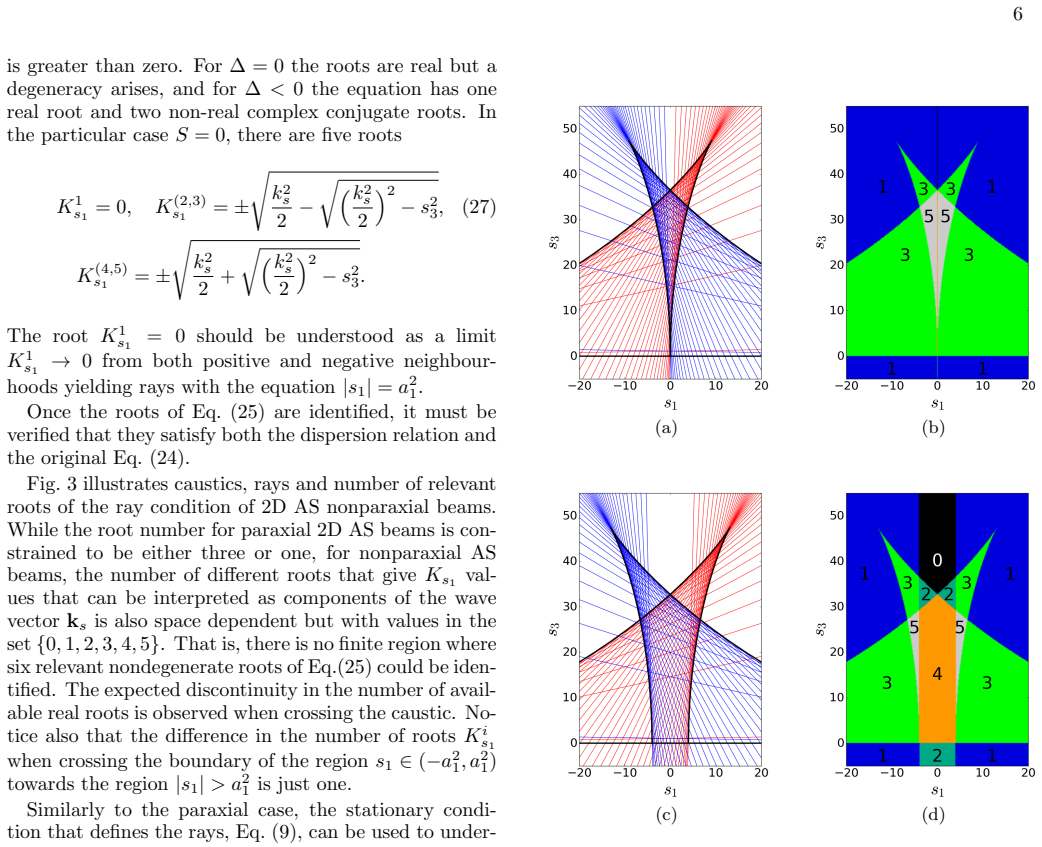
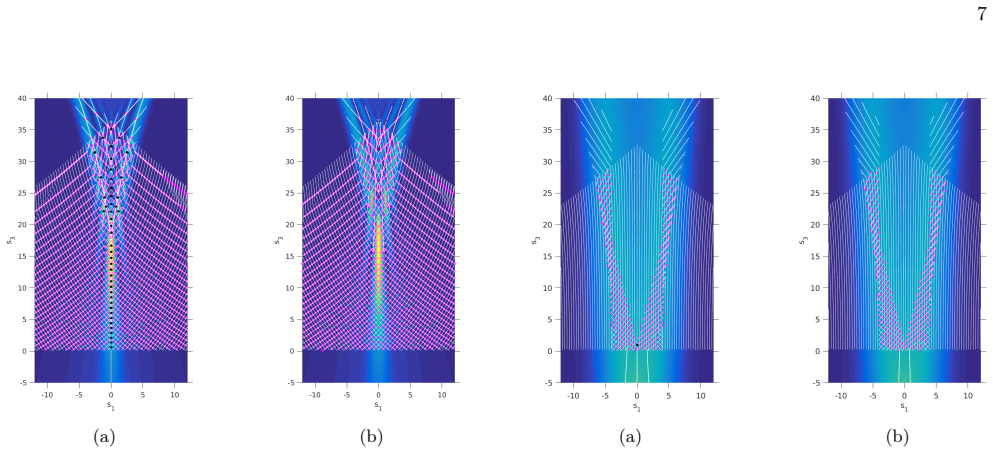
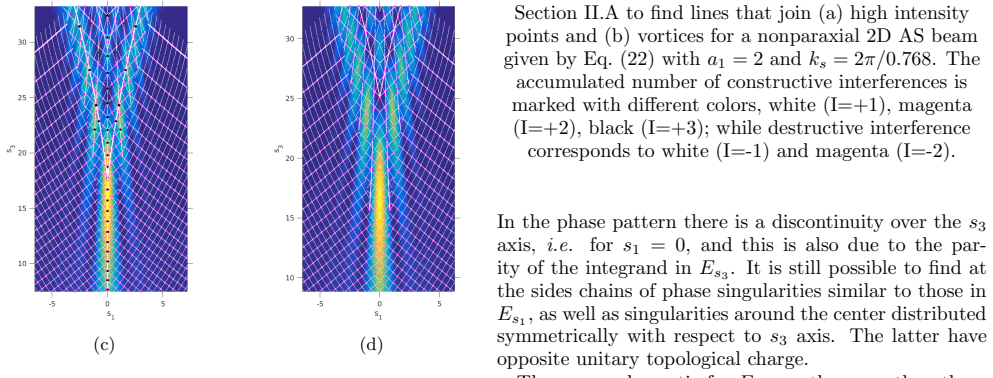
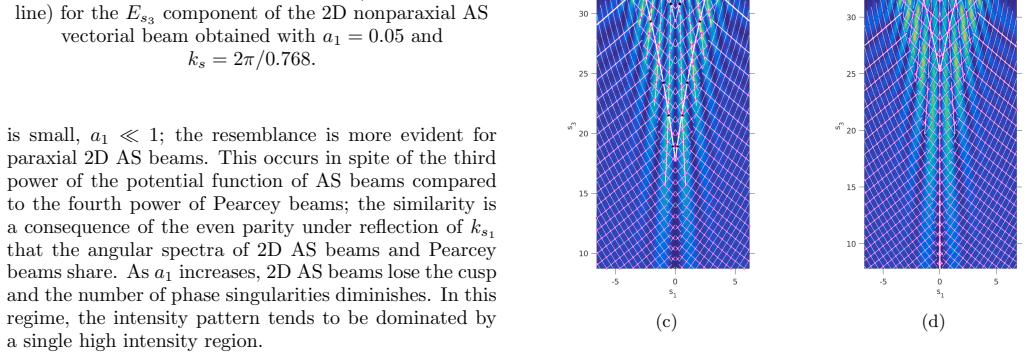
We explore the morphological properties of symmetric Airy beams in the paraxial and nonparaxial regimes. We consider a 2D electromagnetic realization with a single transverse component of the electric field, and in the nonparaxial regime, the longitudinal component along the optic axis. The general structure of these beams is analyzed with the combination of several approaches: geometrical optics through the use of caustics, the asymptotic wave properties of the light field using the stationary wave approximation and numerical integration. The geometrical optics approach involves locating the critical points that are later used in the stationary phase approximation. In the paraxial regime the highest order of the roots is 3, while in the nonparaxial regime, the order can be of up to 6. The technique yields conditions to identify interesting features on the beam, like the number of waves interfering constructively/destructively at the critical positions. The results are confirmed by the numerical simulations. In this way it is possible to distinguish and classify phase singularities like optical vortices and dislocations. The developed algorithm could be used to study any structured light field.
Editorial analysis
A structured set of objections, weighed in public.
Referee Report
Summary. The manuscript analyzes morphological properties of 2D symmetric Airy beams in paraxial and nonparaxial regimes via geometrical optics (caustics to locate critical points), stationary-phase approximation for wave asymptotics, and numerical integration. Paraxial roots reach order 3 and nonparaxial up to order 6; the method supplies explicit conditions for constructive/destructive interference at those points and classifies phase singularities (vortices, dislocations). Results are stated to be confirmed by numerics, with the algorithm positioned as applicable to general structured light fields.
Significance. If the stationary-phase treatment remains quantitatively accurate for the higher-order degeneracies, the work supplies a concrete procedure for extracting interference counts and singularity types from beam profiles. The explicit numerical cross-checks and the inclusion of the longitudinal E_z component constitute positive elements that strengthen the central claim.
major comments (1)
- [nonparaxial regime analysis] Nonparaxial regime (roots of order up to 6): the stationary-phase conditions for locating interference features and classifying singularities are derived from the elementary stationary-phase formula. Standard stationary-phase asymptotics apply to isolated simple or low-order stationary points (Airy/Pearcey); an order-6 degeneracy requires a distinct higher-order canonical integral whose leading term differs. The manuscript does not indicate that uniform asymptotic expansions or higher-order corrections were employed when the longitudinal E_z component is restored. This directly affects the reported interference counts and singularity classifications, which are load-bearing for the central claim.
minor comments (1)
- The abstract states that numerical integration confirms the stationary-phase predictions but does not specify the grid resolution, error metrics, or whether the comparison was performed before or after parameter tuning.
Simulated Author's Rebuttal
We thank the referee for the careful reading and constructive feedback on our manuscript. We address the single major comment below and outline the revisions we will make.
read point-by-point responses
-
Referee: Nonparaxial regime (roots of order up to 6): the stationary-phase conditions for locating interference features and classifying singularities are derived from the elementary stationary-phase formula. Standard stationary-phase asymptotics apply to isolated simple or low-order stationary points (Airy/Pearcey); an order-6 degeneracy requires a distinct higher-order canonical integral whose leading term differs. The manuscript does not indicate that uniform asymptotic expansions or higher-order corrections were employed when the longitudinal E_z component is restored. This directly affects the reported interference counts and singularity classifications, which are load-bearing for the central claim.
Authors: We agree that the elementary stationary-phase formula for isolated simple stationary points does not directly furnish the leading asymptotic term for an order-6 degeneracy, which would instead require the appropriate higher-order canonical integral. In the manuscript the stationary-phase condition is used only to locate the critical points (vanishing first derivative of the total phase) and to obtain the relative phase values that distinguish constructive from destructive interference. The reported interference counts and the classification of phase singularities (vortices versus dislocations) are extracted from these phase relations and are then cross-validated by direct numerical integration of the full vector field, including the restored longitudinal component E_z. We acknowledge that the text does not explicitly discuss the limitations of the elementary formula for high-order points. In the revised manuscript we will insert a short clarifying paragraph in the methods section that states the scope of the stationary-phase approximation employed and notes that amplitude scaling at order-6 points is not claimed from the asymptotic expression but is instead confirmed numerically. This constitutes a partial revision that leaves the central claims unchanged while improving transparency. revision: partial
Circularity Check
No circularity: standard asymptotic methods plus independent numerical checks form self-contained chain
full rationale
The derivation locates critical points via caustics (geometrical optics), applies stationary-phase formulas to obtain interference and singularity conditions, and validates against separate numerical integration. No equations reduce a claimed prediction or classification to a fitted parameter or self-defined quantity from the same data; the stationary-phase step is the standard asymptotic expansion applied to externally located roots. No load-bearing self-citations, uniqueness theorems, or ansatzes imported from prior author work appear in the provided text. The approach is externally falsifiable via the numerical benchmarks and uses only conventional methods.
Axiom & Free-Parameter Ledger
axioms (2)
- domain assumption Stationary phase approximation accurately captures asymptotic interference behavior of the electromagnetic field near caustics
- domain assumption Numerical integration of the wave equation provides an independent verification of the stationary-phase predictions
Reference graph
Works this paper leans on
-
[1]
This is physically equivalent to select the optical aperture
The paraxial condition can be mathematically implemented by the proper selection of the integration region. This is physically equivalent to select the optical aperture. An alternative is to choose an angular spectrum that is not negligible only on the appropriate wavevector region. The bidimensional finite energy Airy beam [19] is usu- ally defined by the ...
-
[2]
(5) Notice the presence of the parametera1 in the expressions of the overall phase
The overall phase in k space for a finite energy Airy beam in the paraxial regime is Φpx F (ks1; s1, ζ) = kss3 + k3 s1 /3− a2 1ks1 + ks1 s1− k2 s1 ζ/2, (4) while out of this regime Φnpx F (ks1; s1, s3) = k3 s1 /3− a2 1ks1 + ks1 s1 + √ k2s− k2s1 s3. (5) Notice the presence of the parametera1 in the expressions of the overall phase. Similarly, the bidimensio...
-
[3]
M. S. Soskin and M. V. Vasnetsov, “Singular Optics,” Progress in Optics 42 , 219276 (2001)
work page 2001
-
[4]
Dynamics of microparticles trapped in a per- fect vortex beam,
M. Chen, M. Mazilu, Y. Arita, E. M. Wright, and K. Dholakia, “Dynamics of microparticles trapped in a per- fect vortex beam,” Opt. Letts. 38, 49194922 (2013)
work page 2013
-
[5]
Quantized Rotation of Atoms from Photons with Orbital Angular Momentum,
M. F. Andersen, C. Ryu, P. Clad´ e, V. Natarajan, A. Vaziri, K. Helmerson, and W. D. Phillips, “Quantized Rotation of Atoms from Photons with Orbital Angular Momentum,” Phys. Rev. Letts. 97, 170406 (2006)
work page 2006
-
[6]
T. A. Klar, E. Engel, and S. W. Hell, “Breaking Abbe’s diffraction resolution limit in fluorescence microscopy with stimulated emission depletion beams of various shapes,” Phys. Rev. E 64, 066613 (2001)
work page 2001
-
[7]
Evolution of quan- tum superoscillations and optical superresolution with- out evanescent waves,
M. V. Berry and S. Popescu, “Evolution of quan- tum superoscillations and optical superresolution with- out evanescent waves,” J. Phys. A: Math. Gen. 39, 69656977 (2006)
work page 2006
-
[8]
Deep microstructure topography characterization with optical vortex interferometer,
J. Masajada, M. Leniec, E. Jankowska, H. Thienpont, H. Ottevaere, V. Gomez, “Deep microstructure topography characterization with optical vortex interferometer,”Opt. Express 16, 1917919191 (2008)
work page 2008
-
[9]
Rotational effects of twisted light on atoms beyond the paraxial approximation,
R. J´ auregui, “Rotational effects of twisted light on atoms beyond the paraxial approximation,” Phys. Rev. A 70, 033415 (2004)
work page 2004
-
[10]
Control of atomic transition rates via laser- light shaping,
R. J´ auregui, “Control of atomic transition rates via laser- light shaping,” Phys. Rev. A 91, 043842 (2015)
work page 2015
-
[11]
Transfer of optical orbital angular momentum to a bound electron,
C. T. Schmiegelow, J. Schulz, H. Kaufmann, T. Ruster, U. G. Poschinger, and F. Schmidt-Kaler, “Transfer of optical orbital angular momentum to a bound electron,” Nat. Commun. 7, 12998 (2016)
work page 2016
-
[12]
W. Ahn, S. V. Boriskina, Y. Hong, and B. M. Rein- hard, “Electromagnetic Field Enhancement and Spec- trum Shaping through Plasmonically Integrated Optical Vortices,” Nano Lett. 12 219227 (2012)
work page 2012
-
[13]
P. Kuang, S. Eyderman, M. Hsieh, A. Post, S. John, and S. Lin, “Achieving an Accurate Surface Profile of a Photonic Crystal for Near-Unity Solar Absorption in a Super Thin-Film Architecture,” ACS Nano 10 61166124 (2016)
work page 2016
-
[14]
Plasmonic materials for energy: From physics to applications,
S. V. Boriskina, H. Ghasemi and G. Chen, “Plasmonic materials for energy: From physics to applications,” Mater. Today 16, 375386 (2013)
work page 2013
-
[15]
Super-resolution optical telescopes with local light diffraction shrinkage,
C. Wang, D. Tang, Y. Wang, Z. Zhao, J. Wang, M. Pu, Y. Zhang, W. Yan, P. Gao, and X. Luo, “Super-resolution optical telescopes with local light diffraction shrinkage,” Sci. Rep. 5, 18485 (2015)
work page 2015
-
[16]
P. Vaveliuk, A. Lencina, J. A. Rodrigo, and O. Mar- tinez Matos, “Symmetric Airy beams,” Opt. Lett. 39, 23702373 (2014)
work page 2014
-
[17]
On the general prop- erties of symmetric incomplete Airy beams,
R. J´ auregui and P. A. Quinto-Su, “On the general prop- erties of symmetric incomplete Airy beams,” J. Opt. Soc. Am. A 31, 24842488 (2014)
work page 2014
-
[18]
Optical stacking of microparticles in a pyramidal structure created with a symmetric cubic phase,
P. A. Quinto-Su and R. J´ auregui, “Optical stacking of microparticles in a pyramidal structure created with a symmetric cubic phase,” Opt. Express 22, 1228312288 (2014)
work page 2014
-
[19]
Caustics, catastrophes, and symmetries in curved beams,
P. Vaveliuk, A. Lencina, J. A. Rodrigo, and O. Mar- tinez Matos, “Caustics, catastrophes, and symmetries in curved beams,” Phys. Rev. A 92, 033850 (2015)
work page 2015
-
[20]
M. V. Berry and N. L. Balazs, “Nonspreading wave pack- ets,” Am. J. Phys. 47, 264267 (1979)
work page 1979
-
[21]
Acceler- ating finite energy Airy beams,
G. A. Siviloglou and D. N. Christodoulides, “Acceler- ating finite energy Airy beams,” Opt. Lett. 32, 979981 (2007)
work page 2007
-
[22]
Observation of Accelerating Airy Beams,
G. A. Siviloglou, J. Broky, A. Dogariu and D. N. Christodoulides, “Observation of Accelerating Airy Beams,” Phys. Rev. Lett. 99, 213901 (2007)
work page 2007
-
[23]
Catastrophe Optics: Mor- phologies of caustics and their diffraction patterns,
M. V. Berry and C. Upstill, “Catastrophe Optics: Mor- phologies of caustics and their diffraction patterns,” Progress in Optics XVIII , 257323 (1980)
work page 1980
-
[24]
V. I. Arnold, Singularities of Caustics and Wave Fronts , Springer, Mathematics and Its Applications (Soviet Se- ries) Volume 62 (1990)
work page 1990
-
[25]
J. F. Nye, Natural Focusing and Fine Structure of Light: Caustics and Wave Dislocations , Taylor & Francis (1999)
work page 1999
-
[26]
V. I. Arnold, Catastrophe Theory , Springer, 3rd ed. (1992). 10
work page 1992
-
[27]
The structure of an electromagnetic field in the neighbourhood of a cusp of a caustic,
T. Pearcey, “The structure of an electromagnetic field in the neighbourhood of a cusp of a caustic,” Phil. Mag. 37, 311317 (1946)
work page 1946
-
[28]
Zur Darstellung von Wellenfeldern
W. Braunbek, “Zur Darstellung von Wellenfeldern”, Z. Naturforsch A 6, 12-15 (1951)
work page 1951
-
[29]
Topology of optical vortex lines formed by the inter- ference of three, four, and five plane waves
K. O’Holleran, M. J. Padgett and M. R. Den- nis,“Topology of optical vortex lines formed by the inter- ference of three, four, and five plane waves”,Opt. Express 14, 3039 (2006)
work page 2006
-
[30]
Self-healing properties of optical Airy beams,
J. Broky, G. A. Siviloglou, A. Dogariu, and D. N. Christodoulides, “Self-healing properties of optical Airy beams,” Opt. Express 16, 1288012891 (2008)
work page 2008
-
[31]
Airy beams: a geometric optics per- spective,
S. Vo, K. Fuerschbach, K. P. Thompson, M. A. Alonso, and J. P. Rolland, “Airy beams: a geometric optics per- spective,” J. Opt. Soc. Am. A 27, 25742582 (2010)
work page 2010
-
[32]
Auto-focusing and self-healing of Pearcey beams,
J. D. Ring, J. Lindberg, A. Mourka, M. Mazilu, K. Dho- lakia, and M. R. Dennis, “Auto-focusing and self-healing of Pearcey beams,” Opt. Express 20, 1895518966 (2012)
work page 2012
-
[33]
V. P. Maslov, Theoria vozmushchenii i asimptoticheskie metody (Theory of Perturbations and Asymptotic Meth- ods) (Izd. MGU, 1965) [French trans.: V. P. Maslov,The- orie des perturbations et methode asymptotique (Duod, 1972)]
work page 1965
-
[34]
Asymptotic theory of wave-propagation
R. M. Lewis, “Asymptotic theory of wave-propagation”, Arch. Ration. Mech. Anal. 20, 191 (1965)
work page 1965
-
[35]
Considerations on the electromagnetic flow in Airy beams based on the Gouy phase,
C. J. Zapata-Rodr´ ıguez, D. Pastor, and J. J. Miret, “Considerations on the electromagnetic flow in Airy beams based on the Gouy phase, ” Opt. Express 20, 2355323559 (2012)
work page 2012
-
[36]
Evolution from a Fraunhofer to a Pearcey diffraction pattern,
J. F. Nye, “Evolution from a Fraunhofer to a Pearcey diffraction pattern,”J. Opt. A: Pure Appl. Opt. 5, 495502 (2003)
work page 2003
-
[37]
Optics of nonuniformly moving media,
U. Leonhardt and P. Piwnicki, “Optics of nonuniformly moving media,” Phys. Rev. A 60, 4301 (1999)
work page 1999
-
[38]
GoosH¨ anchen and Im- bertFedorov shifts for bounded wavepackets of light,
M. Ornigotti and A. Aiello, “ GoosH¨ anchen and Im- bertFedorov shifts for bounded wavepackets of light,” J. Opt. 15, 014004 (2013)
work page 2013
discussion (0)
Sign in with ORCID, Apple, or X to comment. Anyone can read and Pith papers without signing in.