REVIEW 4 major objections 5 minor 24 references
Fast and Accurate Capitalization and Punctuation for Automatic Speech Recognition Using Transformer and Chunk Merging
T0 review · 4 major / 5 minor · reviewed 2026-08-14 · deepseek-v4-flash
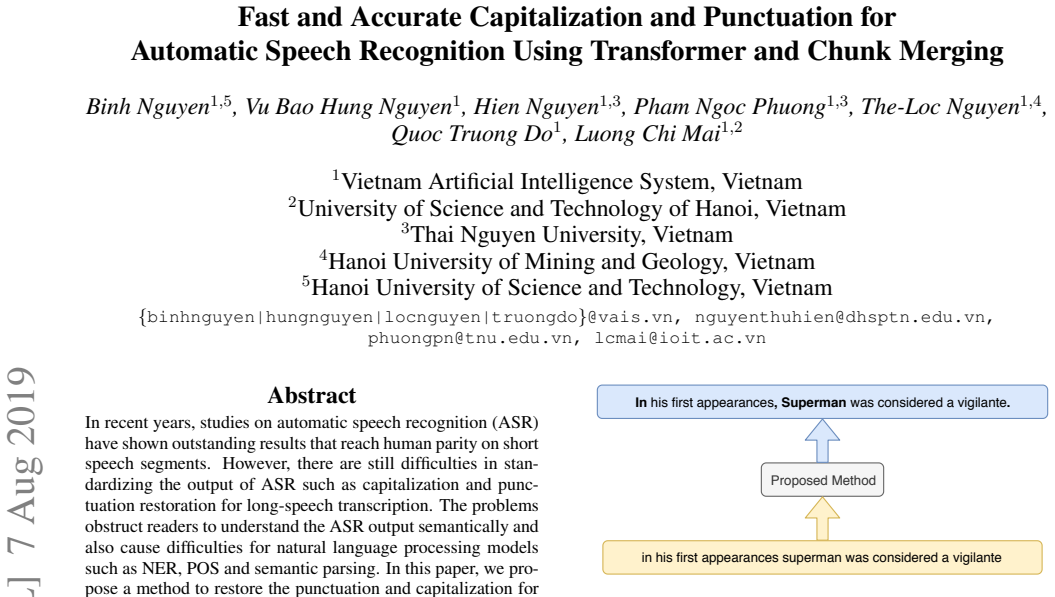
Pith's one-line read The paper claims that overlapping text chunks plus a single Transformer model can restore capitalization and punctuation in ASR transcripts more accurately and faster than non-overlapping baselines.
desk verdict Useful chunk-merging ablation for joint truecasing and punctuation, but the abstract's comparative and speed claims outrun the experiments. read the letter →
The pith
A machine-rendered reading of the paper's core claim, the machinery that carries it, and where it could break.
The reading
What carries the argument
The central object is the Overlapped-Chunk Split and Merging scheme. A long transcript is cut into chunks of size k with a sliding window of k/2, so consecutive chunks overlap; each chunk is labeled independently, and a parameter min_words_cut decides how many words at the end of the first chunk to discard and how many overlapped words from the second chunk to keep. This keeps only predictions made near the middle of a chunk, where self-attention has full context on both sides. The models themselves are standard sequence-to-sequence Transformers (including an Evolved Transformer variant) trained to output truecased, punctuated text directly, so capitalization and punctuation share one decoder.
What would settle it
Run the trained model on genuine ASR transcripts from conversational or noisy speech (not on preprocessed clean text) and compare question-mark, comma, and uppercase F1 against the same model without chunk merging. If the margin disappears or reverses on real errors, the central claim that overlapping chunks improve prediction accuracy for ASR output is not established. A second check: retune min_words_cut on a held-out validation set, then report test F1, to see whether the reported numbers survive without test-set tuning.
Extended reading notes
Core claim
Restoring capitalization and punctuation for ASR output can be done by one sequence-to-sequence model that maps lowercase unpunctuated text to formatted text, provided the input is split into overlapping chunks and the outputs are merged by keeping the region of each chunk where the model had enough left and right context. The paper demonstrates the mechanism with an Evolved Transformer: with chunk merging, F1 for question marks rises from 0.56 to 0.71, for full stops from 0.61 to 0.73, for commas from 0.41 to 0.56, and for uppercase words from 0.81 to 0.87. The same merging also improves a sequence-to-sequence LSTM by about one F1 point per class, which the authors take as evidence the benefit comes from the chunking strategy rather than the model. The authors further claim the approach is faster than conventional methods because chunks are decoded in parallel and the merge step runs in linear time.
Load-bearing premise
The load-bearing premise is that stripping punctuation and case from clean BNC text produces a faithful stand-in for ASR output; if real transcripts contain recognition errors, disfluencies, or uncertain word boundaries, the measured gains may not carry over.
Editorial extensions
If this is right
- Long ASR transcripts can be punctuated and truecased in parallel, so processing time scales with chunk count instead of full sequence length; the merge is O(n).
- A single model handles both capitalization and punctuation, removing the need to pipeline one restoration system into another.
- The same overlapped-chunk strategy improves both LSTM and Transformer models, suggesting it is a general remedy for boundary-context errors in sequence prediction.
- Question-mark restoration, the hardest class, gains the most from chunk merging (0.56 to 0.71), indicating that interrogative context is especially sensitive to missing left or right context.
Reading between the lines
- I would expect the chunk-merging benefit to shrink on real ASR transcripts, because recognition errors and disfluencies add noise the BNC simulation does not model; the paper has not demonstrated gains there.
- The min_words_cut parameter is tuned on test-set F1 curves, so part of the reported margin may be selection on the evaluation data; a held-out validation split would give a fairer estimate.
- The same merging trick could transfer to other long-sequence labeling tasks with boundary errors, such as sentence segmentation, named-entity tagging, or punctuation for machine translation input.
Editorial analysis
A structured set of objections, weighed in public.
Referee Report
Summary. The manuscript proposes an overlapped-chunk splitting and merging procedure for punctuation and capitalization restoration in long ASR transcripts. An end-to-end sequence-to-sequence model (an LSTM or an Evolved Transformer) is applied to overlapping chunks of the input; the overlap region is trimmed according to a parameter called min_words_cut, and the outputs are concatenated into a final sentence. Experiments on the British National Corpus report F1 improvements for the Evolved Transformer (uppercase 0.81→0.87, question mark 0.56→0.71) relative to the same system without merging, and the abstract claims the approach outperforms existing methods in both accuracy and decoding speed.
Significance. If the reported gains are genuine and reproducible, the chunk-merging idea is a simple and useful contribution: it is model-agnostic, supports parallel decoding, and appears to improve boundary predictions by giving the model extra left and right context. The paper is transparent about its architecture and includes a useful confusion-matrix analysis. However, the central comparative claims are not supported by the evidence as presented: there are no external baselines, no inference-time measurements, and the key merging hyperparameter is chosen using the evaluation F1 curve. The paper is therefore best viewed as an internal ablation, not as a demonstrated state-of-the-art result. With proper validation, external comparisons, and timing measurements, the contribution could be solid for a workshop-tier or short-paper venue.
major comments (4)
- [Section 4.4, Figure 5] The merging parameter min_words_cut is chosen by inspecting F1 scores computed on the evaluation test set: the text reports F1 for min_words_cut ranging from 0 to 15 with peaks in the middle range, and no separate validation split is described in Sections 3.3 or 4.1. Since Figure 5 shows that the question-mark F1 curve is not flat and is described as 'quite sensitive' to this parameter, the 0.56-to-0.71 question-mark gain in Table 3 may be partly a selection artifact. The claimed gains should be re-estimated after fixing min_words_cut on a validation set or through cross-validation, and the test set should be used only once.
- [Abstract, Section 4.4, Conclusion] The claim that the approach 'outperforms existing methods in both accuracy and decoding speed' is not tested. Tables 2-4 compare the proposed merging only against the identical model without merging; no prior punctuation or capitalization systems are run as baselines, and no decoding latency or throughput is measured anywhere in the paper. To support the abstract and conclusion, the authors should add comparisons to at least one established baseline (e.g., a CRF-based or LSTM-based punctuation system) and report wall-clock time or tokens-per-second measurements for chunked parallel decoding versus non-chunked decoding. The assertion that the concatenation algorithm is O(n) does not by itself establish decoding speed.
- [Section 3.3] The evaluation simulates ASR output by stripping case and punctuation from clean BNC sentences. Real ASR output contains recognition errors, disfluencies, and uncertain word boundaries that are absent from this preprocessing, so the reported improvements may not transfer to actual transcripts. The authors should either evaluate on real ASR output (for example, transcripts produced by an open ASR system applied to speech data) or inject realistic noise into the evaluation data, and in the abstract and conclusion should scope the claims accordingly.
- [Section 4.3, Table 2] The conclusion that chunk merging improves F1 'consistently by 1%' for the sequence-to-sequence LSTM is based on point estimates from what appears to be a single run, with no confidence intervals or significance testing. Given that min_words_cut is selected on the test set, these small gains are within the range that could arise from tuning noise, so the LSTM result in Table 2 should be accompanied by variance estimates or a significance test.
minor comments (5)
- [Throughout] There are numerous typos and formatting inconsistencies, including 'incoporate' (Section 1), 'comparision' (Section 3.3), 'overlap-ping' (Figure 2), and inconsistent capitalization of 'F1-score' versus 'F1 score'.
- [Sections 3.2 and 4.4] The chunk size k is never reported explicitly; the overlap is stated as 15 words, but the chunk size and sliding-window size are not specified for the reported configurations. Please state k and the overlap size for every experiment so that the setup is reproducible.
- [Section 2, references] The Evolved Transformer is cited to reference [14], which is Zoph and Le's neural architecture search paper, but the Evolved Transformer architecture itself is a separate work (So et al., 2019, 'Evolved Transformer'). A proper citation for the Evolved Transformer should be added.
- [Figure 5] Figure 5 would be clearer if it were accompanied by numeric F1 values for the endpoints and the peak, since the text only says that scores peak in the middle range of min_words_cut; a small table or in-text values would help the reader quantify the sensitivity.
- [Table 1] The notation in Table 1 (e.g., '$' meaning no punctuation after a word) is explained only in the body text and not in the table caption, which makes the table difficult to interpret in isolation.
Circularity Check
No circular derivation: the reported gains are empirical comparisons on held-out data, and the min_words_cut exploration is a hyperparameter study, not a circular step.
full rationale
The paper proposes an overlapped-chunk split and merging method for capitalization and punctuation restoration in ASR transcripts. The model is trained on BNC training sentences and evaluated on a held-out test set. The improvement from chunk merging is measured by comparing the same underlying model (LSTM or Evolved Transformer) with and without the merging module, and the results are reported as F1 scores on the test set. There are no self-citations; all cited works are external prior art. The only free parameter of the merging algorithm, min_words_cut, is explored in Section 4.4 across values 0 to 15, and the paper shows that F1 scores peak in the middle range. The paper does not explicitly state that the final comparisons in Tables 2 and 3 were obtained with a min_words_cut value selected by maximizing test-set F1; if that were the case, the reported gains could be optimistically biased, but that would be a statistical overfitting concern rather than a definitional or self-citational circularity. No equation in the paper defines a predicted quantity in terms of a fitted parameter, and no load-bearing claim rests on a citation to the authors' own prior work. The derivation chain is therefore self-contained, and no circular step can be identified from the text.
Assumptions & free parameters
free parameters (2)
- min_words_cut =
not reported; F1 peaks for values 4-10
- chunk size k and overlap k/2 =
not reported consistently; example uses 10, overlap 15 in Figure 5
assumptions (3)
- domain assumption Clean BNC text with punctuation and case stripped is a valid simulation of ASR output.
- domain assumption A word-level sequence-to-sequence model with only text input has enough information to restore punctuation and capitalization.
- ad hoc to paper Keeping the latter part of the overlap from the second chunk is at least as reliable as the first chunk's prediction, given min_words_cut.
Cite this review
Pith. "Pith review of Fast and Accurate Capitalization and Punctuation for Automatic Speech Recognition Using Transformer and Chunk Merging." pith.science (2026). https://pith.science/paper/BWIKTLZA
@misc{pith2026190802404,
  author       = {Pith},
  title        = {Pith review of: Fast and Accurate Capitalization and Punctuation for Automatic Speech Recognition Using Transformer and Chunk Merging},
  year         = {2026},
  howpublished = {\url{https://pith.science/paper/BWIKTLZA}},
  note         = {Machine review of arXiv:1908.02404}
}
read the original abstract
In recent years, studies on automatic speech recognition (ASR) have shown outstanding results that reach human parity on short speech segments. However, there are still difficulties in standardizing the output of ASR such as capitalization and punctuation restoration for long-speech transcription. The problems obstruct readers to understand the ASR output semantically and also cause difficulties for natural language processing models such as NER, POS and semantic parsing. In this paper, we propose a method to restore the punctuation and capitalization for long-speech ASR transcription. The method is based on Transformer models and chunk merging that allows us to (1), build a single model that performs punctuation and capitalization in one go, and (2), perform decoding in parallel while improving the prediction accuracy. Experiments on British National Corpus showed that the proposed approach outperforms existing methods in both accuracy and decoding speed.
Figures


Figures from the paper (2 more)


Reference graph
Works this paper leans on
-
[1]
Introduction In a typical setup of an ASR system, punctuation and capital- ization of words are removed because they do not affect the pronunciation of words. As the result, the output of ASR con- tains purely a sequence of words or alphabet characters depend- ing on the model type. While this output is sufficient for many applications, such as voice comma...
-
[2]
End-to-end Model for Punctuation and Segmentation End2end models for punctuation works in a similar way with machine translation tasks [10, 11] where it takes input is a se- quence of of lowercase, unpunctuated words and outputs a se- quence with truecase and punctuation inserted. Figure 2a illus- trates the use of end-to-end models for restoring capitali...
-
[3]
Proposed Method Figure 2b describes our system architecture. The system works as follows, first, output from and ASR module (lowercase with- out punctuation) is fed to the Overlapped-Chunk Split module to produce overlapped segments. Second, the Capitalization and Punctuation Model takes the split segments and processes them in parallel to output a list of...
-
[4]
and Tilk et al. [5] incoporate more information from speech signal to improve the performance. In [6, 7], dynamic condi- tional random fields (CRFs) [8] were used to predict punctua- tion. The works proposed by Cho et al. [9] and Tilk et al. [5] Proposed Method In his first appearances, Superman was considered a vigilante. in his first appearances superman w...
work page Pith review arXiv 1908
-
[5]
Conclusion In this research, we have proposed an end-to-end model that restores both punctuation and capitalization in one go. With chunk-split-merging, the method can splits and processes sen- tences in parallel and merges outputs to form the final sentence output. Experiments shows that the approach outperform exist- ing methods that do not utilize chunk...
-
[6]
Experiments and Results 4.1. Corpus Description To train and evaluate the proposed method, we use the British National Corpus (BNC) [16] that contains 100 million words in both written and spoken language from a wide range of sources. It is designed to represent a large cross-section of British En- glish from late 20 th century. We use the XML edition whi...
-
[7]
Improved models for auto- matic punctuation prediction for spoken and written text
N. Ueffing, M. Bisani, and P. V ozila, “Improved models for auto- matic punctuation prediction for spoken and written text.” in In- terspeech, 2013, pp. 3097–3101
work page 2013
-
[8]
E. Cho, J. Niehues, and A. Waibel, “Segmentation and punctua- tion prediction in speech language translation using a monolingual translation system,” in International Workshop on Spoken Lan- guage Translation (IWSLT) 2012, 2012
work page 2012
Show all 24 references
-
[9]
Named entity recognition: Exploring features
M. Tkachenko and A. Simanovsky, “Named entity recognition: Exploring features.” in Proceeding of KONVENS, 2012, pp. 118– 127
2012
-
[10]
A survey on recent advances in named entity recognition from deep learning models,
V . Yadav and S. Bethard, “A survey on recent advances in named entity recognition from deep learning models,” in Proceedings of CICLing, 2018, pp. 2145–2158
2018
-
[11]
Punctuation prediction model for conversational speech,
P. elasko, P. Szymaski, J. Mizgajski, A. Szymczak, Y . Carmiel, and N. Dehak, “Punctuation prediction model for conversational speech,” Interspeech 2018 , Sep 2018. [Online]. Available: http://dx.doi.org/10.21437/Interspeech.2018-1096
2018 doi
-
[12]
Lstm for punctuation restoration in speech transcripts,
O. Tilk and T. Alum ¨ae, “Lstm for punctuation restoration in speech transcripts,” in Sixteenth annual conference of the inter- national speech communication association, 2015
2015
-
[13]
Better punctuation prediction with dynamic conditional random fields,
W. Lu and H. T. Ng, “Better punctuation prediction with dynamic conditional random fields,” inProceedings of the 2010 conference on empirical methods in natural language processing , 2010, pp. 177–186
2010
-
[14]
To modify Transformer model configuration toward a better one, ET uses an evolution-based algorithm with an innovative approach to expedite the process
to look for the most promising setup among different al- ternatives of neural networks. To modify Transformer model configuration toward a better one, ET uses an evolution-based algorithm with an innovative approach to expedite the process
-
[15]
Conditional random fields: Probabilistic models for segmenting and labeling sequence data,
J. Lafferty, A. McCallum, and F. C. Pereira, “Conditional random fields: Probabilistic models for segmenting and labeling sequence data,” 2001
2001
-
[16]
Nmt-based segmentation and punctuation insertion for real-time spoken language translation
E. Cho, J. Niehues, and A. Waibel, “Nmt-based segmentation and punctuation insertion for real-time spoken language translation.” in INTERSPEECH, 2017, pp. 2645–2649
2017
-
[17]
OpenNMT: Open-source toolkit for neural machine translation,
G. Klein, Y . Kim, Y . Deng, J. Senellart, and A. M. Rush, “OpenNMT: Open-source toolkit for neural machine translation,” in Proc. ACL , 2017. [Online]. Available: https: //doi.org/10.18653/v1/P17-4012
2017 doi
-
[18]
Neural machine translation by jointly learning to align and translate,
D. Bahdanau, K. Cho, and Y . Bengio, “Neural machine translation by jointly learning to align and translate,” 2014
2014
-
[19]
Sequence to sequence learning with neural networks,
I. Sutskever, O. Vinyals, and Q. V . Le, “Sequence to sequence learning with neural networks,” inAdvances in neural information processing systems, 2014, pp. 3104–3112
2014
-
[20]
Attention is all you need,
A. Vaswani, N. Shazeer, N. Parmar, J. Uszkoreit, L. Jones, A. N. Gomez, Ł. Kaiser, and I. Polosukhin, “Attention is all you need,” in Advances in Neural Information Processing Systems, 2017, pp. 5998–6008
2017
-
[21]
Neural architecture search with reinforce- ment learning,
B. Zoph and Q. V . Le, “Neural architecture search with reinforce- ment learning,”arXiv preprint arXiv:1611.01578, 2016
2016 arXiv
-
[22]
Tensor2tensor for neural machine translation,
A. Vaswani, S. Bengio, E. Brevdo, F. Chollet, A. N. Gomez, S. Gouws, L. Jones, L. Kaiser, N. Kalchbrenner, N. Parmar, R. Sepassi, N. Shazeer, and J. Uszkoreit, “Tensor2tensor for neural machine translation,” CoRR, vol. abs/1803.07416, 2018. [Online]. Available: http://arxiv.or...
2018 arXiv
-
[23]
Consortium, The British National Corpus, version 3 (BNC XML Edition)
B. Consortium, The British National Corpus, version 3 (BNC XML Edition). Bodleian Libraries, University of Oxford, 2007
2007
-
[24]
Nltk: the natural language toolkit,
E. Loper and S. Bird, “Nltk: the natural language toolkit,” arXiv preprint cs/0205028, 2002
2002 arXiv
Reviewed August 14, 2026 · model on record in the stance chip above.
Discussion (0). Continue with ORCID to comment.