REVIEW 3 major objections 4 minor 16 references
Fitting in or odd one out? Pulls vs residual responses in $b\to s \ell^+\ell^-$
T0 review · 3 major / 4 minor · reviewed 2026-08-14 · deepseek-v4-flash
Pith's one-line read LHCb's new R_K pulls a key new-physics coefficient C10μ toward zero, and a fresh global fit confirms the shift.
desk verdict Useful worked example of a Hessian-based shortcut, honestly validated, but the abstract over-claims when it attributes the C10mu shift to RK and the validation is not independent. read the letter →
The pith
A machine-rendered reading of the paper's core claim, the machinery that carries it, and where it could break.
The reading
What carries the argument
The central object is the residual response $δ_i^{{j±}}$ = ($T_i^{{j±}}$ − $T_i^{{BF}}$) / $\sqrt$(Δ²_exp,i + Δ²_BF,i), evaluated at the twelve SVD points that approximate the 1σ ellipsoid of the old six-dimensional fit via the Hessian. These numbers quantify how much each observable's prediction can vary within the fit uncertainty, and comparing old and new values—which rescale purely from reduced experimental errors—reveals which SVD directions the new measurements constrain. The companion Pull metric (T_BF,i − O_i)/$\sqrt$(Δ²_exp,i + Δ²_BF,i) flags observables inconsistent with the fit.
What would settle it
Redo the six-parameter global fit with the new LHCb R_K but without the Belle and B_s→μ+μ− updates; if the new best-fit point does not move toward C10μ^NP ≈ 0.14 along direction 4−, with the uncertainty shrinking accordingly, the residual-response prediction fails. Alternatively, a future more precise R_K measurement whose central value moves above 0.9, closer to the standard model, would directly test the predicted monotonic pull on C10μ.
Extended reading notes
Core claim
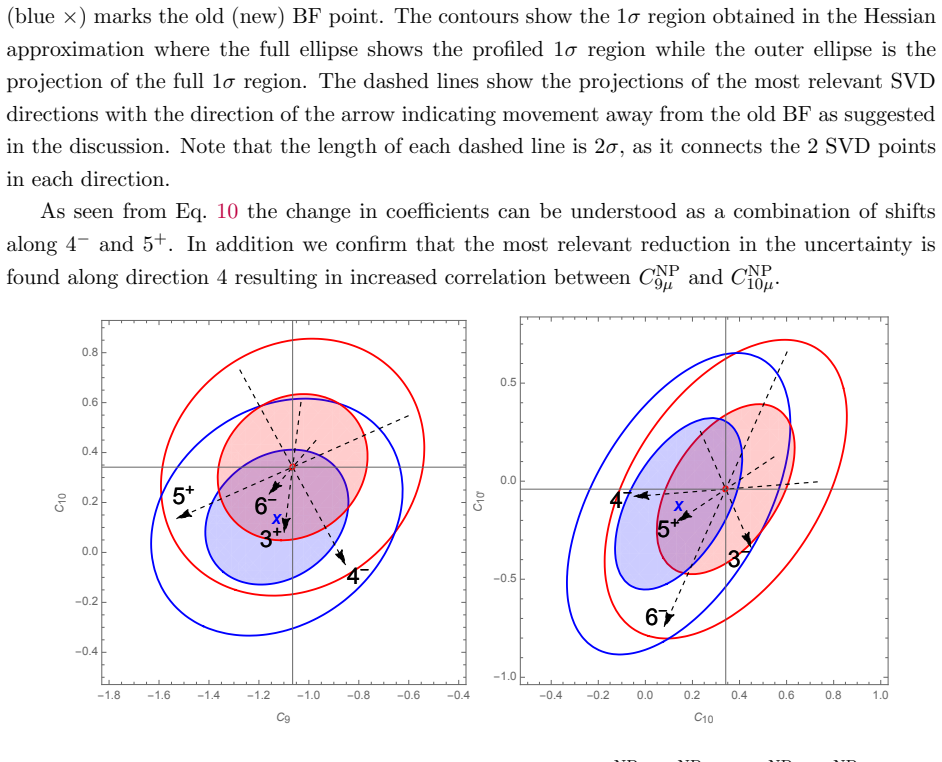
On its own terms, the paper claims that the main impact of the new results—specifically the LHCb average $R_K^{{[1.1,6]}}$ = 0.846—is to tighten the constraint along SVD direction 4, which is mostly C10μ^NP, and to shift the best fit toward the standard model along that direction. In the validation fit, C10μ^NP changes from 0.34 to 0.14, the only significant shift among the six Wilson coefficients, while the pull away from the standard model stays at 5.0σ. The paper further finds that $R_K^{{[1.1,6]}}$ (LHCb) becomes the dominant observable for directions 3± and 4±, and that the updated B(B_s→μ+μ−), depending on the averaging prescription, either slightly shifts C10′ or only reduces uncertainty.
Load-bearing premise
The shortcut assumes the old six-dimensional χ² surface is well approximated by the Hessian at the previous best-fit point, so that the twelve SVD directions capture the full uncertainty envelope and the shift predicted from new measurements actually matches the updated fit.
Editorial extensions
If this is right
- The updated R_K measurement alone now dominates the constraint on the C10μ direction of the global fit, more than any single previous observable.
- The shift along direction 4− means the data prefer a smaller C10μ^NP, moving closer to the standard model in that coefficient while C9μ^NP remains the only large new-physics effect.
- The framework suggests that publishing Hessian approximations alongside global fits would allow quick, fit-free assessments of future measurements, a practice the paper explicitly encourages.
- The R_K^{[14.18<q2]} example shows that a large Pull with small residual responses signals a measurement that lies outside the fit's 1σ region yet does not constrain it, offering a systematic consistency or exclusion criterion.
Reading between the lines
- The method turns a six-dimensional fit into a transferable public artifact: anyone with the Hessian and SVD points can price a new measurement without access to the full fit, a workflow the paper leaves implicit.
- The decrease in C10μ^NP with reduced uncertainty could be read as the b→sℓ+ℓ− anomalies consolidating into a single dominant new-physics effect in C9μ, with C10μ receding—a pattern that future, more precise R_K data will test directly.
- A direct extension would apply the same residual-response analysis to Belle II's R_K and R_K* results as they become more precise; based on current central values, the framework predicts they will start constraining directions 3± and 4±.
Editorial analysis
A structured set of objections, weighed in public.
Referee Report
Summary. This paper applies the residual-response framework developed in the authors' earlier work (arXiv:1811.10793) to assess the impact of several 2019 b→s ℓ+ℓ− measurements on a six-parameter Wilson-coefficient global fit. The new measurements considered are the updated LHCb R_K average, Belle R_K* and R_K results, and updated B(Bs→μ+μ−) averages under two alternative prescriptions (Eqs. 3 and 4). The residual-response analysis identifies R_K[1.1,6] as the dominant new constraint, pushing the fit along SVD direction 4−, which corresponds to a decrease in C10mu^NP. The paper validates this conclusion with a new global fit showing C10mu^NP decreasing from 0.34 to 0.14, with reduced uncertainty, while other coefficients shift less significantly. It also makes a secondary prediction for C10′mu from the Eq. (3) treatment of B(Bs→μ+μ−).
Significance. If the framework is reliable, this note demonstrates a practical shortcut for assessing the impact of new measurements without redoing global fits, and it encourages other groups to publish Hessian approximations, which could be a community-wide benefit. The validation fit confirms the headline shift in C10mu^NP, and the paper is transparent about its limitations, notably the use of Eq. (4) for the validation fit and the consequent lack of validation for the Eq. (3)-based prediction. The work is specifically useful because it translates a multi-dimensional fit into interpretable, single-observable diagnostics.
major comments (3)
- [§4 (Eq. 9) and Abstract] The abstract states that the main impact of the new results is 'due to R_K[1.1,6] from LHCb', but the validation fit in Eq. (9) updates all new measurements simultaneously and does not isolate the effect of R_K. The residual-response tables (Tables 2 and 3) provide directional information, but they do not by themselves quantify the shift in the best-fit point caused by a specific measurement. Please either perform a fit with only R_K updated or provide an explicit decomposition (e.g., sequential fits) to support the attribution. Without this, the 'due to R_K' claim remains an inference rather than a demonstrated result.
- [§5 and §4] The paper predicts that treating B(Bs→μ+μ−) as in Eq. (3) would cause a further shift in C10′mu toward negative values, but the validation fit uses Eq. (4) and therefore does not test this prediction. Since the choice between Eq. (3) and Eq. (4) is a modeling assumption, the reader cannot assess whether this prediction is correct. Please either validate it with a fit using Eq. (3) or soften the claim in Section 5 accordingly.
- [§3 (Eq. 8) and §4 (Eq. 10)] The framework predicts no significant movement along direction 5, but the validation fit shows a shift in v5 from 0.87 to 1.0. The authors explain this as due to the cumulative nature of constraints in that direction. This suggests that the residual-response approximation can miss shifts in directions with distributed constraints. Please discuss the reliability of the attribution method in such cases, or quantify the expected accuracy of the framework's directional predictions.
minor comments (4)
- [Table 2] Table 2 would benefit from explicit column headers distinguishing R_K old/new and B(Bs→μ+μ−) old/new; the current layout requires careful reading of the caption to interpret the four numbers per row.
- [§2] The statement that the χ2 increase of 1.7 is 'roughly 0.07σ' is unclear; please specify the relation (e.g., sqrt of the χ2 change) or rephrase to avoid confusion.
- [Figure 1] In the B(Bs→μ+μ−) panel, the SM prediction is not visible in the printed q2 range; please add a marker or note its position so that the comparison with the data is clear.
- [§1] The justification for excluding the other Belle R_K q2 ranges 'following Ref. [9]' would be clearer if the specific theoretical-error difficulty were stated explicitly, rather than pointing only to that reference.
Circularity Check
No circularity: the central C10mu shift is re-derived in a new global fit, and the residual-response framework is explicitly validated rather than used as a fitted input.
full rationale
The paper's central claim—that the updated LHCb R_K[1.1,6] mainly decreases C10mu^NP with reduced uncertainty—is not derived by construction from its own inputs. The residual-response analysis in Section 3 is presented as a fast diagnostic based on the Hessian/SVD framework of the authors' prior paper [1]; it gives a directional expectation (a shift along SVD direction 4-) rather than a numerical prediction of the best-fit coefficients. That expectation is then independently checked by an actual new global fit in Section 4, Eq. (9), which directly fits the Wilson coefficients to all updated observables. The new fit shows C10mu^NP moving from 0.34 to 0.14 and also reveals an unanticipated shift along direction 5, which the authors explicitly acknowledge could not be predicted by their framework. This acknowledgment shows the validation is not forced: the framework did not dictate the full outcome. The attribution of the shift to R_K is inferred from Tables 2 and 3 and the Pull values, not isolated by a fit that only updates R_K; this is a limitation in causal attribution, not circularity. Self-citations to [1] and [2] provide the previous fit and the Hessian/SVD machinery, but the conclusion is re-derived from data in the new fit, so those citations are not load-bearing in a circular sense. No equation or fitted parameter is renamed as a prediction; no definition of the framework implies the outcome. Thus there is no significant circularity.
Assumptions & free parameters
free parameters (6)
- C7^NP (new BF) =
0.01
- C7'^NP (new BF) =
0.02
- C9mu^NP (new BF) =
-1.13
- C9'mu^NP (new BF) =
0.44
- C10mu^NP (new BF) =
0.14
- C10'mu^NP (new BF) =
-0.12
assumptions (4)
- domain assumption The b→s l+l- observables are described by the Standard Model effective Hamiltonian with six relevant Wilson coefficients (C7, C7', C9mu, C9'mu, C10mu, C10'mu).
- domain assumption Theory predictions for each observable as a function of the Wilson coefficients are taken from the literature (as in [1] and references therein).
- domain assumption The χ2 surface around the best-fit point is well approximated by the Hessian from the six-parameter fit of [1], so SVD points and residual responses reliably describe the 1σ envelope.
- domain assumption Correlations between observables can be neglected when computing Pull and residual responses for individual observables.
Cite this review
Pith. "Pith review of Fitting in or odd one out? Pulls vs residual responses in $b\to s \ell^+\ell^-$." pith.science (2026). https://pith.science/paper/AI6FU7SF
@misc{pith2026190803338,
  author       = {Pith},
  title        = {Pith review of: Fitting in or odd one out? Pulls vs residual responses in $b\to s \ell^+\ell^-$},
  year         = {2026},
  howpublished = {\url{https://pith.science/paper/AI6FU7SF}},
  note         = {Machine review of arXiv:1908.03338}
}
abstract
New results in processes with an underlying quark transition $b\to s \ell^+\ell^-$ have been recently reported by the LHCb and Belle II collaborations. In this note we show how the main implications of a handful of new measurements can be understood with the tools introduced in our recent paper, arXiv:1811.10793, without the need to redo the global fits. We find that the main impact of the new results, due to $R_K^{[1.1,6]}$ from LHCb, is a decrease in $C_{10\mu}^{NP}$ with a reduced uncertainty. We validate this conclusion by presenting the result of a new global fit.
Figures

Reference graph
Works this paper leans on
-
[1]
B. Capdevila, U. Laa and G. Valencia, Anatomy of a six-parameter fit to the b→s𝓁+𝓁− anomalies, Eur. Phys. J. C79 (2019) 462, [ 1811.10793]
arXiv 2019
-
[2]
B. Capdevila, A. Crivellin, S. Descotes-Genon, J. Matias and J. Virto, Patterns of New Physics in b→s𝓁+𝓁− transitions in the light of recent data , JHEP 01 (2018) 093, [1704.05340]
arXiv 2018
-
[3]
Aaij et al., Search for lepton-universality violation in B+→K+𝓁+𝓁− decays, Phys
LHCb collaboration, R. Aaij et al., Search for lepton-universality violation in B+→K+𝓁+𝓁− decays, Phys. Rev. Lett. 122 (2019) 191801, [ 1903.09252]
arXiv 2019
-
[4]
Aaij et al., Test of lepton universality using B+→K+𝓁+𝓁− decays, Phys
LHCb collaboration, R. Aaij et al., Test of lepton universality using B+→K+𝓁+𝓁− decays, Phys. Rev. Lett. 113 (2014) 151601, [ 1406.6482]
arXiv 2014
-
[5]
S. Descotes-Genon, L. Hofer, J. Matias and J. Virto, Global analysis of b→s𝓁𝓁 anomalies, JHEP 06 (2016) 092, [ 1510.04239]
arXiv 2016
-
[6]
Abdesselam et al., Test of lepton flavor universality in B→K∗𝓁+𝓁− decays at Belle , 1904.02440
Belle collaboration, A. Abdesselam et al., Test of lepton flavor universality in B→K∗𝓁+𝓁− decays at Belle , 1904.02440
arXiv 1904
- [7]
-
[8]
J. Aebischer, W. Altmannshofer, D. Guadagnoli, M. Reboud, P. Stangl and D. M. Straub, B-decay discrepancies after Moriond 2019 , 1903.10434. 9
arXiv 2019
Show all 16 references
-
[9]
Alguero, B
M. Alguero, B. Capdevila, A. Crivellin, S. Descotes-Genon, P. Masjuan, J. Matias et al., Emerging patterns of New Physics with and without Lepton Flavour Universal contributions , 1903.09578
1903 arXiv
-
[10]
Abdesselam et al., Test of lepton flavor universality in B→K𝓁+𝓁− decays, 1908.01848
A. Abdesselam et al., Test of lepton flavor universality in B→K𝓁+𝓁− decays, 1908.01848
1908 arXiv
-
[11]
Aaij et al., Angular analysis of the B0→K∗0µ+µ− decay using 3 fb−1 of integrated luminosity, JHEP 02 (2016) 104, [ 1512.04442]
LHCb collaboration, R. Aaij et al., Angular analysis of the B0→K∗0µ+µ− decay using 3 fb−1 of integrated luminosity, JHEP 02 (2016) 104, [ 1512.04442]
2016 arXiv
-
[12]
Aaij et al., Measurements of the S-wave fraction in B0→K+π−µ+µ− decays and the B0→K∗(892)0µ+µ− differential branching fraction, JHEP 11 (2016) 047, [ 1606.04731]
LHCb collaboration, R. Aaij et al., Measurements of the S-wave fraction in B0→K+π−µ+µ− decays and the B0→K∗(892)0µ+µ− differential branching fraction, JHEP 11 (2016) 047, [ 1606.04731]
2016 arXiv
-
[13]
Aaij et al., Measurement of the B0 s→µ+µ− branching fraction and effective lifetime and search for B0→µ+µ− decays, Phys
LHCb collaboration, R. Aaij et al., Measurement of the B0 s→µ+µ− branching fraction and effective lifetime and search for B0→µ+µ− decays, Phys. Rev. Lett. 118 (2017) 191801, [1703.05747]
2017 arXiv
-
[14]
Aaij et al., Test of lepton universality with B0→K∗0𝓁+𝓁− decays, JHEP 08 (2017) 055, [ 1705.05802]
LHCb collaboration, R. Aaij et al., Test of lepton universality with B0→K∗0𝓁+𝓁− decays, JHEP 08 (2017) 055, [ 1705.05802]
2017 arXiv
-
[15]
B.-T. Wang, T. J. Hobbs, S. Doyle, J. Gao, T.-J. Hou, P. M. Nadolsky et al., Mapping the sensitivity of hadronic experiments to nucleon structure , Phys. Rev. D98 (2018) 094030, [1803.02777]
2018 arXiv
-
[16]
D. Cook, U. Laa and G. Valencia, Dynamical projections for the visualization of PDFSense data, Eur. Phys. J. C78 (2018) 742, [ 1806.09742]. 10
2018 arXiv
Reviewed August 14, 2026 · model on record in the stance chip above.
Discussion (0). Continue with ORCID to comment.