REVIEW 1 major objections 4 minor 2 cited by
Fusion of Detected Objects in Text for Visual Question Answering
T0 review · 1 major / 4 minor · reviewed 2026-08-14 · deepseek-v4-flash
Pith's one-line read B2T2 fuses detected-object features into Transformer token embeddings and reports a 25% relative error reduction on visual commonsense reasoning, arguing that grounding words in images should happen early.
desk verdict Early fusion of object features into a text Transformer clearly works on VCR, but the paper's more specific claim that referential binding drives the gain is not actually isolated by the ablations. read the letter →
The pith
A machine-rendered reading of the paper's core claim, the machinery that carries it, and where it could break.
The reading
What carries the argument
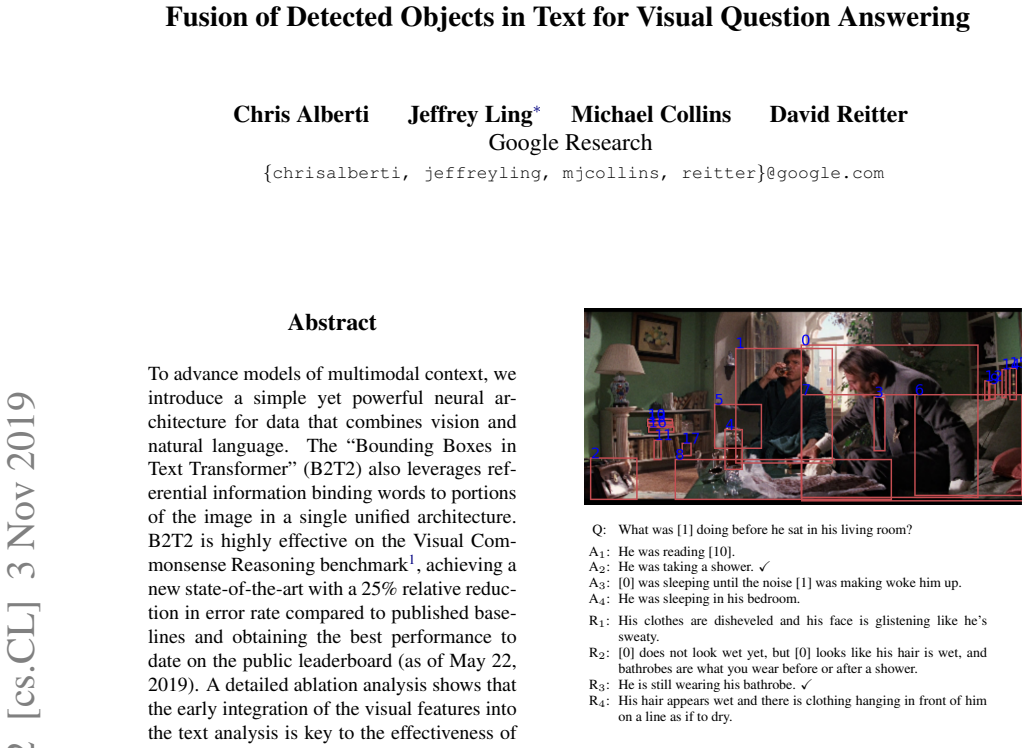
The central object is the early-fusion input embedding $E'(I,B,R,T) = E(T) + \sum_i R_i [M(\Phi(\mathrm{crop}(I,b_i)) + \pi(b_i))]^\top$, in which $E(T)$ is the standard BERT token embedding and $R$ is a binary matrix marking which tokens refer to which bounding boxes. $M$ projects 2048-dimensional ResNet-152 features into BERT's hidden space, and $\pi(b)$ embeds the box's normalized corner coordinates using learned $X$ and $Y$ matrices. This mechanism lets a single Transformer attend jointly over words and visual-object tokens, so cross-modal coreference is resolved inside the self-attention layers instead of being summarized into one fixed vector before fusion.
What would settle it
Train the same early-fusion model on a visual QA dataset that lacks explicit [b_i] annotations, using an automatic object detector to create the box-token links, and compare against a late-fusion baseline with identical text and vision encoders. If early fusion no longer beats late fusion in that setting, the paper's central claim that early fusion is what drives the gain would be undercut.
Extended reading notes
Core claim
B2T2 encodes a passage of text together with explicit links from tokens like [b_i] to bounding boxes in the image, by adding, for each referenced box, a projected visual feature vector (ResNet-152 crop feature plus a learned position embedding) to the corresponding token's input embedding before the Transformer processes the sequence. The paper's central claim is that this early fusion of visual object information into the token representations is what drives the improvement on VCR, not model size or pretraining alone: replacing early fusion with late fusion costs 3.3 percent accuracy, dropping BERT-large to BERT-base costs 2.9 percent, and removing bounding boxes costs about 4.4 percent relative to the full model. It also claims that more visual context helps even when boxes are not explicitly referenced, and that pretraining on Conceptual Captions mainly stabilizes fine-tuning rather than boosting accuracy.
Load-bearing premise
The model depends on VCR's deictic annotations: each text token like [b_i] is assumed to point correctly and completely to one ground-truth bounding box, so if those box-text bindings are noisy or unrepresentative, the measured advantage of early fusion may be an artifact of the annotation format rather than a general property of the architecture.
Editorial extensions
If this is right
- If early fusion is the cause of the gain, visual question answering systems should inject object features into token embeddings rather than combining image and text vectors only at the classifier.
- The ablation results imply that increasing the amount of available visual context, more bounding boxes, their class labels, and their positions, will keep helping up to some limit, since every added source improved accuracy.
- The finding that pretraining mainly stabilizes fine-tuning implies that VCR-style tasks can be approached with modest pretraining budgets, as long as initialization is reliable.
- The error analysis implies that a vision encoder limited to ImageNet object categories caps performance on questions about activities, expressions, and motion, so better visual encoders should translate directly into VQA gains.
Reading between the lines
- Inference beyond the paper: the early-fusion design should transfer to settings without hand-annotated box links, for example by inserting detected-region tokens into the text, but the VCR-specific R matrix alone does not establish that transfer.
- Inference beyond the paper: because removing position embeddings cost only 0.3 percent, the model may be relying mostly on what objects are present rather than where they are, which could be tested by shuffling box coordinates while keeping content features fixed.
- Inference beyond the paper: if the bottleneck is recognizing activities and facial expressions, as the paper's own examples suggest, swapping ResNet-152 for a spatio-temporal or action-aware encoder could produce larger gains than further fusion engineering.
Editorial analysis
A structured set of objections, weighed in public.
Referee Report
Summary. The paper introduces B2T2 (Bounding Boxes in Text Transformer), a Transformer-based architecture for Visual Commonsense Reasoning (VCR). B2T2 injects visual features extracted from detected bounding boxes directly into the token embedding layer, using a referential matrix R to bind textual tokens to their corresponding image regions. The authors report a 25% relative error reduction over published baselines on VCR as of May 2019, and an ensemble variant obtains further gains. A series of ablations shows that removing bounding boxes, switching to late fusion, using a smaller BERT, or using a smaller visual encoder each degrades accuracy, with early fusion and the presence of bounding boxes being the largest factors. The paper also describes pretraining on Conceptual Captions and includes a qualitative error analysis.
Significance. If the reported results hold, this is a useful empirical contribution to multimodal reasoning. The controlled comparison between early and late fusion (3.3 points on VCR dev Q->A) provides concrete evidence for grounding visual features into token-level representations, and the finding that additional non-referenced bounding boxes still help is non-obvious. Strengths include the public release of reference code, the use of an external benchmark, the careful grid of ablations, and an honest error analysis that acknowledges limitations of the visual encoder. The main weakness is that the specific role of the referential matrix R—the abstract's 'referential information binding words to portions of the image'—is not directly tested, so the central claim is somewhat stronger than the reported experiments support.
major comments (1)
- [§5.2, Table 3; §3.2, Eq. (3)] The paper explicitly claims that referential binding—the R matrix linking textual tokens to bounding boxes—is a key ingredient ('early fusion of co-references between textual tokens and visual features of objects', Section 1; 'links to bounding boxes', Section 7). However, no ablation isolates R. The comparisons in Table 3 either remove visual input entirely (No bboxes), move fusion to the last BERT layer (Late fusion), or change other components (class labels, position embeddings, number of appended boxes). Each of these also changes the number or location of visual-feature injections, so the specific contribution of the binding structure is confounded. To support the binding claim, the authors should add a control that scrambles or removes the R linkage while keeping the same set of injected box features and the same early-fusion location. If scrambled R performs as well as full B2T2, the improvement is due to the presence of object features at the input layer, not to binding; if scrambled R drops to the late-fusion level, the binding claim is verified. As it stands, the abstract's referential-binding claim is under-supported by the reported experiments.
minor comments (4)
- [§3.2] The definition of π(b) is dimensionally inconsistent: π is defined as a map R^4 → R^d, but concatenating four rows of k×d matrices yields a vector of dimension 4d. Presumably X and Y should be k×d/4, or the text should explain a different construction.
- [§4] Please clarify how the matrix R is constructed from VCR's deictic annotations, and whether the p appended bounding boxes at the end of the input sequence are associated with tokens through R or are simply additional visual tokens that receive features by other means. This would aid reproducibility and help interpret the ablations.
- [§5.2] The description of the 'Late fusion' control is vague ('if in the full B2T2 model we add visual embeddings in the last layer of BERT rather than in the first'). Please specify exactly which representation receives the visual sum, whether the same R matrix is used, and how the added features are pooled or combined.
- [Abstract and §5.1] The abstract's '25% relative reduction in error rate' is not qualified by task or model. In Table 2, the single B2T2 model's Q->AR test improvement over R2C corresponds to about 19.6% relative error reduction, while the ensemble's Q->A improvement is about 25.5%. Please state which comparison the headline number refers to.
Circularity Check
No significant circularity: B2T2 is evaluated on an external benchmark against published baselines, and its ablations are genuine architectural comparisons.
full rationale
The paper's central claim is empirical rather than definitional: B2T2's input construction E'(I,B,R,T) = E(T) + sum_i R_i [M(Phi(crop(I,b_i)) + pi(b_i))]^T defines a model family, and the reported 25% relative error reduction is measured on the held-out VCR test and dev sets against published R2C baselines and leaderboard entries. No parameter is fitted to the VCR labels and then renamed as a prediction; the model is trained with binary cross-entropy on VCR instances and scored on held-out choices. The ablations in Section 5.2 are genuine controls: removing bounding boxes, reducing the number of appended boxes, removing class labels, removing position embeddings, switching to late fusion, changing BERT size, and changing ResNet size are all architectural variations evaluated on the same task. The only self-citation, Ororbia et al. (2019), appears in related work as a general pointer to visually situated language modeling and is not load-bearing for any equation, theorem, or experimental claim. The paper invokes no uniqueness theorem and imports no result from the authors' prior work to forbid alternatives. The skeptic's point that the R matrix itself is never scrambled or corrupted is a valid missing control for attributing the gain specifically to referential binding, but missing evidence is not circularity: the reported benchmark numbers do not reduce by construction to the training inputs, and the empirical comparison remains externally grounded.
Assumptions & free parameters
free parameters (2)
- p, number of appended bounding boxes =
8 (p=8 in full model; p=4 gives 71.0% Q->A dev)
- k, grid resolution for positional embeddings of bounding boxes =
56
assumptions (4)
- domain assumption BERT-Large, pretrained with masked language modeling, provides a high-quality contextual text encoder (E and Psi).
- domain assumption ResNet-152 pretrained on ImageNet, kept fixed, yields visual features informative enough for commonsense reasoning about objects.
- domain assumption The VCR deictic references and bounding boxes can be mapped unambiguously to text tokens via matrix R, and the appended boxes with class labels provide useful additional context.
- domain assumption Pretraining on Conceptual Captions with mask-LM and impostor identification improves training stability and slightly improves accuracy.
Cite this review
Pith. "Pith review of Fusion of Detected Objects in Text for Visual Question Answering." pith.science (2026). https://pith.science/paper/36JYG46P
@misc{pith2026190805054,
  author       = {Pith},
  title        = {Pith review of: Fusion of Detected Objects in Text for Visual Question Answering},
  year         = {2026},
  howpublished = {\url{https://pith.science/paper/36JYG46P}},
  note         = {Machine review of arXiv:1908.05054}
}
read the original abstract
To advance models of multimodal context, we introduce a simple yet powerful neural architecture for data that combines vision and natural language. The "Bounding Boxes in Text Transformer" (B2T2) also leverages referential information binding words to portions of the image in a single unified architecture. B2T2 is highly effective on the Visual Commonsense Reasoning benchmark (https://visualcommonsense.com), achieving a new state-of-the-art with a 25% relative reduction in error rate compared to published baselines and obtaining the best performance to date on the public leaderboard (as of May 22, 2019). A detailed ablation analysis shows that the early integration of the visual features into the text analysis is key to the effectiveness of the new architecture. A reference implementation of our models is provided (https://github.com/google-research/language/tree/master/language/question_answering/b2t2).
Figures


Figures from the paper (2 more)


Forward citations
Cited by 2 Pith papers
-
VL-BERT: Pre-training of Generic Visual-Linguistic Representations
VL-BERT pre-trains a single-stream Transformer on image captions and text, and the resulting representation improves VCR, VQA, and RefCOCO+ benchmarks.
-
Unicoder-VL: A Universal Encoder for Vision and Language by Cross-modal Pre-training
Image-caption pre-training with masked language, masked object, and image-text matching objectives improves image-text retrieval and, to a lesser extent, visual commonsense reasoning.
Reference graph
Works this paper leans on
-
[1]
URL: " 'urlintro :=
ENTRY address author booktitle chapter edition editor howpublished institution journal key month note number organization pages publisher school series title type volume year eprint doi pubmed url lastchecked label extra.label sort.label short.list INTEGERS output.state before.all mid.sentence after.sentence after.block STRINGS urlintro eprinturl eprintpr...
-
[2]
write newline
" write newline "" before.all 'output.state := FUNCTION n.dashify 't := "" t empty not t #1 #1 substring "-" = t #1 #2 substring "--" = not "--" * t #2 global.max substring 't := t #1 #1 substring "-" = "-" * t #2 global.max substring 't := while if t #1 #1 substring * t #2 global.max substring 't := if while FUNCTION word.in bbl.in capitalize " " * FUNCT...
-
[3]
Peter Anderson, Xiaodong He, Chris Buehler, Damien Teney, Mark Johnson, Stephen Gould, and Lei Zhang. 2018. Bottom-up and top-down attention for image captioning and visual question answering. In Proceedings of the IEEE Conference on Computer Vision and Pattern Recognition, pages 6077--6086
2018
-
[4]
Lawrence Zitnick, and Devi Parikh
Stanislaw Antol, Aishwarya Agrawal, Jiasen Lu, Margaret Mitchell, Dhruv Batra, C. Lawrence Zitnick, and Devi Parikh. 2015. VQA : V isual Q uestion A nswering. In International Conference on Computer Vision (ICCV)
2015
-
[5]
Elia Bruni, Nam-Khanh Tran, and Marco Baroni. 2014. Multimodal distributional semantics. Journal of Artificial Intelligence Research, 49:1--47
work page 2014
-
[6]
Scott Deerwester, Susan T Dumais, George W Furnas, Thomas K Landauer, and Richard Harshman. 1990. Indexing by latent semantic analysis. Journal of the American society for information science, 41(6):391--407
1990
-
[7]
Jacob Devlin, Ming-Wei Chang, Kenton Lee, and Kristina Toutanova. 2018. Bert: Pre-training of deep bidirectional transformers for language understanding. arXiv preprint arXiv:1810.04805
arXiv 2018
-
[8]
John R Firth. 1957. A synopsis of linguistic theory, 1930-1955. Studies in linguistic analysis
1957
Show all 32 references
-
[9]
Daniel Gillick, Alessandro Presta, and Gaurav Singh Tomar. 2018. End-to-end retrieval in continuous space. arXiv preprint arXiv:1811.08008
2018 arXiv
-
[10]
Yash Goyal, Tejas Khot, Douglas Summers - Stay, Dhruv Batra, and Devi Parikh. 2017. Making the V in VQA matter: Elevating the role of image understanding in V isual Q uestion A nswering. In Conference on Computer Vision and Pattern Recognition (CVPR)
2017
-
[11]
Zellig S Harris. 1954. Distributional structure. Word, 10(2-3):146--162
1954
-
[12]
Kaiming He, Xiangyu Zhang, Shaoqing Ren, and Jian Sun. 2016. Identity mappings in deep residual networks. In European conference on computer vision, pages 630--645. Springer
2016
-
[13]
Drew A Hudson and Christopher D Manning. 2018. Compositional attention networks for machine reasoning. In ICLR
2018
-
[14]
Drew A Hudson and Christopher D Manning. 2019. Gqa: a new dataset for compositional question answering over real-world images. arXiv preprint arXiv:1902.09506
2019 arXiv
-
[15]
Justin Johnson, Bharath Hariharan, Laurens van der Maaten, Li Fei-Fei, C Lawrence Zitnick, and Ross Girshick. 2017. Clevr: A diagnostic dataset for compositional language and elementary visual reasoning. In Proceedings of the IEEE Conference on Computer Vision and Pattern Reco...
2017
-
[16]
Douwe Kiela, Alexis Conneau, Allan Jabri, and Maximilian Nickel. 2017. Learning visually grounded sentence representations. arXiv preprint arXiv:1707.06320
2017 arXiv
-
[17]
Diederik P Kingma and Jimmy Ba. 2014. Adam: A method for stochastic optimization. arXiv preprint arXiv:1412.6980
2014 arXiv
-
[18]
Gen Li, Nan Duan, Yuejian Fang, Daxin Jiang, and Ming Zhou. 2019 a . Unicoder-vl: A universal encoder for vision and language by cross-modal pre-training. arXiv preprint arXiv:1908.06066
2019 arXiv
-
[19]
Liunian Harold Li, Mark Yatskar, Da Yin, Cho-Jui Hsieh, and Kai-Wei Chang. 2019 b . Visualbert: A simple and performant baseline for vision and language. arXiv preprint arXiv:1908.03557
2019 arXiv
-
[20]
Tsung-Yi Lin, Michael Maire, Serge Belongie, James Hays, Pietro Perona, Deva Ramanan, Piotr Doll \'a r, and C Lawrence Zitnick. 2014. Microsoft coco: Common objects in context. In European conference on computer vision, pages 740--755. Springer
2014
-
[21]
Jiasen Lu, Dhruv Batra, Devi Parikh, and Stefan Lee. 2019. Vilbert: Pretraining task-agnostic visiolinguistic representations for vision-and-language tasks. arXiv preprint arXiv:1908.02265
2019 arXiv
-
[22]
Jiayuan Mao, Chuang Gan, Pushmeet Kohli, Joshua B Tenenbaum, and Jiajun Wu. 2019. The neuro-symbolic concept learner: Interpreting scenes, words, and sentences from natural supervision. In ICLR
2019
-
[23]
Tomas Mikolov, Ilya Sutskever, Kai Chen, Greg S Corrado, and Jeff Dean. 2013. Distributed representations of words and phrases and their compositionality. In Advances in neural information processing systems, pages 3111--3119
2013
-
[24]
Ororbia, Ankur Mali, Matthew A
Alexander G. Ororbia, Ankur Mali, Matthew A. Kelly, and David Reitter. 2019. Like a baby: Visually situated neural language acquisition. In Proceedings of the 57th Annual Meeting of the Association for Computational Linguistics
2019
-
[25]
Piyush Sharma, Nan Ding, Sebastian Goodman, and Radu Soricut. 2018. Conceptual captions: A cleaned, hypernymed, image alt-text dataset for automatic image captioning. In Proceedings of the 56th Annual Meeting of the Association for Computational Linguistics, pages 2556--2565
2018
-
[26]
Weijie Su, Xizhou Zhu, Yue Cao, Bin Li, Lewei Lu, Furu Wei, and Jifeng Dai. 2019. Vl-bert: Pre-training of generic visual-linguistic representations. arXiv preprint arXiv:1908.08530
2019 arXiv
-
[27]
Chen Sun, Austin Myers, Carl Vondrick, Kevin Murphy, and Cordelia Schmid. 2019. Videobert: A joint model for video and language representation learning. arXiv preprint arXiv:1904.01766
2019 arXiv
-
[28]
Ashish Vaswani, Noam Shazeer, Niki Parmar, Jakob Uszkoreit, Llion Jones, Aidan N Gomez, ukasz Kaiser, and Illia Polosukhin. 2017. Attention is all you need. In Advances in neural information processing systems, pages 5998--6008
2017
-
[29]
Jason Weston, Samy Bengio, and Nicolas Usunier. 2011. Wsabie: Scaling up to large vocabulary image annotation. In Twenty-Second International Joint Conference on Artificial Intelligence
2011
-
[30]
Ledell Yu Wu, Adam Fisch, Sumit Chopra, Keith Adams, Antoine Bordes, and Jason Weston. 2018. Starspace: Embed all the things! In Thirty-Second AAAI Conference on Artificial Intelligence
2018
-
[31]
Rowan Zellers, Yonatan Bisk, Ali Farhadi, and Yejin Choi. 2019. arXiv:1811.10830 From recognition to cognition: Visual commonsense reasoning . In Conference on Computer Vision and Pattern Recognition (CVPR)
2019 arXiv
-
[32]
Peng Zhang, Yash Goyal, Douglas Summers - Stay, Dhruv Batra, and Devi Parikh. 2016. Y in and Y ang: Balancing and answering binary visual questions. In Conference on Computer Vision and Pattern Recognition (CVPR)
2016
Reviewed August 14, 2026 · model on record in the stance chip above.
Discussion (0). Continue with ORCID to comment.