REVIEW 3 major objections 5 minor 32 references
On Gossip-based Information Dissemination in Pervasive Recommender Systems
T0 review · 3 major / 5 minor · reviewed 2026-08-14 · deepseek-v4-flash
Pith's one-line read Nearby smartphones can exchange ratings reliably and offline, a prototype claims.
desk verdict A feasible propagation step, but the paper's 'reliable within 6 meters' headline conflates a 1 m delay measurement with separate 6 m success rates—worth a referee to fix. read the letter →
The pith
A machine-rendered reading of the paper's core claim, the machinery that carries it, and where it could break.
The reading
What carries the argument
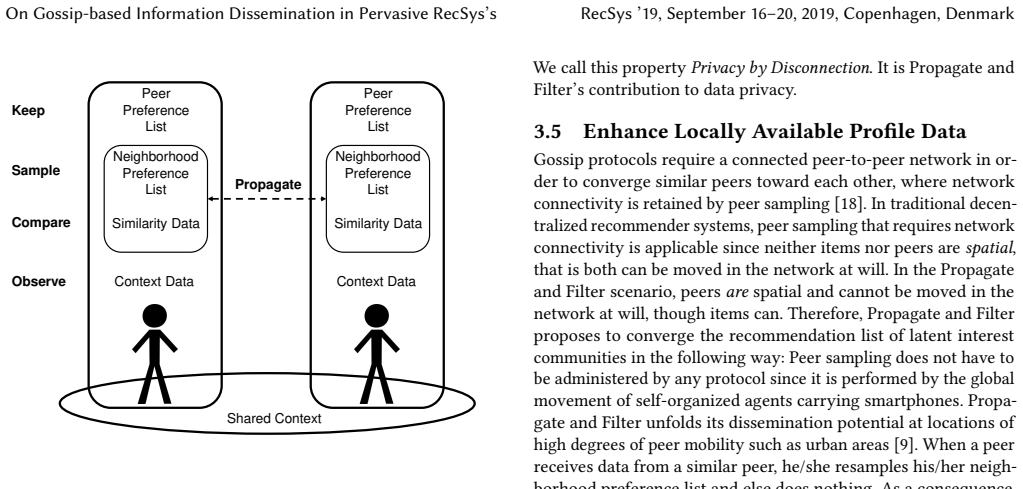
The central object is 'Propagate and Filter', a two-phase method. In the propagate phase, nearby devices exchange two kinds of data: similarity data, chosen to be privacy-preserving, and a neighborhood preference list, an aggregated list of item ratings from the k most similar previously encountered peers. In the filter phase, a device compares similarity data with the sender, and if the sender ranks among the k most similar peers, resamples its own neighborhood preference list from the sender's list and those of the other similar peers; recommendations are then computed locally from all four data pools (peer list, neighborhood list, similarity data, context data). The mechanism is designed so that recommendation flows between similar peers and dries out between dissimilar ones, emulating gossip-protocol convergence without needing a persistent network overlay.
What would settle it
Run the currently placeholder sampling and recommendation steps on real rating histories: if pairs selected as similar by privacy-preserving similarity data share no more preferred items than random pairs, or if resampling from their mixed lists does not improve recommendation accuracy over no exchange, the approach's benefit collapses. For the propagation half, measure connection delay and success rate in dense pedestrian traffic: if the average setup time exceeds the typical duration of street encounters, the stated use cases shrink to waiting and transit only.
Extended reading notes
Core claim
The paper's central claim is that the propagation step of Propagate and Filter is technically feasible today: a smartphone can act as a node in an ephemeral, offline recommender network, passing along ratings and similarity data during brief encounters. The prototype transmitted all 1,000 ratings without loss, handled simultaneous exchanges among four devices, worked in Berlin buses and underground trains without internet, and achieved reliable connections within 3-6 meters at an average initial connection delay of 25.9 seconds. The authors present this as preliminary evidence that pervasive recommender systems can address both data scarcity and some privacy risks by exchanging data only in immediate proximity and then disconnecting.
Load-bearing premise
If similarity data fails to pick out genuinely similar peers, or if mixed neighborhood lists carry little signal, then exchanging ratings with strangers yields poor recommendations and the claimed benefits over centralized recommenders disappear.
Editorial extensions
If this is right
- If propagation is feasible, recommendation models can be built on-device with no internet: ratings arrive during physical encounters and movie metadata is fetched later when connectivity returns.
- Data scarcity in pervasive recommenders can be reduced because recommendations relay between peers that are never geographically close, through chains of similar peers.
- Privacy by disconnection follows: no persistent network overlay exists, queries cannot be issued at will, and a peer is invisible except during an active encounter; only the data a peer chooses to share is exposed, and only at contact time.
- The measured constraints bound the use cases: 25.9 seconds average setup and 6-meter range fit waiting-at-traffic-lights and public-transport settings, while 70-80% success at 6 meters and roughly 5% per hour battery drain set practical limits.
Reading between the lines
- The recommendation-quality layer is untested: if privacy-preserving similarity data does not actually select peers with correlated tastes, mixing their lists could dilute rather than sharpen local preferences; a field trial with ratings and follow-up choices would settle this.
- The 25.9-second connection delay is an average over one API and phone generation; newer radios and connection caching could plausibly push delay below the duration of a pedestrian pass, opening street-level encounters the paper currently excludes.
- The same propagate-and-filter loop could double as a context-discovery mechanism: because encounters are tagged with location and time, exchanged lists implicitly encode place-based tastes, which might enable location-aware recommendations without a central profile.
- Because the prototype exchanged only peer preference lists rather than the full four-layer data stack, the measured feasibility does not yet cover similarity-data propagation or the cost of the filtering computation; those remain open.
Signed reviews
Editorial analysis
A structured set of objections, weighed in public.
Referee Report
Summary. The paper proposes Propagate and Filter, a gossip-based method for exchanging item preference data between smartphones in physical proximity, intended to address data scarcity and privacy in pervasive recommender systems. It describes four data types (peer preference list, neighborhood preference list, similarity data, context data), a propagation step, and a filtering step, then evaluates an Android prototype that implements only the propagation step using Google's Nearby Connections API. The experiments report lossless transfer of 1000 ratings, multi-device transfer, transfer in public transportation, connection success rates by distance (Table 1), an average initial connection delay of 25.9 s measured at 1 m, and pre-connection battery drain of about 5.8%/h. The authors conclude that the propagation step is technically feasible for scenarios such as waiting at traffic lights or taking public transportation, while acknowledging limitations in range and battery consumption.
Significance. The paper's measured results provide useful early empirical evidence that opportunistic proximity-based propagation of rating data is feasible without internet connectivity, and the authors are commendably explicit about limitations such as the 6 m effective range and the battery cost of continuous advertising and discovery. The work is explicitly preliminary: the Filter step and the recommendation algorithm are placeholders, so the claimed data-scarcity and privacy benefits are not empirically demonstrated. The paper does not offer machine-checked proofs or parameter-free derivations; its value is as a system design plus an empirical feasibility study of the propagation step. If the propagation-step scope is made precise, the results are a reasonable contribution for a systems-oriented venue.
major comments (3)
- [Section 5, Experiments (4) and (5); Section 5.1] The abstract's feasibility statement combines a delay measurement taken at 1 m "in order to guarantee connectivity" (Experiment 5) with success rates measured at 3, 6, 10, and 12 m (Table 1) for which no timing information is reported. The joint claim that a 6 m encounter completes an exchange within an acceptable time is therefore not directly supported. At 6 m with obstacles the success rate is already 70%; if connection setup at that distance takes longer than the 25.9 s mean measured at 1 m, the stated use cases (traffic lights, public transport) may be optimistic. Please report delay statistics and timeout thresholds for the distances in Table 1, or explicitly scope the delay claim to the 1 m condition.
- [Section 5, Table 1 and Experiments (1)-(6)] No per-condition sample sizes, confidence intervals, or timeout thresholds are reported for any of the six experiments. The text says experiments were re-run 10 times by default, but it is not stated which conditions used different numbers of runs, nor whether the differences between, say, 80% and 70% success at 6 m are meaningful given the sample size. Because the central feasibility conclusion rests on these rates and on the 25.9 s mean delay, the paper should report N, variation (min/max or confidence intervals), and a precise definition of a failed attempt.
- [Sections 3.3, 3.5, and 6] The Filter step (similarity comparison, neighborhood preference list resampling) and the recommendation algorithm are explicitly left as placeholders, so the claim in Section 3.5 that Propagate and Filter "addresses the profile data scarcity problem" is not supported by the evaluation. The abstract's phrase "the approach's technical feasibility" should be scoped to the propagation step; as written, it invites the reader to infer end-to-end recommender feasibility. If the intended contribution is limited to propagation, a one-sentence scope clarification would suffice; otherwise, evidence about the sampling and recommendation steps is needed.
minor comments (5)
- [Section 1, final paragraph] The bullet list says the paper presents "an implementation of the propagation part" and "its evaluation," which is accurate, but the title and abstract emphasize the full Propagate and Filter method; consider aligning the framing so the reader immediately sees that the evaluation is only of propagation.
- [Section 3.3, step (2)] The phrase "above the k-th highest" is ambiguous; it should say something like "above the k-th highest similarity among known peers" or "in the top k by similarity."
- [Table 1 and Table 2 captions] The captions should state the number of runs per condition and the units (e.g., percentage, %/h) directly, rather than requiring the reader to infer them from the text.
- [Section 4.2] The phrase "as it is commonly the case in underground trains" reads awkwardly; consider rewording to "as is common in underground trains."
- [Abstract] The phrase "raise, communicate, and process data" appears to contain a typo; "raise" should likely be "collect" or "capture."
Circularity Check
No circularity: the feasibility claim rests on direct measurements, not on fitting, prediction, or self-referential derivation.
full rationale
The paper's central claim is that the propagation step of Propagate and Filter is technically feasible, supported by measured connection success rates (Table 1) and an average initial connection delay of 25.9 seconds (Section 5, experiment 5). These are direct empirical observations of the prototype, with no fitted parameter later renamed as a prediction and no equation or derivation whose output is assumed in its input. The design sections describe a propagation/filtering architecture, and the evaluation explicitly measures only what was implemented; the sampling process and recommendation algorithm are admitted placeholders (Section 6), so no hidden result is being smuggled in through them. The self-citations ([4], [5], [15]) provide background or examples of possible similarity data and a previously proposed architecture, but none is load-bearing for the feasibility conclusion; the paper does not invoke a uniqueness theorem, ansatz, or cited prior result to force its design choice. The skeptical concern that the 6 m success-rate data and the 25.9 s delay come from different experimental setups (1 m guaranteed connectivity) is a question of whether the joint feasibility statement was directly measured, not a circularity: the claimed quantities are still outputs of experiments rather than consequences of their own definitions. No step in the paper reduces, by construction or by self-citation, to its own inputs, so the circularity score is 0.
Assumptions & free parameters
assumptions (3)
- domain assumption Physical movement of carriers in urban areas produces sufficient pairwise encounters for gossip dissemination.
- domain assumption Privacy-preserving similarity data reliably captures peer similarity without leaking raw profiles.
- domain assumption Mixing neighborhood preference lists from similar peers converges to latent interest communities.
Cite this review
Pith. "Pith review of On Gossip-based Information Dissemination in Pervasive Recommender Systems." pith.science (2026). https://pith.science/paper/RBMMEZFX
@misc{pith2026190805544,
  author       = {Pith},
  title        = {Pith review of: On Gossip-based Information Dissemination in Pervasive Recommender Systems},
  year         = {2026},
  howpublished = {\url{https://pith.science/paper/RBMMEZFX}},
  note         = {Machine review of arXiv:1908.05544}
}
read the original abstract
Pervasive computing systems employ distributed and embedded devices in order to raise, communicate, and process data in an anytime-anywhere fashion. Certainly, its most prominent device is the smartphone due to its wide proliferation, growing computation power, and wireless networking capabilities. In this context, we revisit the implementation of digitalized word-of-mouth that suggests exchanging item preferences between smartphones offline and directly in immediate proximity. Collaboratively and decentrally collecting data in this way has two benefits. First, it allows to attach for instance location-sensitive context information in order to enrich collected item preferences. %enhance on-device recommendations. Second, model building does not require network connectivity. Despite the benefits, the approach naturally raises data privacy and data scarcity issues. In order to address both, we propose Propagate and Filter, a method that translates the traditional approach of finding similar peers and exchanging item preferences among each other from the field of decentralized to that of pervasive recommender systems. Additionally, we present preliminary results on a prototype mobile application that implements the proposed device-to-device information exchange. Average ad-hoc connection delays of 25.9 seconds and reliable connection success rates within 6 meters underpin the approach's technical feasibility.
Figures
Reference graph
Works this paper leans on
- [1]
-
[2]
Gediminas Adomavicius and Alexander Tuzhilin. 2011. Context-A ware Recom- mender Systems. Springer US, Boston, MA, 217–253. https://doi.org/10.1007/ 978-0-387-85820-3_7
work page 2011
-
[3]
Ranieri Baraglia, Patrizio Dazzi, Matteo Mordacchini, and Laura Ricci. 2013. A peer-to-peer recommender system for self-emerging user communities based on gossip overlays. J. Comput. System Sci. 79, 2 (2013), 291–308. https://doi.org/ 10.1016/j.jcss.2012.05.011 10th IEEE International Conference on Computer and Information Technology, 2010
-
[4]
Felix Beierle. 2018. Do You Like What I Like? Similarity Estimation in Proximity- based Mobile Social Networks. In Proc. 2018 17th IEEE International Conference On Trust, Security And Privacy In Computing And Communications (TrustCom) . IEEE, 1040–1047. https://doi.org/10.1109/TrustCom/BigDataSE.2018.00146
-
[5]
Felix Beierle and Tobias Eichinger. 2019. Collaborating with Users in Proximity for Decentralized Mobile Recommender Systems. In Proceedings of the IEEE 16th International Conference on Ubiquitous Intelligence and Computing (UIC) . IEEE (in press)
work page 2019
-
[6]
Felix Beierle, Vinh Thuy Tran, Mathias Allemand, Patrick Neff, Winfried Schlee, Thomas Probst, Rüdiger Pryss, and Johannes Zimmermann. 2018. Context Data Categories and Privacy Model for Mobile Data Collection Apps. Procedia Com- puter Science 134 (2018), 18–25. https://doi.org/10.1016/j.procs.2018.07.139
-
[7]
Antoine Boutet, Stephane Frenot, Frederique Laforest, Pascale Launay, Nicolas Le Sommer, Yves Maheo, and Damien Reimert. 2015. C3PO: A Network and Application Framework for Spontaneous and Ephemeral Social Networks. In Web Information Systems Engineering – WISE 2015 (Lecture Notes in Computer Science). Springer International Publishing, 348–358. https://d...
work page 2015
-
[8]
Leo Breiman. 1996. Bagging Predictors. Machine Learning 24, 2 (01 Aug 1996), 123–140. https://doi.org/10.1023/A:1018054314350
Show all 32 references
-
[9]
Chancay-GarcÃŋa, E
L. Chancay-GarcÃŋa, E. HernÃąndez-Orallo, P. Manzoni, C. T. Calafate, and J. Cano. 2018. Evaluating and Enhancing Information Dissemination in Urban Areas of Interest Using Opportunistic Networks. IEEE Access 6 (2018), 32514–32531. https://doi.org/10.1109/ACCESS.2018.2846201
2018
-
[10]
Fei Chen, Zhenhua Dong, Zhenguo Li, and Xiuqiang He. 2018. Federated Meta- Learning for Recommendation. CoRR abs/1802.07876 (2018). arXiv:1802.07876 http://arxiv.org/abs/1802.07876
2018 arXiv
-
[11]
Norrie, and Michael Grossniklaus
Alexandre de Spindler, Moira C. Norrie, and Michael Grossniklaus. 2007. Collabo- rative filtering based on opportunistic information sharing in mobile ad-hoc net- works. In On the Move to Meaningful Internet Systems 2007: CoopIS, DOA, ODBASE, GADA, and IS (Lecture Notes in Com...
2007 doi
-
[12]
Juan Vera del Campo, Josep Pegueroles, Juan HernÃąndez-Serrano, and Miguel Soriano. 2012. Design of a P2P content recommendation system using affinity networks. Computer Communications 36, 1 (2012), 90–104. https://doi.org/10. 1016/j.comcom.2012.07.018
2012
-
[13]
Del Prete and L
L. Del Prete and L. Capra. 2010. diffeRS: A Mobile Recommender Service. In 2010 Eleventh International Conference on Mobile Data Management . 21–26. https: //doi.org/10.1109/MDM.2010.22
2010 doi
-
[14]
B. Efron. 1979. Bootstrap Methods: Another Look at the Jackknife. Ann. Statist. 7, 1 (01 1979), 1–26. https://doi.org/10.1214/aos/1176344552
1979
-
[15]
Tobias Eichinger, Felix Beierle, Sumsam Ullah Khan, Robin Middelanis, Veer- araghavan Sekar, and Sam Tabibzadeh. 2019. affinity: A System for Latent User Similarity Comparison on Texting Data (accepted article) (IEEE ICC 2019). IEEE. http://arxiv.org/abs/1904.01897
2019 arXiv
-
[16]
Damianos Gavalas, Charalampos Konstantopoulos, Konstantinos Mastakas, and Grammati Pantziou. 2014. Mobile Recommender Systems in Tourism. J. Netw. Comput. Appl. 39, C (March 2014), 319–333. https://doi.org/10.1016/j.jnca.2013. 04.006
2014 doi
-
[17]
B. Heep, M. Florian, J. Volz, and I. Baumgart. 2013. Overdrive an overlay-based geocast service for smart traffic applications. In 2013 10th Annual Conference on Wireless On-demand Network Systems and Services (WONS) . 1–8. https://doi.org/ 10.1109/WONS.2013.6578313
2013
-
[18]
Márk Jelasity and Ozalp Babaoglu. 2006. T-Man: Gossip-Based Overlay Topology Management. In Engineering Self-Organising Systems. Springer Berlin Heidelberg, Berlin, Heidelberg, 1–15. https://doi.org/10.1007/11734697_1
2006 doi
-
[19]
Márk Jelasity, Spyros Voulgaris, Rachid Guerraoui, Anne-Marie Kermarrec, and Maarten van Steen. 2007. Gossip-based Peer Sampling. ACM Trans. Comput. Syst. 25, 3, Article 8 (Aug. 2007). https://doi.org/10.1145/1275517.1275520
2007
-
[20]
Salma Ktari and Artur Hecker. 2011. A Peer-to-Peer Social Network Overlay for Efficient Information Retrieval and Diffusion. In Future Information Technology. Springer Berlin Heidelberg, Berlin, Heidelberg, 24–33. https://doi.org/10.1007/ 978-3-642-22309-9_4
2011
-
[21]
Magureanu, N
S. Magureanu, N. Dokoohaki, S. Mokarizadeh, and M. Matskin. 2012. Epidemic Trust-Based Recommender Systems. In 2012 International Conference on Privacy, Security, Risk and Trust and 2012 International Confernece on Social Computing . 461–470. https://doi.org/10.1109/SocialCom-...
2012 doi
-
[22]
Brendan McMahan, Eider Moore, Daniel Ramage, and Blaise Agüera y Arcas
H. Brendan McMahan, Eider Moore, Daniel Ramage, and Blaise Agüera y Arcas
-
[23]
Christos Mettouris and George Papadopoulos. 2014. Ubiquitous recom- mender systems. Computing 96 (03 2014), 223–257. https://doi.org/10.1007/ s00607-013-0351-z
2014
-
[24]
Erik Nordström, Per Gunningberg, and Christian Rohner. 2009. Haggle : A Data-centric Network Architecture for Mobile Devices. Invited talk
2009
-
[25]
Nunes Barbosa, J
L. Nunes Barbosa, J. Gemmell, M. Horvath, and T. Heimfarth. 2018. Distributed User-Based Collaborative Filtering on an Opportunistic Network. In 2018 IEEE 32nd International Conference on Advanced Information Networking and Applica- tions (AINA). 266–273. https://doi.org/10.11...
2018
-
[26]
Anna-Kaisa Pietiläinen, Earl Oliver, Jason LeBrun, George Varghese, and Christophe Diot. 2009. MobiClique: Middleware for Mobile Social Network- ing. In Proceedings of the 2Nd ACM Workshop on Online Social Networks (WOSN ’09). ACM, New York, NY, USA, 49–54. https://doi.org/10....
2009
-
[27]
Nikolaos Polatidis and Christos Georgiadis. 2015. A ubiquitous recommender system based on collaborative filtering and social networking data. International Journal of Intelligent Engineering Informatics 3 (01 2015), 186. https://doi.org/10. 1504/IJIEI.2015.069895
2015
-
[28]
Giancarlo Ruffo and Rossano Schifanella. 2009. A peer-to-peer recommender system based on spontaneous affinities. ACM Trans. Internet Techn. 9, 1 (2009), 4:1–4:34. https://doi.org/10.1145/1462159.1462163
2009
-
[29]
Rossano Schifanella, André Panisson, Cristina Gena, and Giancarlo Ruffo. 2008. MobHinter: Epidemic Collaborative Filtering and Self-organization in Mobile Ad-hoc Networks. In Proceedings of the 2008 ACM Conference on Recommender Systems (RecSys ’08) . ACM, New York, NY, USA, 2...
2008
-
[30]
Yurur, C
O. Yurur, C. Liu, Z. Sheng, V. Leung, W. Moreno, and K. Leung. 2014. Context- Awareness for Mobile Sensing: A Survey and Future Directions. IEEE Communi- cations Surveys Tutorials 18, 1 (2014), 1–28. https://doi.org/10.1109/COMST.2014. 2381246
2014 doi
-
[31]
On Gossip-based Information Dissemination in Pervasive Recommender Systems,
Cai-Nicolas Ziegler. 2005. Towards decentralized recommender systems . Ph.D. Dissertation. Albert-Ludwigs-Universität Freiburg. Additional Information Bibliographic Data T. Eichinger, F. Beierle, R. Papke, L. Rebscher, H. Chinh Tran, and M. Trzeciak, “On Gossip-based Informati...
2005
-
[2016]
CoRR abs/1602.05629 (2016)
Federated Learning of Deep Networks using Model Averaging. CoRR abs/1602.05629 (2016)
2016 arXiv
Reviewed August 14, 2026 · model on record in the stance chip above.
Discussion (0). Continue with ORCID to comment.