REVIEW 3 major objections 5 minor 65 references
Enhanced stability, bistability, and exceptional points in saturable active photonic couplers
T0 review · 3 major / 5 minor · reviewed 2026-08-14 · deepseek-v4-flash
Pith's one-line read Saturable gain in an asymmetric active photonic coupler enhances the stability of its steady states, suppresses unbounded growth, and enables bistability and continuous families of exceptional points.
desk verdict Useful numerical map of asymmetric saturable couplers, but the advertised 'continuous families' of exceptional points are not actually demonstrated; tone down or fix. read the letter →
The pith
A machine-rendered reading of the paper's core claim, the machinery that carries it, and where it could break.
The reading
What carries the argument
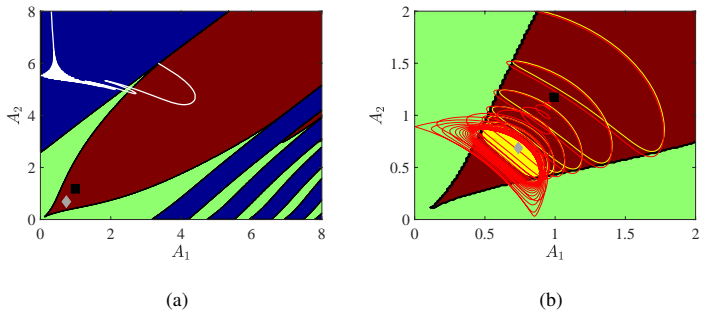
The central object is the set of nonlinear supermodes: fixed points of the three-dimensional amplitude-and-phase dynamical system (3)-(5), characterized by the amplitude ratio $R=(A_2/A_1)^2$ that solves the fourth-order polynomial equation (6). Stability is decided by the eigenvalues of the Jacobian evaluated at each supermode, and parameter-space stability maps count how many of these fixed points are stable. Basins of attraction are computed by numerically integrating the coupled-mode equations over grids of initial conditions on phase-space cuts. Exceptional points are found where eigenvalues of the same Jacobian coalesce as parameters vary. The saturation constant $\epsilon$ is the parameter that clips the active arm's gain and is what produces the paper's main effects.
What would settle it
Numerically integrate the same coupled-mode equations for parameters inside the reported stable and bistable regions, using a fine scan of initial conditions and long propagation distances, and check for attractors that are neither the listed supermodes, the zero state, nor the unbounded state; finding a periodic orbit or chaotic attractor would make the basin maps incomplete. Equivalently, compute Lyapunov exponents or construct Poincaré sections in a bistable parameter plateau such as $\alpha=1.7$, $\beta=1.4$, $\epsilon=1$, and $k/\beta_1=5$.
Extended reading notes
Core claim
The authors establish that saturable activity acts as a stabilizer in the asymmetric active coupler. For the coupled-mode system with Kerr nonlinearity and a gain term $\alpha_2/(1+\epsilon|E_2|^2)$, stable steady states exist over much wider ranges of gain/loss contrast $\alpha$, propagation-constant asymmetry $\beta$, and coupling $k$ when $\epsilon>0$ than when $\epsilon=0$. The unbounded state with $A_1\to 0$ and $A_2\to+\infty$, which dominates unsaturable PT-symmetric couplers, is suppressed, and in sizeable parameter plateaus two distinct stable nonlinear supermodes coexist, yielding bistability with hysteresis. Basins of attraction are mapped on plane cuts of the three-dimensional phase space, showing complex, sometimes thin and striated dependence on initial conditions. The paper further reports that exceptional points, where two or even all three Jacobian eigenvalues coalesce, occur along continuous curves in parameter space and can be reached by tuning any one of the key parameters.
Load-bearing premise
The basin-of-attraction analysis assumes that every trajectory ends up at a stable nonlinear supermode, the zero state, or the unbounded state, with no proof that periodic orbits or chaotic attractors are absent; the paper itself leaves limit cycles for future work.
Editorial extensions
If this is right
- For the same coupler geometry, raising the saturation constant $\epsilon$ at fixed coupling enlarges the bistability plateau, for instance as seen in Figs. 2(c)-2(d), so a designer can move from a single stable output to two coexisting outputs by adjusting material saturation.
- When two stable nonlinear supermodes coexist, the final output is selected by initial conditions, with thin striated basin boundaries in some phase-space cuts; this means small changes in launch conditions can flip the device between states, which is the basis for all-optical switching or memory but also a sensitivity constraint.
- Exceptional points are accessible by changing any one of the coupling, gain/loss asymmetry, or propagation-constant asymmetry, so a single tunable active coupler can be swept through an exceptional-point transition without requiring a symmetry condition.
- In parameter regions with no stable supermode, the system is condemned to the unbounded state; saturation is the control knob that converts some of these regions into stable or bistable regions, so the paper identifies saturation as the practical mechanism preventing blow-up.
- The bistable regions never share a boundary with regions having no stable nonlinear supermode, only touching them at isolated points, which means the transition from one stable output to unstable behavior is abrupt and occurs through isolated critical parameter values.
Reading between the lines
- The stabilizing effect of saturation is likely not specific to two waveguides: adding a saturable gain term to other non-Hermitian dimer models, such as coupled lasers or twisted-fiber amplifiers, could similarly suppress their unbounded modes, since the mechanism only requires that gain decays with the active-arm intensity.
- Because the exceptional points form continuous families rather than isolated points, one could design a sensor that operates near an exceptional point and sweeps the coupling to optimize sensitivity; the paper does not quantify how much sensitivity enhancement such a tunable coupler would provide.
- The thin, striated basin boundaries suggest that in a physical implementation, unavoidable noise in the launch fields may cause switching between coexisting supermodes; quantifying that noise sensitivity would be a natural experimental follow-up.
- If limit cycles or chaotic attractors do occur in the system's phase space, as the paper leaves open, the reported basin maps would be only part of the full dynamical landscape, and the bistable switching behavior could be more fragile than the maps alone suggest.
Signed reviews
Editorial analysis
A structured set of objections, weighed in public.
Referee Report
Summary. The manuscript studies an asymmetric two-waveguide photonic coupler consisting of a lossy waveguide and a saturable-gain waveguide, described by the coupled-mode equations (1)-(2). The authors derive the fixed points (nonlinear supermodes) and their linear stability from the Jacobian (12), then present numerical stability maps showing regions with zero, one, or two stable supermodes as functions of gain/loss asymmetry, index asymmetry, saturation, and coupling. They compute basins of attraction on plane cuts of the three-dimensional phase space for both monostable and bistable cases, and they examine eigenvalue coalescence (exceptional points) through one-parameter sweeps of the gain/loss contrast and coupling. The paper claims that saturable activity enhances the stability of steady states, prevents evolution to unbounded modes, enables bistable operation, and that continuous families of exceptional points are detected, providing a complete description of the nonlinear dynamics landscape.
Significance. If the central claims are correct, this paper provides a useful map of how saturable gain and structural asymmetry stabilize nonlinear supermodes and enable bistability in a generic active photonic coupler. The analytic derivation of the fixed points and the Jacobian is self-contained, and the reduction to previous results in the ε=0 limit is an independent consistency check. The stability maps and basin plots, if reproducible, are of direct practical value for device design. The main advertised novelty—continuous families of exceptional points—is not supported by the evidence presented, and the 'complete description' claim overreaches because other attractors (e.g., limit cycles) are not ruled out. The paper makes clear, falsifiable predictions about stability regions and basins of attraction that could guide future experiments.
major comments (3)
- [Abstract and §III.C (Figs. 8–9)] The abstract and conclusions advertise the detection of 'continuous families of exceptional points,' but the evidence in Figs. 8 and 9 consists solely of one-parameter sweeps in which eigenvalue coalescence occurs at isolated parameter values (indicated by vertical dashed lines). A continuous family is a positive-dimensional set in the multi-dimensional parameter space, such as a curve of EPs in the (α, k) or (α, β) plane; no two-parameter EP map, discriminant-zero locus, or continuity argument is supplied. This is load-bearing because the continuous-family result is one of the three headline contributions stated in the abstract. The authors should either provide a two-parameter EP locus computation (e.g., via the discriminant of det(J−λI)) or revise the abstract and conclusions to claim isolated, tunable exceptional points.
- [§III.B and Concluding Remarks] The claim of a 'complete description of the nonlinear dynamics landscape' and the basin diagrams in Figs. 5–7 presuppose that the only possible asymptotic states are the stable nonlinear supermodes, the zero state, and the unbounded state A2 → +∞. The manuscript provides no proof or numerical evidence that limit cycles or chaotic attractors are absent on the considered initial-condition grid; indeed, the concluding remarks explicitly list periodic oscillations (limit cycles) as a topic for future work. If such attractors exist, the basin diagrams would be incomplete and the description would not be complete. The authors should either prove or bound the absence of other attractors for the parameter ranges studied, or restrict the completeness claim.
- [§III.A (Figs. 2–4) and §III.B (Figs. 5–7)] The stability maps and basin-of-attraction plots are central to the paper's claims, but the numerical procedures are not documented: no grid resolution, ODE solver tolerance, integration length, or criterion for classifying a trajectory as converging to a fixed point versus the unbounded state is given, and no code or raw data are provided. This makes the claimed stability boundaries and basin extents difficult to verify quantitatively and prevents independent reproduction. The authors should state the numerical algorithms and parameter tolerances and, ideally, make the code or data available.
minor comments (5)
- [Captions of Figs. 2–4] The figure captions label the number of stable NS with '0-blue, 1-green, 2-brown,' but the text in §III.A says that two stable NS are designated by 'red' color; please make the color naming consistent.
- [§III.A] The text states that ε is taken within 0 < ε < 1, but Figs. 2(d), 3(d), and 4(b) use ε = 10; the stated parameter range should reflect the values actually scanned.
- [Caption of Fig. 8] The caption labels both the α-sweep and the k-sweep panels as '(a)' and '(b)'; the k-sweep panels should be labeled '(c)' and '(d)'.
- [Page 6 and References] Typos: 'trasformation' should be 'transformation'; reference [43] lists the publisher as 'Willey' but should be 'Wiley'; the page range of reference [57] appears garbled as '192195' and should read '192–195'.
- [Eq. (6)] The typesetting of Eq. (6) is ambiguous; adding explicit parentheses, e.g., [ (γ/ε)(αR−1) + β1(β−1)R/(R−1) ]^2 = k^2 R/4 − α1^2, would improve readability.
Circularity Check
No circularity found: stability maps, basins, and exceptional points are computed directly from the stated coupled-mode model without fitting or self-referential reduction.
full rationale
The paper's derivation is self-contained: the coupled-mode equations (1)-(2) are the input model, the fixed-point equations (6)-(11) follow algebraically, and the stability classification is obtained by evaluating the Jacobian (12) at the computed nonlinear supermodes and sweeping parameter space. No parameter is fitted to data and then renamed a prediction; the stability maps in Figs. 2-4 are direct numerical evaluations of eigenvalue signs, and the basin diagrams in Figs. 5-7 are direct numerical integrations from initial conditions. The reduction to the authors' prior results at epsilon = 0 is used only as a limiting benchmark, not as a load-bearing justification; those prior results are external to this model's derivation. The exceptional-point sweeps in Figs. 8-9 are spectral degeneracies read from the same Jacobian and are not imported from a self-citation. Concerns that the advertised 'continuous families' of exceptional points are not fully established by the one-parameter sweeps, or that limit cycles are not excluded in the basin analysis, are questions of evidence completeness and correctness risk, not circularity, because the claimed quantities are not defined in terms of themselves and no fitted input is renamed as an output.
Assumptions & free parameters
assumptions (3)
- domain assumption The coupled-mode equations (1)-(2) accurately model the two-waveguide system.
- domain assumption Gain saturation has the specific form α2/(1+ε|E2|^2).
- domain assumption The steady-state ansatz with common propagation constant b and constant amplitudes is valid.
Cite this review
Pith. "Pith review of Enhanced stability, bistability, and exceptional points in saturable active photonic couplers." pith.science (2026). https://pith.science/paper/47IR7SEU
@misc{pith2026190806304,
  author       = {Pith},
  title        = {Pith review of: Enhanced stability, bistability, and exceptional points in saturable active photonic couplers},
  year         = {2026},
  howpublished = {\url{https://pith.science/paper/47IR7SEU}},
  note         = {Machine review of arXiv:1908.06304}
}
read the original abstract
A generic photonic coupler with active and lossy parts, gain saturation and asymmetric characteristics is examined. Saturable activity is shown to be able to enhance the overall stability of the steady states, prevent evolution to undesirable unbounded modes and allow for bistable operation in specific regions of parametric space. Both stability and bistability are studied in the phase space of the system, where the basins of attraction of each state are identified, providing an accurate description of the dependence of the electric fields on the initial conditions. Continuous families of exceptional points are detected via suitable regulation of the coupling and asymmetry features of the configuration. In this way, a complete description of the nonlinear dynamics landscape is provided, which should be crucial for multiple application-driven designs incorporating such a ubiquitous optical component.
Figures


Figures from the paper (6 more)




Reference graph
Works this paper leans on
-
[1]
The Nonlinear Coherent Coupler,
S.M. Jensen, “The Nonlinear Coherent Coupler,” IEEE J. Quant. Electron. 18, 1580-1583 (1982)
work page 1982
-
[2]
Moreover, γ is kept constant at γ = 1 . This choice is based on the fact that A1,A 2 are normalized amplitudes usually possessing values of the order of unity; in this way, the nonlinear term gets comparable in magnitude with the linear one reinforcing the interplay between them. For similar reasons, we can use moderate 6 values of the saturation paramete...
-
[3]
B. E. A. Saleh and M. C. Teich, Fundamentals of Photonics (Wiley, 2007)
work page 2007
-
[4]
Stability analysis of nonlinear coherent coupling,
B. Daino, G. Gregori, and S. Wabnitz, “Stability analysis of nonlinear coherent coupling,” J. Appl. Phys. 58, 4512-4514 (1985)
work page 1985
-
[5]
Nonre- ciprocal Light Propagation in a Silicon Photonic Circuit,
L. Feng, M. Ayache, J. Huang, Y .-L. Xu, M.-H. Lu, Y .-F. Chen, Y . Fainman, and A. Scherer, “Nonre- ciprocal Light Propagation in a Silicon Photonic Circuit,” Science 333, 729-733 (2011)
work page 2011
-
[6]
L.Feng, Y .-L. Xu, W. S. Fegadolli, M.-H. Lu, J. E. B. Oliveira, V . R. Almeida, Y .-F. Chen, and A. Scherer, “Experimental demonstration of a unidirectional reflectionless parity-time metamaterial at optical frequencies,” Nat. Mater.12, 108-113 (2013). 17
work page 2013
-
[7]
Limitations of nonlinear optical isolators due to dynamic reciprocity,
Y . Shi, Z. Yu, and S. Fan, “Limitations of nonlinear optical isolators due to dynamic reciprocity,” Nature Photon. 9, 388-392 (2015)
work page 2015
-
[8]
What is - and what is not - an optical isolator,
D. Jalas et al., “What is - and what is not - an optical isolator,” Nature Photon.7, 579-582 (2013)
work page 2013
Show all 65 references
-
[9]
Twin Core Nonlinear Couplers with Gain and Loss,
Y . Chen, A. W. Snyder, and D. N. Payne, “Twin Core Nonlinear Couplers with Gain and Loss,” IEEE J. Quant. Electron. 28, 239-245 (1992)
1992
-
[10]
Analysis of Optical Directional Couplers That Include Gain or Loss and Their Application to Semiconductor Slab Dielectric Guides,
G. H. B. Thompson, “Analysis of Optical Directional Couplers That Include Gain or Loss and Their Application to Semiconductor Slab Dielectric Guides,” J. Light. Technol.4, 1678-1693 (1986)
1986
-
[11]
Self-trapping on a dimer: Time-dependent solutions of a discrete nonlinear Schrodinger equation,
V . M. Kenkre and D. K. Campbell, “Self-trapping on a dimer: Time-dependent solutions of a discrete nonlinear Schrodinger equation,” Phys. Rev. B,34, 4959-4961 (1986)
1986
-
[12]
Polarization dynamics in twisted fiber amplifiers: a non-Hermitian nonlinear dimer model,
J. D. Huerta Morales, B. M. Rodriguez-Lara, and B. A. Malomed, “Polarization dynamics in twisted fiber amplifiers: a non-Hermitian nonlinear dimer model,” Opt. Lett., 42, 4402-4405 (2017)
2017
-
[13]
The dawn of non- Hermitian optics,
R. El-Ganainy, M. Khajavikhan, D. N. Christodoulides, and S. K. Ozdemir, “The dawn of non- Hermitian optics,” Commun. Phys. 2, 37 (2019)
2019
-
[14]
Non-Hermitian evolution of two-level quantum systems,
G. Dattoli, A. Torre, and R. Mignani, “Non-Hermitian evolution of two-level quantum systems,” Phys. Rev. A 42, 1467-1475 (1990)
1990
-
[15]
Parity-Time Symmetric Nonlocal Metasurfaces: All-Angle Negative Refraction and V olumetric Imaging,
F. Monticone, C. A. Valagiannopoulos, and A. Al `u, “Parity-Time Symmetric Nonlocal Metasurfaces: All-Angle Negative Refraction and V olumetric Imaging,” Phys. Rev. X6, 041018 (2016)
2016
-
[16]
Non-Hermitian nanophotonic and plasmonic waveguides,
H. Alaeian and J. A. Dionne, “Non-Hermitian nanophotonic and plasmonic waveguides,” Phys. Rev. B 89, 075136 (2014)
2014
-
[17]
Switching using PT symmetry in plasmonic systems: positive role of the losses,
A. Lupu, H. Benisty, and A. Degiron, “Switching using PT symmetry in plasmonic systems: positive role of the losses,” Opt. Express 21, 21651-21668 (2013)
2013
-
[18]
Optical PT-Symmetric Counterparts of Ordinary Metals,
C. A. Valagiannopoulos, “Optical PT-Symmetric Counterparts of Ordinary Metals,” IEEE J. Sel. Top. Quantum Electron. 22, 5000409 (2016)
2016
-
[19]
Single-mode laser by parity-time symmetry breaking,
L. Feng, Z. J. Wong, R.-M. Ma, Y . Wang, X. Zhang, “Single-mode laser by parity-time symmetry breaking,” Science 346, 972-975 (2014)
2014
-
[20]
An invisible acoustic sensor based on parity-time symmetry,
R. Fleury, D. Sounas, and A. Al `u, “An invisible acoustic sensor based on parity-time symmetry,” Nat. Commun. 6, 5905 (2015)
2015
-
[21]
PT-symmetric laser absorber,
S. Longhi, “PT-symmetric laser absorber,” Phys. Rev. A. 82, 031801 (2010)
2010
-
[22]
Parity-time- symmetric microring lasers,
H. Hodaei, M.-A. Miri, M. Heinrich, D. N. Christodoulides, and M. Khajavikhan, “Parity-time- symmetric microring lasers,” Science 346, 975-978 (2014). 18
2014
-
[23]
Parity–time-symmetric whispering-gallery microcavities,
B. Peng, S. K. ¨Ozdemir, F. Lei, F. Monifi, M. Gianfreda, G. L. Long, S. Fan, F. Nori, C. M. Bender, and L. Yang, “Parity–time-symmetric whispering-gallery microcavities,” Nat. Physics 10, 394-398 (2014)
2014
-
[24]
Non-Hermitian photonics based on parity–time symmetry,
L. Feng, R. El-Ganainy, and L. Ge, “Non-Hermitian photonics based on parity–time symmetry,” Nat. Photonics 11, 752-762 (2017)
2017
-
[25]
Unidirectional nonlinear PT- symmetric optical structures,
H. Ramezani, T. Kottos, R. El-Ganainy, and D. N. Christodoulides, “Unidirectional nonlinear PT- symmetric optical structures,” Phys. Rev. A82, 043803 (2010)
2010
-
[26]
Nonlinear switching and solitons in PT-symmetric photonic systems,
S. V . Suchkov, A. A. Sukhorukov, J. Huang, S. V . Dmitriev, C. Lee, and Y . S. Kivshar, “Nonlinear switching and solitons in PT-symmetric photonic systems,” Laser Photonics Rev.10, 177–213 (2016)
2016
-
[27]
Blow-up regimes in the PT-symmetric coupler and the actively coupled dimer,
I. V . Barashenkov, G. S. Jackson and S. Flach, “Blow-up regimes in the PT-symmetric coupler and the actively coupled dimer,” Phys. Rev. A88, 053817 (2013)
2013
-
[28]
Nonlinear waves in PT-symmetric systems,
V . V . Konotop, J. Yang, and D. A. Zezyulin, “Nonlinear waves in PT-symmetric systems,” Rev. Mod. Phys. 88, 035002 (2016)
2016
-
[29]
Stability through asymmetry: Modulationally stable nonlinear supermodes of asymmetric non-Hermitian optical couplers,
Y . Kominis, T. Bountis, and S. Flach, “Stability through asymmetry: Modulationally stable nonlinear supermodes of asymmetric non-Hermitian optical couplers,” Phys. Rev. A95, 063832 (2017)
2017
-
[30]
Integrable non- linear parity-time-symmetric optical oscillator,
A. U. Hassan, H. Hodaei, M.-A. Miri, M. Khajavikhan, and D. N. Christodoulides, “Integrable non- linear parity-time-symmetric optical oscillator,” Phys. Rev. E93, 042219 (2016)
2016
-
[31]
Controllable Asymmetric Phase-Locked States of the Funda- mental Active Photonic Dimer,
Y . Kominis, V . Kovanis, T. Bountis, “Controllable Asymmetric Phase-Locked States of the Funda- mental Active Photonic Dimer,” Phys. Rev. A96, 043836 (2017)
2017
-
[32]
The Asymmetric Active Coupler: Stable Nonlinear Supermodes and Directed Transport,
Y . Kominis, T. Bountis, and S. Flach, “The Asymmetric Active Coupler: Stable Nonlinear Supermodes and Directed Transport,” Sci. Rep.6, 33699 (2016)
2016
-
[33]
Topological Control of Synchronization Patterns: Trading Symmetry for Stability,
J.D. Hart, Y . Zhang, R. Roy, and A.E. Motter, “Topological Control of Synchronization Patterns: Trading Symmetry for Stability,” Phys. Rev. Lett.122, 058301 (2019)
2019
-
[34]
Parity-time symmetry in coherently coupled vertical cavity laser arrays,
Z. Gao, S.T.M Fryslie, B.J. Thompson, P. Scott Carney, and K.D. Choquette, “Parity-time symmetry in coherently coupled vertical cavity laser arrays,” Optica4, 323-329 (2017)
2017
-
[35]
Soliton dynamics in symmetric and non-symmetric complex potentials,
Y . Kominis, “Soliton dynamics in symmetric and non-symmetric complex potentials,” Opt. Commun. 334, 265–272 (2015). 19
2015
-
[36]
Continuous families of solitary waves in non-symmetric complex potentials: A Melnikov theory approach,
Y . Kominis, J. Cuevas-Maraver, P. G. Kevrekidis, D. J. Frantzeskakis, and A. Bountis, “Continuous families of solitary waves in non-symmetric complex potentials: A Melnikov theory approach,” Chaos Solitons Fract. 118 222–232 (2019)
2019
-
[37]
The effect of nonlinear gain on the stability of evanescently coupled semiconductor laser arrays,
D. T. Nichols and H. G. Winful, “The effect of nonlinear gain on the stability of evanescently coupled semiconductor laser arrays,” J. Appl. Phys. 73, 459-461 (1993)
1993
-
[38]
staggering
and ultrafast all-optical absorption switch for photonic crystals [39]. In this work, we combine the aforementioned characteristics of asymmetry and saturation to study the dynamical features of continuous waves in a generic asymmetric active coupler with saturable gain. After...
-
[39]
Dynamic power balance for nonlinear waves in unbalanced gain and loss landscapes,
Y . Kominis, “Dynamic power balance for nonlinear waves in unbalanced gain and loss landscapes,” Phys. Rev. A 92, 063849 (2015)
2015
-
[40]
Optical Cavity Effects in ZnO Nanowire Lasers and Waveguides,
J. C. Johnson, H. Yan, P. Yang, and R. J. Saykally, “Optical Cavity Effects in ZnO Nanowire Lasers and Waveguides,” J. Phys. Chem. B107, 8816-8828 (2003)
2003
-
[41]
Ultra-fast photonic crystal/quantum dot all-optical switch for future photonic networks,
H. Nakamura et al. , “Ultra-fast photonic crystal/quantum dot all-optical switch for future photonic networks,” Opt. Express 12, 6606-6614 (2004)
2004
-
[42]
Optical Bistability in a Nonlinear Directional Coupler,
C. Thirstrup, “Optical Bistability in a Nonlinear Directional Coupler,” IEEE J. Quant. Electron. 31, 2101-2106 (1995)
1995
-
[43]
Optical bistability with film- coupled metasurfaces,
Z. Huang, A. Baron, S. Larouche, C. Argyropoulos, and D. R. Smith, “Optical bistability with film- coupled metasurfaces,” Opt. Lett. 40, 5638-5641 (2015)
2015
-
[44]
Bistability in two simple symmetrically coupled oscillators with symmetry-broken amplitude- and phase-locking,
A. Rohm, K. Ludge, and I. Schneider, “Bistability in two simple symmetrically coupled oscillators with symmetry-broken amplitude- and phase-locking,” Chaos 28, 063114 (2018)
2018
-
[45]
J. M. T. Thompson and H. B. Stewart, Nonlinear Dynamics and Chaos (Willey, 2002)
2002
-
[46]
Periodic orbits, basins of attraction and chaotic beats in two coupled Kerr oscillators,
I. Sliwa and K. Grygiel, “Periodic orbits, basins of attraction and chaotic beats in two coupled Kerr oscillators,” Nonlinear Dyn. 67, 755-765 (2012)
2012
-
[47]
Basins of Attraction of a Nonlinear Nanomechanical Resonator,
I. Kozinsky, H.W.Ch. Postma, O. Kogan, A. Husain, and M.L. Roukes, “Basins of Attraction of a Nonlinear Nanomechanical Resonator,” Phys. Rev. Lett.99, 207201 (2007)
2007
-
[48]
The physics of exceptional points,
W. D. Heiss, “The physics of exceptional points,” J. Phys. A: Math. Theor. 45, 444016 (2012)
2012
-
[49]
Enhanced sensitivity at higher-order exceptional points,
H. Hodaei, A. U. Hassan, S. Wittek, H. Garcia-Gracia, R. El-Ganainy, D. N. Christodoulides, and M. Khajavikhan, “Enhanced sensitivity at higher-order exceptional points,” Nature548, 187-191 (2017)
2017
-
[50]
Dynamics for encircling an exceptional point in a nonlinear non-Hermitian system,
H. Wang, S. Assawaworrarit, and S. Fan, “Dynamics for encircling an exceptional point in a nonlinear non-Hermitian system,” Opt. Lett. 44, 638-641 (2019)
2019
-
[51]
Coupled-mode theory for optical waveguides: an overview,
W.-P. Huang, “Coupled-mode theory for optical waveguides: an overview,” J. Opt. Soc. Am. A 11, 963-983 (1994)
1994
-
[52]
Bistable metamaterial for switching and cascading elastic vibrations,
O. R. Bilal, A. Foehr, and C. Daraio, “Bistable metamaterial for switching and cascading elastic vibrations,” Proc. Natl. Acad. Sci. U.S.A. 18, 114 (2017)
2017
-
[53]
Radiative Bistability and Thermal Memory,
V . Kubytskyi, S.-A. Biehs, P. Ben-Abdallah, “Radiative Bistability and Thermal Memory,” Phys. Rev. Lett. 113, 074301 (2014). 20
2014
-
[54]
In-memory computing on a photonic platform,
C. R ´ıos, N. Youngblood, Z. Cheng, M. Le Gallo, W. H. P. Pernice, C. D. Wright, A. Sebastian, and H. Bhaskaran, “In-memory computing on a photonic platform,” Sci. Adv.5, eaau5759 (2019)
2019
-
[55]
Atom–light interactions in photonic crystals,
A. Goban, C.-L. Hung, S.-P. Yu, J. D. Hood, J. A. Muniz, J. H. Lee, M. J. Martin, A. C. McClung, K. S. Choi, D. E. Chang, O. Painter, and H. J. Kimble, “Atom–light interactions in photonic crystals,” Nat. Commun. 5, 3808 (2014)
2014
-
[56]
Complicated basins in external-cavity semicon- ductor lasers,
A. Prasad, Y .-C. Lai, A. Gavrielides, and V . Kovanis, “Complicated basins in external-cavity semicon- ductor lasers,” Phys. Lett. A 314, 44-50 (2003)
2003
-
[57]
Exceptional points in optics and photonics,
M.-A. Miri and A. Al `u, “Exceptional points in optics and photonics,” Science363, eaar7709 (2019)
2019
-
[58]
Visualization of Branch Points in PT-Symmetric Waveg- uides,
S. Klaiman, U. Gunther, and N. Moiseyev, “Visualization of Branch Points in PT-Symmetric Waveg- uides,” Phys. Rev. Lett.101, 080402 (2008)
2008
-
[59]
Exceptional points enhance sensing in an optical microcavity,
W. Chen, S. K. Ozdemir, G. Zhao, J. Wiersig, and L. Yang, “Exceptional points enhance sensing in an optical microcavity,” Nature548, 192195 (2017)
2017
-
[60]
Enhanced sensitivity operation of an optical gyroscope near an exceptional point,
Y .-H. Lai, Y .-K. Lu, M.-G. Suh, K. Vahala, “Enhanced sensitivity operation of an optical gyroscope near an exceptional point,” Submitted to ArXiv, https://arxiv.org/abs/1901.08217 (2019)
2019 arXiv
-
[61]
Exceptional points and asymmetric mode conversion in quasi-guided dual-mode optical waveguides,
S. N. Ghosh and Y .D. Chong, “Exceptional points and asymmetric mode conversion in quasi-guided dual-mode optical waveguides,” Sci. Rep.6, 19837 (2016)
2016
-
[62]
Spectral Signatures of Exceptional Points and Bifurcations in the Fundamental Active Photonic Dimer,
Y . Kominis, V . Kovanis, T. Bountis, “Spectral Signatures of Exceptional Points and Bifurcations in the Fundamental Active Photonic Dimer,” Phys. Rev. A96, 053837 (2017)
2017
-
[63]
Exceptional Points in Two Dissimilar Coupled Diode Lasers,
Y . Kominis, K. D. Choquette, T. Bountis, and V . Kovanis, “Exceptional Points in Two Dissimilar Coupled Diode Lasers,” Appl. Phys. Lett. 113, 081103 (2018)
2018
-
[64]
Dynamically En- circling Exceptional Points: Exact Evolution and Polarization State Conversion,
A. U. Hassan, B. Zhen, M. Soljacic, M. Khajavikhan, and D. N. Christodoulides, “Dynamically En- circling Exceptional Points: Exact Evolution and Polarization State Conversion,” Phys. Rev. Lett.118, 093002 (2017)
2017
-
[65]
Exceptional points-based optical amplifiers,
Q. Zhong, S. K. Ozdemir, A. Eisfeld, A. Metelmann, and R. El-Ganainy, “Exceptional points-based optical amplifiers,” arXiv,https://arxiv.org/abs/1904.13005 (2019). 21
2019 arXiv
Reviewed August 14, 2026 · model on record in the stance chip above.
Discussion (0). Continue with ORCID to comment.