REVIEW 3 major objections 5 minor 1 cited by
An extremely X--ray weak blazar at z=5
T0 review · 3 major / 5 minor · reviewed 2026-08-14 · deepseek-v4-flash
Pith's one-line read DES0141-54 is a z=5.0 blazar that is extremely weak in X-rays; the paper attributes its radio-dominant SED to a jet magnetic field of about 9 G and finds the smallest black hole yet seen in a radio-loud AGN at z≥5.
desk verdict Genuine new z=5 radio-loud AGN with interesting X-ray weakness, but both 'blazar' and 'extremely X-ray weak' are stronger than the data support; worth refereeing. read the letter →
The pith
A machine-rendered reading of the paper's core claim, the machinery that carries it, and where it could break.
The reading
What carries the argument
The central machinery is the multi-wavelength spectral energy distribution (SED) of DES0141-54, assembled from radio, infrared, optical, and X-ray photometry. The argument runs through three linked tools: the radio diagnostics of beaming (radio-loudness $R$, flat spectral index $\alpha<0.5$, compactness, variability), the one-zone leptonic jet model in which a single emitting region produces the synchrotron and inverse-Compton components, and the virial black-hole mass estimators from C IV $\lambda1549$ and Mg II $\lambda2798$ checked against standard thin-disk and super-Eddington accretion-disk models. The load-bearing parameter inside the model is the magnetic field $B\approx9$ G: raising $B$ relative to the electron energy density increases the synchrotron radio power while keeping the Compton X-ray and gamma-ray emission faint, exactly the pattern DES0141-54 shows.
What would settle it
Observe DES0141-54 with very long baseline interferometry at about 1–5 GHz with milliarcsecond resolution: a compact, one-sided, Doppler-boosted core with brightness temperature $T_b\gtrsim10^{10}$ K would confirm the blazar interpretation, while resolving the source into symmetric radio lobes or a peaked-spectrum double without a bright core would falsify it. As a second test, a pointed hard-X-ray observation above 10 keV rest-frame that detects a strong jet component would contradict the $B\approx9$ G model, which keeps the inverse-Compton peak faint.
Extended reading notes
Core claim
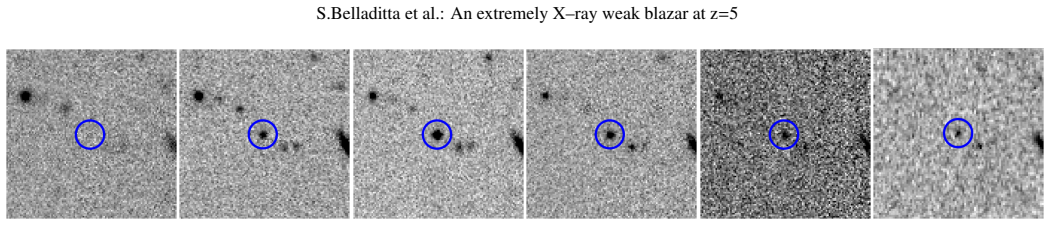
DES0141-54 is a powerful flat-spectrum radio source: the radio-loudness is $R=S_{5\,\mathrm{GHz}}/S_{2500\,\mathrm{\AA}}>10^4$, the spectral index from 76 MHz to 20 GHz is $\alpha=0.35\pm0.02$, the radio morphology is compact at arcsecond resolution, and the 4.8/8.6 GHz fluxes vary by about 10% between epochs, all standard signatures of a blazar. Spectroscopic follow-up gives $z=5.000\pm0.002$ from Ly$\alpha$, C IV, N V, and Mg II lines. In X-rays, XMM-Newton detects only $7.5\pm2.6\times10^{-15}\,\mathrm{erg\,s^{-1}\,cm^{-2}}$ and Swift yields an upper limit, placing the source more than $2\sigma$ below the radio–X-ray relation of high-redshift radio-loud AGNs; its X-ray luminosity is consistent with a radio-quiet quasar of the same optical power, so the jet's inverse-Compton emission must be weak. Modeling the broadband SED with a one-zone leptonic jet model reproduces the radio-to-X-ray shape with a viewing angle $\theta\approx1/\Gamma$ and a magnetic field $B\approx9$ G, higher than the typical $4.6$ G of powerful gamma-ray blazars, which naturally suppresses the Compton X-ray and gamma-ray peaks. The black hole mass, from C IV and Mg II virial estimates and from standard thin-disk and super-Eddington accretion-disk models, is $3$–$8\times10^8\,M_\odot$, making DES0141-54 the radio-loud AGN with the smallest known supermassive black hole at $z\ge5$.
Load-bearing premise
The load-bearing premise is that the flat radio spectrum and extreme radio-loudness of DES0141-54 prove its jet points at us; the paper itself concedes in Section 4.1 that a powerful misaligned radio galaxy, like J2102+6015 or J0311+0507, can look identical, and if DES0141-54 is not beamed, the X-ray weakness is no longer a jet property but something else.
Editorial extensions
If this is right
- DES0141-54 becomes the seventh known $z\ge5$ blazar and demonstrates that cross-matching deep optical surveys like DES with low-frequency radio surveys can uncover beamed AGNs fainter than those found by shallower all-sky surveys.
- The high-field interpretation implies the source should stay undetected by gamma-ray observatories; the predicted faint gamma-ray flux is consistent with existing sensitivity limits, so a future gamma-ray detection would force a downward revision of $B$ or a different emission geometry.
- A black hole of $3$–$8\times10^8\,M_\odot$ powering a radio-loud jet only 1.2 Gyr after the Big Bang shows that jet production does not require $10^{9-10}\,M_\odot$ black holes, and supports growth histories with sustained near-Eddington accretion.
- With $\log(XR)=9.96\pm0.30$ Hz, the source sits in the tail of the low-redshift BZCAT FSRQ distribution, making DES0141-54 the high-redshift analog of a rare class whose other members can be studied nearby at higher signal-to-noise.
Reading between the lines
- The paper does not quantify selection completeness; because the search required SUMSS detection above 30 mJy and specific $r-i/i-z$ dropout colors, the true number density of such X-ray-weak blazars at $z\sim5$ could be higher, and a completeness correction would be a natural next step.
- If high jet magnetic fields are the generic cause of X-ray weakness, then the X-ray-to-radio ratio may serve as a practical magnetization indicator for large blazar samples, and radio-selected samples with X-ray follow-up should find more objects with $\log(XR)\lesssim10$ at all redshifts.
- A direct orientation test not performed in the paper is VLBI imaging: detecting a one-sided, Doppler-boosted core with brightness temperature above $10^{10}$ K would confirm the blazar classification, while a symmetric or non-boosted structure would instead move DES0141-54 toward the misaligned class exemplified by J2102+6015 and J0311+0507.
- The Mg II-based mass uses a line detected at signal-to-noise near 2, so the lower end of the $3$–$8\times10^8\,M_\odot$ range is not secure; higher-signal near-infrared spectroscopy would either confirm the record-low mass or raise it, with direct implications for how early such a black hole could have grown.
Signed reviews
Editorial analysis
A structured set of objections, weighed in public.
Referee Report
Summary. This paper reports the discovery of DESJ014132.4-542749.9 (DES0141-54), a radio-loud AGN at z=5.0 selected from a cross-match of DES DR1 and SUMSS. The authors present optical and NIR spectroscopy (EFOSC2/NTT and X-Shooter/VLT) confirming the redshift via Lyα, O VI, N V, C IV, and Mg II; archival radio data from 76 MHz to 20 GHz showing a flat spectrum (α_total = 0.35 ± 0.02) and a high radio-loudness (R > 10^4); an XMM-Newton detection with eleven counts and a Swift/XRT upper limit; a one-zone leptonic SED fit implying B ≈ 9 G; and black hole mass estimates in the range 3–8 × 10^8 M_sun. The central claims are that DES0141-54 is a z=5 blazar with extremely weak X-ray emission relative to the blazar population, and that it hosts the smallest supermassive black hole known in a radio-loud AGN at z ≥ 5.
Significance. The paper's main value lies in the identification of a rare high-redshift radio-loud AGN with a well-determined redshift, a dense radio SED, and a clean prediction that it should be faint in Fermi/LAT. The comparison of the X-ray-to-radio luminosity ratio with 105 low-redshift BZCAT FSRQs provides a useful quantitative benchmark, and the black hole mass estimates, despite their uncertainties, extend the known range of SMBH masses in z ≥ 5 radio-loud AGN. The empirical measurements (redshift, radio fluxes, optical/IR photometry) are independent and well documented, and the paper explicitly provides the data tables needed to reproduce the SED. However, the central interpretation as an 'extremely X-ray weak blazar' is only as strong as the blazar classification and the marginal X-ray detection.
major comments (3)
- [4.1 (blazar classification)] The classification of DES0141-54 as a blazar rests on indirect radio indicators (R > 10^4, a flat radio spectrum with α_total = 0.35 ± 0.02, and ~10% variability), yet Section 4.1 acknowledges that an intrinsically powerful misaligned RL AGN like J2102+6015 or J0311+0507 cannot be excluded. Flat spectra can also result from the superposition of self-absorbed components, and the variability is measured between two epochs with different telescopes and calibration. Without a VLBI detection of a compact core or a direct brightness-temperature measurement, the beaming interpretation is not established, so the title and abstract overstate the case; the source should be called a blazar candidate and the comparison with the BZCAT population in Fig. 8 phrased as conditional on that classification.
- [2.1 and 3.3 (X-ray detection)] The X-ray flux of DES0141-54 is based on eleven counts in the XMM-Newton PN detector at a claimed significance of ~3σ, with a 50% flux-loss correction and a bright source ~15'' from the target. The Swift/XRT observation yields only an upper limit (1.3×10^-14 erg s^-1 cm^-2) that is consistent with the XMM flux but also with a flux several times lower. The derived log(L_X/L_1.4GHz) = 9.96 ± 0.30 therefore carries systematic uncertainties from the background treatment, the assumed photon index (Γ = 1.75 ± 0.5), and the ARF correction that exceed the quoted statistical error. The paper should provide a detailed robustness analysis (e.g., varying the extraction region, background model, and spectral slope) and explicitly label the 'extremely X-ray weak' claim as provisional pending deeper observations.
- [6 (SED modeling)] The B ≈ 9 G field is an output of a one-zone leptonic model fit to the SED, not an independent measurement. With only a handful of radio points, an optical/IR continuum, and a single X-ray point, other parameter combinations or additional emission components (e.g., a stronger disk/corona contribution to the X-rays) could reproduce the same data. The paper should explicitly acknowledge this degeneracy and avoid wording such as 'a high value of the AGN magnetic field is needed' (Section 6), which implies a uniqueness that the data do not support.
minor comments (5)
- [2.1 (WISE blending correction)] The 60% blending correction to the WISE magnitudes is not assigned an uncertainty and is not propagated into the SED fits; this systematic should be included or discussed.
- [5.1 (MgII virial mass)] The MgII line is detected at S/N ≈ 2, yet the quoted FWHM (2447 ± 141 km/s) and the resulting virial mass are presented with formal errors only; a low-S/N Gaussian fit makes the FWHM highly uncertain, and the mass estimate should carry an explicit warning.
- [Abstract and Section 2] The name 'Sydney' is misspelled as 'Sidney' in the abstract and in the description of the SUMSS survey; this should be corrected throughout.
- [4.2 (comparison sample)] The statement that the 1.5 Jy radio cut produces 'a well-defined radio flux-limited sample' overclaims the completeness of BZCAT; the authors should either cite a completeness analysis or soften the claim.
- [5.2 (disk model degeneracy)] The two accretion disk models (SS73 and super-Eddington) give black hole masses of 8×10^8 and 3×10^8 M_sun, respectively; the paper notes but could more explicitly quantify the degeneracy, since the quoted range is effectively the prior range of the two models rather than a single robust measurement.
Circularity Check
No significant circularity: the paper's empirical claims and model interpretation are self-contained.
full rationale
The paper's central claims rest on independent observations: the z=5.0 redshift from Ly-alpha, NV, CIV, and MgII emission lines; radio fluxes from SUMSS, GLEAM, AT20G, ATPMN, CRATES, and PMN; the X-ray flux from XMM-Newton and the Swift upper limit; and optical/IR photometry from DES, VHS, and WISE. The blazar classification is an inference from radio-loudness, flat spectrum, and variability, and the paper explicitly concedes that a misaligned powerful radio-loud AGN cannot be excluded (Section 4.1); this is a source-selection or correctness limitation, not a circular definition. The black hole mass is derived from standard virial relations and independent accretion-disk model fits, cross-checked against BLR line luminosities. The high magnetic field (B ~ 9 G) in Section 6 is an output parameter of the one-zone leptonic model fitted to the SED, not a quantity predicted from the data; the paper presents it as a possible physical explanation, not as a first-principles derivation. The Fermi non-detection is a genuine, though weak, prediction because gamma-ray data were not used as input to the fit. Self-citations to Ghisellini & Tavecchio (2009, 2015) and Sbarrato et al. (2012) cite a published, general blazar model and earlier sample results, not an unverified uniqueness theorem, and do not carry the argument. No step in the derivation chain reduces by construction to its inputs.
Assumptions & free parameters
free parameters (3)
- Magnetic field B in jet dissipation region =
9.63 G
- Optical/IR continuum spectral index αλ =
-1.2
- X-ray photon index Γ =
1.75 ± 0.5
assumptions (4)
- domain assumption Virial BH mass scaling relations calibrated at low redshift are valid at z=5 for this object.
- domain assumption The one-zone leptonic jet model of Ghisellini & Tavecchio (2009) accurately describes the SED of DES0141-54.
- domain assumption A flat radio spectrum and high radio-loudness imply beaming (small viewing angle).
- domain assumption Standard Shakura-Sunyaev and super-Eddington disk models describe the optical/IR emission.
Cite this review
Pith. "Pith review of An extremely X--ray weak blazar at z=5." pith.science (2026). https://pith.science/paper/ZQWXSEH7
@misc{pith2026190808552,
  author       = {Pith},
  title        = {Pith review of: An extremely X--ray weak blazar at z=5},
  year         = {2026},
  howpublished = {\url{https://pith.science/paper/ZQWXSEH7}},
  note         = {Machine review of arXiv:1908.08552}
}
abstract
We present the discovery and properties of DESJ014132.4-542749.9 (DES0141-54), a new powerful radio-loud active galactic nucleus (AGN) in the early Universe (z=5.0). It was discovered by cross-matching the first data release of the Dark Energy Survey (DES DR1) with the Sidney University Molonglo Survey (SUMSS) radio catalog at 0.843 GHz. This object is the first radio-loud AGN at high redshift discovered in the DES. The radio properties of DES0141-54, namely its very large radio-loudness (R>10$^{4}$), the high radio luminosity (L$_{0.8 GHz}$=1.73$\times$10$^{28}$ W Hz$^{-1}$), and the flatness of the radio spectrum ($\alpha$=0.35) up to very high frequencies (120 GHz in the source's rest frame), classify this object as a blazar, meaning, a radio-loud AGN observed along the relativistic jet axis. However, the X--ray luminosity of DESJ0141-54 is much lower compared to those of the high redshift (z$\geq$4.5) blazars discovered so far. Moreover its X-ray-to-radio luminosity ratio (log($\frac{L_{[0.5-10]keV}}{L_{1.4GHz}}$)=9.96$\pm$0.30 Hz) is small also when compared to lower redshift blazars: only 2\% of the low-z population has a similar ratio. By modeling the spectral energy distribution we found that this peculiar X--ray weakness and the powerful radio emission could be related to a particularly high value of the magnetic field. Finally, the mass of the central black hole is relatively small (M$_{BH}$ = 3-8 $\times$10$^8$ M$_{\odot}$) compared to other confirmed blazars at similar redshift, making DES0141-54 the radio-loud AGN that host the smallest supermassive black hole ever discovered at z$\geq$5.
Figures


Figures from the paper (5 more)


Forward citations
Cited by 1 Pith paper
-
The most extreme high-z radio quasars in the eRASS:1 X-ray survey
The team confirmed 39 new high-redshift radio quasars and found that the number of X-ray-selected blazars at z>4 grows with redshift faster than a constant X-ray/radio ratio model, in broad agreement with the IC/CMB model.
Reference graph
Works this paper leans on
-
[1]
Abbott, T. M. C., Abdalla, F. B., Allam, S., et al. 2018, ApJS, 239, 18
2018
-
[2]
F., Fan, X., Richards, G
Anderson, S. F., Fan, X., Richards, G. T., et al. 2001, AJ, 122, 503
2001
-
[3]
Arnaud, K. A. 1996, Astronomical Data Analysis Software and Systems V , 101, 17 Bañados, E., Venemans, B. P., Morganson, E., et al. 2015, ApJ, 804, 118
1996
-
[4]
C.-J., Large, M
Bock, D. C.-J., Large, M. I., & Sadler, E. M. 1999, AJ, 117, 1578
1999
-
[5]
H., & Perley, R
Bridle, A. H., & Perley, R. A. 1984, ARA&A, 22, 319
1984
-
[6]
Browne, I. W. A., Wilkinson, P. N., Jackson, N. J. F., et al. 2003, MNRAS, 341, 13
2003
-
[7]
1984, The Messenger, 38, 9
Buzzoni, B., Delabre, B., Dekker, H., et al. 1984, The Messenger, 38, 9
1984
-
[8]
2019, MNRAS, 484, 204
Caccianiga, A., Moretti, A., Belladitta, S., et al. 2019, MNRAS, 484, 204
2019
Show all 89 references
-
[9]
2013, MNRAS, 431, 210
Calderone, G., Ghisellini, G., Colpi, M., & Dotti, M. 2013, MNRAS, 431, 210
2013
-
[10]
2018, A&A, 612, A59
Campitiello, S., Ghisellini, G., Sbarrato, T., & Calderone, G. 2018, A&A, 612, A59
2018
-
[11]
2017, A&A, 606, A15
Cao, S., Zheng, X., Biesiada, M., et al. 2017, A&A, 606, A15
2017
-
[12]
1997, MNRAS, 286, 415
Celotti, A., Padovani, P., & Ghisellini, G. 1997, MNRAS, 286, 415
1997
-
[13]
C., & Pan-STARRS Team 2016, American Astronomical Society Meeting Abstracts #227, 227, 324.07
Chambers, K. C., & Pan-STARRS Team 2016, American Astronomical Society Meeting Abstracts #227, 227, 324.07
2016
-
[14]
D., Jones, P
Chhetri, R., Ekers, R. D., Jones, P. A., & Ricci, R. 2013, MNRAS, 434, 956
2013
-
[15]
Cross, N. J. G., Collins, R. S., Mann, R. G., et al. 2012, A&A, 548, A119
2012
-
[16]
Denney, K. D. 2012, ApJ, 759, 44
2012
-
[17]
D., Pogge, R
Denney, K. D., Pogge, R. W., Assef, R. J., et al. 2013, ApJ, 775, 60
2013
-
[18]
Fabian, A. C. 2012, ARA&A, 50, 455
2012
-
[19]
L., & Keating, B
Fan, X., Carilli, C. L., & Keating, B. 2006, ARA&A, 44, 415
2006
-
[20]
2005, International Journal of Modern Physics A, 20, 3121
Flaugher, B. 2005, International Journal of Modern Physics A, 20, 3121
2005
-
[21]
T., Honscheid, K., et al
Flaugher, B., Diehl, H. T., Honscheid, K., et al. 2015, AJ, 150, 150
2015
-
[22]
J., Hewett, P
Francis, P. J., Hewett, P. C., Foltz, C. B., et al. 1991, ApJ, 373, 465
1991
-
[23]
E., de Vicente, P., & Shu, F
Frey, S., Titov, O., Melnikov, A. E., de Vicente, P., & Shu, F. 2018, A&A, 618, A68
2018
-
[24]
2004, ApJ, 611, 1005
Gehrels, N., Chincarini, G., Giommi, P., et al. 2004, ApJ, 611, 1005
2004
-
[25]
2009, MNRAS, 397, 985
Ghisellini, G., & Tavecchio, F. 2009, MNRAS, 397, 985
2009
-
[26]
2010, MNRAS, 402, 497
Ghisellini, G., Tavecchio, F., Foschini, L., et al. 2010, MNRAS, 402, 497
2010
-
[27]
2013, MNRAS, 432, 2818
Ghisellini, G., Haardt, F., Della Ceca, R., V olonteri, M., & Sbarrato, T. 2013, MNRAS, 432, 2818
2013
-
[28]
2014, MNRAS, 440, L111
Ghisellini, G., Sbarrato, T., Tagliaferri, G., et al. 2014, MNRAS, 440, L111
2014
-
[29]
2015, MNRAS, 450, L34
Ghisellini, G., Tagliaferri, G., Sbarrato, T., & Gehrels, N. 2015, MNRAS, 450, L34
2015
-
[30]
2015, MNRAS, 448, 1060
Ghisellini, G., & Tavecchio, F. 2015, MNRAS, 448, 1060
2015
-
[31]
H., Barres de Almeida, U., et al
Giommi, P., Brandt, C. H., Barres de Almeida, U., et al. 2019, arXiv:1904.06043
2019 arXiv
-
[32]
2006, Proc
Goldoni, P., Royer, F., François, P., et al. 2006, Proc. SPIE, 6269, 62692K
2006
-
[33]
R., Suntzeff, N
Hamuy, M., Walker, A. R., Suntzeff, N. B., et al. 1992, PASP, 104, 533
1992
-
[34]
B., Heathcote, S
Hamuy, M., Suntzeff, N. B., Heathcote, S. R., et al. 1994, PASP, 106, 566
1994
-
[35]
E., Romani, R
Healey, S. E., Romani, R. W., Taylor, G. B., et al. 2007, ApJS, 171, 61
2007
-
[36]
C., Kovalev, Y
Homan, D. C., Kovalev, Y . Y ., Lister, M. L., et al. 2006, ApJ, 642, L115
2006
-
[37]
L., & for the DES Collaboration 2008, arXiv:0810.3600
Honscheid, K., DePoy, D. L., & for the DES Collaboration 2008, arXiv:0810.3600
2008 arXiv
-
[38]
R., Hancock, P
Hurley-Walker, N., Callingham, J. R., Hancock, P. J., et al. 2017, MNRAS, 464, 1146
2017
-
[39]
2019, MNRAS, in press
Ighina, L., Caccianiga, A., Moretti, A., et al. 2019, MNRAS, in press. Ivezi´c, Ž., Menou, K., Knapp, G. R., et al. 2002, AJ, 124, 2364
2019
-
[40]
2007, ApJ, 656, 680
Jiang, L., Fan, X., Ivezi´c, Ž., et al. 2007, ApJ, 656, 680
2007
-
[41]
D., Fan, X., et al
Jiang, L., McGreer, I. D., Fan, X., et al. 2016, ApJ, 833, 222
2016
-
[42]
Kalberla, P. M. W., Burton, W. B., Hartmann, D., et al. 2005, A&A, 440, 775
2005
-
[43]
I., Goss, W
Kopylov, A. I., Goss, W. M., Pari˘iski˘i, Y . N., et al. 2006, Astronomy Letters, 32, 433
2006
-
[44]
2016, MNRAS, 456, 2993
Lupi, A., Haardt, F., Dotti, M., et al. 2016, MNRAS, 456, 2993
2016
-
[45]
2011, ApJ, 731, 53
Mainzer, A., Bauer, J., Grav, T., et al. 2011, ApJ, 731, 53
2011
-
[46]
2015, Ap&SS, 357, 75
Massaro, E., Maselli, A., Leto, C., et al. 2015, Ap&SS, 357, 75
2015
-
[47]
J., et al
Mauch, T., Murphy, T., Buttery, H. J., et al. 2003, MNRAS, 342, 1117
2003
-
[48]
P., et al
Mazzucchelli, C., Bañados, E., Venemans, B. P., et al. 2017, ApJ, 849, 91 Article number, page 10 of 12 S.Belladitta et al.: An extremely X–ray weak blazar at z=5
2017
-
[49]
M., Murphy, T., & Ekers, R
McConnell, D., Sadler, E. M., Murphy, T., & Ekers, R. D. 2012, MNRAS, 422, 1527
2012
-
[50]
D., Jiang, L., Fan, X., et al
McGreer, I. D., Jiang, L., Fan, X., et al. 2013, ApJ, 768, 105
2013
-
[51]
G., Banerji, M., Gonzalez, E., et al
McMahon, R. G., Banerji, M., Gonzalez, E., et al. 2013, The Messenger, 154, 35
2013
-
[52]
2006, MNRAS, 365, 807
Meiksin, A. 2006, MNRAS, 365, 807
2006
-
[53]
Mills, B. Y . 1981, Proceedings of the Astronomical Society of Australia, 4, 156
1981
-
[54]
2010, Proc
Modigliani, A., Goldoni, P., Royer, F., et al. 2010, Proc. SPIE, 7737, 773728
2010
-
[55]
2014, A&A, 568, A9
Moehler, S., Modigliani, A., Freudling, W., et al. 2014, A&A, 568, A9
2014
-
[56]
J., Warren, S
Mortlock, D. J., Warren, S. J., Venemans, B. P., et al. 2011, Nature, 474, 616
2011
-
[57]
M., Ekers, R
Murphy, T., Sadler, E. M., Ekers, R. D., et al. 2010, MNRAS, 402, 2403
2010
-
[58]
D., & Thorne, K
Novikov, I. D., & Thorne, K. S. 1973, Black Holes (Les Astres Occlus), 343 O’Dea, C. P. 1998, PASP, 110, 493
1973
-
[59]
2002, ApJ, 574, 315
Ohsuga, K., Mineshige, S., Mori, M., & Umemura, M. 2002, ApJ, 574, 315
2002
-
[60]
N., Thomasson, P., Kopylov, A
Parijskij, Y . N., Thomasson, P., Kopylov, A. I., et al. 2014, MNRAS, 439, 2314
2014
-
[61]
M., Ferrarese, L., Gilbert, K
Peterson, B. M., Ferrarese, L., Gilbert, K. M., et al. 2004, ApJ, 613, 682
2004
-
[62]
2016, MNRAS, 458, 3047
Pezzulli, E., Valiante, R., & Schneider, R. 2016, MNRAS, 458, 3047
2016
-
[63]
Readhead, A. C. S. 1994, ApJ, 426, 51
1994
-
[64]
L., McMahon, R
Reed, S. L., McMahon, R. G., Martini, P., et al. 2017, MNRAS, 468, 4702
2017
-
[65]
L., Banerji, M., Becker, G
Reed, S. L., Banerji, M., Becker, G. D., et al. 2019, arXiv:1901.07456
2019 arXiv
-
[66]
Rees, M. J. 1984, ARA&A, 22, 471
1984
-
[67]
T., Lacy, M., Storrie-Lombardi, L
Richards, G. T., Lacy, M., Storrie-Lombardi, L. J., et al. 2006, ApJS, 166, 470
2006
-
[68]
T., Kruczek, N
Richards, G. T., Kruczek, N. E., Gallagher, S. C., et al. 2011, Bulletin of the American Astronomical Society, 43, 327.13
2011
-
[69]
Robertson, J. G. 1991, Australian Journal of Physics, 44, 729
1991
-
[70]
W., Sowards-Emmerd, D., Greenhill, L., & Michelson, P
Romani, R. W., Sowards-Emmerd, D., Greenhill, L., & Michelson, P. 2004, ApJ, 610, L9
2004
-
[71]
R., Webb, N
Rosen, S. R., Webb, N. A., Watson, M. G., et al. 2019, VizieR Online Data Cat- alog, 9055,
2019
-
[72]
2012, MNRAS, 426, L91
Sbarrato, T., Ghisellini, G., Nardini, M., et al. 2012, MNRAS, 426, L91
2012
-
[73]
Selsing, J., Fynbo, J. P. U., Christensen, L., & Krogager, J.-K. 2016, A&A, 585, A87
2016
-
[74]
I., & Sunyaev, R
Shakura, N. I., & Sunyaev, R. A. 1973, A&A, 24, 337
1973
-
[75]
E., Strauss, M
Shen, Y ., Greene, J. E., Strauss, M. A., Richards, G. T., & Schneider, D. P. 2008, ApJ, 680, 169
2008
-
[76]
A., Ross, N
Shen, Y ., Strauss, M. A., Ross, N. P., et al. 2009, ApJ, 697, 1656
2009
-
[77]
T., Strauss, M
Shen, Y ., Richards, G. T., Strauss, M. A., et al. 2011, ApJS, 194, 45
2011
-
[78]
W., Michelson, P
Sowards-Emmerd, D., Romani, R. W., Michelson, P. F., & Ulvestad, J. S. 2004, ApJ, 609, 564
2004
-
[79]
V ., Brandt, W
Strateva, I. V ., Brandt, W. N., Schneider, D. P., Vanden Berk, D. G., & Vignali, C. 2005, AJ, 130, 387
2005
-
[80]
1993, Astronomical Data Analysis Software and Systems II, 52, 173 Vanden Berk, D
Tody, D. 1993, Astronomical Data Analysis Software and Systems II, 52, 173 Vanden Berk, D. E., Richards, G. T., Bauer, A., et al. 2001, AJ, 122, 549
1993
-
[81]
P., McMahon, R
Venemans, B. P., McMahon, R. G., Warren, S. J., et al. 2007, MNRAS, 376, L76
2007
-
[82]
2011, A&A, 536, A105
Vernet, J., Dekker, H., D’Odorico, S., et al. 2011, A&A, 536, A105
2011
-
[83]
Vestergaard, M., & Peterson, B. M. 2006, ApJ, 641, 689 V olonteri, M., Haardt, F., Ghisellini, G., & Della Ceca, R. 2011, MNRAS, 416, 216
2006
-
[84]
B., Lenc, E., Bell, M
Wayth, R. B., Lenc, E., Bell, M. E., et al. 2015, PASA, 32, e025
2015
-
[85]
J., Delorme, P., Reylé, C., et al
Willott, C. J., Delorme, P., Reylé, C., et al. 2010, AJ, 139, 906
2010
-
[86]
E., Griffith, M
Wright, A. E., Griffith, M. R., Burke, B. F., & Ekers, R. D. 1994, ApJS, 91, 111
1994
-
[87]
L., Eisenhardt, P
Wright, E. L., Eisenhardt, P. R. M., Mainzer, A. K., et al. 2010, AJ, 140, 1868
2010
-
[88]
G., Adelman, J., Anderson, J
York, D. G., Adelman, J., Anderson, J. E., Jr., et al. 2000, AJ, 120, 1579
2000
-
[89]
Zensus, J. A. 1997, ARA&A, 35, 607 Article number, page 11 of 12 A&A proofs: manuscript no. 35965final Appendix A: Tables description Here we report the full description of the archival radio fluxes reported in the GLEAM catalog and the values useful to build the spectral energy...
1997
Reviewed August 14, 2026 · model on record in the stance chip above.
Discussion (0). Continue with ORCID to comment.