REVIEW 3 major objections 4 minor 1 cited by
The chemical structure of young high-mass star-forming clumps: (I) Deuteration
T0 review · 3 major / 4 minor · reviewed 2026-08-14 · deepseek-v4-flash
Pith's one-line read By mapping deuterium fractionation across two parsec-scale clumps in the same infrared dark cloud, this paper establishes that colder, younger clump S is 2-3 times more deuterated in N2H+, HCO+, HCN, and HNC than the more evolved P1, with…
desk verdict The mapped D-fraction gradients for N2H+, HCO+, HCN, and HNC are a solid new result, but the paper's >10% CH3OH deuteration claim outruns its own error bars. read the letter →
The pith
A machine-rendered reading of the paper's core claim, the machinery that carries it, and where it could break.
The reading
What carries the argument
The analysis rests on column-density ratio maps between deuterated and hydrogenated isotopologues (D/hyd), constructed from optically thin lines of 13C or 15N/18O isotopologues. For HCN, HNC, and HCO+, the hydrogenated column densities are recovered from their 13C isotopologues using a fixed 12C/13C ratio of 42.9; excitation temperatures are derived either from hyperfine structure fitting or from the kinetic temperature map from para-NH3. Gas temperature and density maps, built from Herschel/SED dust fits, NH3 hyperfine fitting, and LVG modeling of H2CO and CH3OH, provide the physical backdrop against which the D-fraction gradients are interpreted.
What would settle it
A direct measurement of the local 12C/13C ratio toward P1, S, and Soff, from optically thin double-isotopologue lines, would settle the main systematic: if the ratio is 47-80 rather than 42.9, the reported HCN, HNC, and HCO+ D-fractions drop by a factor of 1.5-2 and the species ordering could change.
Extended reading notes
Core claim
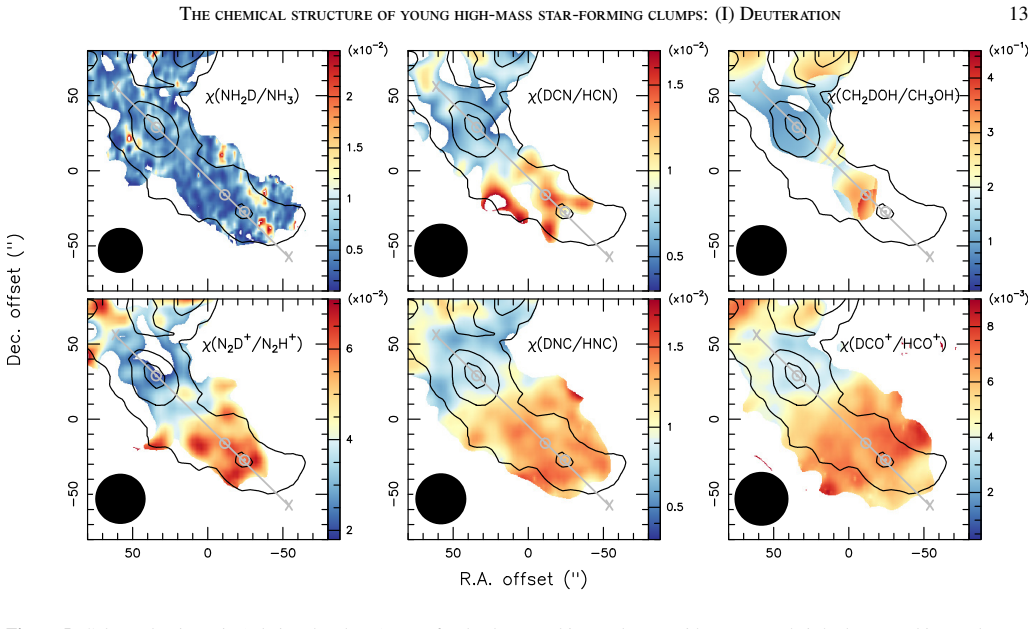
The paper reports measured D-fractions for six molecules toward two high-mass protostellar clumps, P1 and S, in the filamentary infrared dark cloud G28.34+0.06. It finds that D(N2H+) is 2.1% toward P1 and 6.1% toward S, roughly an order of magnitude higher than D(HCO+), D(HCN), and D(HNC), which lie in the 0.4-1.5% range, and that these four D-fractions are enriched toward the colder (Tkin ~14 K), denser clump S by a factor of 2-3. By contrast, D(NH3) stays at $(5\pm 3)\times 10^{-3}$ across the region, and D(CH3OH) peaks at 10-40% at the location Soff, 20 arcseconds northeast of S, where CO depletion reaches about a factor of 10. The authors interpret these patterns as the chemical signature of an evolutionary sequence: deuterium fractionation favors cold, dense, CO-freeze-out gas, and different species respond at different rates.
Load-bearing premise
The maps assume a single uniform 12C/13C ratio of 42.9 across the whole region; if isotopic exchange raises the true ratio to 47-80, the reported D-fractions for HCN, HNC, and HCO+ would be overestimated by a factor of 1.5-2.
Editorial extensions
If this is right
- D(N2H+) of 2-6% places P1 and S between high-mass prestellar and protostellar objects, consistent with embedded but very young protostars.
- D(CH3OH) above 10% toward Soff, comparable to Class 0 low-mass protostars, suggests a deeply embedded, dense object at the CO-depletion peak.
- Maps reveal peaks and gradients that pointing observations miss, for example D(CH3OH) below 0.3% at the pointed location versus 10-40% at Soff.
- The gradient from P1 to S in D(N2H+), D(HCO+), D(HCN), and D(HNC) supports temperature and density, rather than external UV, as the controlling factors.
- Because P1 and S share the same natal cloud, the chemical differences are attributable to evolutionary stage rather than to environmental differences.
Reading between the lines
- One testable extension is to observe the Soff region with sub-arcsecond resolution (e.g., with ALMA): the model that CH3OH forms on grains as CO freezes out predicts a compact, cold, dense object at that position, which single-dish mapping cannot resolve.
- If the 12C/13C exchange models are correct, pixel-by-pixel isotopic ratios would steepen the D-fraction gradients reported here, making the deuteration maps lower limits; this could be tested with higher-J 13C lines or by observing additional rare isotopologues.
- The comparative two-clump design could be scaled to a larger sample of 70-micron-dark/bright clump pairs to convert deuterium fractionation from a chemical tracer into a quantitative evolutionary clock for high-mass star formation.
Signed reviews
Editorial analysis
A structured set of objections, weighed in public.
Referee Report
Summary. This paper presents IRAM-30 m on-the-fly spectral line maps of two parsec-scale clumps, P1 and S, in the infrared dark cloud G28.34+0.06, together with archival Herschel, CSO, SCUBA-2, and VLA+Effelsberg NH3 data. The authors derive dust and gas temperature maps, H2 and NH3 column density maps, and deuterium fraction maps for six species: NH3, N2H+, HCN, HNC, HCO+, and CH3OH. The main claims are that low-J lines of the dense gas tracers are subthermally excited; that D(N2H+) is several percent and exceeds D(HCO+), D(HCN), and D(HNC) by about an order of magnitude; that these D-fractions are enriched by a factor of 2-3 in the colder, denser, younger clump S relative to P1; that D(NH3) is essentially uniform at the few x 10^-3 level; and that single-deuterated methanol reaches >10%, with a peak of ~30-40% toward the CO-depletion peak Soff. The paper argues that these chemical variations trace evolutionary differences between the two clumps and that the deuterium fraction of different species can serve as an evolutionary diagnostic for high-mass star formation.
Significance. If the main claims hold, this is a valuable comparative dataset: it provides simultaneous, spatially resolved deuterium fraction maps for six species in two clumps of different evolutionary stages in the same cloud, with physical properties derived from independent gas and dust temperature diagnostics. The paper's strengths are its mapping approach over single-pointing studies, the explicit error budget in Section 5.4, the use of isotopologue ratios to test optical depth assumptions, and the cross-check of LTE rotational diagrams against LVG/RADEX fits. The qualitative conclusion that N2H+ deuteration is higher than the carbon-bearing species and that the D-fractions of these species increase toward the colder, denser clump S is credible. However, the headline quantitative claim of >10% single-deuterated methanol is not supported at the stated precision, and the absolute D-fractions for HCN, HNC, and HCO+ carry an unquantified factor-1.5-2 systematic uncertainty from the adopted 12C/13C ratio.
major comments (3)
- [§5.5, Table 4, Abstract] The stated detection of single-deuterated methanol with D(CH2DOH/CH3OH) > 10% is not supported by the quoted errors. At Soff, Table 4 gives D = 33.3 ± 26.7%, so the 1σ lower bound is 6.6%, below the >10% threshold asserted in the Abstract and Conclusions; the underlying line ratio in Table 4 is only 2.8 ± 0.8% and rests on a single CH2DOH transition at 89.408 GHz. The '10%-39%' range in §5.5 also appears to be a scatter range rather than an uncertainty-weighted interval. Please propagate all relevant uncertainties (CH2DOH integrated intensity, T_rot from the CH3OH rotational diagram, beam-filling, and column density uncertainties) and either report the CH3OH deuteration as a tentative detection with a firm upper limit, or present additional checks (e.g., a second CH2DOH transition) before claiming >10%.
- [§5.2, §5.4, Table 4] The absolute D-fractions for HCN, HNC, and HCO+ are linearly scaled by a single assumed 12C/13C ratio of 42.9, while §5.4 item 4 explicitly notes that isotopic exchange in cold, dense gas can raise the ratio to 47-80 for these species. This factor of 1.5-2 is not folded into the quoted uncertainties in Table 4, and because the correction differs per species (e.g., ~80 for HCN/HNC versus ~47 for HCO+ according to Furuya et al. 2011), the relative ordering of D(HCN), D(HNC), and D(HCO+) and the comparison with literature values are not robust at the stated precision. Please either quote D-fractions with a systematic error bar reflecting the plausible 12C/13C range, or present the raw isotopologue line ratios (already listed in Table 4) as the primary quantitative result.
- [§5.1, Table 1, Figure 5] The D(NH3) map combines NH3 column densities at ~5'' resolution (VLA+Effelsberg) with NH2D column densities from a single ~30'' IRAM beam. Unless the NH3 map is explicitly smoothed to the NH2D beam before forming the ratio, the claimed uniformity of D(NH3) at (5 ± 3) x 10^-3 could be a beam-mismatch artifact: compact NH2D emission would be beam-diluted while the NH3 reference would not, and the local value toward Soff could be underestimated. Please state the smoothing/resolution-matching procedure used for Figure 5 and Table 4, or add a resolution-matched analysis.
minor comments (4)
- [§7] The sentence 'CO starts to catastrophy called freezes out' contains a typo; it should read something like 'CO starts to freeze out catastrophically.'
- [§2.1, §7] There are small language errors, including 'an line imaging survey' and 'determine the the extremely young protostellar objects'; these should be corrected in a language pass.
- [Table A1] The H13CO+ and DCO+ rows appear in both subtable I and subtable II with different fit methods; consider clarifying in the table notes which rows correspond to GAUSS fits and which to HFS fits to avoid apparent duplication.
- [Figure A4] The axis label 'Log1 N_r' appears garbled and should read 'Log10 N_rot' for clarity.
Circularity Check
No circularity: the D-fractions are measured line-intensity ratios converted with externally adopted excitation temperatures, isotopic ratios, and OPR values; no fitted parameter is relabeled as a prediction.
full rationale
The paper is an observational measurement study, not a derivation from first principles, and no load-bearing step reduces to its own input. The D-fraction maps are constructed from ratios of deuterated to hydrogenated isotopologue line intensities; for HCN, HNC, and HCO+ the hydrogenated column is recovered from 13C isotopologues using the fixed external ratio 12C/13C = 42.9 (Giannetti et al. 2014), with the paper itself stating that a different ratio would scale the values but not erase the P1-S gradient or the N2H+ versus other species ordering. Gas temperature comes from p-NH3 (VLA+Effelsberg) and dust temperature from archival SED fits; these are independent inputs, not parameters fitted to the deuterium lines. The CH2DOH/CH3OH ratio is derived from a single CH2DOH line under an assumed T_rot taken from CH3OH; the quoted 1-sigma uncertainties are large (33.3% +/- 26.7% at Soff), so the headline '>10%' claim is statistically fragile, but that is an error-budget and robustness issue, not circularity. Self-citations to Feng et al. 2016b/c establish source properties such as CO depletion, outflow presence, and dynamic age; these are external observational characterizations and are not used to force the D-fraction values. The paper is benchmarked against independent external results (Chen et al. 2010b, Fontani et al. 2011/2014/2015, Barnes et al. 2016), and the caveats in Section 5.4 explicitly expose the adopted 12C/13C and OPR sensitivities rather than hiding them. No uniqueness theorem, ansatz, or self-citation chain is invoked to make the choice of result forced. Accordingly, there is no circular step to report.
Assumptions & free parameters
free parameters (3)
- Isotopic ratio 12C/13C =
42.9 (adopted from Giannetti et al. 2014)
- Ortho-to-para ratio of NH3 =
1 (assumed)
- Ortho-to-para ratio of NH2D =
3 (assumed)
assumptions (6)
- domain assumption p-NH3 (1,1) and (2,2) lines are thermalized (LTE), so the CTEX method with constant excitation temperature is valid for NH3 column density.
- domain assumption All hydrogenated and deuterated lines used for D-fractions are optically thin (except resolved NH3 lines with modest optical depth).
- domain assumption Unity beam filling factor for all molecular lines.
- domain assumption Dust opacity law with kappa_230 = 0.899 cm^2/g and gas-to-dust ratio R = 150.
- domain assumption Foreground and background contamination of the C18O (2-1) line is negligible.
- standard math Spectroscopic parameters and collisional rate coefficients from CDMS/JPL and LAMDA are accurate.
Cite this review
Pith. "Pith review of The chemical structure of young high-mass star-forming clumps: (I) Deuteration." pith.science (2026). https://pith.science/paper/NJVMRLKD
@misc{pith2026190900209,
  author       = {Pith},
  title        = {Pith review of: The chemical structure of young high-mass star-forming clumps: (I) Deuteration},
  year         = {2026},
  howpublished = {\url{https://pith.science/paper/NJVMRLKD}},
  note         = {Machine review of arXiv:1909.00209}
}
abstract
The chemical structure of high-mass star nurseries is important for a general understanding of star formation. Deuteration is a key chemical process in the earliest stages of star formation because its efficiency is sensitive to the environment. Using the IRAM-30 m telescope at 1.3--4.3 mm wavelengths, we have imaged two parsec-scale high-mass protostellar clumps (P1 and S) that show different evolutionary stages but are located in the same giant filamentary {infrared dark cloud} G28.34+0.06. Deep spectral images at subparsec resolution reveal the dust and gas physical structures of both clumps. We find that (1) the low-$J$ lines of $\rm N_2H^+$, HCN, HNC, and $\rm HCO^+$ isotopologues are subthermally excited; and (2) the deuteration of $\rm N_2H^+$ is more efficient than that of $\rm HCO^+$, HCN, and HNC by an order of magnitude. The deuterations of these species are enriched toward the chemically younger clump S compared with P1, indicating that this process favors the colder and denser environment ($\rm T_{kin} \sim14 K$, $\rm N(NH_3) \sim 9\times 10^{15}\,cm^{-2}$). In contrast, single deuteration of $\rm NH_3$ is insensitive to the environmental difference between P1 and S; and (3) single deuteration of $\rm CH_3OH$ ($\rm > 10\%$) is detected toward the location where CO shows a depletion of $\sim10$. This comparative chemical study between P1 and S links the chemical variations to the environmental differences and shows chemical similarities between the early phases of high- and low-mass star-forming regions.
Figures


Figures from the paper (3 more)


Forward citations
Cited by 1 Pith paper
-
Anomalously high deuterium fractionation in a galactic translucent cloud: a challenge to chemical models
First detection of DCN and DNC absorption in a Galactic translucent cloud shows deuterium fractionation ~100× higher than elemental D/H, challenging standard chemical models.
Reference graph
Works this paper leans on
-
[1]
, " * write output.state after.block = add.period write newline
ENTRY address archivePrefix author booktitle chapter doi edition editor eprint howpublished institution journal key month number organization pages publisher school series title misctitle type volume year version url label extra.label sort.label short.list INTEGERS output.state before.all mid.sentence after.sentence after.block FUNCTION init.state.consts ...
-
[2]
write newline
" write newline "" before.all 'output.state := FUNCTION format.url url empty "" new.block "" url * "" * if FUNCTION format.eprint eprint empty "" archivePrefix empty "" archivePrefix "arXiv" = new.block " " eprint * " " * new.block " " eprint * " " * if if if FUNCTION format.doi doi empty "" " " doi * " " * if FUNCTION format.pid doi empty eprint empty ur...
-
[3]
˾v >?+ɯrZ[d([Y Yﭒ9? j ݯ_ 967v-+8qz- sx/M ŮZg d_ԯd?\
thebibliography [1] 20pt to REFERENCES 6pt =0pt 10pt plus 3pt =0pt =0pt =1pt plus 1pt =0pt =0pt -12pt =13pt plus 1pt =20pt =13pt plus 1pt \@M =10000 =-1.0em =0pt =0pt 0pt =0pt =1.0em @enumiv\@empty 10000 10000 `\.\@m \@noitemerr \@latex@warning Empty `thebibliography' environment \@ifnextchar \@reference \@latexerr Missing key on reference command Each re...
2017
-
[4]
Adande , G. R., & Ziurys , L. M. 2012, , 744, 194, 10.1088/0004-637X/744/2/194
-
[5]
2005, , 620, 330, 10.1086/427017
Aikawa , Y., Herbst , E., Roberts , H., & Caselli , P. 2005, , 620, 330, 10.1086/427017
doi:10.1086/427017 2005
-
[6]
Aikawa , Y., Wakelam , V., Garrod , R. T., & Herbst , E. 2008, , 674, 984, 10.1086/524096
doi:10.1086/524096 2008
-
[7]
Aikawa , Y., Wakelam , V., Hersant , F., Garrod , R. T., & Herbst , E. 2012, , 760, 40, 10.1088/0004-637X/760/1/40
-
[8]
Albertsson , T., Semenov , D. A., Vasyunin , A. I., Henning , T., & Herbst , E. 2013, , 207, 27, 10.1088/0067-0049/207/2/27
Show all 145 references
-
[9]
M., et al
Ao , Y., Henkel , C., Menten , K. M., et al. 2013, , 550, A135, 10.1051/0004-6361/201220096
2013 doi
-
[10]
2014, , 443, 275, 10.1093/mnras/stu1141
Awad , Z., Viti , S., Bayet , E., & Caselli , P. 2014, , 443, 275, 10.1093/mnras/stu1141
2014 doi
-
[11]
2003, , 585, L55, 10.1086/374263
Bacmann , A., Lefloch , B., Ceccarelli , C., et al. 2003, , 585, L55, 10.1086/374263
2003 doi
-
[12]
T., Kong , S., Tan , J
Barnes , A. T., Kong , S., Tan , J. C., et al. 2016, , 458, 1990, 10.1093/mnras/stw403
2016 doi
-
[13]
2015, , 453, L31, 10.1093/mnrasl/slv094
Barone , V., Latouche , C., Skouteris , D., et al. 2015, , 453, L31, 10.1093/mnrasl/slv094
2015 doi
-
[14]
2014, , 787, 113, 10.1088/0004-637X/787/2/113
Battersby , C., Ginsburg , A., Bally , J., et al. 2014, , 787, 113, 10.1088/0004-637X/787/2/113
2014 doi
-
[15]
A., Alves , J., Huard , T., & Lada , C
Bergin , E. A., Alves , J., Huard , T., & Lada , C. J. 2002, , 570, L101, 10.1086/340950
2002 doi
-
[16]
A., Plume , R., Williams , J
Bergin , E. A., Plume , R., Williams , J. P., & Myers , P. C. 1999, , 512, 724, 10.1086/306791
1999 doi
-
[17]
Beuther , H., & Sridharan , T. K. 2007, , 668, 348, 10.1086/521142
2007 doi
-
[18]
2015, , 579, A51, 10.1051/0004-6361/201321269
Bihr , S., Beuther , H., Linz , H., et al. 2015, , 579, A51, 10.1051/0004-6361/201321269
2015 doi
-
[19]
2014, , 569, A27, 10.1051/0004-6361/201423858
Bizzocchi , L., Caselli , P., Spezzano , S., & Leonardo , E. 2014, , 569, A27, 10.1051/0004-6361/201423858
2014 doi
- [20]
- [21]
-
[22]
J., Noriega-Crespo , A., Mizuno , D
Carey , S. J., Noriega-Crespo , A., Mizuno , D. R., et al. 2009, , 121, 76, 10.1086/596581
2009 doi
-
[23]
2012, , 538, A89, 10.1051/0004-6361/201118452
Carter , M., Lazareff , B., Maier , D., et al. 2012, , 538, A89, 10.1051/0004-6361/201118452
2012 doi
-
[24]
J., Myers , P
Caselli , P., Benson , P. J., Myers , P. C., & Tafalla , M. 2002 a , , 572, 238, 10.1086/340195
2002 doi
-
[25]
I., & Herbst , E
Caselli , P., Hasegawa , T. I., & Herbst , E. 1993, , 408, 548, 10.1086/172612
1993 doi
-
[26]
M., Tafalla , M., Dore , L., & Myers , P
Caselli , P., Walmsley , C. M., Tafalla , M., Dore , L., & Myers , P. C. 1999, , 523, L165, 10.1086/312280
1999 doi
-
[27]
M., Zucconi , A., et al
Caselli , P., Walmsley , C. M., Zucconi , A., et al. 2002 b , , 565, 344, 10.1086/324302
2002 doi
- [28]
-
[29]
2014, Protostars and Planets VI, 859, 10.2458/azu_uapress_9780816531240-ch037
Ceccarelli , C., Caselli , P., Bockel \'e e-Morvan , D., et al. 2014, Protostars and Planets VI, 859, 10.2458/azu_uapress_9780816531240-ch037
2014 doi
-
[30]
Ceccarelli , C., Caselli , P., Herbst , E., Tielens , A. G. G. M., & Caux , E. 2007, in Protostars and Planets V, ed. B. Reipurth , D. Jewitt , & K. Keil , 47. astro-ph/0603018
2007 arXiv
-
[32]
2010 b , , 713, L50, 10.1088/2041-8205/713/1/L50
---. 2010 b , , 713, L50, 10.1088/2041-8205/713/1/L50
2010 doi
-
[33]
2013, , 552, A40, 10.1051/0004-6361/201219567
Chira , R.-A., Beuther , H., Linz , H., et al. 2013, , 552, A40, 10.1051/0004-6361/201219567
2013 doi
-
[34]
2018, , 609, A129, 10.1051/0004-6361/201730576
Colzi , L., Fontani , F., Caselli , P., et al. 2018, , 609, A129, 10.1051/0004-6361/201730576
2018 doi
-
[35]
M., et al
Crapsi , A., Caselli , P., Walmsley , C. M., et al. 2005, , 619, 379, 10.1086/426472
2005 doi
-
[36]
C., & Tafalla , M
Crapsi , A., Caselli , P., Walmsley , M. C., & Tafalla , M. 2007, , 470, 221, 10.1051/0004-6361:20077613
2007 doi
-
[37]
2017, , 600, L10, 10.1051/0004-6361/201629754
Csengeri , T., Bontemps , S., Wyrowski , F., et al. 2017, , 600, L10, 10.1051/0004-6361/201629754
2017 doi
-
[38]
J., Whitney , B
Cyganowski , C. J., Whitney , B. A., Holden , E., et al. 2008, , 136, 2391, 10.1088/0004-6256/136/6/2391
2008 doi
-
[39]
Draine , B. T. 2003, , 41, 241, 10.1146/annurev.astro.41.011802.094840
2003 arXiv
-
[40]
2011, Physics of the Interstellar and Intergalactic Medium
---. 2011, Physics of the Interstellar and Intergalactic Medium
2011
-
[41]
H., Stutzki , J., & Wiedner , M
Emprechtinger , M., Caselli , P., Volgenau , N. H., Stutzki , J., & Wiedner , M. C. 2009, , 493, 89, 10.1051/0004-6361:200810324
2009 doi
-
[42]
2017, , 129, 025003, 10.1088/1538-3873/129/972/025003
Estalella , R. 2017, , 129, 025003, 10.1088/1538-3873/129/972/025003
2017 doi
-
[43]
2015, , 581, A71, 10.1051/0004-6361/201322725
Feng , S., Beuther , H., Henning , T., et al. 2015, , 581, A71, 10.1051/0004-6361/201322725
2015 doi
-
[44]
2016 a , , 593, A46, 10.1051/0004-6361/201424912
Feng , S., Beuther , H., Semenov , D., et al. 2016 a , , 593, A46, 10.1051/0004-6361/201424912
2016 doi
-
[45]
2016 b , , 592, A21, 10.1051/0004-6361/201526864
Feng , S., Beuther , H., Zhang , Q., et al. 2016 b , , 592, A21, 10.1051/0004-6361/201526864
2016 doi
-
[46]
2016 c , , 828, 100, 10.3847/0004-637X/828/2/100
---. 2016 c , , 828, 100, 10.3847/0004-637X/828/2/100
2016 doi
-
[47]
Feroz , F., & Hobson , M. P. 2008, , 384, 449, 10.1111/j.1365-2966.2007.12353.x
2008
-
[49]
P., Cameron , E., & Pettitt , A
Feroz , F., Hobson , M. P., Cameron , E., & Pettitt , A. N. 2013, arXiv e-prints. 1306.2144
2013 arXiv
-
[50]
2015, , 575, A87, 10.1051/0004-6361/201424753
Fontani , F., Busquet , G., Palau , A., et al. 2015, , 575, A87, 10.1051/0004-6361/201424753
2015 doi
-
[51]
2006, , 460, 709, 10.1051/0004-6361:20066105
Fontani , F., Caselli , P., Crapsi , A., et al. 2006, , 460, 709, 10.1051/0004-6361:20066105
2006 doi
-
[52]
T., et al
Fontani , F., Giannetti , A., Beltr \'a n , M. T., et al. 2012, , 423, 2342, 10.1111/j.1365-2966.2012.21043.x
2012
-
[53]
2014, , 440, 448, 10.1093/mnras/stu298
Fontani , F., Sakai , T., Furuya , K., et al. 2014, , 440, 448, 10.1093/mnras/stu298
2014 doi
-
[54]
2011, , 529, L7, 10.1051/0004-6361/201116631
Fontani , F., Palau , A., Caselli , P., et al. 2011, , 529, L7, 10.1051/0004-6361/201116631
2011 doi
-
[55]
A., Langer , W
Frerking , M. A., Langer , W. D., & Wilson , R. W. 1982, , 262, 590, 10.1086/160451
1982 doi
-
[56]
2011, , 731, 38, 10.1088/0004-637X/731/1/38
Furuya , K., Aikawa , Y., Sakai , N., & Yamamoto , S. 2011, , 731, 38, 10.1088/0004-637X/731/1/38
2011 doi
-
[57]
T., Wakelam , V., & Herbst , E
Garrod , R. T., Wakelam , V., & Herbst , E. 2007, , 467, 1103, 10.1051/0004-6361:20066704
2007 doi
-
[58]
L., Beuther , H., et al
Gerner , T., Shirley , Y. L., Beuther , H., et al. 2015, , 579, A80, 10.1051/0004-6361/201423989
2015 doi
-
[59]
2017, , 603, A33, 10.1051/0004-6361/201630048
Giannetti , A., Leurini , S., Wyrowski , F., et al. 2017, , 603, A33, 10.1051/0004-6361/201630048
2017 doi
-
[60]
2014, , 570, A65, 10.1051/0004-6361/201423692
Giannetti , A., Wyrowski , F., Brand , J., et al. 2014, , 570, A65, 10.1051/0004-6361/201423692
2014 doi
-
[61]
2011, PySpecKit: Python Spectroscopic Toolkit , Astrophysics Source Code Library
Ginsburg , A., & Mirocha , J. 2011, PySpecKit: Python Spectroscopic Toolkit , Astrophysics Source Code Library. 1109.001
2011
-
[62]
2016, , 586, A50, 10.1051/0004-6361/201526100
Ginsburg , A., Henkel , C., Ao , Y., et al. 2016, , 586, A50, 10.1051/0004-6361/201526100
2016 doi
-
[63]
M., Herbst , E., \"O berg , K
Graninger , D. M., Herbst , E., \"O berg , K. I., & Vasyunin , A. I. 2014, , 787, 74, 10.1088/0004-637X/787/1/74
2014 doi
-
[64]
2017, , 600, A61, 10.1051/0004-6361/201628463
Harju , J., Daniel , F., Sipil \"a , O., et al. 2017, , 600, A61, 10.1051/0004-6361/201628463
2017 doi
-
[65]
D., Caselli , P., Fontani , F., et al
Henshaw , J. D., Caselli , P., Fontani , F., et al. 2016, , 463, 146, 10.1093/mnras/stw1794
2016 doi
-
[66]
K., Tan , J
Hernandez , A. K., Tan , J. C., Caselli , P., et al. 2011, , 738, 11, 10.1088/0004-637X/738/1/11
2011 doi
-
[67]
2004, , 614, 1124, 10.1086/423889
Hidaka , H., Watanabe , N., Shiraki , T., Nagaoka , A., & Kouchi , A. 2004, , 614, 1124, 10.1086/423889
2004 doi
-
[68]
2006, , 643, 917, 10.1086/501517
Hiraoka , K., Ushiama , S., Enoura , T., et al. 2006, , 643, 917, 10.1086/501517
2006 doi
-
[69]
Ho , P. T. P., & Townes , C. H. 1983, , 21, 239, 10.1146/annurev.aa.21.090183.001323
1983
-
[71]
Johnstone , D., Boonman , A. M. S., & van Dishoeck , E. F. 2003, , 412, 157, 10.1051/0004-6361:20031370
2003 doi
-
[72]
K., Sch \"o ier , F
J rgensen , J. K., Sch \"o ier , F. L., & van Dishoeck , E. F. 2004, , 416, 603, 10.1051/0004-6361:20034440
2004 doi
-
[73]
2011, , 739, 63, 10.1088/0004-637X/739/2/63
Juvela , M., & Ysard , N. 2011, , 739, 63, 10.1088/0004-637X/739/2/63
2011 doi
-
[74]
V., & Kurtz , S
Kalenskii , S. V., & Kurtz , S. 2016, Astronomy Reports, 60, 702, 10.1134/S1063772916080047
2016 doi
-
[75]
C., Wakelam , V., & Sipil \"a , O
Kong , S., Caselli , P., Tan , J. C., Wakelam , V., & Sipil \"a , O. 2015, , 804, 98, 10.1088/0004-637X/804/2/98
2015 doi
-
[76]
C., Caselli , P., et al
Kong , S., Tan , J. C., Caselli , P., et al. 2018, , 867, 94, 10.3847/1538-4357/aae1b2
2018 doi
-
[77]
M., & Walmsley , C
Leurini , S., Menten , K. M., & Walmsley , C. M. 2016, , 592, A31, 10.1051/0004-6361/201527974
2016 doi
-
[78]
M., et al
Leurini , S., Schilke , P., Menten , K. M., et al. 2004, , 422, 573, 10.1051/0004-6361:20047046
2004 doi
-
[79]
Leurini , S., Schilke , P., Wyrowski , F., & Menten , K. M. 2007, , 466, 215, 10.1051/0004-6361:20054245
2007 doi
-
[80]
B., Dale , J
Lin , Y., Liu , H. B., Dale , J. E., et al. 2017, , 840, 22, 10.3847/1538-4357/aa6c67
2017 doi
-
[81]
L., Draine , B
Linsky , J. L., Draine , B. T., Moos , H. W., et al. 2006, , 647, 1106, 10.1086/505556
2006 doi
- [82]
-
[83]
Lucy , L. B. 1974, , 79, 745, 10.1086/111605
1974 doi
-
[84]
G., Emerson , D
Mangum , J. G., Emerson , D. T., & Greisen , E. W. 2007, , 474, 679, 10.1051/0004-6361:20077811
2007 doi
- [85]
- [86]
-
[87]
2009, , 399, 425, 10.1111/j.1365-2966.2009.15294.x
Maret , S., Faure , A., Scifoni , E., & Wiesenfeld , L. 2009, , 399, 425, 10.1111/j.1365-2966.2009.15294.x
2009
-
[88]
2011, , 526, A47, 10.1051/0004-6361/201015487
Maret , S., Hily-Blant , P., Pety , J., Bardeau , S., & Reynier , E. 2011, , 526, A47, 10.1051/0004-6361/201015487
2011 doi
- [89]
-
[90]
2011, , 534, A134, 10.1051/0004-6361/201117187
Miettinen , O., Hennemann , M., & Linz , H. 2011, , 534, A134, 10.1051/0004-6361/201117187
2011 doi
-
[91]
J., Bennett , A., & Herbst , E
Millar , T. J., Bennett , A., & Herbst , E. 1989, , 340, 906, 10.1086/167444
1989 doi
-
[92]
2010, , 518, L100, 10.1051/0004-6361/201014659
Molinari , S., Swinyard , B., Bally , J., et al. 2010, , 518, L100, 10.1051/0004-6361/201014659
2010 doi
-
[93]
u ller , H. S. P., Schl \
M \"u ller , H. S. P., Schl \"o der , F., Stutzki , J., & Winnewisser , G. 2005, Journal of Molecular Structure, 742, 215, 10.1016/j.molstruc.2005.01.027
2005 doi
-
[94]
E., Shirley , Y
M \"u ller , K. E., Shirley , Y. L., Evans , II, N. J., & Jacobson , H. R. 2002, , 143, 469, 10.1086/342881
2002 doi
-
[95]
M., H \'e brard , G., Howk , J
Oliveira , C. M., H \'e brard , G., Howk , J. C., et al. 2003, , 587, 235, 10.1086/368019
2003 doi
-
[96]
1994, , 291, 943
Ossenkopf , V., & Henning , T. 1994, , 291, 943
1994
-
[97]
M., Tafalla , M., Hily-Blant , P., & Pineau Des For \^e ts , G
Padovani , M., Walmsley , C. M., Tafalla , M., Hily-Blant , P., & Pineau Des For \^e ts , G. 2011, , 534, A77, 10.1051/0004-6361/201117134
2011 doi
-
[98]
Parise , B., Ceccarelli , C., Tielens , A. G. G. M., et al. 2006, , 453, 949, 10.1051/0004-6361:20054476
2006 doi
-
[99]
2002, , 393, L49, 10.1051/0004-6361:20021131
---. 2002, , 393, L49, 10.1051/0004-6361:20021131
2002 doi
-
[100]
A., Duarte-Cabral , A., et al
Peretto , N., Fuller , G. A., Duarte-Cabral , A., et al. 2013, , 555, A112, 10.1051/0004-6361/201321318
2013 doi
-
[101]
2005, in SF2A-2005: Semaine de l'Astrophysique Francaise, ed
Pety , J. 2005, in SF2A-2005: Semaine de l'Astrophysique Francaise, ed. F. Casoli , T. Contini , J. M. Hameury , & L. Pagani , 721
2005
-
[102]
M., Poynter , R
Pickett , H. M., Poynter , R. L., Cohen , E. A., et al. 1998, , 60, 883, 10.1016/S0022-4073(98)00091-0
1998 doi
-
[103]
2011, , 530, A118, 10.1051/0004-6361/201015899
Pillai , T., Kauffmann , J., Wyrowski , F., et al. 2011, , 530, A118, 10.1051/0004-6361/201015899
2011 doi
-
[104]
J., & Menten , K
Pillai , T., Wyrowski , F., Carey , S. J., & Menten , K. M. 2006, , 450, 569, 10.1051/0004-6361:20054128
2006 doi
-
[105]
J., Johnstone , D., et al
Pon , A., Kaufman , M. J., Johnstone , D., et al. 2016 a , , 827, 107, 10.3847/0004-637X/827/2/107
2016 doi
-
[106]
2016 b , , 587, A96, 10.1051/0004-6361/201527154
Pon , A., Johnstone , D., Caselli , P., et al. 2016 b , , 587, A96, 10.1051/0004-6361/201527154
2016 doi
-
[108]
Rabli , D., & Flower , D. R. 2010, , 406, 95, 10.1111/j.1365-2966.2010.16671.x
2010
-
[109]
2012, , 547, A49, 10.1051/0004-6361/201219232
Ragan , S., Henning , T., Krause , O., et al. 2012, , 547, A49, 10.1051/0004-6361/201219232
2012 doi
-
[110]
E., Bergin , E
Ragan , S. E., Bergin , E. A., & Gutermuth , R. A. 2009, , 698, 324, 10.1088/0004-637X/698/1/324
2009 doi
-
[111]
E., Bergin , E
Ragan , S. E., Bergin , E. A., & Wilner , D. 2011, , 736, 163, 10.1088/0004-637X/736/2/163
2011 doi
-
[112]
E., Henning , T., & Beuther , H
Ragan , S. E., Henning , T., & Beuther , H. 2013, , 559, A79, 10.1051/0004-6361/201321869
2013 doi
-
[113]
M., Jackson , J
Rathborne , J. M., Jackson , J. M., & Simon , R. 2006, , 641, 389, 10.1086/500423
2006 doi
-
[114]
Richardson, W. H. 1972, J. Opt. Soc. Am., 62, 55, 10.1364/JOSA.62.000055
1972 doi
-
[115]
P., Meade , M
Robitaille , T. P., Meade , M. R., Babler , B. L., et al. 2008, , 136, 2413, 10.1088/0004-6256/136/6/2413
2008 doi
-
[116]
W., Pineda , J
Rosolowsky , E. W., Pineda , J. E., Foster , J. B., et al. 2008, , 175, 509, 10.1086/524299
2008 doi
-
[117]
2012, , 747, 140, 10.1088/0004-637X/747/2/140
Sakai , T., Sakai , N., Furuya , K., et al. 2012, , 747, 140, 10.1088/0004-637X/747/2/140
2012 doi
-
[118]
2008, , 678, 1049, 10.1086/587050
Sakai , T., Sakai , N., Kamegai , K., et al. 2008, , 678, 1049, 10.1086/587050
2008 doi
-
[119]
M., Zhang , Q., et al
Sanhueza , P., Jackson , J. M., Zhang , Q., et al. 2017, , 841, 97, 10.3847/1538-4357/aa6ff8
2017 doi
-
[120]
L., van der Tak , F
Sch \"o ier , F. L., van der Tak , F. F. S., van Dishoeck , E. F., & Black , J. H. 2005, , 432, 369, 10.1051/0004-6361:20041729
2005 doi
-
[121]
M., Contreras , Y., et al
Schuller , F., Menten , K. M., Contreras , Y., et al. 2009, , 504, 415, 10.1051/0004-6361/200811568
2009 doi
-
[122]
Shirley , Y. L. 2015, , 127, 299, 10.1086/680342
2015 doi
-
[123]
L., Ellsworth-Bowers, T
Shirley, Y. L., Ellsworth-Bowers, T. P., Svoboda, B., et al. 2013, The Astrophysical Journal Supplement Series, 209, 2, 10.1088/0067-0049/209/1/2
2013 doi
-
[124]
2015, , 581, A122, 10.1051/0004-6361/201526468
Sipil \"a , O., Harju , J., Caselli , P., & Schlemmer , S. 2015, , 581, A122, 10.1051/0004-6361/201526468
2015 doi
-
[125]
E., et al
Sokolov , V., Wang , K., Pineda , J. E., et al. 2018, , 611, L3, 10.1051/0004-6361/201832746
2018 doi
-
[126]
K., Beuther , H., Saito , M., Wyrowski , F., & Schilke , P
Sridharan , T. K., Beuther , H., Saito , M., Wyrowski , F., & Schilke , P. 2005, , 634, L57, 10.1086/498644
2005 doi
-
[127]
E., Shirley , Y
Svoboda , B. E., Shirley , Y. L., Battersby , C., et al. 2016, , 822, 59, 10.3847/0004-637X/822/2/59
2016 doi
-
[128]
C., Beltr \'a n , M
Tan , J. C., Beltr \'a n , M. T., Caselli , P., et al. 2014, Protostars and Planets VI, 149, 10.2458/azu_uapress_9780816531240-ch007
2014 doi
-
[129]
C., Kong , S., Zhang , Y., et al
Tan , J. C., Kong , S., Zhang , Y., et al. 2016, , 821, L3, 10.3847/2041-8205/821/1/L3
2016 doi
-
[130]
D., Henkel , C., Menten , K
Tang , X. D., Henkel , C., Menten , K. M., et al. 2018, , 609, A16, 10.1051/0004-6361/201731849
2018 doi
-
[131]
2002, , 382, 624, 10.1051/0004-6361:20011646
Teyssier , D., Hennebelle , P., & P \'e rault , M. 2002, , 382, 624, 10.1051/0004-6361:20011646
2002 doi
-
[132]
Turner , B. E. 2001, , 136, 579, 10.1086/322536
2001 doi
-
[133]
van der Tak , F. F. S., Black , J. H., Sch \"o ier , F. L., Jansen , D. J., & van Dishoeck , E. F. 2007, , 468, 627, 10.1051/0004-6361:20066820
2007 doi
-
[134]
G., Caselli , P., Ceccarelli , C., & Pagani , L
Vastel , C., Phillips , T. G., Caselli , P., Ceccarelli , C., & Pagani , L. 2006, Philosophical Transactions of the Royal Society of London Series A, 364, 3081, 10.1098/rsta.2006.1880
2006
-
[135]
I., Caselli , P., Dulieu , F., & Jim \'e nez-Serra , I
Vasyunin , A. I., Caselli , P., Dulieu , F., & Jim \'e nez-Serra , I. 2017, , 842, 33, 10.3847/1538-4357/aa72ec
2017 doi
-
[136]
2011, , 527, A88, 10.1051/0004-6361/201014974
Vasyunina , T., Linz , H., Henning , T., et al. 2011, , 527, A88, 10.1051/0004-6361/201014974
2011 doi
-
[137]
M., & Ungerechts , H
Walmsley , C. M., & Ungerechts , H. 1983, , 122, 164
1983
-
[138]
2015, The Earliest Stages of Massive Clustered Star Formation: Fragmentation of Infrared Dark Clouds , 10.1007/978-3-662-44969-1
Wang , K. 2015, The Earliest Stages of Massive Clustered Star Formation: Fragmentation of Infrared Dark Clouds , 10.1007/978-3-662-44969-1
2015 doi
-
[139]
2018, Research Notes of the American Astronomical Society, 2, 52, 10.3847/2515-5172/aacb29
---. 2018, Research Notes of the American Astronomical Society, 2, 52, 10.3847/2515-5172/aacb29
2018 doi
-
[140]
2012, , 745, L30, 10.1088/2041-8205/745/2/L30
Wang , K., Zhang , Q., Wu , Y., Li , H.-b., & Zhang , H. 2012, , 745, L30, 10.1088/2041-8205/745/2/L30
2012 doi
-
[141]
2011, , 735, 64, 10.1088/0004-637X/735/1/64
Wang , K., Zhang , Q., Wu , Y., & Zhang , H. 2011, , 735, 64, 10.1088/0004-637X/735/1/64
2011 doi
-
[142]
2014, , 439, 3275, 10.1093/mnras/stu127
Wang , K., Zhang , Q., Testi , L., et al. 2014, , 439, 3275, 10.1093/mnras/stu127
2014 doi
-
[143]
2008, , 672, L33, 10.1086/524949
Wang , Y., Zhang , Q., Pillai , T., Wyrowski , F., & Wu , Y. 2008, , 672, L33, 10.1086/524949
2008 doi
-
[144]
2002, , 571, L173, 10.1086/341412
Watanabe , N., & Kouchi , A. 2002, , 571, L173, 10.1086/341412
2002 doi
-
[145]
2012, , 544, A146, 10.1051/0004-6361/201118107
Wienen , M., Wyrowski , F., Schuller , F., et al. 2012, , 544, A146, 10.1051/0004-6361/201118107
2012 doi
-
[146]
L., & Rood , R
Wilson , T. L., & Rood , R. 1994, , 32, 191, 10.1146/annurev.aa.32.090194.001203
1994
-
[147]
Woon , D. E. 2002, , 569, 541, 10.1086/339279
2002 doi
-
[148]
2017, , 603, A22, 10.1051/0004-6361/201630210
Zeng , S., Jim \'e nez-Serra , I., Cosentino , G., et al. 2017, , 603, A22, 10.1051/0004-6361/201630210
2017 doi
-
[149]
2015, , 804, 141, 10.1088/0004-637X/804/2/141
Zhang , Q., Wang , K., Lu , X., & Jim \'e nez-Serra , I. 2015, , 804, 141, 10.1088/0004-637X/804/2/141
2015 doi
Reviewed August 14, 2026 · model on record in the stance chip above.
Discussion (0). Continue with ORCID to comment.