REVIEW 4 major objections 5 minor 64 references
Lund jet images from generative and cycle-consistent adversarial networks
T0 review · 4 major / 5 minor · reviewed 2026-08-14 · deepseek-v4-flash
Pith's one-line read This paper claims that a neural generative model trained on Lund jet images reproduces the two-dimensional radiation-pattern density within a few percent, and that a cycle-consistent network can map images between jet categories.
desk verdict A genuinely useful and honest paper: gLund and CycleJet bring GANs to the Lund plane with open code and data, and the few-percent claim holds for average densities, with the authors upfront that event-level correlations are a known limitation. read the letter →
The pith
A machine-rendered reading of the paper's core claim, the machinery that carries it, and where it could break.
The reading
What carries the argument
The central object is the primary Lund jet plane: reclustering a jet's constituents with the Cambridge/Aachen algorithm and stepping down the hardest branch assigns each emission a pixel at coordinates ($\ln(1/\Delta_{ab})$, $\ln k_t$), producing a 24 by 24 binary image of the jet's radiation pattern. The paper's training trick is to average $n_{\rm avg}$ such sparse images and treat each averaged pixel as an activation probability, which makes the discrete images learnable by a Least-Squares GAN, a generator/discriminator pair with a quadratic loss and a minibatch-discrimination layer. For the mapping half, a cycle-consistent adversarial network learns paired forward and inverse translations between two jet-image domains, enforcing that translating an image to the other domain and back recovers the original.
What would settle it
Compute the joint probability that two pixels separated widely in $\ln k_t$ or $\ln(1/\Delta_{ab})$ are simultaneously activated, for both generated and reference samples; if the single-pixel densities agree to a few percent but the joint probabilities disagree by more than the statistical uncertainty, the model's independent-pixel sampling is falsified as a description of individual jets.
Extended reading notes
Core claim
The central discovery claimed is twofold. First, with a stochastic probabilistic interpretation of Lund images, averaging $n_{\rm avg}$ input images and sampling each pixel as a probability, an LSGAN with a minibatch-discrimination layer and ZCA whitening reproduces the average Lund jet plane density of detector-level QCD jets to within 3 to 5 percent in the bulk region, matching a WGAN-GP and clearly outperforming a VAE whose accuracy saturates around 20 percent because of posterior collapse. Second, a CycleGAN-based model, CycleJet, learns unpaired translations between parton-level and detector-level Lund images and between QCD-jet and W-jet images, with the translated average images matching their target domains well enough to be used for retroactive changes of simulation settings or underlying process.
Load-bearing premise
The load-bearing premise is that averaging $n_{\rm avg}$ images and sampling each pixel independently as a probability gives a faithful model of individual jet radiation patterns, not just of the average density.
Editorial extensions
If this is right
- Jet-substructure samples for the bulk of phase space can be produced by fast network inference instead of full Monte Carlo generation, reducing simulation time and storage.
- Parton-level samples can be upgraded to detector-level Lund images with a learned mapping, avoiding a full detector-simulation pass.
- An existing QCD dijet sample can be reinterpreted as a sample of boosted hadronically decaying W jets (and vice versa), enabling process remapping without new event generation.
- Among the tested alternatives, the LSGAN is the practical choice: the VAE is limited to roughly 20 percent accuracy by posterior collapse, while the WGAN-GP matches distributions but produces less realistic individual images.
- Groomed observables reconstructed from generated images, such as soft-drop multiplicity and jet mass, follow the reference distributions, supporting the use of these samples in physics analyses.
Reading between the lines
- The paper's per-pixel independence assumption implies that event-level observables sensitive to correlations between widely separated emissions are not guaranteed by the few-percent density agreement; testing such observables would probe the boundary of the claim.
- The same cycle-consistency recipe could be applied to other domain pairs, such as quark- versus gluon-initiated jets or different pileup conditions, provided the two domains share the Lund-plane support; the paper's two examples motivate but do not establish that generality.
- Because CycleJet is trained on averages and then samples pixels, applying it to real data would require the preprocessing to be invertible or the mapping to be trained directly on individual events.
- If the few-percent density accuracy persists at higher jet transverse momenta or in rarer kinematic corners, fast inference could be combined with traditional generators in a hybrid scheme, using the network for bulk phase space and the generator for tails.
Editorial analysis
A structured set of objections, weighed in public.
Referee Report
Summary. The paper introduces two neural-network-based tools for Lund jet images. The first, gLund, is an LSGAN trained on 500k Pythia+Delphes QCD jets. To handle sparsity, training images are produced by averaging navg=32 individual Lund images, and generated images are converted back to discrete images by independent per-pixel Bernoulli sampling. The paper reports agreement with the reference sample within a few percent in the bulk of the Lund plane, and compares gLund with a VAE and a WGAN-GP on density slices and derived observables. The second tool, CycleJet, is a CycleGAN trained to map between parton-level and detector-level images and between QCD and boosted-W jets, with validation based on comparisons of average images. Code and data are released openly.
Significance. If the reported accuracy extends to event-level jet substructure, the paper would provide a fast, storage-efficient alternative to full Monte Carlo simulation and a new way to reinterpret event samples. The strengths of the work are its open-source implementation, reproducible data release, systematic hyperparameter optimization, and a useful benchmark comparison among LSGAN, WGAN-GP, and VAE. However, as presented, the evidence supports reproduction of the one-point Lund-plane density, not the joint distribution of activated pixels that defines individual jet radiation patterns. The authors explicitly concede in Section 4 that their preprocessing loses wide-separation correlations and that the formal logarithmic accuracy of generated samples is hard to evaluate. The paper is therefore a useful contribution to fast approximate simulation of averaged jet densities, but its central event-level claims need either additional validation or a careful reframing.
major comments (4)
- [Section 2.3 and Section 4] The stochastic generation step treats each pixel as an independent Bernoulli random variable with probability equal to the averaged pixel value. This preserves per-pixel marginal rates but cannot reproduce correlations between emissions that are well separated in the Lund plane; real Lund images have structured activation patterns inherited from the clustering history. The few-percent agreement shown in Figures 7 through 10 therefore constrains only the average density, not the joint distribution over individual jet images. The paper's own Section 4 concession, that the preprocessing 'looses information on correlations between emissions at wide angular and transverse momentum separation' and that it is 'difficult to evaluate or improve the formal logarithmic accuracy of the generated samples,' confirms this limitation. The authors should either validate event-level observables sensitive to inter-pixel correlations or explicitly restrict the central claim to reproduction of the averaged Lund-plane density.
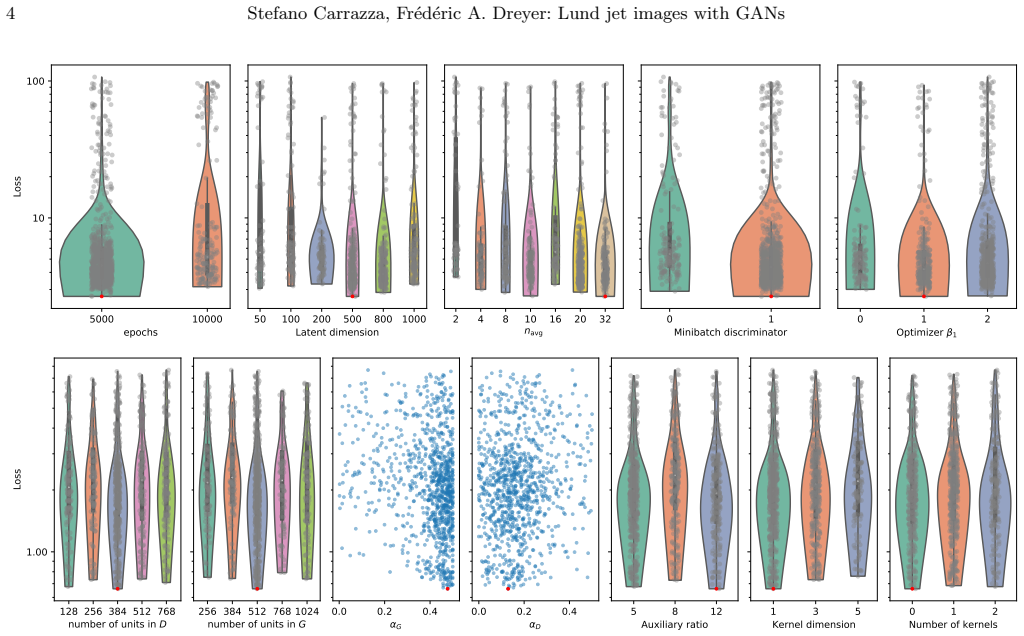
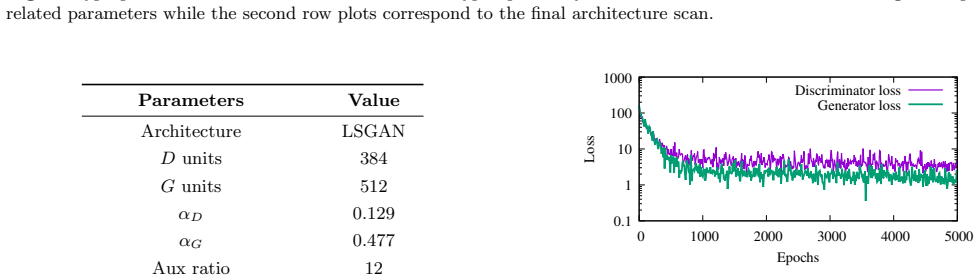
- [Sections 2.4 and 2.5] No train/test split is described anywhere in the experimental setup. Hyperparameter selection is performed using the loss Lh in Eq. (3), which compares generated images with the reference preprocessed images, and the final validation in Figures 7-10 again compares generated samples against the same reference sample used for training. Without an independent test set and without statistical uncertainties on the ratio plots, the reported 'few percent' accuracy may reflect memorization or overfitting rather than generalization. The authors should specify the split between training, validation, and test samples, and report quantitative errors with uncertainties for Figures 7-10.
- [Section 3.2, Eq. (11)] The CycleJet validation is based on the loss Lh = ||RA - P_{B->A}|| + ||RB - P_{A->B}||, which compares only the average reference images with the average transformed images. Consequently, the claim that one can 'retroactively change simulation settings or the underlying process on an existing sample' is demonstrated only at the level of mean densities. Individual event mappings may not preserve the correlations required for physics applications. The authors should add per-event validation metrics, such as distributions of pixel counts, two-point correlations, or downstream substructure observables evaluated on individual transformed events, or substantially weaken the corresponding claims in the abstract and Section 3.
- [Figure 7(c) and abstract] The abstract states that the model 'retrieves the underlying two-dimensional distribution to within a few percent,' but Figure 7(c) shows deviations well beyond a few percent near the boundaries of the Lund plane, and the 'bulk' region is never quantitatively defined. The authors should define the region over which the few-percent claim holds and report a concrete aggregate metric, e.g., a maximum or average relative deviation over that region, rather than relying on visual inspection of ratio plots.
minor comments (5)
- [Section 4] The sentence 'loosing information on correlations' should read 'losing information on correlations.'
- [Section 3.2] The caption of Figure 12 refers to 'delphes-level sample'; the capitalization should be 'Delphes-level' for consistency with the rest of the text.
- [Equation (6)] The quantities z(i) and Delta(i) in Eq. (6) are not defined in the text; please define them explicitly or refer to the original mMDT definition.
- [Appendix A] The hyperparameter tables would be more reproducible if they included the random seed and the number of evaluation samples used for each reported metric.
- [References] Reference [40] is incomplete: it lists only '(2019), 1909.04451' without authors or title. Please complete the bibliographic entry.
Circularity Check
No load-bearing circularity: the generative models are trained and evaluated on the same Pythia/Delphes reference, so the few-percent agreement is a consistency/fit-quality statement rather than a disguised prediction; the only self-citation is the externally published Lund-plane encoding.
full rationale
The paper makes no claim to derive a physical constant or first-principles result. The gLund and CycleJet networks are trained on Lund images from Pythia v8.223 + Delphes and then compared with averages from the same simulation; agreement to a few percent is therefore a measure of how well the trained generative model represents its training distribution, not an external prediction. This is a consistency check, and the paper does not relabel fitted hyperparameters or the training objective as an independent result: the hyperopt procedure in Sec. 2.4 explicitly minimizes Lh = I + 5S, an average-image discrepancy, and the CycleJet scan in Sec. 3.2 minimizes ||RA - PB->A|| + ||RB - PA->B||, so the subsequent agreement figures are evaluations on the same metrics used for model selection. That is model-selection and validation practice rather than circular derivation. The one self-citation, the Lund-plane representation [22], is an externally published coordinate construction used as input encoding; it is not invoked as a uniqueness theorem or as evidence for the generative claims. Section 4's explicit concession that the averaging preprocessing loses correlations between emissions at wide angular and transverse-momentum separation is a real limitation on event-level fidelity, but it is a scope limitation, not circular reasoning. No load-bearing circular step is present; the modest score reflects only the presence of a minor, non-load-bearing self-citation to the Lund-plane encoding.
Assumptions & free parameters
free parameters (6)
- navg (gLund averaging window) =
32
- navg (CycleJet averaging window) =
20
- Latent dimension (gLund) =
500
- ZCA whitening =
True
- Cycle consistency weight lambda =
10
- Lh loss weights =
I + 5*S
assumptions (4)
- domain assumption The primary Lund plane, encoded as a 24x24 binary image, is an adequate representation of jet radiation patterns for generative modeling.
- ad hoc to paper Averaging navg images and treating pixel values as independent activation probabilities produces samples that are physically faithful.
- domain assumption Pythia 8 v8.223 plus Delphes 3 v3.4.1 CMS particle-flow is a valid reference for detector-level jet substructure.
- domain assumption Cycle-consistency loss guarantees the learned domain mapping is physically meaningful rather than a pixel-space artifact.
Cite this review
Pith. "Pith review of Lund jet images from generative and cycle-consistent adversarial networks." pith.science (2026). https://pith.science/paper/CZNFJD7K
@misc{pith2026190901359,
  author       = {Pith},
  title        = {Pith review of: Lund jet images from generative and cycle-consistent adversarial networks},
  year         = {2026},
  howpublished = {\url{https://pith.science/paper/CZNFJD7K}},
  note         = {Machine review of arXiv:1909.01359}
}
read the original abstract
We introduce a generative model to simulate radiation patterns within a jet using the Lund jet plane. We show that using an appropriate neural network architecture with a stochastic generation of images, it is possible to construct a generative model which retrieves the underlying two-dimensional distribution to within a few percent. We compare our model with several alternative state-of-the-art generative techniques. Finally, we show how a mapping can be created between different categories of jets, and use this method to retroactively change simulation settings or the underlying process on an existing sample. These results provide a framework for significantly reducing simulation times through fast inference of the neural network as well as for data augmentation of physical measurements.
Figures


Figures from the paper (10 more)


Reference graph
Works this paper leans on
- [1]
- [2]
- [3]
-
[4]
Y.L. Dokshitzer, G.D. Leder, S. Moretti, B.R. Webber, JHEP 08, 001 (1997), hep-ph/9707323
arXiv 1997
- [5]
- [6]
- [7]
-
[8]
S.D. Ellis, C.K. Vermilion, J.R. Walsh, Phys. Rev. D80, 051501 (2009), 0903.5081
arXiv 2009
Show all 64 references
-
[9]
Ellis, C.K
S.D. Ellis, C.K. Vermilion, J.R. Walsh, Phys. Rev. D81, 094023 (2010), 0912.0033
2010 arXiv
-
[10]
Plehn, G.P
T. Plehn, G.P. Salam, M. Spannowsky, Phys. Rev. Lett. 104, 111801 (2010), 0910.5472
2010 arXiv
- [11]
- [12]
- [13]
- [14]
- [15]
- [16]
-
[17]
Dasgupta, A
M. Dasgupta, A. Fregoso, S. Marzani, G.P. Salam, JHEP 09, 029 (2013), 1307.0007
2013 arXiv
-
[18]
Larkoski, S
A.J. Larkoski, S. Marzani, G. Soyez, J. Thaler, JHEP 05, 146 (2014), 1402.2657
2014 arXiv
-
[19]
Komiske, E.M
P.T. Komiske, E.M. Metodiev, B. Nachman, M.D. Schwartz, JHEP 12, 051 (2017), 1707.08600
2017 arXiv
-
[20]
Komiske, E.M
P.T. Komiske, E.M. Metodiev, J. Thaler, JHEP 04, 013 (2018), 1712.07124 Stefano Carrazza, Fr´ ed´ eric A. Dreyer: Lund jet images with GANs 11
2018 arXiv
- [21]
- [22]
- [23]
- [24]
- [25]
-
[26]
Moreno, O
E.A. Moreno, O. Cerri, J.M. Duarte, H.B. Newman, T.Q. Nguyen, A. Periwal, M. Pierini, A. Serikova, M. Spiropulu, J.R. Vlimant (2019), 1908.05318
2019 arXiv
-
[27]
Fischer, S
N. Fischer, S. Gieseke, S. Pltzer, P. Skands, Eur. Phys. J. C74, 2831 (2014), 1402.3186
2014 arXiv
-
[28]
Les Houches 2017: Physics at TeV Colliders Standard Model Working Group Report (2018), 1803.07977
2018 arXiv
-
[29]
Goodfellow, J
I. Goodfellow, J. Pouget-Abadie, M. Mirza, B. Xu, D. Warde-Farley, S. Ozair, A. Courville, Y. Bengio, Gen- erative adversarial nets, in Advances in neural information processing systems (2014), pp. 2672–2680
2014
-
[30]
Kingma, M
D.P. Kingma, M. Welling, Auto-Encoding Variational Bayes, in 2nd International Conference on Learn- ing Representations, ICLR 2014, Banff, AB, Canada, April 14-16, 2014, Conference Track Proceedings (2014), http://arxiv.org/abs/1312.6114
2014 arXiv
-
[31]
de Oliveira, M
L. de Oliveira, M. Paganini, B. Nachman, Comput. Softw. Big Sci. 1, 4 (2017), 1701.05927
2017 arXiv
-
[32]
Paganini, L
M. Paganini, L. de Oliveira, B. Nachman, Phys. Rev. Lett. 120, 042003 (2018), 1705.02355
2018 arXiv
-
[33]
Paganini, L
M. Paganini, L. de Oliveira, B. Nachman, Phys. Rev. D97, 014021 (2018), 1712.10321
2018 arXiv
-
[34]
Otten, S
S. Otten, S. Caron, W. de Swart, M. van Beekveld, L. Hen- driks, C. van Leeuwen, D. Podareanu, R. Ruiz de Austri, R. Verheyen (2019), 1901.00875
2019 arXiv
- [35]
- [36]
-
[37]
Cerri, T.Q
O. Cerri, T.Q. Nguyen, M. Pierini, M. Spiropulu, J.R. Vli- mant, JHEP 05, 036 (2019), 1811.10276
2019 arXiv
-
[38]
Di Sipio, M
R. Di Sipio, M. Faucci Giannelli, S. Ketabchi Haghighat, S. Palazzo (2019), 1903.02433
2019 arXiv
- [39]
-
[41]
collaboration (ATLAS) (2019)
T.A. collaboration (ATLAS) (2019)
2019
-
[42]
X. Mao, Q. Li, H. Xie, R.Y.K. Lau, Z. Wang, CoRR abs/1611.04076 (2016), 1611.04076
2016 arXiv
-
[43]
Sjstrand, S
T. Sjstrand, S. Ask, J.R. Christiansen, R. Corke, N. De- sai, P. Ilten, S. Mrenna, S. Prestel, C.O. Rasmussen, P.Z. Skands, Comput. Phys. Commun. 191, 159 (2015), 1410.3012
2015 arXiv
-
[44]
de Favereau, C
J. de Favereau, C. Delaere, P. Demin, A. Giammanco, V. Lematre, A. Mertens, M. Selvaggi (DELPHES 3), JHEP 02, 057 (2014), 1307.6346
2014 arXiv
-
[45]
Arjovsky, S
M. Arjovsky, S. Chintala, L. Bottou, Wasser- stein Generative Adversarial Networks , in Pro- ceedings of the 34th International Conference on Machine Learning, ICML 2017, Sydney, NSW, Australia, 6-11 August 2017 (2017), pp. 214–223, http://proceedings.mlr.press/v70/arjovsky17a.html
2017
-
[46]
J.Y. Zhu, T. Park, P. Isola, A.A. Efros, Unpaired Image- to-Image Translation using Cycle-Consistent Adversarial Networkss, in Computer Vision (ICCV), 2017 IEEE In- ternational Conference on (2017)
2017
-
[47]
Duarte et al., JINST 13, P07027 (2018), 1804.06913
J. Duarte et al., JINST 13, P07027 (2018), 1804.06913
2018 arXiv
-
[48]
Dreyer, S
F. Dreyer, S. Carrazza, Jetsgame/glund v1.0.0 (2019), https://doi.org/10.5281/zenodo.3384920
2019 doi
-
[49]
Dreyer, S
F. Dreyer, S. Carrazza, Jetsgame/cyclejet v1.0.0 (2019), https://doi.org/10.5281/zenodo.3384918
2019 doi
-
[50]
Carrazza, F.A
S. Carrazza, F.A. Dreyer, JetsGame/data v1.0.0 (2019), this repository is git-lfs., https://doi.org/10.5281/zenodo.2602514
2019 doi
-
[51]
Wobisch, T
M. Wobisch, T. Wengler, Hadronization corrections to jet cross-sections in deep inelastic scattering , in Monte Carlo generators for HERA physics. Proceedings, Work- shop, Hamburg, Germany, 1998-1999 (1998), pp. 270–279, hep-ph/9907280
1998 arXiv
-
[52]
Cacciari, G.P
M. Cacciari, G.P. Salam, G. Soyez, Eur. Phys. J. C72, 1896 (2012), 1111.6097
2012 arXiv
-
[53]
Goodfellow, J
I.J. Goodfellow, J. Pouget-Abadie, M. Mirza, B. Xu, D. Warde-Farley, S. Ozair, A. Courville, Y. Bengio, inPro- ceedings of the 27th International Conference on Neural Information Processing Systems - Volume 2 (MIT Press, Cambridge, MA, USA, 2014), NIPS’14, pp. 2672–2680, http:...
2014
-
[54]
Salimans, I.J
T. Salimans, I.J. Goodfellow, W. Zaremba, V. Cheung, A. Radford, X. Chen, CoRR abs/1606.03498 (2016), 1606.03498
2016 arXiv
-
[55]
Bell, T.J
A.J. Bell, T.J. Sejnowski, Vision Research 37, 3327 (1997)
1997
-
[56]
Bergstra, D
J. Bergstra, D. Yamins, D.D. Cox, Making a Science of Model Search: Hyperparameter Optimization in Hundreds of Dimensions for Vision Architectures , in Proceedings of the 30th International Conference on International Con- ference on Machine Learning - Volume 28 (JMLR.org, 201...
2013
-
[57]
Bovik, H.R
Zhou Wang, A.C. Bovik, H.R. Sheikh, E.P. Simoncelli, IEEE Transactions on Image Processing 13, 600 (2004)
2004
-
[58]
Maas, A.Y
A.L. Maas, A.Y. Hannun, A.Y. Ng, Rectifier nonlineari- ties improve neural network acoustic models , in in ICML Workshop on Deep Learning for Audio, Speech and Lan- guage Processing (2013)
2013
-
[59]
Higgins, L
I. Higgins, L. Matthey, X. Glorot, A. Pal, B. Uria, C. Blun- dell, S. Mohamed, A. Lerchner, CoRR abs/1606.05579 (2016), 1606.05579
2016 arXiv
-
[60]
Burgess, I
C.P. Burgess, I. Higgins, A. Pal, L. Matthey, N. Wat- ters, G. Desjardins, A. Lerchner, CoRR abs/1804.03599 (2018), 1804.03599
2018 arXiv
-
[61]
Gulrajani, F
I. Gulrajani, F. Ahmed, M. Arjovsky, V. Dumoulin, A.C. Courville, CoRR abs/1704.00028 (2017), 1704.00028
2017 arXiv
-
[62]
Bowman, L
S.R. Bowman, L. Vilnis, O. Vinyals, A.M. Dai, R. J´ ozefowicz, S. Bengio, CoRRabs/1511.06349 (2015), 1511.06349
2015 arXiv
- [63]
- [64]
-
[65]
Ulyanov, A
D. Ulyanov, A. Vedaldi, V.S. Lempitsky, CoRR abs/1607.08022 (2016), 1607.08022
2016 arXiv
Reviewed August 14, 2026 · model on record in the stance chip above.
Discussion (0). Continue with ORCID to comment.