REVIEW 3 major objections 6 minor 74 references
How do bound star clusters form?
T0 review · 3 major / 6 minor · reviewed 2026-08-14 · deepseek-v4-flash
Pith's one-line read Bound star clusters form in a conveyor-belt mode: gas streams in while stars form slowly, so the cluster never assembles all its gas at once; global collapse and time-dependent efficiency models fail the data.
desk verdict A careful Bayesian model comparison that makes a real case for the conveyor-belt picture, with the ATLASGAL-to-progenitor identification as the main load-bearing caveat—worth serious engagement even if the conclusion stays conditional. read the letter →
The pith
A machine-rendered reading of the paper's core claim, the machinery that carries it, and where it could break.
The reading
What carries the argument
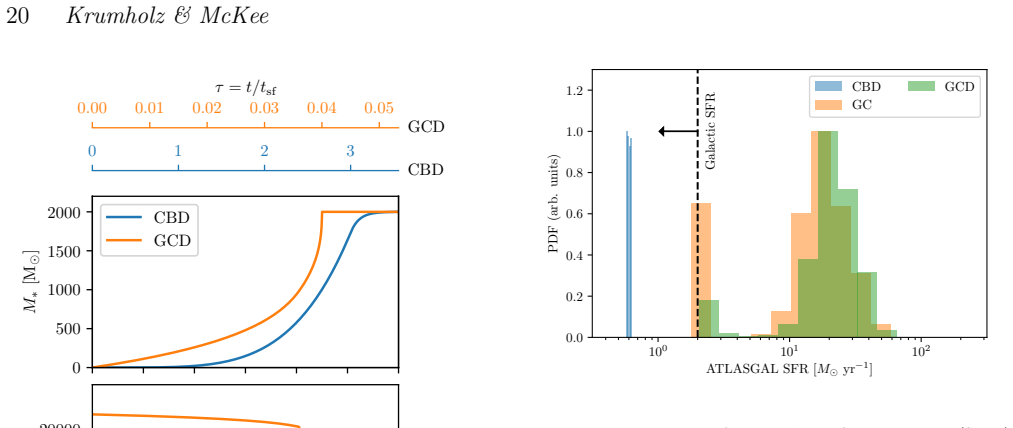
The argument rests on a family of one-zone analytic models in which the star formation rate is $\dot M_*=\epsilon_{\rm ff} M_g/t_{\rm ff}$ and gas evolves as $\dot M_g = \dot M_{\rm acc} - (1+\eta)\dot M_*$, with $t_{\rm ff}$ the free-fall time and $\eta$ a mass-loading factor. Each scenario, static, conveyor belt, global collapse, and increasing efficiency, is a different prescription for $\dot M_{\rm acc}$, $t_{\rm ff}$, or $\epsilon_{\rm ff}$, and the models are compared to data through Bayesian likelihoods for the age distribution and the $\epsilon_{\rm ff}$ distribution, plus an analytic calculation of the Galaxy-wide star formation rate implied by the ATLASGAL clump population. The load-bearing identity is the global SFR equation, which shows that global-collapse models overproduce stars unless star formation efficiency is low enough to prevent bound clusters from forming.
What would settle it
A survey that measured star formation efficiency per free-fall time as a function of evolutionary stage in a large sample of dense clumps and found it rising with time, rather than staying near one percent, would falsify the conveyor-belt conclusion. Equivalently, finding a massive, dense, quiescent gas cloud with a free-fall time shorter than the age of its cluster and no embedded stars would resurrect the static-cloud scenario.
Extended reading notes
Core claim
The central claim is that the best available explanation for all three constraints is the conveyor belt mode: gas accretes at an increasing rate, approximately as $\dot M_{\rm acc}\propto t^3$, while the central cluster-forming region has a star formation efficiency per free-fall time $\epsilon_{\rm ff}\simeq 0.01$ that is low and roughly constant. In this picture the observed acceleration of star formation in young clusters reflects the growing gas mass available in the hub, not a global collapse of the cloud or a time-dependent efficiency. Global collapse models fail because, once tuned to produce accelerating star formation, they predict that the dense ATLASGAL clumps should form stars at roughly five to ten times the Milky Way's entire star formation rate; increasing-efficiency models fail because the stellar ages demand $\epsilon_{\rm ff}$ that rises steeply with time while the YSO-gas correlation demands it be nearly constant.
Load-bearing premise
The argument assumes that the ATLASGAL clumps, the dense dusty gas clouds in which young stellar objects are counted, are the true gas-rich progenitors of bound clusters like the Orion Nebula Cluster and NGC 6530; if most of them will never become bound clusters, the star-formation-rate test that rules out collapse loses its target.
Editorial extensions
If this is right
- Massive gas clouds as massive as the future cluster need not exist at any time; the gas is consumed and replenished simultaneously.
- Observed dense gas clumps like ATLASGAL are caught mid-accretion, which is why they look gas-rich and young relative to their embedded stars.
- A successful cluster-forming region should show a near-constant $\epsilon_{\rm ff}\sim 0.01$ while its gas mass and star formation rate rise together.
- The Milky Way's total star formation rate is consistent with dense clumps producing only about a tenth of all stars, matching the observed bound-cluster fraction.
- Acceleration of star formation in a cluster is a sign of accelerating gas supply, not of an imminent global collapse.
Reading between the lines
- Going beyond the paper, the conveyor-belt picture suggests that a protocluster's final mass is set more by how long its feeder filaments keep supplying gas than by the initial cloud mass; this could be tested by comparing filament inflow rates to cluster stellar masses.
- The same reasoning predicts that in galaxies with more gas accretion, a higher fraction of stars should end up in bound clusters, a correlation that could be measured with resolved young-stellar-object surveys in nearby galaxies.
- A direct test would be to measure $\epsilon_{\rm ff}$ in a single protocluster as a function of time by dating successive generations of embedded stars; if it rises, the conveyor-belt conclusion would need revision.
- The paper's argument treats gas density and star formation as volume-averaged; a more detailed version might distinguish the hub from filaments, and could reveal whether stars formed in filaments also join the bound cluster.
Signed reviews
Editorial analysis
A structured set of objections, weighed in public.
Referee Report
Summary. This paper investigates how gravitationally bound star clusters assemble and argues that the available Milky Way observations favor a 'conveyor belt' formation mode. The authors construct six zero-dimensional, analytically solvable model scenarios—static (ST), conveyor belt (CB), conveyor belt with rapid dispersal (CBD), global collapse (GC), global collapse with dispersal (GCD), and increasing star formation efficiency (IE)—and test them with MCMC forward modeling against three data sets: the stellar age distributions in the ONC and NGC 6530, the distribution of star formation efficiencies per free-fall time (epsilon_ff) inferred from YSO counts in ATLASGAL clumps, and the global star formation rate of the Milky Way. They find that ST and CB(p=0) cannot reproduce the accelerating-but-extended age distributions; IE needs an efficiency slope delta at the prior boundary (delta=3) for the ages, in conflict with the near-constant efficiency (delta≈0) required by the YSO data; and GC/GCD models that fit the ages and YSO counts imply the ATLASGAL clumps alone form stars at roughly 11 Msun/yr, several times the observed total Galactic SFR. CB and CBD, by contrast, naturally produce accelerating star formation at constant low efficiency (~1%) and predict a contribution of ~0.3 Msun/yr from the ATLASGAL clumps. The paper concludes that cluster-forming regions accrete gas at an increasing rate while forming stars inefficiently and without global collapse.
Significance. The paper is significant for the star formation field and is unusually transparent in its construction: the six models have closed-form solutions, the fitting code is publicly available on Bitbucket, and the treatment of observational uncertainties (biased log-normal age errors, finite-window SFR averaging, selection of gas-dominated systems) is careful and clearly described. The global SFR argument of Section 3.4.2 is a valuable and falsifiable discriminant that ties the cluster-formation question to the Milky Way's total star formation budget, and the paper's prediction that ATLASGAL clumps contribute roughly 10% of the Galactic SFR is testable. The conclusion that bound clusters form via conveyor-belt accretion with epsilon_ff ~ 0.01 and the Goldbaum et al. p=3 scaling directly addresses the long-standing problem that gas clouds as massive as mature clusters are not observed. If the central claim survives scrutiny, it should reshape how the field interprets cluster formation, and the framework will be reusable as Gaia-based ages and YSO surveys improve.
major comments (3)
- [Sections 3.2.1, 3.4.1, and 3.4.2 (Eq. 56)] The identification of the ATLASGAL clump population as the direct progenitor population of bound clusters like the ONC and NGC 6530 is load-bearing in two places: Section 3.2.1 uses it to turn the observed epsilon_ff distribution into a constraint on cluster formation models, and Section 3.4.2 applies the GC/GCD models to the full ATLASGAL mass Mtot ≈ 1e7 Msun in Eq. (56) to exclude those scenarios on the grounds that they overproduce the Galactic SFR. The paper asserts that the clumps 'very likely' become ONC-like clusters, but in Section 3.4.1 it concedes that 'we do not in fact know if the density range that is selected by ATLASGAL corresponds well to the conditions that delineate between bound and unbound star formation.' If most ATLASGAL clumps are unbound and will never form bound clusters, the epsilon_ff constraint would not directly apply to cluster progenitors, and the mass entering Eq. (56) should be reduced to the bound-forming subset, which would relax the overproduction argument and remove the unique support for the conveyor-belt conclusion. The authors should quantify the bound fraction of the ATLASGAL sample (e.g., via virial-parameter estimates) and redo the Section 3.4.2 calculation for the bound subset only, or otherwise demonstrate that the exclusion of GC/GCD is insensitive to this fraction.
- [Sections 3.1.1, Table 3, and 3.4.2 (Eq. 56)] The paper states in Section 3.1.1 that the posterior PDFs for some parameters and the relative goodness-of-fit are sensitive to the assumed stellar-age error parameters (sigma, b), which observationally lie in a range up to about 0.2–0.3 dex, and it limits the analysis to features that are robust. This promise is not fully delivered in the global SFR argument: Eq. (56) is normalized to the age-derived value tau_coll = 0.03, and the exclusion of the IE model relies on the age-derived delta sitting at the prior boundary (delta = 3). Both discriminants are therefore downstream of the age-error assumption. I ask the authors to demonstrate explicitly, over the plausible range of (sigma, b), that the tau_coll posterior for GC/GCD and the delta posterior for IE remain incompatible with the YSO and SFR constraints; if only the qualitative conclusion is claimed, the text should make that limitation clearer in Sections 3.3 and 3.4.
- [Sections 3.2.1 and 3.2.2 (Eq. 42)] In the epsilon_ff likelihood, clumps with no detected YSOs are treated as detections at their stated 2-sigma upper limits rather than as censored data points. A proper treatment would integrate the model prediction up to the upper limit for these clumps (a survival-analysis likelihood). Because the derived values epsilon_ff ≈ 0.01–0.02 and sigma_log_eps ≈ 0.15 dex drive the combined constraints of Section 3.3 and the SFR estimates of Section 3.4, the authors should either implement the censored likelihood or demonstrate that the posterior PDFs in Table 4, and the conclusions drawn from them, are unchanged when non-detections are handled consistently.
minor comments (6)
- [Section 3.2.1] There is a typo in the sentence 'objects that are will become clusters like NGC 6530 or the ONC'; it should read 'objects that will become clusters.'
- [Section 3.1.2] The double-peaked age distribution predicted by the GC and GCD models is mentioned but never displayed or explained in the main text; adding a sentence on the origin of the second peak (stars formed near the collapse singularity) would aid the reader.
- [Table 3] Several of the marginalized posteriors are effectively unconstrained (e.g., CB p=3 for the ONC gives log epsilon_ff = −0.24 with asymmetric uncertainties spanning more than an order of magnitude); the text should flag which parameters the age data do not constrain, to avoid over-reading the 'successful' fits.
- [Section 3.3] The 'combined' constraints are overlaps of independently derived posterior PDFs rather than a joint fit; the paper should state explicitly that this identifies consistency regions rather than joint posterior modes.
- [Section 3.1.3] MCMC convergence is asserted by visual inspection only; reporting a quantitative diagnostic (e.g., Gelman-Rubin R-hat or effective sample size) would be appropriate, particularly since the tails of the chains drive the SFR distributions in Figure 8.
- [Sections 3.2.3 and 3.4.2] The GC/GCD analysis imposes the prior t_ff,0 > 0.3 Myr when fitting the YSO data, but Eq. (56) sets t_ff,0 = 0.3 Myr for the SFR calculation; the authors should clarify the relationship between these two choices and confirm explicitly the direction of the resulting bias (the claim that Eq. 56 is a lower limit appears correct but is not argued).
Circularity Check
No significant circularity: the models are tested against independent Gaia age, ATLASGAL YSO, and Galactic-SFR data, and self-citations are ancillary.
full rationale
The paper's central inference is a model-selection argument: six analytic cartoons (ST, CB, CBD, GC, GCD, IE) are confronted with three external constraints: Gaia-based stellar age distributions in the ONC and NGC 6530 (Section 3.1), YSO counts in ATLASGAL clumps from Heyer et al. 2016 (Section 3.2), and the Milky Way's total star formation rate from Chomiuk & Povich 2011 (Section 3.4). The likelihoods in equations (35) and (41) are forward models that take the model parameters as inputs and predict observed distributions; the parameters are then fit by MCMC, and no fitted parameter is later relabeled as a prediction. The global SFR calculation uses the fitted parameters to compute a quantity that was not used in the fits, so equation (56) is a genuine prediction for the GC/GCD models rather than a restatement of their inputs. The favored conveyor-belt scenario was not invented here; it is attributed to Longmore et al. (2014), and the p = 3 accretion scaling is imported from Goldbaum et al. (2011) and Lee & Hennebelle (2016b) as an external theoretical input that is then tested against the age data, including the p = 0 variant that fails. The self-citations to Goldbaum et al. (2011) and Krumholz et al. (2019) provide a derived scaling with stated assumptions and background compilations; they do not contain the target result, and the accretion scaling is corroborated by non-self work. The paper does contain a load-bearing observational-identification assumption, namely that ATLASGAL clumps are the direct progenitors of bound clusters like the ONC and NGC 6530; the authors explicitly flag this in Section 3.4.1: 'we do not in fact know if the density range that is selected by ATLASGAL corresponds well to the conditions that delineate between bound and unbound star formation.' This caveat weakens the force of the GC/GCD exclusion, but it is a sample-selection assumption, not a circular reduction: the models are not defined in terms of the data they are tested against, and the paper's own equations do not make any claimed prediction equivalent to its inputs by construction.
Assumptions & free parameters
free parameters (11)
- epsilon_ff =
~0.01-0.02 (log eps_ff = -1.74 to -1.78, Table 4)
- eta =
log eta < ~0 (upper limit, Tables 3 and 4)
- sigma_log_eps =
~0.16 dex (log sigma = -0.79, Table 4)
- tsf =
log tsf ~ 1-5 Myr depending on model (Tables 3 and 4)
- tclust =
log tclust ~ 0.5-1.1 Myr (Table 3)
- tacc =
log tacc ~ 0.6-1.8 Myr (Tables 3 and 4)
- phi_d =
log phi_d ~ 0.5-1.8 (Tables 3 and 4)
- tcoll =
log tcoll ~ 0.8-1.6 Myr (Tables 3 and 4)
- delta =
delta ~ 0.06 for YSO counts, ~ 2.7-3.0 for ages (Tables 3 and 4)
- tfb =
log tfb ~ -0.45 to 0.81 (Tables 3 and 4)
- xi =
xi ~ 1-8 (Table 3)
assumptions (5)
- domain assumption Star formation rate is set by SFR = eps_ff Mg/t_ff at every point (equation 1).
- domain assumption Gas mass and density evolution can be prescribed without solving the full dynamical equations (Section 2: 'we will simply prescribe the evolution of parameters such as cloud mass and density').
- domain assumption Stellar age errors are Gaussian in log age with sigma = 0.13 dex and bias = -0.05 dex (Section 3.1.1).
- domain assumption The ATLASGAL clump population is in a steady state and represents the progenitors of bound clusters (Section 3.4.2, equation 44).
- standard math Bayesian/MCMC methodology (emcee) is valid for the likelihoods as written.
Cite this review
Pith. "Pith review of How do bound star clusters form?." pith.science (2026). https://pith.science/paper/REXH3NEN
@misc{pith2026190901565,
  author       = {Pith},
  title        = {Pith review of: How do bound star clusters form?},
  year         = {2026},
  howpublished = {\url{https://pith.science/paper/REXH3NEN}},
  note         = {Machine review of arXiv:1909.01565}
}
read the original abstract
Gravitationally-bound clusters that survive gas removal represent an unusual mode of star formation in the Milky Way and similar spiral galaxies. While forming, they can be distinguished observationally from unbound star formation by their high densities, virialised velocity structures, and star formation histories that accelerate toward the present, but extend multiple free-fall times into the past. In this paper we examine several proposed scenarios for how such structures might form and evolve, and carry out a Bayesian analysis to test these models against observed distributions of protostellar age, counts of young stellar objects relative to gas, and the overall star formation rate of the Milky Way. We show that models in which the acceleration of star formation is due either to a large-scale collapse or a time-dependent increase in star formation efficiency are unable to satisfy the combined set of observational constraints. In contrast, models in which clusters form in a "conveyor belt" mode where gas accretion and star formation occur simultaneously, but the star formation rate per free-fall time is low, can match the observations.
Figures


Figures from the paper (4 more)



Reference graph
Works this paper leans on
-
[1]
Adamo A., Kruijssen J. M. D., Bastian N., Silva-Villa E., Ryon J., 2015, @doi [ ] 10.1093/mnras/stv1203 , http://adsabs.harvard.edu/abs/2015MNRAS.452..246A 452, 246
-
[2]
Astropy Collaboration et al., 2013, @doi [ ] 10.1051/0004-6361/201322068 , http://adsabs.harvard.edu/abs/2013A
-
[3]
Astropy Collaboration et al., 2018, @doi [ ] 10.3847/1538-3881/aabc4f , https://ui.adsabs.harvard.edu/abs/2018AJ....156..123A 156, 123
-
[4]
Azimlu M., Mart \' nez-Galarza J. R., Muench A. A., 2015, @doi [ ] 10.1088/0004-6256/150/3/95 , http://adsabs.harvard.edu/abs/2015AJ....150...95A 150, 95
-
[5]
Beccari G., et al., 2017, @doi [ ] 10.1051/0004-6361/201730432 , http://adsabs.harvard.edu/abs/2017A
-
[6]
Caldwell S., Chang P., 2018, @doi [ ] 10.1093/mnras/stx3037 , http://adsabs.harvard.edu/abs/2018MNRAS.474.4818C 474, 4818
-
[7]
Chandar R., Fall S. M., Whitmore B. C., Mulia A. J., 2017, @doi [ ] 10.3847/1538-4357/aa92ce , http://adsabs.harvard.edu/abs/2017ApJ...849..128C 849, 128
-
[8]
Chomiuk L., Povich M. S., 2011, @doi [ ] 10.1088/0004-6256/142/6/197 , http://adsabs.harvard.edu/abs/2011AJ....142..197C 142, 197
Show all 74 references
-
[9]
Csengeri T., et al., 2014, @doi [ ] 10.1051/0004-6361/201322434 , https://ui.adsabs.harvard.edu/abs/2014A&A...565A..75C 565, A75
2014 doi
-
[10]
C., Jaehnig K., 2014, @doi [ ] 10.1088/0004-637X/795/1/55 , http://adsabs.harvard.edu/abs/2014ApJ...795...55D 795, 55
Da Rio N., Tan J. C., Jaehnig K., 2014, @doi [ ] 10.1088/0004-637X/795/1/55 , http://adsabs.harvard.edu/abs/2014ApJ...795...55D 795, 55
2014 doi
-
[11]
Da Rio N., et al., 2016, @doi [ ] 10.3847/0004-637X/818/1/59 , http://adsabs.harvard.edu/abs/2016ApJ...818...59D 818, 59
2016 doi
-
[12]
R., 2013, @doi [ ] 10.1093/mnras/stt480 , http://adsabs.harvard.edu/abs/2013MNRAS.432..455D 432, 455
Dekel A., Krumholz M. R., 2013, @doi [ ] 10.1093/mnras/stt480 , http://adsabs.harvard.edu/abs/2013MNRAS.432..455D 432, 455
2013 doi
-
[13]
G., 2000, @doi [ ] 10.1086/308361 , http://adsabs.harvard.edu/abs/2000ApJ...530..277E 530, 277
Elmegreen B. G., 2000, @doi [ ] 10.1086/308361 , http://adsabs.harvard.edu/abs/2000ApJ...530..277E 530, 277
2000 doi
-
[14]
J., et al., 2009, @doi [ ] 10.1088/0067-0049/181/2/321 , http://adsabs.harvard.edu/abs/2009ApJS..181..321E 181, 321
Evans N. J., et al., 2009, @doi [ ] 10.1088/0067-0049/181/2/321 , http://adsabs.harvard.edu/abs/2009ApJS..181..321E 181, 321
2009 doi
-
[15]
J., Heiderman A., Vutisalchavakul N., 2014, @doi [ ] 10.1088/0004-637X/782/2/114 , http://adsabs.harvard.edu/abs/2014ApJ...782..114E 782, 114
Evans II N. J., Heiderman A., Vutisalchavakul N., 2014, @doi [ ] 10.1088/0004-637X/782/2/114 , http://adsabs.harvard.edu/abs/2014ApJ...782..114E 782, 114
2014 doi
-
[16]
W., Megeath S
F u r \'e sz G., Hartmann L. W., Megeath S. T., Szentgyorgyi A. H., Hamden E. T., 2008, @doi [ ] 10.1086/525844 , http://adsabs.harvard.edu/abs/2008ApJ...676.1109F 676, 1109
2008 doi
-
[17]
W., Lang D., Goodman J., 2013, @doi [ ] 10.1086/670067 , http://adsabs.harvard.edu/abs/2013PASP..125..306F 125, 306
Foreman-Mackey D., Hogg D. W., Lang D., Goodman J., 2013, @doi [ ] 10.1086/670067 , http://adsabs.harvard.edu/abs/2013PASP..125..306F 125, 306
2013 doi
-
[18]
Ginsburg A., Bressert E., Bally J., Battersby C., 2012, @doi [ ] 10.1088/2041-8205/758/2/L29 , http://adsabs.harvard.edu/abs/2012ApJ...758L..29G 758, L29
2012 doi
-
[19]
J., Krumholz M
Goldbaum N. J., Krumholz M. R., Matzner C. D., McKee C. F., 2011, @doi [ ] 10.1088/0004-637X/738/1/101 , http://adsabs.harvard.edu/abs/2011ApJ...738..101G 738, 101
2011 doi
-
[20]
A., Megeath S
Gutermuth R. A., Megeath S. T., Myers P. C., Allen L. E., Pipher J. L., Fazio G. G., 2009, @doi [ ] 10.1088/0067-0049/184/1/18 , http://ukads.nottingham.ac.uk/abs/2009ApJS..184...18G 184, 18
2009 doi
-
[21]
A., Pipher J
Gutermuth R. A., Pipher J. L., Megeath S. T., Myers P. C., Allen L. E., Allen T. S., 2011, @doi [ ] 10.1088/0004-637X/739/2/84 , http://adsabs.harvard.edu/abs/2011ApJ...739...84G 739, 84
2011 doi
-
[22]
S., Csengeri T., Wienen M., Leurini S., Menten K., Wyrowski F., 2016, @doi [ ] 10.1051/0004-6361/201527681 , http://adsabs.harvard.edu/abs/2016A
Heyer M., Gutermuth R., Urquhart J. S., Csengeri T., Wienen M., Leurini S., Menten K., Wyrowski F., 2016, @doi [ ] 10.1051/0004-6361/201527681 , http://adsabs.harvard.edu/abs/2016A
2016 doi
-
[23]
A., Hartmann L
Hillenbrand L. A., Hartmann L. W., 1998, @doi [ ] 10.1086/305076 , http://adsabs.harvard.edu/abs/1998ApJ...492..540H 492, 540
1998 doi
-
[24]
M., Stahler S
Huff E. M., Stahler S. W., 2006, @doi [ ] 10.1086/503357 , http://adsabs.harvard.edu/abs/2006ApJ...644..355H 644, 355
2006 doi
-
[25]
O., Da Rio N., Tan J
Jaehnig K. O., Da Rio N., Tan J. C., 2015, @doi [ ] 10.1088/0004-637X/798/2/126 , http://adsabs.harvard.edu/abs/2015ApJ...798..126J 798, 126
2015 doi
-
[26]
D., 2007, @doi [ ] 10.1111/j.1365-2966.2007.12304.x , http://adsabs.harvard.edu/abs/2007MNRAS.381.1169J 381, 1169
Jeffries R. D., 2007, @doi [ ] 10.1111/j.1365-2966.2007.12304.x , http://adsabs.harvard.edu/abs/2007MNRAS.381.1169J 381, 1169
2007
-
[27]
D., 2017, , https://ui.adsabs.harvard.edu/abs/2017MmSAI..88..637J 88, 637
Jeffries R. D., 2017, , https://ui.adsabs.harvard.edu/abs/2017MmSAI..88..637J 88, 637
2017
-
[28]
C., et al., 2016, @doi [ ] 10.3847/0004-637X/827/1/33 , http://adsabs.harvard.edu/abs/2016ApJ...827...33J 827, 33
Johnson L. C., et al., 2016, @doi [ ] 10.3847/0004-637X/827/1/33 , http://adsabs.harvard.edu/abs/2016ApJ...827...33J 827, 33
2016 doi
-
[29]
V., Piskunov A
Kharchenko N. V., Piskunov A. E., Schilbach E., R \"o ser S., Scholz R.-D., 2013, @doi [ ] 10.1051/0004-6361/201322302 , http://adsabs.harvard.edu/abs/2013A
2013 doi
-
[30]
R., Konopacky Q., Chu L., Toller E., Anderson J., Theissen C
Kim D., Lu J. R., Konopacky Q., Chu L., Toller E., Anderson J., Theissen C. A., Morris M. R., 2019, @doi [ ] 10.3847/1538-3881/aafb09 , https://ui.adsabs.harvard.edu/abs/2019AJ....157..109K 157, 109
2019 doi
-
[31]
R., 1962, @doi [ ] 10.1086/108756 , http://adsabs.harvard.edu/abs/1962AJ.....67..471K 67, 471
King I. R., 1962, @doi [ ] 10.1086/108756 , http://adsabs.harvard.edu/abs/1962AJ.....67..471K 67, 471
1962 doi
-
[32]
S., Burkert A., 2000, @doi [ ] 10.1086/313371 , http://adsabs.harvard.edu/abs/2000ApJS..128..287K 128, 287
Klessen R. S., Burkert A., 2000, @doi [ ] 10.1086/313371 , http://adsabs.harvard.edu/abs/2000ApJS..128..287K 128, 287
2000 doi
-
[33]
Kounkel M., et al., 2018, @doi [ ] 10.3847/1538-3881/aad1f1 , https://ui.adsabs.harvard.edu/#abs/2018AJ....156...84K 156, 84
2018 doi
-
[34]
Kroupa P., Aarseth S., Hurley J., 2001, , http://adsabs.harvard.edu/cgi-bin/nph-bib\_query?bibcode=2001MNRAS.321..699K&db\_key=AST 321, 699
2001
-
[35]
Kruijssen J. M. D., Dale J. E., Longmore S. N., 2015, @doi [ ] 10.1093/mnras/stu2526 , http://adsabs.harvard.edu/abs/2015MNRAS.447.1059K 447, 1059
2015 doi
-
[36]
Kruijssen J. M. D., et al., 2019, @doi [ ] 10.1038/s41586-019-1194-3 , https://ui.adsabs.harvard.edu/abs/2019Natur.569..519K 569, 519
2019 doi
-
[37]
R., Tan J
Krumholz M. R., Tan J. C., 2007, @doi [ ] 10.1086/509101 , http://adsabs.harvard.edu/abs/2007ApJ...654..304K 654, 304
2007 doi
-
[38]
R., Dekel A., McKee C
Krumholz M. R., Dekel A., McKee C. F., 2012, @doi [ ] 10.1088/0004-637X/745/1/69 , http://adsabs.harvard.edu/abs/2012ApJ...745...69K 745, 69
2012 doi
-
[39]
R., McKee C
Krumholz M. R., McKee C. F., Bland-Hawthorn J., 2019, , in press (arXiv:1812.01615), https://ui.adsabs.harvard.edu/\#abs/2018arXiv181201615K
2019 arXiv
-
[40]
A., Hillenbrand L
Kuhn M. A., Hillenbrand L. A., Sills A., Feigelson E. D., Getman K. V., 2019, @doi [ ] 10.3847/1538-4357/aaef8c , https://ui.adsabs.harvard.edu/abs/2019ApJ...870...32K 870, 32
2019 doi
-
[41]
Kuznetsova A., Hartmann L., Ballesteros-Paredes J., 2015, @doi [ ] 10.1088/0004-637X/815/1/27 , http://adsabs.harvard.edu/abs/2015ApJ...815...27K 815, 27
2015 doi
-
[42]
Kuznetsova A., Hartmann L., Ballesteros-Paredes J., 2018, @doi [ ] 10.1093/mnras/stx2480 , http://adsabs.harvard.edu/abs/2018MNRAS.473.2372K 473, 2372
2018 doi
-
[43]
J., Lada E
Lada C. J., Lada E. A., 2003, @doi [ ] 10.1146/annurev.astro.41.011802.094844 , http://adsabs.harvard.edu/cgi-bin/nph-bib\_query?bibcode=2003ARA\\ 41, 57
2003 arXiv
-
[44]
J., Lombardi M., Roman-Zuniga C., Forbrich J., Alves J
Lada C. J., Lombardi M., Roman-Zuniga C., Forbrich J., Alves J. F., 2013, @doi [ ] 10.1088/0004-637X/778/2/133 , http://adsabs.harvard.edu/abs/2013ApJ...778..133L 778, 133
2013 doi
-
[45]
Lee Y.-N., Hennebelle P., 2016a, @doi [ ] 10.1051/0004-6361/201527981 , http://adsabs.harvard.edu/abs/2016A
-
[46]
Lee Y.-N., Hennebelle P., 2016b, @doi [ ] 10.1051/0004-6361/201527982 , http://adsabs.harvard.edu/abs/2016A
-
[47]
J., Chang P., Murray N., 2015, @doi [ ] 10.1088/0004-637X/800/1/49 , https://ui.adsabs.harvard.edu/abs/2015ApJ...800...49L 800, 49
Lee E. J., Chang P., Murray N., 2015, @doi [ ] 10.1088/0004-637X/800/1/49 , https://ui.adsabs.harvard.edu/abs/2015ApJ...800...49L 800, 49
2015 doi
-
[48]
J., Miville-Desch \^e nes M.-A., Murray N
Lee E. J., Miville-Desch \^e nes M.-A., Murray N. W., 2016, @doi [ ] 10.3847/1538-4357/833/2/229 , http://adsabs.harvard.edu/abs/2016ApJ...833..229L 833, 229
2016 doi
-
[49]
N., et al., 2013, @doi [ ] 10.1093/mnras/sts376 , http://adsabs.harvard.edu/abs/2013MNRAS.429..987L 429, 987
Longmore S. N., et al., 2013, @doi [ ] 10.1093/mnras/sts376 , http://adsabs.harvard.edu/abs/2013MNRAS.429..987L 429, 987
2013 doi
-
[50]
N., et al., 2014, @doi [Protostars and Planets VI] 10.2458/azu_uapress_9780816531240-ch013 , http://adsabs.harvard.edu/abs/2014prpl.conf..291L pp 291--314
Longmore S. N., et al., 2014, @doi [Protostars and Planets VI] 10.2458/azu_uapress_9780816531240-ch013 , http://adsabs.harvard.edu/abs/2014prpl.conf..291L pp 291--314
2014 doi
-
[51]
D., Jumper P
Matzner C. D., Jumper P. H., 2015, @doi [ ] 10.1088/0004-637X/815/1/68 , http://adsabs.harvard.edu/abs/2015ApJ...815...68M 815, 68
2015 doi
-
[52]
Messa M., et al., 2018, @doi [ ] 10.1093/mnras/stx2403 , http://adsabs.harvard.edu/abs/2018MNRAS.473..996M 473, 996
2018 doi
-
[53]
Motte F., Bontemps S., Louvet F., 2018, @doi [ ] 10.1146/annurev-astro-091916-055235 , https://ui.adsabs.harvard.edu/#abs/2018ARA&A..56...41M 56, 41
2018 doi
-
[54]
Murray N., Chang P., 2015, @doi [ ] 10.1088/0004-637X/804/1/44 , http://adsabs.harvard.edu/abs/2015ApJ...804...44M 804, 44
2015 doi
-
[55]
B., Meixner M., Roman-Duval J., Rahman M., Evans II N
Ochsendorf B. B., Meixner M., Roman-Duval J., Rahman M., Evans II N. J., 2017, @doi [ ] 10.3847/1538-4357/aa704a , http://adsabs.harvard.edu/abs/2017ApJ...841..109O 841, 109
2017 doi
-
[56]
W., 2000, @doi [ ] 10.1086/309312 , http://adsabs.harvard.edu/abs/2000ApJ...540..255P 540, 255
Palla F., Stahler S. W., 2000, @doi [ ] 10.1086/309312 , http://adsabs.harvard.edu/abs/2000ApJ...540..255P 540, 255
2000 doi
-
[57]
Preibisch T., 2012, @doi [Research in Astronomy and Astrophysics] 10.1088/1674-4527/12/1/001 , https://ui.adsabs.harvard.edu/abs/2012RAA....12....1P 12, 1
2012 doi
-
[58]
Prisinzano L., et al., 2019, @doi [ ] 10.1051/0004-6361/201834870 , https://ui.adsabs.harvard.edu/abs/2019A&A...623A.159P 623, A159
2019 doi
-
[59]
M., et al., 2014, @doi [ ] 10.1088/0004-637X/786/2/140 , http://adsabs.harvard.edu/abs/2014ApJ...786..140R 786, 140
Rathborne J. M., et al., 2014, @doi [ ] 10.1088/0004-637X/786/2/140 , http://adsabs.harvard.edu/abs/2014ApJ...786..140R 786, 140
2014 doi
-
[60]
R., Soderblom D
Reggiani M., Robberto M., Da Rio N., Meyer M. R., Soderblom D. R., Ricci L., 2011, @doi [ ] 10.1051/0004-6361/201116946 , http://adsabs.harvard.edu/abs/2011A\
2011 doi
-
[61]
E., et al., 2014, @doi [ ] 10.1088/0004-6256/148/2/33 , http://adsabs.harvard.edu/abs/2014AJ....148...33R 148, 33
Ryon J. E., et al., 2014, @doi [ ] 10.1088/0004-6256/148/2/33 , http://adsabs.harvard.edu/abs/2014AJ....148...33R 148, 33
2014 doi
-
[62]
Schuller F., et al., 2009, @doi [ ] 10.1051/0004-6361/200811568 , http://adsabs.harvard.edu/abs/2009A
2009 doi
-
[63]
R., Hillenbrand L
Soderblom D. R., Hillenbrand L. A., Jeffries R. D., Mamajek E. E., Naylor T., 2014, in Protostars and Planets VI. p. 219 ( @eprint arXiv 1311.7024 ), @doi 10.2458/azu_uapress_9780816531240-ch010
2014 arXiv
-
[64]
C., Krumholz M
Tan J. C., Krumholz M. R., McKee C. F., 2006, @doi [ ] 10.1086/504150 , http://adsabs.harvard.edu/abs/2006ApJ...641L.121T 641, L121
2006 doi
-
[65]
A., V \'a zquez-Semadeni E., G \'o mez G
Toal \'a J. A., V \'a zquez-Semadeni E., G \'o mez G. C., 2012, @doi [ ] 10.1088/0004-637X/744/2/190 , http://adsabs.harvard.edu/abs/2012ApJ...744..190T 744, 190
2012 doi
-
[66]
J., Hartmann L., Furesz G., Mateo M., Megeath S
Tobin J. J., Hartmann L., Furesz G., Mateo M., Megeath S. T., 2009, @doi [ ] 10.1088/0004-637X/697/2/1103 , http://adsabs.harvard.edu/abs/2009ApJ...697.1103T 697, 1103
2009 doi
-
[67]
S., et al., 2018, @doi [ ] 10.1093/mnras/stx2258 , https://ui.adsabs.harvard.edu/#abs/2018MNRAS.473.1059U 473, 1059
Urquhart J. S., et al., 2018, @doi [ ] 10.1093/mnras/stx2258 , https://ui.adsabs.harvard.edu/#abs/2018MNRAS.473.1059U 473, 1059
2018 doi
-
[68]
V \'a zquez-Semadeni E., Gonz \'a lez-Samaniego A., Col \' n P., 2017, @doi [ ] 10.1093/mnras/stw3229 , http://adsabs.harvard.edu/abs/2017MNRAS.467.1313V 467, 1313
2017 doi
-
[69]
C., Zamora-Avil \'e s M., 2019, , https://ui.adsabs.harvard.edu/abs/2019arXiv190311247V pp submitted, arXiv:1903.11247
V \'a zquez-Semadeni E., Palau A., Ballesteros-Paredes J., G \'o mez G. C., Zamora-Avil \'e s M., 2019, , https://ui.adsabs.harvard.edu/abs/2019arXiv190311247V pp submitted, arXiv:1903.11247
2019 arXiv
-
[70]
J., Heyer M., 2016, @doi [ ] 10.3847/0004-637X/831/1/73 , http://adsabs.harvard.edu/abs/2016ApJ...831...73V 831, 73
Vutisalchavakul N., Evans II N. J., Heyer M., 2016, @doi [ ] 10.3847/0004-637X/831/1/73 , http://adsabs.harvard.edu/abs/2016ApJ...831...73V 831, 73
2016 doi
-
[71]
L., Longmore S
Walker D. L., Longmore S. N., Bastian N., Kruijssen J. M. D., Rathborne J. M., Galv \'a n-Madrid R., Liu H. B., 2016, @doi [ ] 10.1093/mnras/stw313 , https://ui.adsabs.harvard.edu/#abs/2016MNRAS.457.4536W 457, 4536
2016 doi
-
[72]
L., Kruijssen J
Ward J. L., Kruijssen J. M. D., 2018, @doi [ ] 10.1093/mnras/sty117 , http://adsabs.harvard.edu/abs/2018MNRAS.475.5659W 475, 5659
2018 doi
-
[73]
Zamora-Avil \'e s M., V \'a zquez-Semadeni E., 2014, @doi [ ] 10.1088/0004-637X/793/2/84 , http://adsabs.harvard.edu/abs/2014ApJ...793...84Z 793, 84
2014 doi
-
[74]
J., 1974, , http://adsabs.harvard.edu/cgi-bin/nph-bib\_query?bibcode=1974ApJ...192L.149Z&db\_key=AST 192, L149
Zuckerman B., Evans N. J., 1974, , http://adsabs.harvard.edu/cgi-bin/nph-bib\_query?bibcode=1974ApJ...192L.149Z&db\_key=AST 192, L149
1974
Reviewed August 14, 2026 · model on record in the stance chip above.
Discussion (0). Continue with ORCID to comment.