REVIEW 5 major objections 3 minor 1 cited by
Microwave Spectro-Polarimetry of Matter and Radiation across Space and Time
T0 review · 5 major / 3 minor · reviewed 2026-08-14 · deepseek-v4-flash
Pith's one-line read A single 8 K telescope could survey the Universe's matter and motion
desk verdict A competent, honest Voyage 2050 white paper that synthesizes prior mission concepts into a single L-class observatory; its headline science goals rest on foreground subtraction that the paper itself admits is assumed. read the letter →
The pith
A machine-rendered reading of the paper's core claim, the machinery that carries it, and where it could break.
The reading
What carries the argument
The load-bearing mechanism is the CMB itself, used as a backlight that illuminates everything between last scattering and us: scattering by free electrons produces the thermal, kinetic, and relativistic Sunyaev-Zeldovich signals; gravitational lensing deflects the CMB; and dust and line emission from galaxies add foregrounds that are also the science targets. The proposed hardware is a 3.5 m, roughly 8 K telescope feeding three instruments: a broad-band polarized imager with about 20 channels from 20 to 800 GHz, an R≈300 filter-bank spectrometer for 100–1000 GHz line and continuum mapping, and Fourier-transform spectrometer modules covering 10–2000 GHz that compare the sky to a blackbody calibrator. The argument is that combining these three instruments in one survey simultaneously measures the target signals and the foregrounds that would otherwise bury them.
What would settle it
Run an end-to-end sky simulation with the proposed 20-band imager plus FTS and a realistic foreground model: if the best achievable component separation leaves CIB fluctuations above about 20 percent of their original amplitude on arcminute scales, or if the FTS channel-to-channel calibration cannot reach part-per-million stability, the paper's headline spectral-distortion and low-mass-cluster goals cannot be met.
Extended reading notes
Core claim
The paper's central claim is that the five main observables of the microwave sky—thermal and kinematic Sunyaev-Zeldovich signals, CMB lensing, high-redshift dust and line emission, primary CMB anisotropies, and CMB spectral distortions—cannot be exploited in isolation, but can all be exploited together by one L-class space mission. Using the CMB as a known backlight, the combination of a roughly arcminute-resolution polarized imager, a moderate-resolution (R≈300) filter-bank spectrometer, and absolutely calibrated FTS modules would map hot gas pressure and temperature, line-of-sight velocities, the gravitational potential, dusty star-forming galaxies and line-emitting gas at high redshift, and the near-blackbody spectrum of the CMB. The authors state that this would provide a tomographic and dynamic census of the three-dimensional distribution of hot gas, velocity flows, early metals, dust, and mass in the Hubble volume, with sensitivities such as σ(r) around 10⁻⁴, σ(N_eff) near 0.02, and a few-sigma detection of the expected ΛCDM μ-distortion.
Load-bearing premise
The science case assumes that astrophysical foregrounds can be measured and subtracted at the same accuracy as the target signals—in particular, cosmic infrared background fluctuations must be reduced to roughly 20 percent of their initial amplitude on arcminute scales—so that faint spectral distortions and low-mass cluster signals are not buried.
Editorial extensions
If this is right
- A complete catalog of galaxy clusters above roughly 5×10¹³ solar masses, about 1.5 million objects, would be produced, with individual kSZ velocities detectable at the 1 µK.arcmin level.
- Full-sky CMB lensing maps would calibrate cluster masses to about 1 percent and extend mass measurements beyond the reach of galaxy shear surveys.
- Filter-bank spectroscopy would discover protoclusters through sub-millimeter lines out to the reionization epoch, with hundreds of thousands expected at z=2–3 and tens of thousands of strongly lensed dusty starbursts.
- Primary CMB science would reach σ(r)≈10⁻⁴, σ(n_s)≲0.0015, and σ(N_eff)≈0.022, giving new leverage on inflation, neutrinos, and extra light relics.
- Absolute spectroscopy at 0.1–10 Jy/sr could detect or rule out the standard-model μ-distortion, measure the average y-distortion from structure formation, and open a new window on particle decays and the cosmological recombination radiation.
Reading between the lines
- If the foreground-cleaning assumption fails—say the cosmic infrared background cannot be reduced to about 20 percent of its original amplitude—the headline spectral-distortion and low-mass-cluster science would degrade, while the primary-CMB and high-mass-cluster science would be more resilient because those signals are less foreground-limited.
- The mission's three-instrument design is modular enough that a smaller version with a roughly 1.4 m telescope would still deliver most primary-CMB science, so the program could be staged and de-risked before the full high-resolution survey is flown.
- A concrete pre-flight test of the central assumption is possible now: run the proposed component-separation pipeline on existing multifrequency submillimeter maps and measure whether residual CIB fluctuations on arcminute scales fall below the 20 percent threshold the paper requires.
- Because the mission includes an observatory mode open to community targets, the same 10–2000 GHz maps would become a lasting archive for time-domain and target-of-opportunity microwave astronomy, extending the science beyond the cosmology goals stated in the paper.
Editorial analysis
A structured set of objections, weighed in public.
Referee Report
Summary. This white paper proposes a single L-class space mission, 'Microwave Spectro-Polarimetry of Matter and Radiation across Space and Time,' built around a 3.5-m, 8-K telescope with a broad-band polarized imager (20–800 GHz), a moderate-resolution filter-bank spectro-imager (R ~ 300, 100–1000 GHz), and absolutely calibrated Fourier-transform spectrometer modules (10–2000 GHz). The stated goal is a tomographic and dynamic census of hot gas, velocity flows, early metals, dust, and mass in the Hubble volume, using five observables: SZ effects, CMB lensing, high-redshift dust and line emission, primary CMB anisotropies, and CMB spectral distortions. The paper derives sensitivity and resolution requirements, lists instrument performance tables, and argues that the mission would reach spectral-distortion sensitivities near 0.1 Jy/sr, detect the expected μ-distortion and rSZ signal, map clusters down to ~10^13 M_sun, and improve cosmological parameter constraints toward the cosmic-variance limit.
Significance. If the stated performance could be realized, the proposed mission would indeed be transformative: no single planned experiment combines full-sky, arcminute-resolution polarization with absolute spectroscopy over six octaves in frequency. The quantitative forecasts are generally traceable to prior studies (PICO, CORE, PIXIE, and the CMB spectral-distortion literature), and the paper is commendably explicit in stating some of its key assumptions, including foreground-subtraction requirements and line-model uncertainties. The technology-readiness discussion is concrete and useful for mission planning. However, several load-bearing capabilities—foreground cleaning to the required accuracy, scaling of the PICO optical design to 3.5 m, and control of FTS calibration systematics—are asserted rather than demonstrated. The paper itself, in the Fig. 8 caption and Section 2.3, concedes that the headline spectral-distortion and low-mass-cluster science is conditional on foreground subtraction at a level never shown end-to-end.
major comments (5)
- [§2.3; Fig. 8 caption] The low-mass cluster and spectral-distortion science goals rest on a foreground-cleaning assumption that the paper states explicitly but does not substantiate. Section 2.3 asserts that reducing CIB fluctuations to about 20% of their initial amplitude 'should be feasible' with 300–800 GHz observations, and the Fig. 8 caption states that the quoted y, mu, rSZ, and line sensitivities hold only 'assuming that the total foreground emission can be measured and subtracted at the same level of accuracy.' No end-to-end component-separation simulation or analysis of existing data is presented to support this feasibility. Because the mission's headline deliverables depend on these marginal detections, this is a load-bearing feasibility condition rather than a cosmetic caveat; the paper should either provide a demonstration or explicitly reframe the affected forecasts as goals conditioned on a yet-to-be-validated assumption.
- [§6.2, Table II] The absolute-spectrometer sensitivities in Table II appear to be photon-noise limits only. The text states that spectral-distortion science requires 'part-per-million channel-to-channel calibration stability' and precise knowledge of the spectral response, but no error budget, calibration strategy, or systematic-error analysis is given for the multi-module FTS. As written, the column 'Mission sens. (Jy sr−1)' presents numbers such as 0.12 Jy/sr as achieved sensitivities, which is misleading if calibration systematics are not included. The table should be relabeled as photon-noise-limited sensitivity, and a quantitative systematic-error budget (or a concrete path to one) should be provided before the 0.1 Jy/sr goal can be considered established.
- [§6.1–6.2, Fig. 9, Table I] The imager performance is scaled from the PICO 1.4-m design to a 3.5-m aperture, but the scaling is not validated. Section 6.2 states that a factor-two increase to 2.8 m requires 'no other changes (except for the need of deployable shields)' and that 'changes to the optical design' would allow 3.5–4 m, while Table I quotes sensitivities for a 3.5-m aperture. No optical design, stray-light analysis, or thermal-mechanical assessment for the 8-K 3.5-m telescope is presented, and it is not shown that the PICO focal-plane layout or noise equivalences carry over unchanged. The table should state explicitly which entries are taken from the PICO study and which are extrapolated, with the extrapolation assumptions (beam scaling, detector count, optical efficiency) made auditable.
- [Executive summary; Abstract] The final sentence of the Executive summary—'the survey proposed is guaranteed to transform our knowledge of the Universe'—is not supported by the analysis presented, particularly given the explicit foreground-subtraction caveat in Fig. 8 and the absence of end-to-end validation discussed above. The abstract and executive summary should be reworded to claim that the survey is designed to, or has the potential to, transform the field, conditional on the stated assumptions.
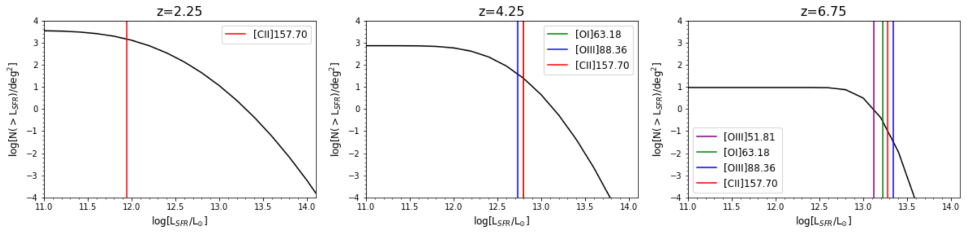
- [§3.3, Fig. 5] The line-intensity mapping forecasts are explicitly model-dependent: the Fig. 5 caption acknowledges that the line modeling is 'uncertain by a factor of a few (low redshift) to an order of magnitude towards high redshift (z > 6).' Since the high-redshift census (protoclusters, first metals, LIM cosmology) is one of the five core observables, the quantitative detection claims (e.g., [C II] out to z ~ 5, CO ladder to z ~ 4) should be presented as a central range rather than a single curve, or the sensitivity requirements should be recomputed for the pessimistic end of the model uncertainty.
minor comments (3)
- [Throughout] The text contains repeated bold sub-headings (e.g., 'Sensitivity and angular resolution:' repeated multiple times in Sections 2.3 and 2.5) and garbled symbols such as 'dY500≈9×10&'' in Fig. 2. These formatting artifacts should be corrected before publication.
- [Fig. 5] Use standard chemical notation ([C II], [O III], [N II]) consistently; the text and figure use 'Cii', 'Oiii', 'Nii'.
- [References] Reference [88] is cited as 'J. Chluba et al., Voyage 2050 Survey (2019)' without a journal or arXiv identifier; please provide a citable version or replace with the published companion paper.
Circularity Check
No significant circularity: the mission science case is assembled from external physical models and prior instrument-concept studies, with no fitted quantity repackaged as a prediction.
full rationale
This is a science white paper for a proposed ESA Voyage 2050 mission. The central claims are forecasts of what a 3.5 m, 8 K telescope with a polarimetric imager, filter-bank spectrometer, and Fourier transform spectrometers could measure. Those forecasts are derived from external physical modeling (e.g., the Arnaud et al. self-similar cluster scaling relation, Negrello et al. IR luminosity functions, EAGLE simulation-based line-intensity estimates) and from prior instrument-concept studies (PICO, CORE, PIXIE, PRISM, Super-PIXIE). None of these is defined in terms of the paper's target results. The paper derives survey requirements from target signal amplitudes (e.g., the δY500 needed to detect 5×10^13 Msun clusters) and then adopts instrument designs that meet those requirements; this is forward requirements flow-down, not circularity. The instrument sensitivities in Table I explicitly come from the PICO study, and the FTS configuration is inspired by prior work such as Super-PIXIE, but these are inputs to the proposal rather than predictions being passed off as new derivations. The one clearly load-bearing caveat is foreground subtraction: the Fig. 8 caption states that quoted y, mu, rSZ, and line sensitivities hold only 'assuming that the total foreground emission can be measured and subtracted at the same level of accuracy,' and Section 2.3 asserts that CIB fluctuations can be reduced to ~20% without showing a full pipeline. This is an acknowledged feasibility assumption, not a circular derivation: the paper does not claim to have derived foreground subtraction from the target signals, nor does it rename a fitted parameter as a prediction. Self-citations to CORE and PICO are references to published, simulation-based studies by overlapping authors, and they are used as engineering heritage and component-separation evidence rather than as a uniqueness theorem forbidding alternatives. No equation in the paper reduces to its own input, and no fitted quantity is relabeled as a discovery. The paper is therefore not significantly circular, though its headline sensitivity numbers inherit the unvalidated foreground-control assumption that the paper itself discloses.
Assumptions & free parameters
assumptions (5)
- domain assumption Foregrounds can be cleaned to the required levels, in particular CIB fluctuations can be reduced to about 20% of their initial amplitude and total foreground emission can be measured and subtracted at the accuracy of the spectral distortion targets.
- domain assumption Cluster masses and SZ signals follow self-similar scaling relations calibrated on low-redshift clusters.
- domain assumption Line emission scaling relations and line ratios used for line intensity mapping remain valid at high redshift, with ratios assumed constant with redshift.
- ad hoc to paper The PICO focal plane and optical design can be scaled from a 1.4 m to a 3.5 m telescope with no change other than deployable shields.
- domain assumption A 3.5 m telescope cooled to about 8 K and focal plane instruments at sub-kelvin temperatures can be operated in an L-class space mission.
Cite this review
Pith. "Pith review of Microwave Spectro-Polarimetry of Matter and Radiation across Space and Time." pith.science (2026). https://pith.science/paper/6H67MLMO
@misc{pith2026190901591,
  author       = {Pith},
  title        = {Pith review of: Microwave Spectro-Polarimetry of Matter and Radiation across Space and Time},
  year         = {2026},
  howpublished = {\url{https://pith.science/paper/6H67MLMO}},
  note         = {Machine review of arXiv:1909.01591}
}
read the original abstract
This paper discusses the science case for a sensitive spectro-polarimetric survey of the microwave sky. Such a survey would provide a tomographic and dynamic census of the three-dimensional distribution of hot gas, velocity flows, early metals, dust, and mass distribution in the entire Hubble volume, exploit CMB temperature and polarisation anisotropies down to fundamental limits, and track energy injection and absorption into the radiation background across cosmic times by measuring spectral distortions of the CMB blackbody emission. In addition to its exceptional capability for cosmology and fundamental physics, such a survey would provide an unprecedented view of microwave emissions at sub-arcminute to few-arcminute angular resolution in hundreds of frequency channels, a data set that would be of immense legacy value for many branches of astrophysics. We propose that this survey be carried-out with a large space mission featuring a broad-band polarised imager and a moderate resolution spectro-imager at the focus of a 3.5m aperture telescope actively cooled to about 8K, complemented with absolutely-calibrated Fourier Transform Spectrometer modules observing at degree-scale angular resolution in the 10-2000 GHz frequency range. We propose two observing modes: a survey mode to map the entire sky as well as a few selected wide fields, and an observatory mode for deeper observations of regions of specific interest.
Figures


Figures from the paper (7 more)


Forward citations
Cited by 1 Pith paper
-
Reconstructing simulated CMB polarization power spectra with the Analytical Blind Separation method
On simulated future-space-mission data, the ABS component separation method recovers CMB E- and B-mode power spectra to better than 20 percent accuracy for multipoles from 30 to 1050, with larger biases at the largest...
Reference graph
Works this paper leans on
-
[1]
full-sky maps with sensitivity and angular resolution matching the CMB-S4 3% sky patch
-
[2]
isotropic maps (with no filtering along the scans)
-
[3]
High-redshift structures on the largest scales While the first stars reionize the Universe at redshift z≃ 8, they also convert a fraction of the primor- dial hydrogen and helium into heavier atoms (metals), which then form molecules and dust particles that emit radiation at (sub)mm wavelength through thermal and line emission. Their detection out to high r...
-
[4]
Significantly more information can be extracted by a more sensitive survey that has better angular resolution
Cosmology and fundamental physics With its measurements of the CMB Planck gave percent level constraints on seven ΛCDM parameters. Significantly more information can be extracted by a more sensitive survey that has better angular resolution. Figure 7 shows the increase in the figure of merit (FOM) since COBE for the ΛCDM model (dark purple) and several exte...
-
[5]
capability to de-lens with different methods (from CMB and from CIB maps)
-
[6]
capability of full-sky delensing
-
[7]
capability to measure B-mode polarization with a sensitivity to r of the levelO(10−4)
-
[8]
Laureijs, arXiv e-prints arXiv:0912.0914 (2009), 0912.0914
R. Laureijs, arXiv e-prints arXiv:0912.0914 (2009), 0912.0914
arXiv 2009
Show all 201 references
-
[9]
extended frequency coverage, in the sub-mm domain and between atmospheric windows. Sensitivity and angular resolution:Sensitivity and angular resolution:Sensitivity and angular resolution:Sensitivity and angular resolution:Sensitivity and angular resolution:Sensitivity and ang...
-
[10]
missing baryon problem
Information from the CMB’s near-blackbody spectrum The precise shape of the CMB energy spectrum encodes new information that can be extracted using absolute CMB spectroscopy. At redshifts z & 2× 10⁶, thermalization processes are efficient and promptly restore a near perfect blac...
2000
-
[11]
Possible mission profiles Summarizing the requirements detailed above, this science program requires detecting the following signals with high signal-to-noise ratio and high precision, over the entire sky
-
[12]
Thermal SZ emission from most galaxy clusters in the Hubble volume, to map hot ionized gas in the cosmic web: angular resolution 1.5 to 1 ′; CMB sensitivity ∆ y≃ 10−6 at 1σ per arcmin pixel around 150 and 350 GHz;≃ 20 frequency channels in the 50–800 GHz frequency range
-
[13]
CMB anisotropies generated by lensing effects and the kSZ effect; angular resolution 1.5 to 1 ′; CMB sensitivity ∆T ≃ 1 to 0.6µK.arcmin;∼ 20 frequency channels covering the 50–800 GHz frequency range
-
[14]
CMB anisotropies from z≃ 1100; angular resolution 5 ′ to 1′; sensitivity ∆ T ≃ 1µK.arcmin; ∼ 20 frequency band in the 20–800 GHz frequency range
-
[15]
Absolute emission and fluctuations from dust continuum and [ Cii]/CO lines across a wide range of redshifts (up to z≃ 10) with spectral resolution R = 300 extending from ∼ 100 to ∼ 1000 GHz; angular resolution 1–5′; capability to map deep patches
-
[16]
Absolute spectrum of the microwave sky emission from 10 to 2000 GHz; angular resolution∼ 1◦; sensitivity integrated over the full observing time in the 0.1–10 Jy sr−1 range. Overall, the goal would be to achieve, with a combination of instruments, a spectro-polarimetric survey...
2000
-
[17]
The last line gives the aggregated focal plane array sensitivity to signals with the color of CMB or tSZ (actual sensitivity will be reduced after separation of the astrophysical components). ν Beam CMB σI tSZ σy σI PS 5σ CMB σI tSZ σy σI Flux×10−20 PS 5σ (GHz) (arcmin) (µK) (...
-
[18]
Scientific heritage and complementarity of probes The roadmap to the proposed mission benefits from intermediate projects that address a fraction of the science case
Scientific and technological roadmap 7.1. Scientific heritage and complementarity of probes The roadmap to the proposed mission benefits from intermediate projects that address a fraction of the science case. 19 • LiteBIRD plans to observe CMB polarization on large angular scales...
-
[19]
Planck Collaboration 2018 I, arXiv e-prints arXiv:1807.06205 (2018), 1807.06205
2018 arXiv
-
[20]
A. G. Riess, S. Casertano, W. Yuan, L. M. Macri, and D. Scolnic, ApJ 876, 85 (2019), 1903.07603
2019 arXiv
-
[21]
J. S. Bullock and M. Boylan-Kolchin, ARA&A 55, 343 (2017), 1707.04256
2017 arXiv
-
[22]
Planck Collaboration 2018 VI, arXiv e-prints arXiv:1807.06209 (2018), 1807.06209
2018 arXiv
-
[23]
Planck Collaboration 2013 XVII, A&A 571, A17 (2014), 1303.5077
2014 arXiv
-
[24]
B. D. Sherwin, A. van Engelen, N. Sehgal, M. Madhavacheril, G. E. Addison, S. Aiola, R. Allison, N. Battaglia, D. T. Becker, J. A. Beall, et al., Phys. Rev. D 95, 123529 (2017), 1611.09753
2017 arXiv
-
[25]
Simard, Y
G. Simard, Y. Omori, K. Aylor, E. J. Baxter, B. A. Benson, L. E. Bleem, J. E. Carlstrom, C. L. Chang, H. M. Cho, R. Chown, et al., ApJ 860, 137 (2018), 1712.07541
2018 arXiv
- [26]
- [27]
-
[28]
S. C. Hotinli, J. Meyers, N. Dalal, A. H. Jaffe, M. C. Johnson, J. B. Mertens, M. M¨ unchmeyer, K. M. Smith, and A. van Engelen, arXiv e-prints arXiv:1812.03167 (2018), 1812.03167
2018 arXiv
-
[29]
Staniszewski, P
Z. Staniszewski, P. A. R. Ade, K. A. Aird, B. A. Benson, L. E. Bleem, J. E. Carlstrom, C. L. Chang, H. M. Cho, T. M. Crawford, A. T. Crites, et al., ApJ 701, 32 (2009), 0810.1578
2009 arXiv
-
[30]
Hasselfield, M
M. Hasselfield, M. Hilton, T. A. Marriage, G. E. Addison, L. F. Barrientos, N. Battaglia, E. S. Battistelli, J. R. Bond, D. Crichton, S. Das, et al., JCAP 2013, 008 (2013), 1301.0816
2013 arXiv
-
[31]
L. E. Bleem, B. Stalder, T. de Haan, K. A. Aird, S. W. Allen, D. E. Applegate, M. L. N. Ashby, M. Bautz, M. Bayliss, B. A. Benson, et al., ApJS 216, 27 (2015), 1409.0850
2015 arXiv
-
[32]
Planck Collaboration 2015 XXVII, A&A 594, A27 (2016), 1502.01598
2016 arXiv
- [33]
-
[34]
K. Basu, J. Erler, J. Chluba, and et al., BAAS 51, 302 (2019), 1903.04944
2019 arXiv
-
[35]
Remazeilles, B
M. Remazeilles, B. Bolliet, A. Rotti, and J. Chluba, MNRAS 483, 3459 (2019), 1809.09666
2019 arXiv
-
[36]
Remazeilles and J
M. Remazeilles and J. Chluba, arXiv e-prints arXiv:1907.00916 (2019), 1907.00916
2019 arXiv
-
[37]
Rephaeli and O
Y. Rephaeli and O. Lahav, ApJ 372, 21 (1991)
1991
-
[38]
N. Hand, G. E. Addison, E. Aubourg, N. Battaglia, E. S. Battistelli, D. Bizyaev, J. R. Bond, H. Brew- ington, J. Brinkmann, B. R. Brown, et al., Phys. Rev. Lett 109, 041101 (2012), 1203.4219
2012 arXiv
-
[39]
Planck Collaboration Int XIII, A&A 561, A97 (2014), 1303.5090
2014 arXiv
-
[40]
Arnaud, G
M. Arnaud, G. W. Pratt, R. Piffaretti, H. B¨ ohringer, J. H. Croston, and E. Pointecouteau, A&A 517, A92 (2010), 0910.1234
2010 arXiv
-
[41]
Challinor, R
A. Challinor, R. Allison, J. Carron, and et al., JCAP 2018, 018 (2018), 1707.02259
2018 arXiv
-
[42]
Hanany and et al., arXiv e-prints arXiv:1902.10541 (2019), 1902.10541
S. Hanany and et al., arXiv e-prints arXiv:1902.10541 (2019), 1902.10541
2019 arXiv
-
[43]
Dunkley, E
J. Dunkley, E. Calabrese, J. Sievers, and et al., JCAP 2013, 025 (2013), 1301.0776
2013 arXiv
-
[44]
Lagache, J.-L
G. Lagache, J.-L. Puget, and H. Dole, ARA&A 43, 727 (2005), astro-ph/0507298
2005 arXiv
-
[45]
A. V. Kravtsov and S. Borgani, ARA&A 50, 353 (2012), 1205.5556
2012 arXiv
-
[46]
R. A. Overzier, AAPR 24, 14 (2016), 1610.05201
2016 arXiv
-
[47]
Dannerbauer and et al., A&A 570, A55 (2014), 1410.3730
H. Dannerbauer and et al., A&A 570, A55 (2014), 1410.3730
2014 arXiv
-
[48]
D. L. Clements and et al., MNRAS 461, 1719 (2016), 1605.06433
2016 arXiv
-
[49]
C. M. Casey, D. Narayanan, and A. Cooray, Phys. Rep. 541, 45 (2014), 1402.1456
2014 arXiv
-
[50]
Negrello, J
M. Negrello, J. Gonzalez-Nuevo, G. De Zotti, M. Bonato, Z.-Y. Cai, D. Clements, L. Danese, H. Dole, J. Greenslade, A. Lapi, et al., MNRAS 470, 2253 (2017), 1706.00116
2017 arXiv
-
[51]
R. J. Ivison and et al., ApJ 772, 137 (2013), 1302.4436
2013 arXiv
-
[52]
Wang and et al., ApJ 828, 56 (2016), 1604.07404
T. Wang and et al., ApJ 828, 56 (2016), 1604.07404
2016 arXiv
-
[53]
T. B. Miller and et al., Nature 556, 469 (2018), 1804.09231
2018 arXiv
-
[54]
Oteo and et al., ApJ 856, 72 (2018), 1709.02809
I. Oteo and et al., ApJ 856, 72 (2018), 1709.02809
2018 arXiv
-
[55]
Dannerbauer, E
H. Dannerbauer, E. van Kampen, and et al., BAAS 51, 293 (2019), 1903.06238
2019 arXiv
-
[56]
Klaassen, T
P. Klaassen, T. Mroczkowski, S. Bryan, C. Groppi, K. Basu, C. Cicone, H. Dannerbauer, C. De Breuck, W. J. Fischer, J. Geach, et al., arXiv e-prints (2019), 1907.04756
2019 arXiv
-
[57]
De Zotti, M
G. De Zotti, M. Bonato, M. Negrello, T. Trombetti, C. Burigana, D. Herranz, M. L´ opez-Caniego, Z. Y. Cai, L. Bonavera, and J. Gonz´ alez-Nuevo, arXiv e-prints arXiv:1907.05323 (2019), 1907.05323
2019 arXiv
-
[58]
Ca˜ nameras and et al., A&A 581, A105 (2015), 1506.01962
R. Ca˜ nameras and et al., A&A 581, A105 (2015), 1506.01962
2015 arXiv
-
[59]
from which it is inspired, could almost reach the cosmic-variance limit. It would outperform what is expected from the combination of upcoming instruments, such as LiteBIRD for large angular scales [60], and Simons Observatory [61] or CMB-S4 [62] at higher angular resolution. ...
1992
-
[60]
K. C. Harrington and et al., MNRAS 458, 4383 (2016), 1603.05622
2016 arXiv
-
[61]
Dannerbauer, K
H. Dannerbauer, K. Harrington, A. D´ ıaz-S´ anchez, S. Iglesias-Groth, R. Rebolo, R. T. Genova-Santos, and M. Krips, AJ 158, 34 (2019), 1812.03845
2019 arXiv
-
[62]
B. L. Frye and et al., ApJ 871, 51 (2019), 1805.04790
2019 arXiv
-
[63]
R. Hill, K. W. Masui, and D. Scott, Applied Spectroscopy 72, 663 (2018), 1802.03694
2018 arXiv
-
[64]
Odegard, J
N. Odegard, J. L. Weiland, D. J. Fixsen, D. T. Chuss, E. Dwek, A. Kogut, and E. R. Switzer, Astrophys. J. 877, 40 (2019), 1904.11556
2019 arXiv
-
[65]
Creque-Sarbinowski and M
C. Creque-Sarbinowski and M. Kamionkowski, Phys. Rev. D98, 063524 (2018), 1806.11119
2018 arXiv
-
[66]
Maniyar, M
A. Maniyar, M. B´ ethermin, and G. Lagache, Astron. Astrophys. 614, A39 (2018), 1801.10146
2018 arXiv
-
[67]
B´ ethermin, L
M. B´ ethermin, L. Wang, O. Dor´ e, G. Lagache, M. Sargent, E. Daddi, M. Cousin, and H. Aussel, Astron. 21 Astrophys. 557, A66 (2013), 1304.3936
2013 arXiv
-
[68]
Tucci, V
M. Tucci, V. Desjacques, and M. Kunz, Mon. Not. Roy. Astron. Soc. 463, 2046 (2016), 1606.02323
2016 arXiv
-
[69]
E. D. Kovetz et al. (2017), 1709.09066
2017 arXiv
-
[70]
M. T. Sargent, M. B´ ethermin, E. Daddi, and D. Elbaz, ApJL 747, L31 (2012), 1202.0290
2012 arXiv
-
[71]
Bonato, G
M. Bonato, G. De Zotti, D. Leisawitz, M. Negrello, M. Massardi, I. Baronchelli, Z.-Y. Cai, C. M. Bradford, A. Pope, E. J. Murphy, et al., PASA 36, e017 (2019), 1903.00946
2019 arXiv
-
[72]
Schaye, R
J. Schaye, R. A. Crain, R. G. Bower, M. Furlong, M. Schaller, T. Theuns, C. Dalla Vecchia, C. S. Frenk, I. G. McCarthy, J. C. Helly, et al., MNRAS 446, 521 (2015), 1407.7040
2015 arXiv
- [73]
-
[74]
J. L. Bernal, P. C. Breysse, and E. D. Kovetz (2019), 1907.10065
2019
-
[75]
Moradinezhad Dizgah and G
A. Moradinezhad Dizgah and G. K. Keating, Astrophys. J. 872, 126 (2019), 1810.02850
2019 arXiv
-
[76]
J. L. Bernal, P. C. Breysse, H. Gil-Mar´ ın, and E. D. Kovetz (2019), 1907.10067
2019
-
[77]
Andre, C
PRISM Collaboration, P. Andre, C. Baccigalupi, D. Barbosa, J. Bartlett, and et al., arXiv e-prints arXiv:1306.2259 (2013), 1306.2259
2013 arXiv
-
[78]
Hazumi et al., J
M. Hazumi et al., J. Low. Temp. Phys. 194, 443 (2019)
2019
- [79]
- [80]
-
[81]
P. A. R. Ade et al. (BICEP2, Keck Array), Phys. Rev. Lett. 121, 221301 (2018), 1810.05216
2018 arXiv
-
[82]
Planck Collaboration 2018 X (Planck) (2018), 1807.06211
2018 arXiv
- [83]
-
[84]
Kallosh, A
R. Kallosh, A. Linde, T. Wrase, and Y. Yamada, Journal of High Energy Physics 2017, 144 (2017), 1704.04829
2017 arXiv
-
[85]
Planck Collaboration 2018 IX (Planck) (2019), 1905.05697
2019 arXiv
-
[86]
P. F. de Salas and S. Pastor, JCAP 2016, 051 (2016), 1606.06986
2016 arXiv
-
[87]
Remazeilles, A
M. Remazeilles, A. J. Banday, C. Baccigalupi, and et al., JCAP 2018, 023 (2018), 1704.04501
2018 arXiv
-
[88]
Delabrouille, P
J. Delabrouille, P. de Bernardis, F. R. Bouchet, A. Ach´ ucarro, P. A. R. Ade, R. Allison, F. Arroja, E. Artal, M. Ashdown, C. Baccigalupi, et al., JCAP 2018, 014 (2018), 1706.04516
2018 arXiv
-
[89]
Planck Collaboration 2018 VII, arXiv e-prints arXiv:1906.02552 (2019), 1906.02552
2019 arXiv
-
[90]
Burigana, C
C. Burigana, C. S. Carvalho, T. Trombetti, A. Notari, M. Quartin, G. de Gasperis, A. Buzzelli, N. Vittorio, G. De Zotti, P. de Bernardis, et al., JCAP 2018, 021 (2018), 1704.05764
2018 arXiv
-
[91]
Y. B. Zeldovich and R. A. Sunyaev, ApSS 4, 301 (1969)
1969
-
[92]
R. A. Sunyaev and Y. B. Zeldovich, ApSS 7, 20 (1970)
1970
-
[93]
Burigana, L
C. Burigana, L. Danese, and G. de Zotti, A&A 246, 49 (1991)
1991
-
[94]
Hu and J
W. Hu and J. Silk, Phys. Rev. D 48, 485 (1993)
1993
- [95]
- [96]
- [97]
- [98]
-
[99]
Kogut, D
A. Kogut, D. J. Fixsen, D. T. Chuss, J. Dotson, E. Dwek, M. Halpern, G. F. Hinshaw, S. M. Meyer, S. H. Moseley, M. D. Seiffert, et al., JCAP 7, 25 (2011), 1105.2044
2011 arXiv
-
[100]
Andr´ e, C
PRISM Collaboration, P. Andr´ e, C. Baccigalupi, A. Banday, D. Barbosa, and et al., JCAP 2014, 006 (2014), 1310.1554
2014 arXiv
-
[101]
Kogut, M
A. Kogut, M. H. Abitbol, J. Chluba, J. Delabrouille, D. Fixsen, J. C. Hill, S. P. Patil, and A. Rotti, arXiv e-prints arXiv:1907.13195 (2019), 1907.13195
2019 arXiv
-
[102]
R. A. Sunyaev and Y. B. Zeldovich, ApSS 9, 368 (1970)
1970
-
[103]
R. A. Daly, ApJ 371, 14 (1991)
1991
- [104]
- [105]
-
[106]
Chluba et al., Voyage 2050 Survey (2019)
J. Chluba et al., Voyage 2050 Survey (2019)
2019
- [107]
- [108]
- [109]
- [110]
-
[111]
Refregier, E
A. Refregier, E. Komatsu, D. N. Spergel, and U.-L. Pen, Phys. Rev. D 61, 123001 (2000)
2000
-
[112]
Miniati, D
F. Miniati, D. Ryu, H. Kang, T. W. Jones, R. Cen, and J. P. Ostriker, ApJ 542, 608 (2000)
2000
-
[113]
S. P. Oh, A. Cooray, and M. Kamionkowski, MNRAS 342, L20 (2003)
2003
-
[114]
J. C. Hill et al., Phys. Rev. Lett 115, 261301 (2015), 1507.01583
2015 arXiv
-
[115]
E. L. Wright, ApJ 232, 348 (1979)
1979
-
[116]
S. Y. Sazonov and R. A. Sunyaev, ApJ 508, 1 (1998)
1998
-
[117]
N. Itoh, Y. Kohyama, and S. Nozawa, ApJ 502, 7 (1998), arXiv:astro-ph/9712289
1998 arXiv
-
[118]
S. P. Oh, ApJ 527, 16 (1999), astro-ph/9904255
1999 arXiv
-
[119]
P. P. Ponente, J. M. Diego, R. K. Sheth, C. Burigana, S. R. Knollmann, and Y. Ascasibar, MNRAS 410, 2353 (2011), 1006.2243
2011 arXiv
- [120]
-
[121]
Seiffert, D
M. Seiffert, D. J. Fixsen, A. Kogut, S. M. Levin, M. Limon, P. M. Lubin, P. Mirel, J. Singal, T. Villela, 22 E. Wollack, et al., ApJ 734, 6 (2011)
2011
-
[122]
J. D. Bowman, A. E. E. Rogers, R. A. Monsalve, T. J. Mozdzen, and N. Mahesh, Nature 555, 67 (2018)
2018
- [123]
- [124]
- [125]
-
[126]
Agnese et al
R. Agnese et al. (SuperCDMS), Phys. Rev. Lett 116, 071301 (2016), 1509.02448
2016 arXiv
- [127]
-
[128]
D. S. Akerib et al. (LUX), Phys. Rev. Lett 118, 021303 (2017), 1608.07648
2017 arXiv
-
[129]
Jungman, M
G. Jungman, M. Kamionkowski, and K. Griest, Phys. Rep. 267, 195 (1996), hep-ph/9506380
1996 arXiv
-
[130]
J. L. Feng, A. Rajaraman, and F. Takayama, Phys. Rev. Lett 91, 011302 (2003)
2003
-
[131]
J. L. Feng, A. Rajaraman, and F. Takayama, Phys. Rev. D68, 063504 (2003)
2003
- [132]
-
[133]
J. L. Feng, ARA&A 48, 495 (2010), 1003.0904
2010 arXiv
-
[134]
B. J. Carr, K. Kohri, Y. Sendouda, and J. Yokoyama, Phys. Rev. D81, 104019 (2010)
2010
-
[135]
D. J. E. Marsh, Phys. Rep. 643, 1 (2016), 1510.07633
2016 arXiv
-
[136]
Ellis, G
J. Ellis, G. B. Gelmini, J. L. Lopez, D. V. Nanopoulos, and S. Sarkar, Nu. Phys. B 373, 399 (1992)
1992
-
[137]
J. A. Adams, S. Sarkar, and D. W. Sciama, MNRAS 301, 210 (1998), astro-ph/9805108
1998 arXiv
-
[138]
Chen and M
X. Chen and M. Kamionkowski, Phys. Rev. D70, 043502 (2004), arXiv:astro-ph/0310473
2004 arXiv
-
[139]
Padmanabhan and D
N. Padmanabhan and D. P. Finkbeiner, Phys. Rev. D72, 023508 (2005)
2005
-
[140]
Galli, F
S. Galli, F. Iocco, G. Bertone, and A. Melchiorri, Phys. Rev. D 80, 023505 (2009), 0905.0003
2009 arXiv
-
[141]
T. R. Slatyer, N. Padmanabhan, and D. P. Finkbeiner, Phys. Rev. D80, 043526 (2009)
2009
-
[142]
T. R. Slatyer and C.-L. Wu, Phys. Rev. D95, 023010 (2017), 1610.06933
2017 arXiv
- [143]
-
[144]
R. J. Wilkinson, C. Bœhm, and J. Lesgourgues, JCAP 2014, 011 (2014), 1401.7597
2014 arXiv
-
[145]
Dvorkin, K
C. Dvorkin, K. Blum, and M. Kamionkowski, Phys. Rev. D89, 023519 (2014), 1311.2937
2014 arXiv
-
[146]
R. J. Wilkinson, J. Lesgourgues, and C. ´ e. Bœhm, JCAP 2014, 026 (2014), 1309.7588
2014 arXiv
-
[147]
Gluscevic and K
V. Gluscevic and K. K. Boddy, Phys. Rev. Lett 121, 081301 (2018), 1712.07133
2018 arXiv
-
[148]
Kawasaki, K
M. Kawasaki, K. Kohri, and T. Moroi, Phys. Rev. D71, 083502 (2005)
2005
- [149]
-
[150]
Kawasaki, K
M. Kawasaki, K. Kohri, T. Moroi, and Y. Takaesu, Phys. Rev. D97, 023502 (2018)
2018
- [151]
-
[152]
Sarkar and A
S. Sarkar and A. M. Cooper, Physics Letters B 148, 347 (1984)
1984
-
[153]
Ellis, D
J. Ellis, D. V. Nanopoulos, and S. Sarkar, Nuclear Physics B 259, 175 (1985)
1985
-
[154]
Kawasaki and K
M. Kawasaki and K. Sato, Physics Letters B 169, 280 (1986)
1986
-
[155]
Hu and J
W. Hu and J. Silk, Phys. Rev. Lett 70, 2661 (1993)
1993
-
[156]
J. L. Aalberts, S. Ando, W. M. Borg, E. Broeils, J. Broeils, S. Broeils, B. J. Kavanagh, G. Leguijt, M. Reemst, D. R. van Arneman, et al., Phys. Rev. D98, 023001 (2018)
2018
-
[157]
McDonald, R
P. McDonald, R. J. Scherrer, and T. P. Walker, Phys. Rev. D63, 023001 (2001)
2001
-
[158]
Y. E. Lyubarsky and R. A. Sunyaev, A&A 123, 171 (1983)
1983
- [159]
- [160]
- [161]
-
[162]
T. R. Slatyer, Phys. Rev. D93, 023521 (2016), 1506.03812
2016 arXiv
-
[163]
S. K. Acharya and R. Khatri, Phys. Rev. D 99, 043520 (2019), 1808.02897
2019 arXiv
-
[164]
Tashiro, J
H. Tashiro, J. Silk, and D. J. E. Marsh, Phys. Rev. D88, 125024 (2013), 1308.0314
2013 arXiv
- [165]
- [166]
-
[167]
Dimastrogiovanni, L
E. Dimastrogiovanni, L. M. Krauss, and J. Chluba, Phys. Rev. D94, 023518 (2016)
2016
-
[168]
J. P. Ostriker and C. Thompson, ApJL 323, L97 (1987)
1987
- [169]
-
[170]
Ali-Ha¨ ımoud, J
Y. Ali-Ha¨ ımoud, J. Chluba, and M. Kamionkowski, Phys. Rev. D115, 071304 (2015)
2015
-
[171]
J. A. D. Diacoumis and Y. Y. Y. Wong, JCAP 9, 011 (2017), 1707.07050
2017 arXiv
-
[172]
Kumar, E
S. Kumar, E. Dimastrogiovanni, G. D. Starkman, C. Copi, and B. Lynn, Phys. Rev. D 99, 023521 (2019), 1804.08601
2019 arXiv
-
[173]
Jedamzik, V
K. Jedamzik, V. Katalini´ c, and A. V. Olinto, PRL 85, 700 (2000), arXiv:astro-ph/9911100
2000 arXiv
-
[174]
S. K. Sethi and K. Subramanian, MNRAS 356, 778 (2005), astro-ph/0405413
2005 arXiv
-
[175]
K. E. Kunze and E. Komatsu, JCAP 1, 009 (2014), 1309.7994
2014 arXiv
-
[176]
J. M. Wagstaff and R. Banerjee, Phys. Rev. D92, 123004 (2015), 1508.01683
2015 arXiv
-
[177]
V. K. Dubrovich, Soviet Astronomy Letters 1, 196 (1975)
1975
-
[178]
G. B. Rybicki and I. P. dell’Antonio, ApJ 427, 603 (1994), astro-ph/9312006
1994 arXiv
-
[179]
V. K. Dubrovich and V. A. Stolyarov, A&A 302, 635 (1995)
1995
-
[180]
E. E. Kholupenko, A. V. Ivanchik, and D. A. Varshalovich, Gravitation and Cosmology 11, 161 (2005), astro-ph/0509807
2005 arXiv
-
[181]
W. Y. Wong, S. Seager, and D. Scott, MNRAS 367, 1666 (2006), astro-ph/0510634
2006 arXiv
-
[182]
J. A. Rubi˜ no-Mart´ ın, J. Chluba, and R. A. Sunyaev, MNRAS371, 1939 (2006). 23
2006
- [183]
-
[184]
J. A. Rubi˜ no-Mart´ ın, J. Chluba, and R. A. Sunyaev, A&A485, 377 (2008)
2008
- [185]
- [186]
-
[187]
R. A. Sunyaev and J. Chluba, Astronomische Nachrichten 330, 657 (2009), 0908.0435
2009 arXiv
- [188]
-
[189]
P. J. Shirron, M. O. Kimball, D. J. Fixsen, A. J. Kogut, X. Li, and M. J. DiPirro, Cryogenics 52, 140 (2012), URL https://ui.adsabs.harvard.edu/#abs/2012Cryo...52..140S
2012
-
[190]
P. J. Shirron, M. O. Kimball, B. L. James, T. Muench, M. J. DiPirro, T. G. Bialas, G. A. Sneiderman, F. S. Porter, and R. L. Kelley, Cryogenics 74, 24 (2016)
2016
-
[191]
T. L. R. Brien, E. Castillo-Dominguez, S. Chase, and S. M. Doyle, Journal of Low Temperature Physics 193, 805 (2018), ISSN 1573-7357, URL https://doi.org/10.1007/s10909-018-2024-y
2018 doi
-
[192]
Suzuki, K
A. Suzuki, K. Arnold, J. Edwards, G. Engargiola, W. Holzapfel, B. Keating, A. T. Lee, X. F. Meng, M. J. Myers, R. O’Brient, et al., Journal of Low Temperature Physics 176, 650 (2014)
2014
-
[193]
Datta, J
R. Datta, J. Hubmayr, C. Munson, J. Austermann, J. Beall, D. Becker, H. M. Cho, N. Halverson, G. Hilton, K. Irwin, et al., Journal of Low Temperature Physics 176, 670 (2014), 1401.8029
2014 arXiv
-
[194]
M. H. Abitbol, J. Chluba, J. C. Hill, and B. R. Johnson, MNRAS 471, 1126 (2017)
2017
-
[195]
A. Endo, K. Karatsu, Y. Tamura, and et al., arXiv e-prints arXiv:1906.10216 (2019), 1906.10216
2019 arXiv
-
[196]
J. J. A. Baselmans, J. Bueno, S. J. C. Yates, O. Yurduseven, N. Llombart, K. Karatsu, A. M. Baryshev, L. Ferrari, A. Endo, D. J. Thoen, et al., A&A 601, A89 (2017), 1609.01952
2017 arXiv
-
[197]
Bueno, O
J. Bueno, O. Yurduseven, S. J. C. Yates, N. Llombart, V. Murugesan, D. J. Thoen, A. M. Baryshev, A. Neto, and J. J. A. Baselmans, Applied Physics Letters 110, 233503 (2017)
2017
-
[198]
Origins STDT, Origins space telescope, https://asd.gsfc.nasa.gov/firs/ (2019)
2019
-
[199]
Aieta, M
F. Aieta, M. A. Kats, P. Genevet, and F. Capasso, Science 347, 1342 (2015), ISSN 0036-8075, https://science.sciencemag.org/content/347/6228/1342.full.pdf, URL https://science.sciencemag. org/content/347/6228/1342
2015
-
[200]
Pisano, M
G. Pisano, M. W. Ng, F. Ozturk, B. Maffei, and V. Haynes, Appl. Opt. 52, 2218 (2013)
2013
-
[201]
Abitbol, A
EBEX Collaboration, M. Abitbol, A. M. Aboobaker, P. Ade, D. Araujo, F. Aubin, C. Baccigalupi, C. Bao, D. Chapman, J. Didier, et al., ApJS 239, 8 (2018), 1803.01018. 24
2018 arXiv
Reviewed August 14, 2026 · model on record in the stance chip above.
Discussion (0). Continue with ORCID to comment.