REVIEW 3 major objections 4 minor 64 references
Spin--lattice coupling and the emergence of the trimerized phase in the $S=1$ Kagome antiferromagnet Na$_2$Ti$_3$Cl$_8$
T0 review · 3 major / 4 minor · reviewed 2026-08-14 · deepseek-v4-flash
Pith's one-line read Spin-lattice coupling, not spins alone, selects the trimerized phase in Na2Ti3Cl8.
desk verdict The high-temperature nematic result is solid and novel; the spin-lattice mechanism for the trimerized phase is a well-labeled surmise that the abstract overstates. read the letter →
The pith
A machine-rendered reading of the paper's core claim, the machinery that carries it, and where it could break.
The reading
What carries the argument
The load-bearing object is the extended spin Hamiltonian of Eq. (1), $H = J \sum_{\langle ij\rangle} \mathbf{S}_i\cdot\mathbf{S}_j + J_{bq} \sum_{\langle ij\rangle} (\mathbf{S}_i\cdot\mathbf{S}_j)^2 + \frac{J_R}{2} \sum_{\triangle=i,j,k}[(\mathbf{S}_i\cdot\mathbf{S}_j)(\mathbf{S}_i\cdot\mathbf{S}_k) + (\mathbf{S}_i\cdot\mathbf{S}_k)(\mathbf{S}_i\cdot\mathbf{S}_j)]$, together with the Wannier-function tight-binding model of the $t_{2g}$ orbitals that explains both the origin and the distortion dependence of these couplings. The Hamiltonian is what the DFT energy fits, and its negative biquadratic coupling is what produces the ferroquadrupolar (nematic) ground state seen in ED and DMRG. The Wannier model provides the mechanism: as the lattice interpolates from HT to LT, the $A_g$--$B_g$ orbital splitting grows by nearly an order of magnitude, hoppings across large triangles vanish, and the dominant hopping becomes relatively larger, which is argued to suppress the biquadratic-to-Heisenberg ratio and push the system into the trimerized regime. The trimerized and quadrupolar order parameters measured in DMRG -- the difference of bond energies on up and down triangles, and $\langle (S_i^z)^2 \rangle - 2/3$ -- are what certify which phase each parameter set realizes.
What would settle it
Take the low-temperature (breathing) crystal structure and fit the same $J$, $J_{bq}$, $J_R$ Hamiltonian to DFT+U energies, exactly as was done for the high-temperature structure; if the fitted $J_{bq}/J$ is not significantly smaller than the HT value, or if $J_R/J$ changes so as to enlarge the nematic region, then the proposed spin-lattice stabilization of the trimerized phase fails. A complementary experiment would seek the predicted ferroquadrupolar state in the high-temperature phase by looking for the low-lying $S=2$ excitation in inelastic neutron scattering before the structural transition.
Extended reading notes
Core claim
The central claim is that the effective magnetic Hamiltonian of Na$_2$Ti$_3$Cl$_8$ in its high-temperature (HT) kagome structure must include, beyond the nearest-neighbor Heisenberg exchange $J \approx 9.2$ meV, a negative biquadratic coupling $J_{bq} \approx -1.8$ meV and a ring-exchange term $J_R \approx 3.4$ meV (for $U = 3$ eV), of the form $H = J \sum_{\langle ij\rangle} \mathbf{S}_i \cdot \mathbf{S}_j + J_{bq} \sum_{\langle ij\rangle} (\mathbf{S}_i \cdot \mathbf{S}_j)^2 + \frac{J_R}{2} \sum_{\triangle = i,j,k} [(\mathbf{S}_i \cdot \mathbf{S}_j)(\mathbf{S}_i \cdot \mathbf{S}_k) + (\mathbf{S}_i \cdot \mathbf{S}_k)(\mathbf{S}_i \cdot \mathbf{S}_j)]$. Exact diagonalization on 18-site clusters and DMRG on kagome cylinders show that with these parameters the ground state of the HT Hamiltonian is ferroquadrupolar (spin-nematic), with a low-lying $S=2$ excitation, not trimerized. The paper then claims that the breathing distortion observed at low temperature -- which creates small and large Ti triangles -- is required to stabilize the trimerized phase: Wannier-based analysis shows that under the distortion the $A_g$--$B_g$ crystal-field splitting grows and the dominant orbital hopping becomes even more dominant, which enhances $J$ and suppresses $J_{bq}/J$. Because DFT finds no unstable $\Gamma_2^-$ phonon in the HT structure, the authors conclude that the structural transition itself is driven by spin-lattice coupling rather than by a bare lattice or magnetic instability. The upshot is that neither the electronic nor the lattice Hamiltonian alone contains the instability; their coupling does.
Load-bearing premise
The argument rests on the assumption that the Wannier-derived trend of the hopping parameters under the breathing distortion correctly predicts that the biquadratic-to-Heisenberg ratio $J_{bq}/J$ is suppressed enough in the low-temperature structure to move the ground state from nematic to trimerized; the paper does not directly fit the low-temperature magnetic Hamiltonian.
Editorial extensions
If this is right
- In the high-temperature structure, the magnetic ground state is a spin nematic (ferroquadrupolar) phase, not a trimerized one, and the lowest magnetic excitation has total spin $S=2$.
- The breathing (trimerizing) lattice distortion is necessary to stabilize the experimentally observed trimerized phase; the spin model alone prefers the quadrupolar state at high-temperature parameters.
- Because DFT shows no bare $\Gamma_2^-$ lattice instability, the approximately 200 K structural transition is driven by spin-lattice coupling, so magnetic and structural order must be described together.
- Because the $\Gamma_2^-$ distortion is polar, an external electric field couples linearly to it and could, at low temperature, bias the lattice enough to move the system between trimerized and quadrupolar magnetic phases.
Reading between the lines
- A direct DFT fit of the low-temperature magnetic Hamiltonian, which the authors state is technically challenging, is the cleanest test of the mechanism: if the fitted $J_{bq}/J$ is not substantially smaller than the high-temperature value, the spin-lattice stabilization argument would lose its quantitative basis.
- The same Wannier-based logic suggests a design rule: among $S=1$ kagome halides, the size of the breathing distortion needed to enter the trimerized phase should correlate with how strongly the distortion suppresses $J_{bq}/J$, so compounds with stiffer lattices should remain spin-nematic at low temperature.
- If the electric-field coupling to the polar distortion is strong, a field quench could reveal a quantum critical point between nematic and trimerized phases; the paper hints at this possibility but does not estimate the required field scale.
- The prediction that the high-temperature phase is a spin nematic could be tested on a sample held above the structural transition, for example by looking for quadrupolar correlations in neutron scattering or NMR that do not rely on static magnetic order.
Editorial analysis
A structured set of objections, weighed in public.
Referee Report
Summary. The manuscript studies the S=1 kagome compound Na2Ti3Cl8 using DFT-based exchange fits, exact diagonalization, and DMRG. It claims that the high-temperature (HT) magnetic Hamiltonian contains essential biquadratic and ring-exchange terms, that the HT ground state is ferroquadrupolar (nematic) rather than trimerized, and that the experimentally observed breathing distortion is driven by spin-lattice coupling, which suppresses Jbq/J and stabilizes the trimerized phase. The paper also reports the absence of a bare lattice instability in DFT phonon calculations and concludes that neither the electronic nor the lattice Hamiltonian alone is sufficient.
Significance. If the HT Hamiltonian extraction is accepted, the paper is valuable as a concrete ab initio-supported example of non-Heisenberg magnetism in a S=1 frustrated material, and it extends the phase diagram of an S=1 kagome model with biquadratic and ring exchange. The DFT fits are careful: the three-parameter model reaches R²=0.996, jackknife resampling shows stable signs, and several Hubbard-U values are compared. The ED and DMRG results are mutually consistent and locate the HT parameters in the nematic phase. The Wannier analysis of orbital-dependent hoppings is a plausible microscopic rationale for the presence of the non-Heisenberg terms. The principal weakness is that the LT-phase parameters are never computed, so the spin-lattice mechanism remains a conjecture rather than an established result.
major comments (3)
- [Emergence of trimerized phase and the role of lattice distortions (pp. 4-5) and Fig. 4a] The paper's central claim that the breathing distortion stabilizes the trimerized phase is not quantitatively demonstrated. The LT values of Jbq/J and JR/J are never extracted; the only evidence is the Wannier hopping trend of Fig. 3c. This is insufficient because the ED scan in Fig. 4a shows that the nematic region extends to small negative Jbq/J once JR is positive: on the U=3 eV line the phase boundary occurs at JR≈1 meV, corresponding to Jbq/J≈−0.06. Since the text states that 'JR/J, on the other hand, is not easy to predict' and notes that the xz-yz hopping process contributing to JR is enhanced in the LT phase, the LT parameters could still lie in the nematic phase. A direct fit of the LT magnetic Hamiltonian, or at least a scan over LT parameter values consistent with the Wannier trends, is needed to support the assertion that spin-lattice coupling drives the transition. The paper's own summary calls this a 'surmise,' but the abstract presents it as the central conclusion.
- [Supplement V and Fig. 3c] The orbital-occupancy argument used to predict suppression of Jbq/J in the LT phase does not transfer straightforwardly. The Bhatt-Yang and Mila-Zhang models quoted in the paper assume atomic-like orbitals and local interactions, but the LT Wannier functions are bond-centered rather than t2g-like, as stated in Supplement V. Using the hopping amplitudes of Fig. 3c to infer that Jbq/J is suppressed in the LT phase therefore requires additional justification that the fourth-order exchange processes are governed by the same mechanism. Without this, the sign and magnitude of Jbq changes under the breathing distortion are unknown.
- [Exact diagonalization and DMRG (Fig. 4) and Supplement I] The ED and DMRG calculations use only the three-parameter Hamiltonian of Eq. (1), but the supplementary fits show that the symmetry-allowed three-spin terms JL and JC are nonzero in the HT phase: at U=3 eV the five-parameter fit gives JL≈−1.3 meV and JC≈1.5 meV, comparable in magnitude to Jbq≈−2.0 meV. The effect of these terms on the nematic-to-trimerized boundary is not examined. Since the conclusion that the HT ground state is nematic depends on the location of the HT parameters relative to the phase boundary, the omission of JL and JC from the many-body calculations should be justified or tested.
minor comments (4)
- [Abstract and Conclusions] The abstract states that the structural transition 'is driven by spin-lattice coupling,' but the Conclusions call the same mechanism a 'surmise.' This inconsistency should be resolved; at present the abstract overstates the certainty of the central claim.
- [Fig. 4c caption] The notation 'JR/J≈−1.89Jbq/J≈0.37' is ambiguous; it should be written with parentheses, e.g., JR/J≈−1.89 (Jbq/J)≈0.37, so that the reader can see that this is a relation between the two ratios.
- [Supplement I and main text, Eq. (1)] The main text says the model of Eq. (1) is the fit used for the HT phase, but Supplement I shows that the more complete model including JL and JC gives different values for JR (e.g., 2.9 vs 3.4 meV). The choice of the three-parameter model as the 'minimal model' is reasonable, but the main text should explicitly note the spread in JR and its potential effect on the phase boundary.
- [Reference [36]] Reference [36] is listed as 'S. supplemental information for further details' in several places; it should be replaced with the standard citation of the supplementary material.
Circularity Check
No circularity found: phases are computed from fitted Hamiltonians and independently confirmed, and the LT spin-lattice mechanism is explicitly labeled a surmise.
full rationale
The central derivation chain is not circular. The paper fits the parameters J, Jbq, and JR of Eq. (1) to DFT total energies of many collinear and non-collinear spin configurations, and then separately solves the resulting quantum Hamiltonian with ED and DMRG. The fitted parameters are not chosen to produce a nematic phase; the phase is a many-body output of the fitted Hamiltonian, not an input to the fit. The ED spectrum and DMRG order parameters in Fig. 4 provide independent evidence for the ferromagnetic-quadrupolar ground state, and the paper explicitly confirms the prior S=1 kagome phase diagram with its own calculations rather than relying only on the self-citation to Ref. [15]. The low-temperature spin-lattice argument is admittedly incomplete: the paper states that 'JR/J, on the other hand, is not easy to predict' and describes the magneto-structural mechanism as a 'surmise.' Whatever the strength of that conjecture as a scientific claim, it is not a circular reduction because the conclusion is not built into the inputs by construction. The bond-centered character of the LT Wannier functions is disclosed in Supplement V and weakens the orbital-based argument, but again this is a correctness or completeness concern, not a circularity. No equation, fitted parameter, or cited theorem is defined in terms of the claimed result, and no 'prediction' is statistically forced by its own fitting target. The paper therefore does not meet the evidentiary bar for a circularity finding.
Assumptions & free parameters
free parameters (4)
- Hubbard U =
3 eV (also 2, 4, 5 eV in SI)
- Heisenberg exchange J =
9.2 meV (U=3 eV, 3-parameter model)
- Biquadratic exchange Jbq =
-1.8 meV (U=3 eV, 3-parameter model)
- Ring exchange JR =
3.4 meV (U=3 eV, 3-parameter model)
assumptions (4)
- domain assumption Equation (1) captures the low-energy spin physics of Na2Ti3Cl8; other terms (J2, J3, Jd, JL, JC) can be neglected.
- domain assumption DFT+U (PBEsol, Dudarev U) gives accurate relative energies of magnetic configurations.
- domain assumption Finite-size ED (18-site cluster) and DMRG (XC8-3 cylinder) results represent the thermodynamic limit.
- domain assumption The Wannier tight-binding evolution under linearly interpolated structures is a valid proxy for the exchange parameter evolution into the LT phase.
Cite this review
Pith. "Pith review of Spin--lattice coupling and the emergence of the trimerized phase in the $S=1$ Kagome antiferromagnet Na$_2$Ti$_3$Cl$_8$." pith.science (2026). https://pith.science/paper/62QSBVH2
@misc{pith2026190902020,
  author       = {Pith},
  title        = {Pith review of: Spin--lattice coupling and the emergence of the trimerized phase in the $S=1$ Kagome antiferromagnet Na$_2$Ti$_3$Cl$_8$},
  year         = {2026},
  howpublished = {\url{https://pith.science/paper/62QSBVH2}},
  note         = {Machine review of arXiv:1909.02020}
}
abstract
Spin-1 antiferromagnets are abundant in nature, but few theories or results exist to understand their general properties and behavior, particularly in situations when geometric frustration is present. Here we study the $S=1$ Kagome compound Na$_2$Ti$_3$Cl$_8$ using a combination of Density Functional Theory, Exact Diagonalization, and Density Matrix Renormalization Group methods to achieve a first principles supported explanation of exotic magnetic phases in this compound. We find that the effective magnetic Hamiltonian includes essential non-Heisenberg terms that do not stem from spin-orbit coupling, and both trimerized and spin-nematic magnetic phases are relevant. The experimentally observed structural transition to a breathing Kagome phase is driven by spin--lattice coupling, which favors the trimerized magnetic phase against the quadrupolar one. We thus show that lattice effects can be necessary to understand the magnetism in frustrated magnetic compounds, and surmise that Na$_2$Ti$_3$Cl$_8$ is a compound which cannot be understood from only electronic or only lattice Hamiltonians, very much like VO$_2$.
Figures


Figures from the paper (1 more)
Reference graph
Works this paper leans on
-
[1]
J. S. Helton, K. Matan, M. P. Shores, E. A. Nytko, B. M. Bartlett, Y . Yoshida, Y . Takano, A. Suslov, Y . Qiu, J.-H. Chung, D. G. Nocera, and Y . S. Lee, Phys. Rev. Lett. 98, 107204 (2007)
work page 2007
-
[2]
Tian-Heng Han, Joel S. Helton, Shaoyan Chu, Daniel G. No- cera, Jose A. Rodriguez-Rivera, Collin Broholm and Young S. Lee, Nature 492, 406-410 (2012)
work page 2012
-
[3]
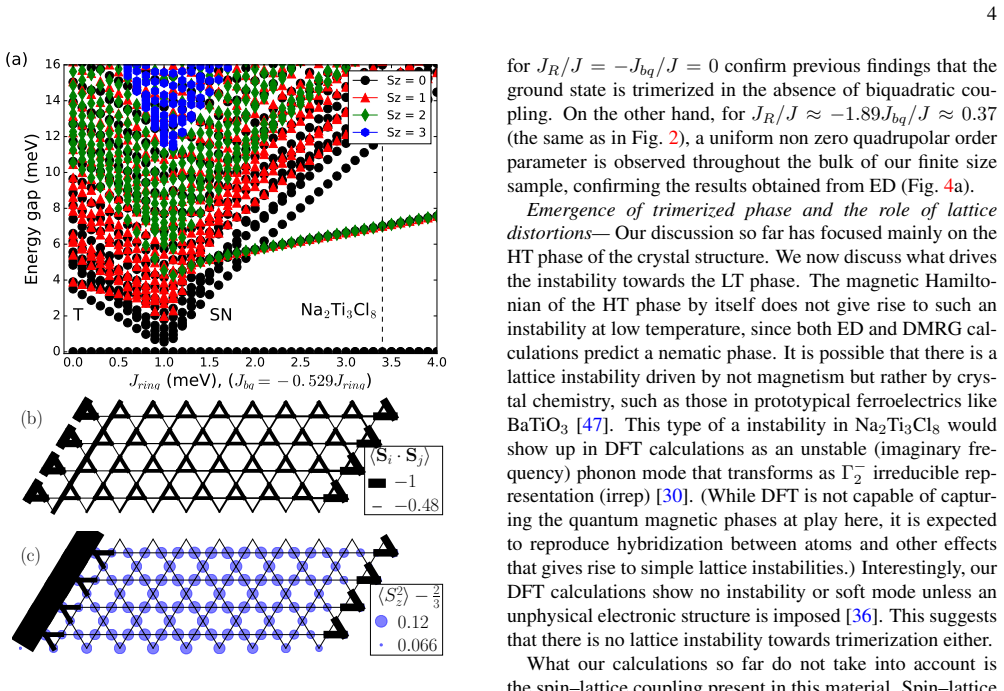
Results presented in Fig. 4b forJR/J =−Jbq/J = 0 confirm previous findings that the ground state is trimerized in the absence of biquadratic cou- pling. On the other hand, for JR/J≈− 1.89Jbq/J≈ 0.37 (the same as in Fig. 2), a uniform non zero quadrupolar order parameter is observed throughout the bulk of our finite size sample, confirming the results obtained...
- [4]
-
[5]
S. Yan, D. A. Huse, and S. R. White, Science 332, 1173 (2011), http://www.sciencemag.org/content/332/6034/1173.full.pdf
work page 2011
-
[6]
Y . Ran, M. Hermele, P. A. Lee, and X.-G. Wen, Phys. Rev. Lett. 98, 117205 (2007)
work page 2007
-
[7]
S. Depenbrock, I. P. McCulloch, and U. Schollwöck, Phys. Rev. Lett. 109, 067201 (2012)
work page 2012
- [8]
Show all 64 references
-
[9]
M. R. Norman, Rev. Mod. Phys. 88, 041002 (2016)
2016
-
[10]
Kumar, H
K. Kumar, H. J. Changlani, B. K. Clark, and E. Fradkin, Phys. Rev. B 94, 134410 (2016)
2016
-
[11]
H. J. Changlani, D. Kochkov, K. Kumar, B. K. Clark, and E. Fradkin, Phys. Rev. Lett. 120, 117202 (2018)
2018
-
[12]
Hida, Journal of the Physical Society of Japan 69, 4003 (2000)
K. Hida, Journal of the Physical Society of Japan 69, 4003 (2000)
2000
-
[13]
Götze, D
O. Götze, D. J. J. Farnell, R. F. Bishop, P. H. Y . Li, and J. Richter, Phys. Rev. B 84, 224428 (2011)
2011
-
[14]
D. P. Arovas, Phys. Rev. B 77, 104404 (2008)
2008
-
[15]
Corboz, K
P. Corboz, K. Penc, F. Mila, and A. M. Läuchli, Phys. Rev. B 86, 041106 (2012)
2012
-
[16]
H. J. Changlani and A. M. Läuchli, Phys. Rev. B 91, 100407 (2015)
2015
-
[17]
T. Liu, W. Li, A. Weichselbaum, J. von Delft, and G. Su, Phys. Rev. B 91, 060403 (2015)
2015
-
[18]
Ghosh, A
P. Ghosh, A. K. Verma, and B. Kumar, Phys. Rev. B93, 014427 (2016)
2016
-
[19]
K. W. Plumb, H. J. Changlani, A. Scheie, S. Zhang, J. W. Krizan, J. A. Rodriguez-Rivera, Y . Qiu, B. Winn, R. J. Cava, and C. L. Broholm, Nature Physics 15, 54 (2019)
2019
-
[20]
Zhang, H
S. Zhang, H. J. Changlani, K. W. Plumb, O. Tchernyshyov, and R. Moessner, Phys. Rev. Lett. 122, 167203 (2019)
2019
-
[21]
Iqbal, T
Y . Iqbal, T. Müller, P. Ghosh, M. J. P. Gingras, H. O. Jeschke, S. Rachel, J. Reuther, and R. Thomale, Phys. Rev. X 9, 011005 (2019)
2019
-
[22]
Nakatsuji, Y
S. Nakatsuji, Y . Nambu, H. Tonomura, O. Sakai, S. Jonas, C. Broholm, H. Tsunetsugu, Y . Qiu, and Y . Maeno, Science 309, 1697 (2005), https://science.sciencemag.org/content/309/5741/1697.full.pdf
2005
-
[23]
J. G. Cheng, G. Li, L. Balicas, J. S. Zhou, J. B. Goodenough, C. Xu, and H. D. Zhou, Phys. Rev. Lett. 107, 197204 (2011)
2011
-
[24]
Serbyn, T
M. Serbyn, T. Senthil, and P. A. Lee, Phys. Rev. B 84, 180403 (2011)
2011
-
[25]
Läuchli, F
A. Läuchli, F. Mila, and K. Penc, Phys. Rev. Lett. 97, 087205 (2006)
2006
-
[26]
Kumar, T
R. Kumar, T. Dey, P. M. Ette, K. Ramesha, A. Chakraborty, I. Dasgupta, J. C. Orain, C. Baines, S. Tóth, A. Shahee, S. Kundu, M. Prinz-Zwick, A. A. Gippius, N. Büttgen, P. Gegenwart, and A. V . Mahajan, Phys. Rev. B 99, 054417 (2019). 6
2019
-
[27]
H. J. Silverstein, R. Sinclair, A. Sharma, Y . Qiu, I. Heinmaa, A. Leitmäe, C. R. Wiebe, R. Stern, and H. Zhou, Phys. Rev. Materials 2, 044006 (2018)
2018
-
[28]
Takagi, T
E. Takagi, T. Aoyama, S. Hara, H. Sato, T. Kimura, and Y . Wakabayashi, Phys. Rev. B95, 104416 (2017)
2017
-
[29]
D. J. Hinz, G. Meyer, T. Dedecke, and W. Urland, Angewandte Chemie International Edition in English 34, 71 (1995)
1995
-
[30]
Hanni, M
N. Hanni, M. D. Frontzek, J. Hauser, D. Cheptiakov, and K. Kramer, Zeitschrift fuer Anorganische und Allgemeine Chemie 643 (2017), 10.1002/zaac.201700331
2017 doi
-
[31]
Z. A. Kelly, T. T. Tran, and T. M. McQueen, Inorganic Chem- istry , acs.inorgchem.9b01110 (2019)
2019
-
[32]
H. J. Changlani, H. Zheng, and L. K. Wagner, The Journal of Chemical Physics 143, 102814 (2015), https://doi.org/10.1063/1.4927664
2015 doi
-
[33]
Zheng, H
H. Zheng, H. J. Changlani, K. T. Williams, B. Busemeyer, and L. K. Wagner, Frontiers in Physics 6, 43 (2018)
2018
-
[34]
N. S. Fedorova, C. Ederer, N. A. Spaldin, and A. Scaramucci, Phys. Rev. B 91, 165122 (2015)
2015
-
[35]
H. O. Jeschke, F. Salvat-Pujol, and R. Valentí, Phys. Rev. B88, 075106 (2013)
2013
-
[36]
Birol, K
T. Birol, K. Haule, and D. Vanderbilt, Physical Review B 98, 134432 (2018)
2018
-
[37]
supplemental information for further details., Tech
S. supplemental information for further details., Tech. Rep
-
[38]
Kresse and J
G. Kresse and J. Furthmuller, Computational Materials Science 6, 15 (1996)
1996
-
[39]
Kresse and J
G. Kresse and J. Furthmüller, Physical Review B 54, 11169 (1996)
1996
-
[40]
J. P. Perdew, A. Ruzsinszky, G. I. Csonka, O. A. Vydrov, G. E. Scuseria, L. A. Constantin, X. Zhou, and K. Burke, Physical Review Letters 100, 136406 (2008)
2008
-
[41]
S. L. Dudarev, G. A. Botton, S. Y . Savrasov, C. J. Humphreys, and A. P. Sutton, Physical Review B57, 1505 (1998)
1998
-
[42]
Blume and Y
M. Blume and Y . Y . Hsieh, Journal of Applied Physics40, 1249 (1969), https://doi.org/10.1063/1.1657616
1969 doi
-
[43]
R. N. Bhatt and K. Yang, Journal of Applied Physics 83, 7231 (1998), https://doi.org/10.1063/1.367612
1998 doi
-
[44]
Mila and F.-C
F. Mila and F.-C. Zhang, European Physical Journal B 16, 7 (2000), arXiv:cond-mat/0006068 [cond-mat.str-el]
2000 arXiv
-
[45]
Fazekas, Lecture notes on electron correlation and mag- netism, V ol
P. Fazekas, Lecture notes on electron correlation and mag- netism, V ol. 5 (World scientific, 1999)
1999
-
[46]
Desai and R
N. Desai and R. Kaul, arXiv e-prints , arXiv:1904.09629 (2019), arXiv:1904.09629 [cond-mat.str-el]
2019 arXiv
-
[47]
Oitmaa and R
J. Oitmaa and R. R. P. Singh, Phys. Rev. B 93, 014424 (2016)
2016
-
[48]
R. E. Cohen, Nature 358, 136 (1992)
1992
-
[49]
Birol, N
T. Birol, N. A. Benedek, H. Das, A. L. Wysocki, A. T. Mulder, B. M. Abbett, E. H. Smith, S. Ghosh, and C. J. Fennie, Current Opinion in Solid State and Materials Science 16, 227 (2012)
2012
-
[50]
A. L. Wysocki and T. Birol, Physical Review B 93, 134425 (2016), arXiv:1508.00834v1
2016 arXiv
-
[51]
Zylbersztejn and N
A. Zylbersztejn and N. F. Mott, Physical Review B 11, 4383 (1975)
1975
-
[52]
R. M. Wentzcovitch, W. W. Schulz, and P. B. Allen, Physical Review Letters 72, 3389 (1994)
1994
-
[53]
M. W. Haverkort, Z. Hu, A. Tanaka, W. Reichelt, S. V . Streltsov, M. A. Korotin, V . I. Anisimov, H. H. Hsieh, H.-J. Lin, C. T. Chen, D. I. Khomskii, and L. H. Tjeng, Physical Review Let- ters 95, 196404 (2005)
2005
-
[54]
Biermann, A
S. Biermann, A. Poteryaev, A. I. Lichtenstein, and A. Georges, Physical Review Letters 94, 026404 (2005)
2005
-
[55]
Weber, D
C. Weber, D. D. O’Regan, N. D. M. Hine, M. C. Payne, G. Kotliar, and P. B. Littlewood, Physical Review Letters 108, 256402 (2012)
2012
-
[56]
A. X. Gray, J. Jeong, N. P. Aetukuri, P. Granitzka, Z. Chen, R. Kukreja, D. Higley, T. Chase, A. H. Reid, H. Ohldag, M. A. Marcus, A. Scholl, A. T. Young, A. Doran, C. A. Jenkins, P. Shafer, E. Arenholz, M. G. Samant, S. S. P. Parkin, and H. A. Dürr, Physical Review Letters 11...
2016
-
[57]
N. F. Quackenbush, J. W. Tashman, J. A. Mundy, S. Sallis, H. Paik, R. Misra, J. A. Moyer, J.-H. Guo, D. A. Fischer, J. C. Woicik, D. A. Muller, D. G. Schlom, and L. F. J. Piper, Nano Letters 13, 4857 (2013)
2013
-
[58]
T. J. Huffman, C. Hendriks, E. J. Walter, J. Yoon, H. Ju, R. Smith, G. L. Carr, H. Krakauer, and M. M. Qazilbash, Phys- ical Review B 95, 075125 (2017)
2017
-
[59]
Nájera, M
O. Nájera, M. Civelli, V . Dobrosavljevi´c, and M. J. Rozenberg, Phys. Rev. B 95, 035113 (2017)
2017
-
[60]
Stoudenmire and S.R
M. Stoudenmire and S.R. White, www.itensor.org
-
[61]
M. H. Quenouille, Ann. Math. Statist. 20, 355 (1949)
1949
-
[62]
M. H. QUENOUILLE, Biometrika 43, 353 (1956)
1956
-
[63]
J. W. Tukey, Ann. Math. Statist. 29, 614 (1958). 1 Supplementary Information: Spin–lattice coupling and the emergence of the trimerized phase in the S = 1 Kagome antiferromagnet Na2Ti3Cl8 I. MAGNETIC HAMILTONIAN FOR THREE SITES Along with the conventional three-site intra-tria...
1958
-
[64]
is non zero. VIII. ORIGIN OF THE BIQUADRA TIC TERM IN S = 1 SYSTEMS In the main text we discussed the importance of the biquadratic term that was needed to accurately fit the DFT energies. We found that in the high temperature structure, the value of the biquadratic coupling Jb...
Reviewed August 14, 2026 · model on record in the stance chip above.
Discussion (0). Continue with ORCID to comment.