REVIEW 5 major objections 7 minor 4 cited by
TIGEr: Text-to-Image Grounding for Image Caption Evaluation
T0 review · 5 major / 7 minor · reviewed 2026-08-14 · deepseek-v4-flash
Pith's one-line read TIGEr: a caption metric that checks the image as well as the text
desk verdict TIGEr is a plausible and interpretable new grounding-based caption metric, but its reported gains are weakened by undisclosed tuning of tau, post hoc averaging, and missing significance tests. read the letter →
The pith
A machine-rendered reading of the paper's core claim, the machinery that carries it, and where it could break.
The reading
What carries the argument
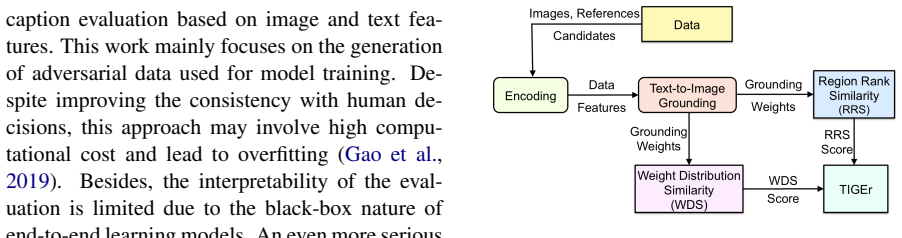
The load-bearing object is the grounding vector $s(V,C)$, one scalar per image region, produced by a pre-trained Stacked Cross Attention Network (SCAN): word embeddings from an RNN attend over 36 bottom-up region features, and each region's grounding score is the cosine similarity between the region vector and the caption's attention-weighted feature. The comparison stage rests on two identities applied to these vectors: RRS treats the grounding scores as a relevance ranking and applies normalized discounted cumulative gain; WDS converts the vectors to attention distributions and combines KL divergence with a log-ratio of vector magnitudes. Averaging the two yields TIGEr. The machinery replaces exact n-gram matching with semantic region-level matching, which is what allows the metric to catch captions that reuse reference words but describe the wrong image content.
What would settle it
Build a test set of images paired with reference captions and two candidate captions that differ only by an action verb (e.g., 'walk' vs. 'run' for the same scene), and score them with human raters and TIGEr. If TIGEr fails to prefer the human-chosen caption at rates well above chance on such action pairs, the paper's claim that TIGEr has higher consistency with human judgments would be undermined. A cheaper check: compute TIGEr's caption-level correlation with human scores on a held-out set of non-photo images (drawings or abstract scenes), where SCAN grounding was not trained.
Extended reading notes
Core claim
TIGEr's central claim is that a caption should be evaluated by whether it attends to the image the way human references do, not by whether it shares words with them. For a candidate caption $C$, an image $V$, and references $R$, the score averages two comparisons of grounding vectors $s(V,C)$ and $s(V,R)$: Region Rank Similarity (RRS), a normalized discounted cumulative gain over image regions ordered by grounding strength, and Weight Distribution Similarity (WDS), a softmax-normalized KL divergence augmented by a log-ratio of grounding-vector norms. The result is a score in $[0,1]$. On the Composite, Flickr 8K, and PASCAL-50S datasets, the paper reports that TIGEr's caption-level correlations with human scores exceed those of BLEU-1/4, ROUGE-L, METEOR, CIDEr, and SPICE, and that its pairwise accuracy on PASCAL-50S is highest overall, improving machine-machine pair accuracy by about ten absolute points over the best prior metric while being less sensitive to the number of references.
Load-bearing premise
TIGEr's scores are only as trustworthy as the pre-trained SCAN grounding model, which was trained on MS-COCO photos; if that model does not accurately ground captions in an evaluation image, both the region ranking and weight-distribution comparisons inherit the error.
Editorial extensions
If this is right
- If TIGEr's reported correlations hold, captioning systems can be ranked without relying on many reference captions, since performance stays stable as references drop from 50 to 1.
- The metric's strength on machine-machine pairs means it can discriminate between two generated captions for the same image, the setting where text-overlap metrics are weakest.
- Because TIGEr detects object-level mismatches better than action-level ones, its use would encourage systems to get objects right while remaining less sensitive to verb changes.
- The interpretable decomposition into rank and distribution similarity gives developers a diagnostic: a low RRS means attention is on the wrong regions, a low WDS means the attention profile is too concentrated or diffuse.
- Existing text-only metrics could be augmented with TIGEr as a second signal, making evaluation of open-domain captioning less dependent on reference coverage.
Reading between the lines
- The grounding-model dependence cuts both ways: replacing SCAN with a stronger grounding model that handles actions and attributes should directly raise TIGEr's ceiling, a testable extension the paper itself points toward.
- One could use TIGEr as a reward or loss during caption training, but that invites metric gaming, and whether TIGEr stays reliable under optimization is an open question the paper does not test.
- The same region-level comparison could be adapted to other image-to-text tasks such as visual storytelling or text-to-image generation evaluation, where reference coverage is even more incomplete.
- A useful stress test would be evaluating TIGEr on abstract or imaginative captions, which the appendix identifies as hard, to see where human-TIGEr agreement breaks down.
Signed reviews
Editorial analysis
A structured set of objections, weighed in public.
Referee Report
Summary. The paper proposes TIGEr, a new automatic metric for image caption evaluation. TIGEr computes text-to-image grounding vectors for a candidate caption and for human references using a pre-trained SCAN model, then compares the vectors using two scores: RRS, a normalized discounted cumulative gain that compares the ranking of image regions by grounding relevance, and WDS, a sigmoid-mapped combination of KL divergence between grounding softmax distributions and a log-ratio of vector norms. The final score is the arithmetic mean of RRS and WDS. The authors evaluate TIGEr against BLEU, METEOR, ROUGE-L, CIDEr, and SPICE on three datasets: Composite, Flickr8K, and PASCAL-50S, reporting correlations with human scores (Kendall's tau and Spearman's rho) on the first two and pairwise accuracy on PASCAL-50S. They claim that TIGEr achieves higher consistency with human judgments than existing metrics, particularly for machine-machine caption pairs and when few references are available. Code is released.
Significance. If the empirical claims hold, TIGEr offers a useful new direction for caption evaluation by incorporating image content through an external grounding model, moving beyond pure text-matching. The decomposition into ranking-based and distribution-based similarities is interpretable, and the component analysis (Section 4.6) gives insight into which caption aspects the metric captures. The release of code and the analysis of reference-number sensitivity are strengths. However, the headline result depends on an evaluation protocol with undisclosed free parameters and no significance testing, so the significance is conditional on those issues being resolved.
major comments (5)
- [3.2.2, Eq. (13)] The temperature τ is described only as 'to-be-tuned,' and the paper never reports its value, its search range, or the criterion used to select it. If τ was chosen by optimizing agreement with human judgments on the test sets behind Tables 1 and 2, the reported gains (e.g., TIGEr's 80.70% vs. METEOR's 77.98% in Table 2) could be inflated by test-set selection. Please disclose the exact τ used for each dataset, the selection procedure (e.g., a held-out validation split or cross-validation), and a sensitivity analysis over τ.
- [3.2.3, Eq. (14)] The arithmetic mean of RRS and WDS is justified by 'empirically observing the value variance between RRS and WDS in the [0,1] interval,' which is a post hoc choice made after inspecting the test data. The paper does not report whether alternative combination weights (e.g., weighted averages) would change the conclusions. Please select the combination weight on a validation set or provide evidence that the ranking of metrics is stable across a range of weights.
- [Tables 1 and 2] The paper reports no confidence intervals or significance tests for the differences between TIGEr and the baselines. For instance, the 2.72-point aggregate accuracy advantage over METEOR in Table 2, and the τ differences in Table 1 (TIGEr 0.454 vs. SPICE 0.419 on Composite), are not assessed for statistical significance. Please report bootstrap confidence intervals for the correlation coefficients and paired significance tests (e.g., McNemar's test for pairwise accuracy) to support the claim that TIGEr has 'higher consistency with human judgments.'
- [Section 4.3] The protocol counts equally-scored candidate pairs as incorrect, whereas Anderson et al. (2016) counted them as correct. This choice systematically penalizes discrete-valued baselines like SPICE (which can produce ties) while TIGEr's continuous score rarely ties. The reported accuracy differences on PASCAL-50S, especially the 2.72% aggregate gain, may be partly attributable to this tie-handling difference. Please report results under both conventions or justify the chosen one with a sensitivity analysis.
- [Sections 3.1, 4.6, Appendix A.2] The grounding model SCAN is pre-trained on MS-COCO, and the Composite test set draws images from MS-COCO; meanwhile the paper's own component analysis shows TIGEr is weak on action differences, and Appendix A.2 concedes difficulty with semantically close objects and imaginative captions. As a result, the abstract's unqualified claim of 'higher consistency with human judgments' should be scoped to the evaluated domain and caption types, or supported by out-of-domain results that show the metric retains its advantage.
minor comments (7)
- [Abstract and Conclusion] The phrase 'higher consistency with human judgments' should be qualified with 'on the datasets and caption types tested,' given the limitations disclosed in Appendix A.2.
- [Section 4.1] The Composite dataset description lists 2007 MS-COCO images, 997 Flickr 8k pictures, and 991 Flickr 30k images, but does not explain how these map to the 11,985 candidates; please clarify the sampling.
- [Table 1] The statement 'All p-values < 0.01' is ambiguous; specify which test produced these p-values and whether they are corrected for multiple comparisons.
- [References] The reference 'Aditya et al., 2015a' appears twice with identical content, and 'Karpathy and Li, 2015' and 'Karpathy and Fei-Fei, 2015' refer to the same CVPR paper; duplicate references should be merged.
- [Figure 5] The figure legend is embedded in the caption; adding a legend inside the plot or directly labeling lines would improve readability.
- [Appendix A.1] The mapping from continuous TIGEr scores to score groups is described only vaguely; please specify the binning procedure (e.g., quantiles vs. equal-width) since the error analysis depends on it.
- [General] There are minor typos: 'Flick8K' in Section 4.4 should be 'Flickr8K', and 'matching-generated captions' in Section 4.1 should be 'machine-generated captions'.
Circularity Check
No significant circularity: TIGEr is an external-model-based metric evaluated against, not derived from, human judgments.
full rationale
The TIGEr score is computed from grounding vectors produced by the external SCAN model (Eqs. 1-7) and then combines two hand-defined comparison functions, RRS and WDS (Eqs. 8-14). Human judgment data are not used in the construction of the metric; they appear only in the evaluation stage, where the paper measures correlation or pairwise agreement between TIGEr and human annotations. The temperature tau in Eq. 13 is described only as 'to-be-tuned' and no value or tuning protocol is reported, which is a reproducibility and potential selection-bias concern, but the paper does not state that tau was fitted to the human evaluation data, so no reduction-by-construction is established. Similarly, the choice of arithmetic mean in Eq. 14 is described as based on 'empirically observing the value variance between RRS and WDS', a post hoc modeling choice rather than a fit to human labels. The appendix limitations about semantically close objects and imaginative captions weaken generality but do not make the derivation circular. The paper's self-citations, such as Gao et al. (2019), are not load-bearing for the central claim. Therefore no specific circular step can be identified under the required standard.
Assumptions & free parameters
free parameters (3)
- tau (WDS temperature) =
not reported
- RRS/WDS combination weight =
0.5 (arithmetic mean)
- lambda (grounding smoothing factor) =
not reported
assumptions (4)
- domain assumption SCAN grounding scores represent how much attention a human judge or the captioning system pays to each image region when generating a caption.
- domain assumption The mean of reference grounding vectors (Eq 7) is an adequate summary of human caption consensus for an image.
- domain assumption Reference grounding scores can be treated as human-labeled graded relevance for NDCG (Eqs 8-10).
- domain assumption KL divergence plus log-norm difference in grounding vectors captures perceived caption quality (Eqs 11-13).
Cite this review
Pith. "Pith review of TIGEr: Text-to-Image Grounding for Image Caption Evaluation." pith.science (2026). https://pith.science/paper/VC43NRP6
@misc{pith2026190902050,
  author       = {Pith},
  title        = {Pith review of: TIGEr: Text-to-Image Grounding for Image Caption Evaluation},
  year         = {2026},
  howpublished = {\url{https://pith.science/paper/VC43NRP6}},
  note         = {Machine review of arXiv:1909.02050}
}
read the original abstract
This paper presents a new metric called TIGEr for the automatic evaluation of image captioning systems. Popular metrics, such as BLEU and CIDEr, are based solely on text matching between reference captions and machine-generated captions, potentially leading to biased evaluations because references may not fully cover the image content and natural language is inherently ambiguous. Building upon a machine-learned text-image grounding model, TIGEr allows to evaluate caption quality not only based on how well a caption represents image content, but also on how well machine-generated captions match human-generated captions. Our empirical tests show that TIGEr has a higher consistency with human judgments than alternative existing metrics. We also comprehensively assess the metric's effectiveness in caption evaluation by measuring the correlation between human judgments and metric scores.
Figures


Figures from the paper (5 more)


Forward citations
Cited by 4 Pith papers
-
VCapsBench: A Large-scale Fine-grained Benchmark for Video Caption Quality Evaluation
VCapsBench is a video caption quality benchmark with 109,796 QA pairs across 21 fine-grained dimensions on 5,677 videos, evaluating caption accuracy, inconsistency, and coverage.
-
Neptune: The Long Orbit to Benchmarking Long Video Understanding
Neptune is a 3,268-question, 2,405-video benchmark for long video understanding with a scalable LLM-based generation pipeline and an open-source answer-equivalence metric, GEM.
-
A Survey of Automatic Evaluation Methods on Text, Visual and Speech Generations
A unified taxonomy and comparative meta-evaluation of automatic evaluation methods across text, vision, and speech generation, concluding that LLM-based evaluators dominate current practice.
-
Towards Evaluating Robustness of Prompt Adherence in Text to Image Models
New benchmark results show that Stable Diffusion 3.x and Janus Pro models struggle to place simple geometric shapes in the correct image quadrant, with best F1 scores around 0.41 to 0.5.
Reference graph
Works this paper leans on
-
[1]
URL: " 'urlintro :=
ENTRY address author booktitle chapter edition editor howpublished institution journal key month note number organization pages publisher school series title type volume year eprint doi pubmed url lastchecked label extra.label sort.label short.list INTEGERS output.state before.all mid.sentence after.sentence after.block STRINGS urlintro eprinturl eprintpr...
-
[2]
write newline
" write newline "" before.all 'output.state := FUNCTION n.dashify 't := "" t empty not t #1 #1 substring "-" = t #1 #2 substring "--" = not "--" * t #2 global.max substring 't := t #1 #1 substring "-" = "-" * t #2 global.max substring 't := while if t #1 #1 substring * t #2 global.max substring 't := if while FUNCTION word.in bbl.in capitalize " " * FUNCT...
-
[4]
Somak Aditya, Yezhou Yang, Chitta Baral, Cornelia Fermuller, and Yiannis Aloimonos. 2015 b . From images to sentences through scene description graphs using commonsense reasoning and knowledge. arXiv preprint arXiv:1511.03292
arXiv 2015
-
[5]
Peter Anderson, Basura Fernando, Mark Johnson, and Stephen Gould. 2016. Spice: Semantic propositional image caption evaluation. In ECCV
work page 2016
-
[6]
Peter Anderson, Xiaodong He, Chris Buehler, Damien Teney, Mark Johnson, Stephen Gould, and Lei Zhang. 2018. Bottom-up and top-down attention for image captioning and vqa. In CVPR
work page 2018
-
[7]
Dzmitry Bahdanau, Kyunghyun Cho, and Yoshua Bengio. 2015. Neural machine translation by jointly learning to align and translate. In ICLR
2015
-
[8]
Satanjeev Banerjee and Alon Lavie. 2005. Meteor: An automatic metric for mt evaluation with improved correlation with human judgments. In Proceedings of the ACL workshop
work page 2005
-
[9]
Raffaella Bernardi, Ruket Cakici, Desmond Elliott, Aykut Erdem, Erkut Erdem, Nazli Ikizler-Cinbis, Frank Keller, Adrian Muscat, and Barbara Plank. 2016. Automatic description generation from images: A survey of models, datasets, and evaluation measures. Journal of Artificial Intelligence Research
work page 2016
Show all 36 references
-
[10]
Hongge Chen, Huan Zhang, Pin-Yu Chen, Jinfeng Yi, and Cho-Jui Hsieh. 2018. Attacking visual language grounding with adversarial examples: A case study on neural image captioning. In ACL
2018
-
[11]
Simon Corston-Oliver, Michael Gamon, and Chris Brockett. 2001. A machine learning approach to the automatic evaluation of machine translation. In ACL
2001
-
[12]
Yin Cui, Guandao Yang, Andreas Veit, Xun Huang, and Serge Belongie. 2018. Learning to evaluate image captioning. In CVPR
2018
-
[13]
Bo Dai, Sanja Fidler, Raquel Urtasun, and Dahua Lin. 2017. Towards diverse and natural image descriptions via a conditional gan. In ICCV
2017
-
[14]
Desmond Elliott and Frank Keller. 2014. Comparing automatic evaluation measures for image description. In ACL
2014
-
[15]
Hao Fang, Saurabh Gupta, Forrest Iandola, Rupesh K Srivastava, Li Deng, Piotr Doll \'a r, Jianfeng Gao, Xiaodong He, Margaret Mitchell, John C Platt, et al. 2015. From captions to visual concepts and back. In CVPR
2015
-
[16]
Andrea Frome, Greg S Corrado, Jon Shlens, Samy Bengio, Jeff Dean, Tomas Mikolov, et al. 2013. Devise: A deep visual-semantic embedding model. In NeurIPS
2013
-
[17]
Akira Fukui, Dong Huk Park, Daylen Yang, Anna Rohrbach, Trevor Darrell, and Marcus Rohrbach. 2016. Multimodal compact bilinear pooling for visual question answering and visual grounding. In EMNLP
2016
-
[18]
Zhe Gan, Chuang Gan, Xiaodong He, Yunchen Pu, Kenneth Tran, Jianfeng Gao, Lawrence Carin, and Li Deng. 2017. Semantic compositional networks for visual captioning. In CVPR
2017
-
[19]
Jianfeng Gao, Michel Galley, and Lihong Li. 2019. Neural approaches to conversational ai. Foundations and Trends in Information Retrieval
2019
-
[20]
Micah Hodosh, Peter Young, and Julia Hockenmaier. 2013. Framing image description as a ranking task: Data, models and evaluation metrics. Journal of Artificial Intelligence Research
2013
-
[21]
Qiuyuan Huang, Zhe Gan, Asli Celikyilmaz, Dapeng Wu, Jianfeng Wang, and Xiaodong He. 2019. Hierarchically structured reinforcement learning for topically coherent visual story generation. In AAAI
2019
-
[22]
Allan Jabri, Armand Joulin, and Laurens van der Maaten. 2016. Revisiting visual question answering baselines. In ECCV
2016
-
[23]
a rvelin and Jaana Kek \
Kalervo J \"a rvelin and Jaana Kek \"a l \"a inen. 2002. Cumulated gain-based evaluation of ir techniques. ACM Transactions on Information Systems
2002
-
[24]
Andrej Karpathy and Li Fei-Fei. 2015. Deep visual-semantic alignments for generating image descriptions. In CVPR
2015
-
[25]
Andrej Karpathy, Armand Joulin, and Li F Fei-Fei. 2014. Deep fragment embeddings for bidirectional image sentence mapping. In NeurIPS
2014
-
[26]
Andrej Karpathy and Fei-Fei Li. 2015. Deep visual-semantic alignments for generating image descriptions. In CVPR
2015
-
[27]
Ryan Kiros, Ruslan Salakhutdinov, and Richard S. Zemel. 2014. Unifying visual-semantic embeddings with multimodal neural language models. arXiv preprint arXiv:1411.2539
2014 arXiv
-
[28]
Alex Kulesza and Stuart M Shieber. 2004. A learning approach to improving sentence-level mt evaluation. In Proceedings of the 10th International Conference on Theoretical and Methodological Issues in Machine Translation
2004
-
[29]
Solomon Kullback and Richard A Leibler. 1951. On information and sufficiency. The annals of mathematical statistics
1951
-
[30]
Kuang-Huei Lee, Xi Chen, Gang Hua, Houdong Hu, and Xiaodong He. 2018. Stacked cross attention for image-text matching. In ECCV
2018
-
[31]
Chin-Yew Lin. 2004. Rouge: A package for automatic evaluation of summaries. Text Summarization Branches Out
2004
-
[32]
Tsung-Yi Lin, Michael Maire, Serge Belongie, James Hays, Pietro Perona, Deva Ramanan, Piotr Doll \'a r, and C Lawrence Zitnick. 2014. Microsoft coco: Common objects in context. In ECCV
2014
-
[33]
Ryan Lowe, Michael Noseworthy, Iulian Vlad Serban, Nicolas Angelard-Gontier, Yoshua Bengio, and Joelle Pineau. 2017. Towards an automatic T uring test: Learning to evaluate dialogue responses. In ACL
2017
-
[34]
Kishore Papineni, Salim Roukos, Todd Ward, and Wei-Jing Zhu. 2002. Bleu: a method for automatic evaluation of machine translation. In ACL
2002
-
[35]
Ramakrishna Vedantam, C Lawrence Zitnick, and Devi Parikh. 2015. Cider: Consensus-based image description evaluation. In CVPR
2015
-
[36]
Liwei Wang, Yin Li, Jing Huang, and Svetlana Lazebnik. 2018 a . Learning two-branch neural networks for image-text matching tasks. PAMI
2018
-
[37]
Xin Wang, Wenhu Chen, Yuan-Fang Wang, and William Yang Wang. 2018 b . No metrics are perfect: Adversarial reward learning for visual storytelling. In ACL
2018
Reviewed August 14, 2026 · model on record in the stance chip above.
Discussion (0). Continue with ORCID to comment.