Recognition: unknown
The cut of time
Pith reviewed 2026-05-06 20:12 UTC · model claude-opus-4-7
The pith
A short essay arguing that time should be read as a cut between states rather than as a duration, and asking what energy mere existence in time costs.
A machine-rendered reading of the paper's core claim, the machinery that carries it, and where it could break.
Core claim
The paper proposes that time should be conceived not as a duration — a stretch one traverses — but as a cut, a sectioning that separates states. The author argues this re-reading clarifies the diverse roles time plays across mechanics, thermodynamics, relativity, and quantum theory, and suggests that the existing vocabulary around time carries metaphors that mislead physical intuition. From this reframing the author raises a further question: how much energy does a physical object expend simply to persist in time, when it neither moves nor interacts with anything else.
What carries the argument
A conceptual reinterpretation: "time as cut" (a sectioning between states) replacing "time as duration" (a traversed interval), paired with a terminological housecleaning meant to remove metaphors that the author judges misleading in physics.
If this is right
- <parameter name="0">If time is fundamentally a cut between states
- then formulations of physics that take an interval as primitive (proper time
- thermodynamic time
- evolution parameter) should be rewritable in terms of state-separations without loss.
Where Pith is reading between the lines
- <parameter name="0">Editor's inference: the "cut" picture resonates with views in which time enters physics only through correlations between subsystems (one acting as a clock for the other)
- recasting the proposal in that language could give it computational
- not just verbal
- content.
Load-bearing premise
That switching the word "duration" for "cut" actually changes what physics can compute or predict, rather than relabeling structure that is already there — and that "the energy needed to merely exist in time, without motion or interaction" is a well-defined quantity in any standard framework rather than an artefact of the chosen metaphor.
What would settle it
Produce a concrete calculation in any standard physical framework — classical, relativistic, statistical, or quantum — in which interpreting the time variable as a "cut" rather than a "duration" yields a different, testable numerical prediction than the conventional reading. Absent such a difference, the proposal is a relabeling. Equivalently, give an operational definition of the "energy to exist in time without motion or interaction" that is not just the rest energy of a free body, and exhibit a measurement that would return it.
Figures
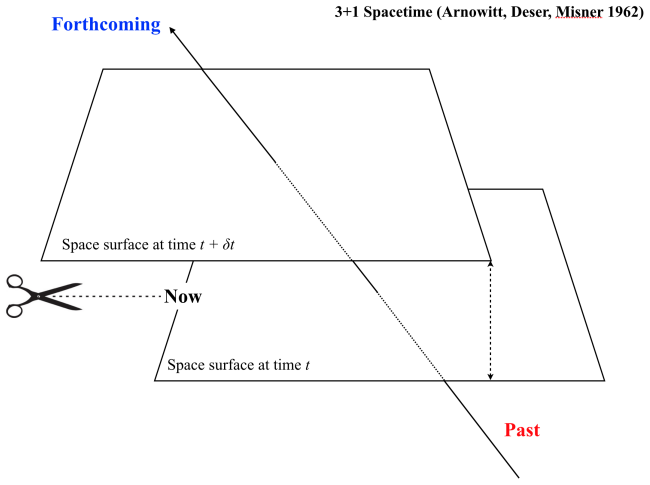

read the original abstract
After a short review on the use of time in various branches of physics, I suggest to change the interpretation of time, from a duration to a cut. A reassessment of terminology is also required to avoid meaning traps. I also address the problem of estimating the energy needed by a physical object to shift in time without any other interaction or motion, that is, only to exist.
Editorial analysis
A structured set of objections, weighed in public.
Referee Report
Summary. The abstract proposes a reinterpretation of the concept of time in physics: rather than treating time as a "duration," the author suggests it should be understood as a "cut" (a sectioning). The author argues that this reinterpretation requires a corresponding revision of terminology to avoid "meaning traps." A second claim is announced: the abstract states the paper addresses the problem of estimating the energy required by a physical object "to shift in time without any other interaction or motion, that is, only to exist." The work is presented as following a short review of how time is used across various branches of physics.
Significance. If the "cut" reinterpretation were shown to alter a calculable quantity — a propagator, an action principle, a predicted observable — the paper would be of broad interest. Similarly, if "energy to merely exist in time" were given a precise operational definition distinguishable from rest energy, that would be a substantive contribution. As stated in the abstract, however, the significance hinges on whether the reframing has operational content beyond terminology. The abstract does not advertise a free-parameter-free derivation, a falsifiable prediction, machine-checked proofs, or reproducible code; on the evidence available, the contribution appears to be conceptual/terminological rather than computational. That is a legitimate genre, but it bounds the significance accordingly.
major comments (3)
- [Abstract / central claim 1 (cut vs. duration)] The abstract proposes replacing the interpretation of time as 'duration' with time as a 'cut,' but does not indicate that any calculable quantity (action, propagator, equation of motion, measurement outcome) changes under the substitution. For a physics manuscript this is the load-bearing question: does the reinterpretation modify any prediction, or is it a relabeling of existing structure? The manuscript should state explicitly, ideally in the introduction, at least one quantity whose value or definition changes under the 'cut' interpretation but not under the 'duration' interpretation. If no such quantity exists, the claim should be rephrased as a philosophical/terminological proposal rather than a physical one.
- [Abstract / central claim 2 (energy to merely exist)] The abstract poses 'the energy needed by a physical object to shift in time without any other interaction or motion, that is, only to exist' as a problem to be addressed. In standard relativistic mechanics this quantity is the rest energy E = mc²; in standard quantum mechanics, time-translation of a free state under H is generated by a norm-preserving unitary e^{-iHt/ℏ} with constant energy expectation, so no additional 'cost to persist' exists. The manuscript must therefore (i) explain in what framework the question is non-trivial, (ii) distinguish the proposed quantity from rest energy, and (iii) specify whether the framework is unitary or requires a dissipative/non-unitary extension. Without this, the question is not yet well-posed within any standard dynamical setting.
- [Terminology section] The abstract states that 'a reassessment of terminology is also required to avoid meaning traps.' For this argument to land, the manuscript needs to identify at least one concrete inference in the existing literature that goes wrong because of the current terminology and is corrected under the proposed terminology. A worked example — a physics argument that produces a different (and verifiable) conclusion under the new vocabulary — would convert the terminological claim into a substantive one.
minor comments (3)
- [Abstract phrasing] The phrase 'shift in time without any other interaction or motion, that is, only to exist' equates time-translation with 'existence.' These are not synonymous in any standard formalism (an object at rest in an inertial frame is already time-translating); the abstract should be tightened to make the intended distinction explicit.
- [Review of time across branches of physics] If a literature review is included, please ensure it cites the standard treatments of the problem of time (e.g., Kuchař, Isham, Rovelli) so the reader can locate the proposal within existing debates.
- [Title] 'The cut of time' is evocative but ambiguous; consider a subtitle that signals whether the contribution is a reinterpretation, a new formalism, or a review.
Simulated Author's Rebuttal
We thank the referee for a careful and fair reading. The report correctly identifies that the manuscript, as written, is a conceptual and terminological proposal rather than a derivation of new observables, and that two of its claims are stated more strongly than the content supports. We accept this diagnosis on substance.\n\nSpecifically: (1) the cut-vs-duration proposal does not, in this paper, modify any calculable quantity; we will reclassify it explicitly as an interpretive/terminological proposal in the abstract and introduction. (2) The 'energy to merely exist in time' question is, as the referee notes, answered by rest energy in special relativity and is trivial under unitary quantum evolution; we will state this explicitly and present the question as a speculative prompt contingent on a non-unitary extension we do not construct here, rather than as a problem the paper solves. (3) We agree that the terminology argument needs at least one worked example in which an existing inference is repaired by the new vocabulary, and we will attempt to supply one; failing that, we will weaken the claim.\n\nWe believe these revisions bring the manuscript's stated scope into honest alignment with its actual content. We acknowledge that this leaves the paper a modest conceptual note rather than a quantitative contribution, and we will frame it accordingly.
read point-by-point responses
-
Referee: Central claim 1 (cut vs. duration): the abstract does not indicate that any calculable quantity changes under the substitution. State at least one quantity whose value or definition changes under the 'cut' interpretation, or rephrase as a philosophical/terminological proposal.
Authors: We accept the referee's framing. In the present manuscript the cut-vs-duration distinction is offered as an interpretive/ontological proposal: time as an instantaneous sectioning of state-space rather than as an extended interval. We do not claim, and the manuscript does not derive, any modification of an action, propagator, equation of motion, or measurement outcome. The same Lagrangians, Hamiltonians, and unitary evolution remain in force; what changes is the reading of the symbol t and of the verbal scaffolding around it. We will revise the introduction and abstract to state this explicitly, classifying the contribution as a conceptual/terminological proposal rather than a physical prediction, and will remove any wording that could be read as implying altered observables. We will also add a short paragraph acknowledging that, absent such a calculable change, the proposal stands or falls on whether it clarifies arguments rather than on empirical adjudication. revision: yes
-
Referee: Central claim 2 (energy to merely exist): in standard relativistic mechanics this is rest energy E=mc²; in QM unitary time-translation preserves energy expectation. Explain in what framework the question is non-trivial, distinguish the proposed quantity from rest energy, and specify whether the framework is unitary or requires a non-unitary extension.
Authors: The referee is correct that within standard relativistic mechanics and unitary quantum mechanics the question as literally posed is either answered by mc² or is empty (e^{-iHt/ℏ} is norm- and energy-preserving for stationary states). The manuscript intends the question heuristically — as a prompt for whether persistence-in-time should carry a bookkeeping cost in a hypothetical extension — not as a derivation within an existing dynamical framework. We concede that, as written, the question is not well-posed in any standard setting. In revision we will (i) state explicitly that within special relativity the answer is rest energy and within unitary QM the cost is zero, (ii) flag the question as speculative and contingent on a non-unitary or dissipative extension that the present paper does not construct, and (iii) drop any phrasing that suggests an answer has been obtained. We do not at this stage have a precise operational definition that distinguishes the proposed quantity from rest energy; we will say so plainly rather than imply otherwise. revision: yes
-
Referee: Terminology section: identify at least one concrete inference in the existing literature that goes wrong under current terminology and is corrected under the proposed terminology — a worked example.
Authors: This is a fair demand and we agree it is the test the terminological claim must pass. The manuscript currently motivates the 'meaning traps' in general terms (conflations of duration, instant, and parameter t in informal physical reasoning) without producing a worked example in which a published inference is repaired by the new vocabulary. In revision we will attempt to supply at least one such example — candidates we are exploring include verbal arguments around the 'flow of time,' the use of 'during' in discussions of tunneling times, and informal statements about what occurs 'in' a Planck time. If we cannot produce a case in which the terminological substitution alters a conclusion (as opposed to merely rephrasing it), we will downgrade the claim accordingly and present the terminology proposal as a clarification of usage rather than as a corrective to existing inferences. revision: partial
- We cannot, at present, exhibit a calculable quantity whose value changes under the cut interpretation versus the duration interpretation; the contribution is conceptual.
- We do not have an operational definition of 'energy to merely exist in time' that is distinguishable from rest energy within a standard (unitary) dynamical framework, and the manuscript does not construct the non-unitary extension in which such a quantity could be defined.
- We are not yet able to guarantee a worked literature example in which the proposed terminology repairs a faulty inference; this will be attempted in revision and, if unsuccessful, the claim will be weakened.
Circularity Check
Conceptual/terminological essay; no derivation chain in the abstract to reduce to its inputs.
full rationale
Only the abstract is available, and the abstract advertises a reinterpretation ("time as a cut, not a duration"), a "reassessment of terminology," and a posed problem ("energy needed by a physical object to shift in time without any other interaction or motion, that is, only to exist"). There is no equation, fitted parameter, uniqueness theorem, or self-citation chain visible in the abstract. Therefore there is nothing of the form "X derives Y, but X is defined via Y" to flag. The reader's stated worry — that "energy to merely exist" might either rename the rest energy or require an unspecified non-unitary extension — is a content/well-posedness concern (does the new term carry operational meaning?), not a circularity concern in the technical sense (a prediction reducing to a fitted input). I therefore record no circular steps and assign a score of 1 to reflect that the abstract leaves open the possibility that, in the body, the "cut" reframing turns out to be a relabeling of structure already present (which would be pattern 6, "renaming a known result"), but on the available evidence I cannot quote such a reduction and so cannot assert it. If the full text were provided and the "energy to exist" turned out to equal mc² with a new name, that would warrant a higher score; absent the text, the honest finding is "no demonstrable circularity, pending body."
discussion (0)
Sign in with ORCID, Apple, or X to comment. Anyone can read and Pith papers without signing in.