CHAD: Combinatory Homomorphic Automatic Differentiation
Pith reviewed 2026-05-24 13:31 UTC · model grok-4.3
The pith
CHAD performs automatic differentiation as a unique homomorphic source-code transformation that extends Elliott's first-order definitions while preserving correctness for higher-order languages.
A machine-rendered reading of the paper's core claim, the machinery that carries it, and where it could break.
Core claim
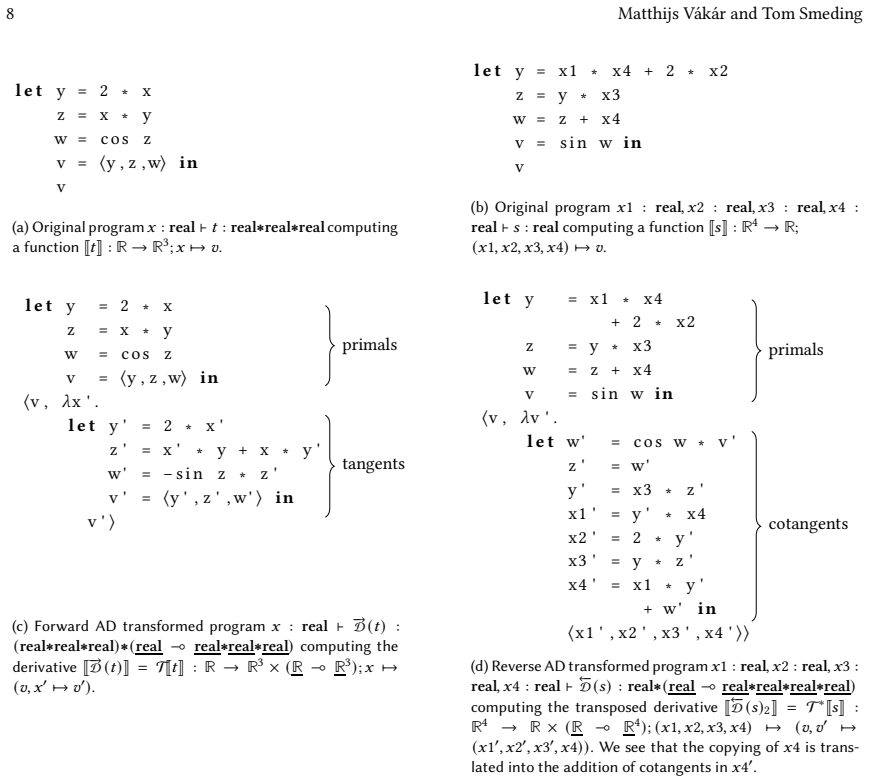
CHAD defines forward- and reverse-mode automatic differentiation as the unique homomorphic extension of Elliott's first-order functional-language definitions to a higher-order language with statically sized arrays, realized as a compositional type-respecting source transformation that produces purely functional code; a logical-relations argument establishes that the semantics of this syntactic derivative is exactly the usual calculus derivative of the semantics of the source program.
What carries the argument
The homomorphic (structure-preserving) source-code transformation that uniquely extends Elliott's first-order AD definitions, generating derivative code whose semantics matches the mathematical derivative.
If this is right
- Correct forward- and reverse-mode derivatives are obtained for programs using higher-order functions and arrays.
- The generated code remains purely functional and type-safe even when implemented in languages without native linear types.
- The same methodology applies to functional languages with additional expressive features beyond arrays.
- Other dynamic program analyses that accumulate data in a commutative monoid can be implemented via analogous homomorphic transformations.
Where Pith is reading between the lines
- The method could reduce the need for language-specific AD implementations by providing a uniform transformation recipe.
- It suggests a route to proving correctness for AD in languages with more advanced features such as effects or polymorphism.
- Similar homomorphic transformations might be explored for analyses like taint propagation or resource tracking.
- An implementation test would involve checking whether abstract-type encodings preserve the expected linearity invariants in practice.
Load-bearing premise
The transformations are the unique homomorphic extension to expressive languages of Elliott's definitions of AD for a first-order functional language.
What would settle it
A concrete higher-order array program for which the semantics of the CHAD-generated derivative code differs from the true mathematical derivative of the original program, for example by finite-difference verification of the reverse-mode output.
Figures



read the original abstract
We introduce Combinatory Homomorphic Automatic Differentiation (CHAD), a principled, pure, provably correct define-then-run method for performing forward- and reverse-mode automatic differentiation (AD) on programming languages with expressive features. It implements AD as a compositional, type-respecting source-code transformation that generates purely functional code. This code transformation is principled in the sense that it is the unique homomorphic (structure-preserving) extension to expressive languages of Elliott's well-known and unambiguous definitions of AD for a first-order functional language. Correctness of the method follows by a compositional logical-relations argument that shows that the semantics of the syntactic derivative is the usual calculus derivative of the semantics of the original program. In their most elegant formulation, the transformations generate code with linear types. However, the code transformations can be implemented in a standard functional language lacking linear types: while the correctness proof requires tracking linearity, the actual transformations do not. In fact, even in a standard functional language, we can get all the type safety that linear types give us: we can implement all linear types used to type the transformations as abstract types by using a basic module system. In this paper, we detail the method when applied to a simple higher-order language for manipulating statically sized arrays. However, we explain how the methodology applies, more generally, to functional languages with other expressive features. Finally, we discuss how the scope of CHAD extends beyond applications in AD to other dynamic program analyses that accumulate data in a commutative monoid.
Editorial analysis
A structured set of objections, weighed in public.
Referee Report
Summary. The paper introduces Combinatory Homomorphic Automatic Differentiation (CHAD), a source-to-source transformation for forward- and reverse-mode AD on higher-order functional languages with arrays. The transformations are presented as the unique homomorphic extension of Elliott's first-order definitions; correctness is claimed to follow from a compositional logical-relations argument equating the semantics of the syntactic derivative to the usual calculus derivative of the program semantics. The paper notes that while the elegant formulation uses linear types, the transformations can be realized in standard functional languages by encoding linear types as abstract types via a module system, and it discusses generalization to other language features and other monoid-accumulating analyses.
Significance. If the logical-relations argument and the transfer to the abstract-type implementation both hold, the work supplies a principled, compositional foundation for AD in expressive languages that extends Elliott's definitions without ad-hoc adjustments. The emphasis on homomorphic structure preservation and the explicit separation of the linearity-tracking proof from the implementable transformation are notable strengths; the discussion of applicability to other dynamic analyses is a further positive.
major comments (2)
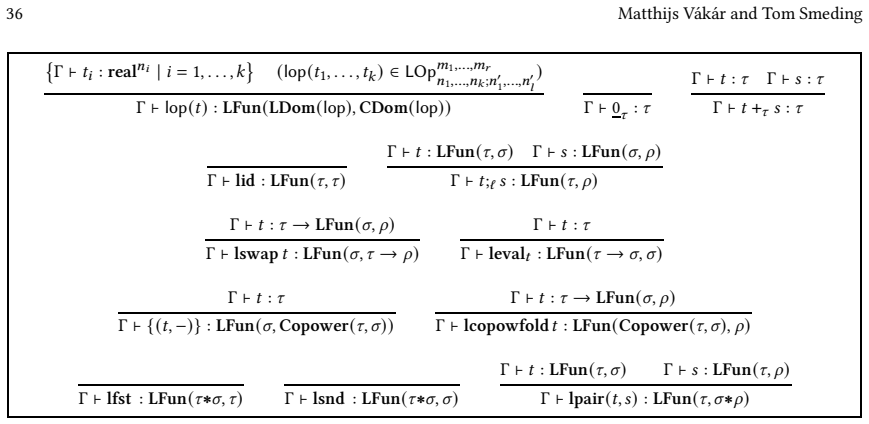
- [Abstract (linearity paragraph) and the section detailing the module-system implementation] The central claim that the implemented code (using abstract types) satisfies the same correctness statement as the logical-relations proof is load-bearing. The abstract states that 'the correctness proof requires tracking linearity' while 'the actual transformations do not,' yet the denotational semantics of the module interface must still enforce the linear usage discipline (no duplication or discarding) for the relational interpretation to carry over; no section appears to supply a formal argument or model showing that the abstract-type encoding preserves the required relational properties at the semantic level rather than merely providing syntactic type safety.
- [Section defining the CHAD transformations for the array language] The claim that the transformations constitute 'the unique homomorphic (structure-preserving) extension' of Elliott's definitions is central to the methodology. The paper should make explicit, in the section defining the combinatory transformations, the precise categorical or algebraic structure with respect to which uniqueness is asserted and verify that the higher-order array language satisfies the necessary universal property.
minor comments (2)
- [Implementation section] Notation for the linear-type constructors and the module interface could be clarified with a small example showing the exported operations and their types.
- [Preliminaries] The paper would benefit from an explicit statement of the language grammar and typing rules before the transformation definitions, to make the homomorphic extension precise.
Simulated Author's Rebuttal
We thank the referee for the positive assessment of the paper's significance and for the constructive major comments. We address each point below and will revise the manuscript accordingly to strengthen the presentation.
read point-by-point responses
-
Referee: [Abstract (linearity paragraph) and the section detailing the module-system implementation] The central claim that the implemented code (using abstract types) satisfies the same correctness statement as the logical-relations proof is load-bearing. The abstract states that 'the correctness proof requires tracking linearity' while 'the actual transformations do not,' yet the denotational semantics of the module interface must still enforce the linear usage discipline (no duplication or discarding) for the relational interpretation to carry over; no section appears to supply a formal argument or model showing that the abstract-type encoding preserves the required relational properties at the semantic level rather than merely providing syntactic type safety.
Authors: We agree this is a substantive point requiring clarification. The current manuscript separates the linear-typed formulation (used for the logical-relations proof) from the module-based implementation (which provides only syntactic safety via abstract types). To bridge this, the revised manuscript will add a new subsection in the implementation section that supplies a denotational model for the module interface. In this model, the abstract linear types are interpreted in a suitable linear category (or via a relational interpretation that forbids duplication/discarding), ensuring the relational properties transfer from the linear case to the abstract-type encoding. This will make explicit that the implemented transformations inherit the correctness statement. revision: yes
-
Referee: [Section defining the CHAD transformations for the array language] The claim that the transformations constitute 'the unique homomorphic (structure-preserving) extension' of Elliott's definitions is central to the methodology. The paper should make explicit, in the section defining the combinatory transformations, the precise categorical or algebraic structure with respect to which uniqueness is asserted and verify that the higher-order array language satisfies the necessary universal property.
Authors: We agree that the uniqueness claim benefits from greater precision. The transformations are defined as the unique structure-preserving map (i.e., the unique functor) extending Elliott's first-order combinators to the full language syntax. In the revised manuscript, the section on the CHAD transformations will explicitly identify the relevant structure as the initial algebra for the signature of the language (cartesian closed structure plus array operations) and verify that the higher-order array language is freely generated by this signature, thereby satisfying the universal property that guarantees uniqueness of the homomorphic extension. revision: yes
Circularity Check
No significant circularity; correctness via self-contained logical relations extending independent prior work
full rationale
The paper's central derivation is a compositional logical-relations argument establishing that the semantics of the syntactic derivative equals the calculus derivative of the original program's semantics. This rests on the transformations being the homomorphic extension of Elliott's independent first-order definitions (cited as external, well-known work by Conal Elliott). No equations, fitted parameters, or self-citations are shown reducing the result to its inputs by construction. The linearity-to-abstract-type implementation detail is presented as a separate realization step that does not alter the proof's premises. The derivation is therefore self-contained against external benchmarks and does not match any enumerated circularity pattern.
Axiom & Free-Parameter Ledger
axioms (1)
- domain assumption Elliott's definitions of AD for a first-order functional language
Forward citations
Cited by 1 Pith paper
-
Higher Order Automatic Differentiation of Higher Order Functions
The paper characterizes forward-mode AD as a unique structure-preserving macro on a higher-order language with ADTs and proves its semantic correctness using a gluing construction on diffeological spaces, extending to...
Reference graph
Works this paper leans on
-
[1]
Martín Abadi, Paul Barham, Jianmin Chen, Zhifeng Chen, A ndy Davis, Jeffrey Dean, Matthieu Devin, Sanjay Ghemawat, Ge offrey Irving, Michael Isard, et al. 2016. Tensorflow: A system for large-scale mach ine learning. In 12th USENIX Symposium on Operating Systems Design and Imple men- tation (OSDI 16) . 265–283
work page 2016
-
[2]
Martín Abadi and Gordon D Plotkin. 2020. A Simple Differen tiable Programming Language. In Proc. POPL 2020 . ACM
work page 2020
-
[3]
Andrew Barber and Gordon Plotkin. 1996. Dual intuitionistic linear logic . University of Edinburgh, Department of Computer Science, Laboratory for Foundations of Computer Science
work page 1996
-
[4]
Gilles Barthe, Raphaëlle Crubillé, Ugo Dal Lago, and Fra ncesco Gavazzo. 2020. On the Versatility of Open Logical Relations - Continuity, Automatic Differentiation, and a Containment Theorem. In Programming Languages and Systems - 29th European Symposium on Programming, ESOP 2020, Held as Part of the European Joint Conferences on Theory and Practic e of So...
-
[5]
Atilim Gunes Baydin and Barak A Pearlmutter. 2014. Autom atic differentiation of algorithms for machine learning. arXiv preprint arXiv:1404.7456 (2014)
work page internal anchor Pith review Pith/arXiv arXiv 2014
-
[6]
P Nick Benton. 1994. A mixed linear and non-linear logic: Proofs, terms and models. In International Workshop on Computer Science Logic. Springer, 121–135
work page 1994
- [7]
-
[8]
Alois Brunel, Damiano Mazza, and Michele Pagani. 2020. B ackpropagation in the Simply Typed Lambda-calculus with Li near Negation. In Proc. POPL 2020
work page 2020
-
[9]
Bob Carpenter, Matthew D Hoffman, Marcus Brubaker, Danie l Lee, Peter Li, and Michael Betancourt. 2015. The Stan math l ibrary: Reverse-mode automatic differentiation in C++. arXiv preprint arXiv:1509.07164 (2015)
work page internal anchor Pith review Pith/arXiv arXiv 2015
-
[10]
Manuel MT Chakravarty, Gabriele Keller, Sean Lee, Trev or L McDonell, and Vinod Grover. 2011. Accelerating Haskell array codes with multicore GPUs. In Proceedings of the sixth workshop on Declarative aspects of m ulticore programming. 3–14
work page 2011
-
[11]
Chakravarty, Gabriele Keller, Sean Lee, Trevor L
Manuel M.T. Chakravarty, Gabriele Keller, Sean Lee, Trevor L. McDonell, and Vinod Grover. 2011. Accelerating Haskell Array Codes with Multicore GPUs. In Proceedings of the Sixth Workshop on Declarative Aspects of M ulticore Programming (Austin, Texas, USA) (DAMP ’11) . ACM, New York, NY, USA, 3–14. https://doi.org/10.1145/1926354.1926358
-
[12]
J. Robin B. Cockett, Geoff S. H. Cruttwell, Jonathan Gall agher, Jean-Simon Pacaud Lemay, Benjamin MacAdam, Gordon D . Plotkin, and Dorette Pronk. 2020. Reverse Derivative Categories. In Proc. CSL 2020
work page 2020
-
[13]
P-L Curien. 1986. Categorical combinators. Information and Control 69, 1-3 (1986), 188–254
work page 1986
-
[14]
Jeff Egger, Rasmus Ejlers Møgelberg, and Alex Simpson. 2 009. Enriching an effect calculus with linear types. In International Workshop on Computer Science Logic. Springer, 240–254
-
[15]
Thomas Ehrhard. 2018. An introduction to differential l inear logic: proof-nets, models and antiderivatives. Mathematical Structures in Computer Science 28, 7 (2018), 995–1060
work page 2018
-
[16]
Conal Elliott. 2018. The simple essence of automatic di fferentiation. Proceedings of the ACM on Programming Languages 2, ICFP (2018), 1–29
work page 2018
-
[17]
Marcelo P Fiore. 2007. Differential structure in models of multiplicative biadditive intuitionistic linear logic . In International Conference on Typed Lambda Calculi and Applications. Springer, 163–177
work page 2007
-
[18]
Ralf Hannemann-Tamas, Diego A Munoz, and Wolfgang Marquardt. 2015. Adjoint sensitivity analysis for nonsmooth differential-algebraic equation systems. SIAM Journal on Scientific Computing 37, 5 (2015), A2380–A2402
work page 2015
-
[19]
Troels Henriksen, Niels GW Serup, Martin Elsman, Fritz Henglein, and Cosmin E Oancea. 2017. Futhark: purely functi onal GPU-programming with nested parallelism and in-place array updates. In Proceedings of the 38th ACM SIGPLAN Conference on Programming L anguage Design and Implementation. 556–571
work page 2017
-
[20]
Mathieu Huot, Sam Staton, and Matthijs Vákár. 2022. Hig her order automatic differentiation of higher order functions. Logical Methods in Computer Science 18 (2022), 41:1–41:34. Issue 1
work page 2022
-
[21]
Mathieu Huot, Sam Staton, and Matthijs Vákár. 2020. Cor rectness of Automatic Differentiation via Diffeologies and C ategorical Gluing. In Proc. FoS- SaCS
work page 2020
-
[22]
Michael Innes. 2018. Don’t unroll adjoint: differentia ting SSA-Form programs. arXiv preprint arXiv:1810.07951 (2018)
work page internal anchor Pith review Pith/arXiv arXiv 2018
-
[23]
Peter T Johnstone. 2002. Sketches of an elephant: A topos theory compendium . Vol. 2. Oxford University Press
work page 2002
-
[24]
Peter T Johnstone, Stephen Lack, and P Sobocinski. 2007 . Quasitoposes, Quasiadhesive Categories and Artin Gluein g. In Proc. CALCO 2007
work page 2007
-
[25]
Faustyna Krawiec, Neel Krishnaswami, Simon Peyton Jon es, Tom Ellis, Andrew Fitzgibbon, and R Eisenberg. 2022. Provably correct, asymptotically efficient, higher-order reverse-mode automatic differentia tion. Proceedings of the ACM on Programming Languages 6, POPL (2022), 1–30
work page 2022
-
[26]
Andreas Kriegl and Peter W Michor. 1997. The convenient setting of global analysis . Vol. 53. American Mathematical Soc
work page 1997
-
[27]
Joachim Lambek and Philip J Scott. 1988. Introduction to higher-order categorical logic . Vol. 7. Cambridge University Press
work page 1988
-
[28]
Serge Lang. 2002. Algebra. Springer, New York, NY
work page 2002
-
[29]
Paul Blain Levy. 2012. Call-by-push-value: A Functional/imperative Synthesis . Vol. 2. Springer Science & Business Media
work page 2012
- [30]
- [31]
-
[32]
Charles C Margossian. 2019. A review of automatic differ entiation and its efficient implementation. Wiley interdisciplinary reviews: data mining and knowledge discovery 9, 4 (2019), e1305
work page 2019
-
[33]
Damiano Mazza and Michele Pagani. 2021. Automatic diffe rentiation in PCF. Proceedings of the ACM on Programming Languages 5, POPL (2021), 1–27
work page 2021
-
[34]
Trevor L. McDonell, Manuel M.T. Chakravarty, Gabriele Keller, and Ben Lippmeier. 2013. Optimising Purely Functio nal GPU Programs. In Proceed- ings of the 18th ACM SIGPLAN International Conference on Func tional Programming (Boston, Massachusetts, USA) (ICFP ’13) . ACM, New York, NY, USA, 49–60. https://doi.org/10.1145/2500365.2500595
-
[35]
Paul-André Mellies. 2009. Categorical semantics of li near logic. Panoramas et syntheses 27 (2009), 15–215
work page 2009
-
[36]
Adam Paszke, Sam Gross, Soumith Chintala, Gregory Chan an, Edward Yang, Zachary DeVito, Zeming Lin, Alban Desmaiso n, Luca Antiga, and Adam Lerer. 2017. Automatic differentiation in pytorch. (20 17)
work page 2017
-
[37]
Barak A Pearlmutter and Jeffrey Mark Siskind. 2008. Reve rse-mode AD in a functional framework: Lambda the ultimate b ackpropagator. ACM Transactions on Programming Languages and Systems (TOPLAS) 30, 2 (2008), 7
work page 2008
-
[38]
Amir Shaikhha, Andrew Fitzgibbon, Dimitrios Vytiniot is, and Simon Peyton Jones. 2019. Efficient differentiable pro gramming in a functional array-processing language. Proceedings of the ACM on Programming Languages 3, ICFP (2019), 97
work page 2019
-
[39]
Lau Skorstengaard. 2019. An Introduction to Logical Re lations. CoRR abs/1907.11133 (2019). arXiv:1907.11133 http://arxiv.org/abs/1907.11133
work page internal anchor Pith review Pith/arXiv arXiv 2019
-
[40]
Periklis Tsiros, Frederic Y Bois, Aristides Dokoumetz idis, Georgia Tsiliki, and Haralambos Sarimveis. 2019. Pop ulation pharmacokinetic reanalysis of a Diazepam PBPK model: a comparison of Stan and GNU MCSim. Journal of Pharmacokinetics and Pharmacodynamics 46, 2 (2019), 173–192
work page 2019
-
[41]
Matthijs Vákár. 2017. In search of effectful dependent t ypes. arXiv preprint arXiv:1706.07997 (2017)
work page internal anchor Pith review Pith/arXiv arXiv 2017
-
[42]
Matthijs Vákár. 2021. Reverse AD at Higher Types: Pure, Principled and Denotationally Correct. Proc. ESOP (2021)
work page 2021
-
[43]
Dimitrios Vytiniotis, Dan Belov, Richard Wei, Gordon P lotkin, and Martin Abadi. 2019. The Differentiable Curry. In NeurIPS 2019 Workshop Program Transformations
work page 2019
-
[44]
Fei Wang, Xilun Wu, Gregory Essertel, James Decker, and Tiark Rompf. 2019. Demystifying differentiable programming: Shift/reset the penultimate backpropagator. Proceedings of the ACM on Programming Languages 3, ICFP (2019)
work page 2019
-
[45]
Paul W. Wilson and Fabio Zanasi. 2020. Reverse Derivati ve Ascent: A Categorical Approach to Learning Boolean Circu its. In Proceedings of the 3rd Annual International Applied Category Theory Conference 2 020, ACT 2020, Cambridge, USA, 6-10th July 2020 (EPTCS, Vol. 3 33), David I. Spivak and Jamie Vicary (Eds.). 247–260. https://doi.org/10.4204/EPTCS.333....
discussion (0)
Sign in with ORCID, Apple, or X to comment. Anyone can read and Pith papers without signing in.