REVIEW 2 major objections 2 minor 1 cited by
On skein algebras of planar surfaces
T0 review · 2 major / 2 minor · reviewed 2026-05-24 · grok-4.3
Pith's one-line read The ideal of relations among generators of the Kauffman bracket skein algebra of an n-holed disk is generated by relations from small subsurfaces.
desk verdict Chen gives concrete degree bounds on the relations among known generators for skein algebras of planar surfaces, but the work rests entirely on two 1999-2000 papers for the generators themselves. read the letter →
The pith
A machine-rendered reading of the paper's core claim, the machinery that carries it, and where it could break.
The reading
What carries the argument
The Kauffman bracket skein algebra S_n of the n-holed disk, presented via generators whose relations reduce to those supported on small planar subsurfaces.
What would settle it
An explicit element of the ideal of defining relations that cannot be written as an R-linear combination of the local relations coming from the stated small subsurfaces.
Extended reading notes
Core claim
When q+q^{-1} is invertible, the ideal of defining relations among the n + binom(n,2) + binom(n,3) generators is generated by relations of degree ≤6 supported by subsurfaces diffeomorphic to Σ_{0,k+1} with k≤6; when q+q^{-1} is not invertible, the ideal for the 2^n-1 generators is generated by relations of degree ≤2k+2 supported by subsurfaces with k≤n.
Load-bearing premise
The sets of generators identified by Przytycki-Sikora and Bullock are generating sets for the skein algebra over the given ring.
Editorial extensions
If this is right
- The skein algebra admits a presentation whose relations are all supported on subsurfaces with at most six holes when q+q^{-1} is invertible.
- Any relation among the generators can be rewritten using only the relations visible inside a 6-holed subsurface.
- The complexity of the presentation is bounded independently of n in the invertible case.
- Verification of the presentation reduces to checking finitely many small cases for each fixed n.
Reading between the lines
- An explicit list of the small relations could yield an algorithm to multiply elements in S_n for any n by reducing via the local moves.
- The same reduction technique might apply to skein modules of other surfaces once generating sets are known.
- If the local relations can be classified completely for k=6, the structure constants of S_n become computable from a finite table.
- These bounded-support results suggest that the skein algebra behaves like a local theory on the surface.
Signed reviews
Editorial analysis
A structured set of objections, weighed in public.
Referee Report
Summary. The paper claims to determine explicit presentations for the Kauffman bracket skein algebra S_n of the n-holed disk Σ_{0,n+1} over a commutative ring R with invertible q^{1/2}. When q + q^{-1} is invertible, it asserts that the ideal of relations among the n + binom(n,2) + binom(n,3) generators identified by Przytycki-Sikora is generated by relations of degree ≤6 supported on subsurfaces diffeomorphic to Σ_{0,k+1} with k≤6. When q + q^{-1} is not invertible, it asserts that the ideal among the 2^n - 1 generators identified by Bullock is generated by relations of degree ≤2k+2 supported on subsurfaces with k≤n. These are presented as progress toward Problem 1.92(J) in Kirby's list.
Significance. If the results hold, they supply concrete, finite presentations for skein algebras of planar surfaces with explicit degree and support bounds on the relations. This would be a useful advance for explicit computations in quantum topology and for studying the algebraic structure of skein modules. The case distinction based on invertibility of q + q^{-1} is a substantive feature, and the subsurface-supported nature of the relations aligns with known locality properties of skein algebras.
major comments (2)
- [Introduction, §2] Introduction and §2 (generating sets): The central claims concern the ideal of defining relations among the listed generators, but the manuscript takes the surjectivity of the maps from the free algebras on the Przytycki-Sikora and Bullock sets onto S_n as given from the 2000 and 1999 citations without an independent check or self-contained outline. If either set fails to generate, the stated relations do not present the full algebra S_n. This assumption is load-bearing for interpreting the results as presentations rather than relations among a proper subset.
- [Main theorems] Theorem statements (e.g., the two main theorems): The degree bounds (≤6 and ≤2k+2) and the restriction to subsurfaces with k≤6 or k≤n are asserted to generate the full relation ideal, but the manuscript does not appear to contain an explicit reduction showing that all higher-degree or larger-support relations follow from these via the skein relations or the algebra structure; the argument relies on the external generating sets without deriving the completeness internally.
minor comments (2)
- [§1] Notation for the ring R and the element q^{1/2} should be fixed consistently at the first appearance to avoid ambiguity when q + q^{-1} is or is not invertible.
- [Abstract, Introduction] The abstract and introduction cite the prior generating sets but could include one-sentence reminders of the precise counts (n + binom(n,2) + binom(n,3) and 2^n - 1) for readability.
Simulated Author's Rebuttal
We thank the referee for the thoughtful report and the recommendation for major revision. The comments correctly identify that our results build directly on the cited generation theorems, and we address each point below with plans for clarification where appropriate.
read point-by-point responses
-
Referee: [Introduction, §2] The manuscript takes the surjectivity of the maps from the free algebras on the Przytycki-Sikora and Bullock sets onto S_n as given from the 2000 and 1999 citations without an independent check or self-contained outline. If either set fails to generate, the stated relations do not present the full algebra S_n.
Authors: The generation results are classical and are cited from Przytycki-Sikora (2000) and Bullock (1999), which are standard references establishing that the indicated sets generate S_n. Our contribution is the explicit description of the relation ideal among those generators. We will add a short clarifying paragraph in the introduction that recalls these generation theorems with precise citations to make the logical structure self-contained. revision: partial
-
Referee: [Main theorems] The degree bounds and subsurface restrictions are asserted to generate the full relation ideal, but the manuscript does not appear to contain an explicit reduction showing that all higher-degree or larger-support relations follow from these; the argument relies on the external generating sets without deriving the completeness internally.
Authors: The proofs establish completeness by showing that any relation can be reduced, via repeated application of the skein relations and the algebra product, to linear combinations of the listed bounded-degree, small-support relations. To make this reduction step more transparent, we will expand the statements of the main theorems with a brief outline of the reduction strategy (induction on degree and support size) before the detailed arguments. revision: yes
Circularity Check
No circularity; derivation builds on external generating sets from independent prior literature
full rationale
The paper states its results conditional on the generating sets identified in Przytycki-Sikora (2000) and Bullock (1999), which are cited as external prior work by different authors. It then proves statements about the ideal of relations among those generators. No self-citations appear in the load-bearing steps, no parameters are fitted inside the paper, and no step reduces a claimed result to a definition or ansatz internal to the manuscript. The cited generating property is an independent external benchmark, so the central claims about relation generators do not collapse by construction.
Assumptions & free parameters
free parameters (1)
- q^{1/2}
assumptions (1)
- domain assumption R is a commutative ring with identity
Cite this review
Pith. "Pith review of On skein algebras of planar surfaces." pith.science (2026). https://pith.science/paper/2206.07856
@misc{pith2026220607856,
  author       = {Pith},
  title        = {Pith review of: On skein algebras of planar surfaces},
  year         = {2026},
  howpublished = {\url{https://pith.science/paper/2206.07856}},
  note         = {Machine review of arXiv:2206.07856}
}
abstract
Let $R$ be a commutative ring with identity and a fixed invertible element $q^{\frac{1}{2}}$. Let $\mathcal{S}_n$ denote the Kauffman bracket skein algebra of the $n$-holed disk $\Sigma_{0,n+1}$ over $R$. When $q+q^{-1}$ is invertible, in 2000 Przytycki and Sikora found a set of $n+{n\choose 2}+{n\choose 3}$ generators for $\mathcal{S}_n$; we show that the ideal of defining relations among these generators is generated by relations of degree $\le6$ supported by certain subsurfaces diffeomorphic to $\Sigma_{0,k+1}$ with $k\le 6$. When $q+q^{-1}$ is not invertible, a set of $2^n-1$ generators for $\mathcal{S}_n$ was known to Bullock in 1999; we show that the ideal of defining relations is generated by relations of degree $\le 2k+2$ supported by certain subsurfaces diffeomorphic to $\Sigma_{0,k+1}$ with $k\le n$. These results are substantial progresses towards answering Problem 1.92 (J) in the Kirby's list.
Figures


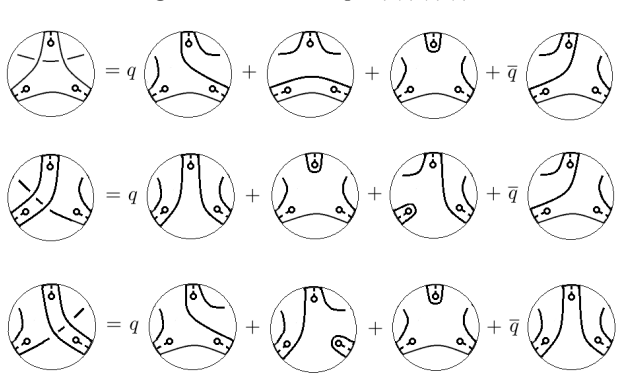
Figures from the paper (14 more)


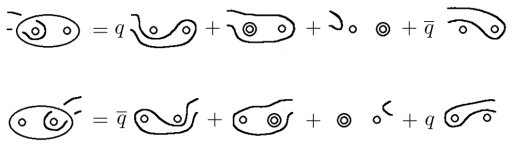


Forward citations
Cited by 1 Pith paper
-
Monoidal categorification of genus zero skein algebras
The relative Kauffman bracket skein algebra of a genus zero surface with boundary is isomorphic to a quantized K-theoretic Coulomb branch, yielding a convolution-product categorification.
Reference graph
Works this paper leans on
-
[1]
F. Bonahon and H. Wong, Quantum traces for representations of surface groups in SL 2(C), Geom. Topol. 15 (2011), 1569–1615. Doi: 10.2140/gt.2011.15.1569
-
[2]
Bullock, Rings of SL2(C)-characters and the Kauffman bracket skein mod- ule
D. Bullock, Rings of SL2(C)-characters and the Kauffman bracket skein mod- ule. Comment. Math. Helv. 72 (1997) 521–542. Doi: 10.1007/s000140050032
-
[3]
Bullock, A finite set of generators for the Kauffman bracket skein algebra
D. Bullock, A finite set of generators for the Kauffman bracket skein algebra. Math. Z. 231 (1999), 91–101. Doi: 10.1007/PL00004727
-
[4]
D. Bullock, and J.H. Przytycki. Multiplicative structure of Kauffman bracket skein module quantizations. Proc. Amer. Math. Soc. 128 (2000), no. 3, 923–
work page 2000
-
[5]
Doi: 10.1090/s0002-9939-99-05043-1
-
[6]
L. Charles and J. March´ e, Multicurves and regular functions on the rep- resentation variety of a surface in SU(2). Comment. Math. Helv. 87 (2012), 409–431. DOI: 10.4171/cmh/258
-
[7]
Chen, Integral structure of the skein algebra of the 5-punctured sphere
H.-M. Chen, Integral structure of the skein algebra of the 5-punctured sphere. arXiv:2304.06605
-
[8]
Chen, Presentation of Kauffman bracket skein algebras of planar sur- faces
H.-M. Chen, Presentation of Kauffman bracket skein algebras of planar sur- faces. In preparation
Show all 23 references
-
[9]
Cooke and A
J. Cooke and A. Lacabanne, Higher rank Askey-Wilson algebras as skein algebras. arXiv:2205.04414
-
[10]
Cooke and P
J. Cooke and P. Samuelson, On the genus two skein algebra. J. Lond. Math. Soc. 104 (2021), no. 5, 2260–2298. Doi: 10.1112/jlms.12497
2021 doi
-
[11]
Frohman and J
C. Frohman and J. Kania-Bartoszynska, The structure of the Kauffman bracket skein algebra at roots of unity. Math. Z. 289 (2018), no. 3–4, 889–
2018
-
[12]
Doi: 10.1007/s00209-017-1980-2
1980 doi
-
[13]
Frohman, J
C. Frohman, J. Kania-Bartoszynska and T.T.Q. Lˆ e, Dimension and trace of the Kauffman bracket skein algebra. Trans. Amer. Math. Soc. (Series B) 8 (2021), no. 18, 510–547. Doi: 10.1090/btran/69. 27
2021 doi
-
[14]
Kirby, Problems in low-dimensional topology , AMS/IP Stud
R. Kirby, Problems in low-dimensional topology , AMS/IP Stud. Adv. Math., 2.2, Geometric topology (Athens, GA, 1993), 35–473, Amer. Math. Soc., Providence, RI, 1997
1993
-
[15]
Korinman, Finite presentations for stated skein algebras and lattice gauge field theory
J. Korinman, Finite presentations for stated skein algebras and lattice gauge field theory. Algebr. Geom. Topol. 23 (2023), no.3 , 1249–1302. Doi: 10.2140/agt.2023.23.1249
2023 doi
-
[16]
Lˆ e, Quantum Teichmuller spaces and quantum trace map
T.T.Q. Lˆ e, Quantum Teichmuller spaces and quantum trace map. J. Ins. Math. Jussieu 18 (2019), no. 2, 249–291. Doi: 10.1017/S1474748017000068
2019 doi
-
[17]
Quantum Topol
Muller, Skein and cluster algebras of marked surfaces. Quantum Topol. 7 (2016), no. 3, 435–503. Doi: 10.4171/QT/79
2016 doi
-
[18]
Ohtsuki, Problems on invariants of knots and 3-manifolds, with an intro- duction by J
T. Ohtsuki, Problems on invariants of knots and 3-manifolds, with an intro- duction by J. Roberts. Geom. Topol. Monogr., 4, Invariants of knots and 3- manifolds (Kyoto, 2001), i–iv, 377–572, Geom. Topol. Publ., Coventry, 2002
2001
-
[19]
Przytycki and A.S
J. Przytycki and A.S. Sikora, On skein algebras and Sl 2(C)-character vari- eties. Topology 39 (2000), no. 1, 115–148. Doi: 10.1016/S0040-9383(98)00062-7
2000 doi
-
[20]
Przytycki and A.S
J. Przytycki and A.S. Sikora, Skein algebras of surfaces.Trans. Amer. Math. Soc. 371 (2019), no. 2, 1309–1332. Doi: 10.1090/tran/7298
2019 doi
-
[21]
Sikora and B.W
A.S. Sikora and B.W. Westbury, Confluence theory for graphs. Algebr. Geom. Topol. 7 (2007), 439–478. Doi:10.2140/agt.2007.7.439
2007 doi
-
[22]
Santharoubane, Algebraic generators of the skein algebra of a surface
R. Santharoubane, Algebraic generators of the skein algebra of a surface. arXiv: 1803.09804
-
[23]
Turaev, Skein quantization of Poisson algebras of loops on surfaces.Ann
V. Turaev, Skein quantization of Poisson algebras of loops on surfaces.Ann. Sci. ´Ecole Norm. Sup. 24 (1991), 635–704. Doi: 10.24033/asens.1639. Haimiao Chen (orcid: 0000-0001-8194-1264) chenhm@math.pku.edu.cn Department of Mathematics, Beijing Technology and Business Universi...
1991 doi
Reviewed May 24, 2026 · model on record in the stance chip above.
Discussion (0). Continue with ORCID to comment.