A Rank-Based Reward between a Principal and a Field of Agents: Application to Energy Savings
Pith reviewed 2026-05-24 10:29 UTC · model grok-4.3
The pith
A principal designs rank-based rewards that induce a unique explicit equilibrium distribution among agents to meet energy sobriety targets.
A machine-rendered reading of the paper's core claim, the machinery that carries it, and where it could break.
Core claim
For any given rank-based reward the mean-field interaction among agents possesses a unique equilibrium distribution of efforts that admits an explicit representation; the optimal reward achieving a prescribed sobriety target is characterized by a convex reformulation when agents are homogeneous and extends to a subclass of heterogeneous populations, with the ranking mechanism shown to attain the regulatory target in the French energy certificates setting.
What carries the argument
The mean-field equilibrium distribution of agent efforts and ranks induced by the rank-based reward, which exists, is unique, and possesses an explicit closed-form representation.
If this is right
- Any rank-based reward produces a unique equilibrium whose distribution is given explicitly by the derived formula.
- The convex reformulation yields the reward that exactly meets the target savings level for homogeneous populations.
- The same convex characterization remains valid for a subclass of heterogeneous agent populations.
- A convergent numerical scheme computes the equilibrium for arbitrary heterogeneity.
- The ranking mechanism attains the sobriety target in the French energy certificates application.
Where Pith is reading between the lines
- The explicit equilibrium formula could be differentiated to obtain sensitivity of savings to changes in the reward parameters.
- The mean-field ranking approach might be tested for convergence by comparing finite-population simulations against the derived limit.
- Similar rank-based contracts could be examined for other regulatory targets such as emissions caps or water usage quotas.
Load-bearing premise
Each agent responds only to the overall distribution of ranks and efforts rather than to the actions of any specific peers.
What would settle it
A direct computation or controlled simulation in which the observed distribution of efforts deviates from the explicit equilibrium formula derived from the reward function, or in which the realized aggregate savings fall short of the imposed target.
Figures
read the original abstract
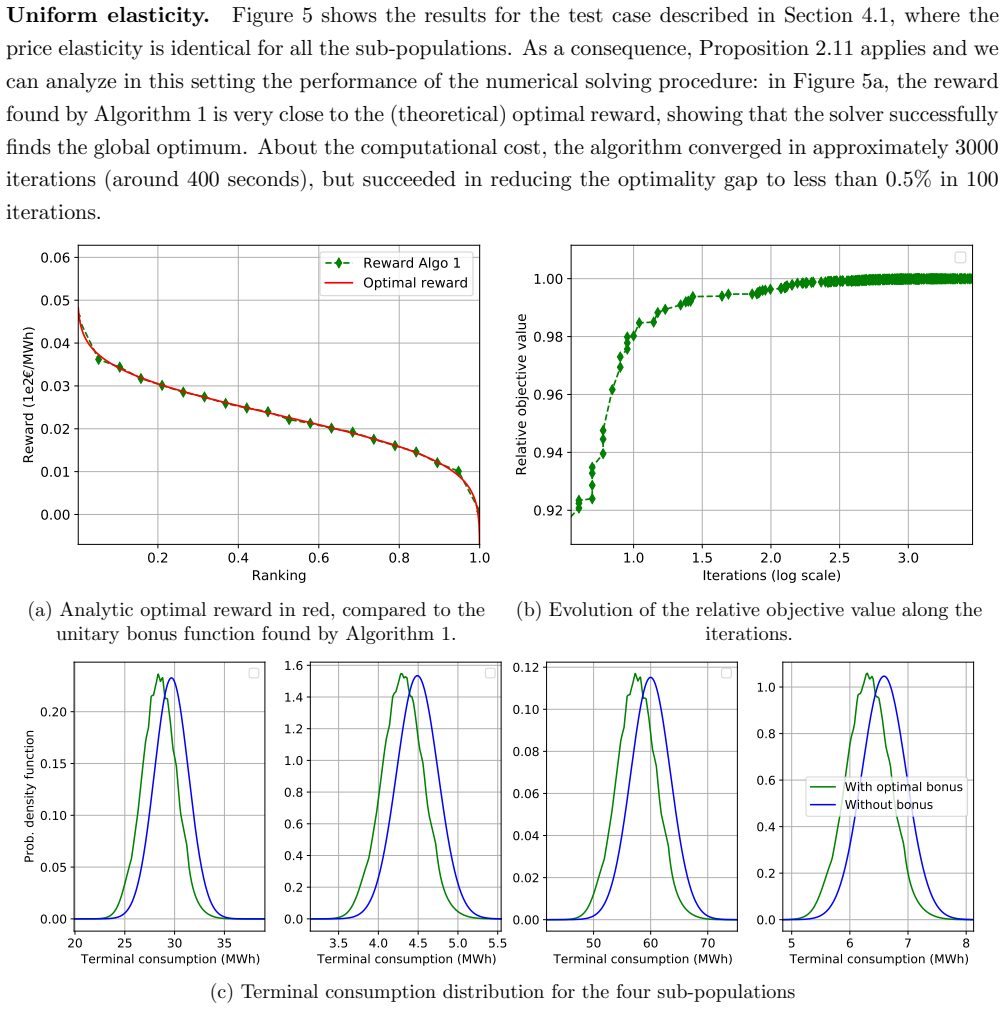
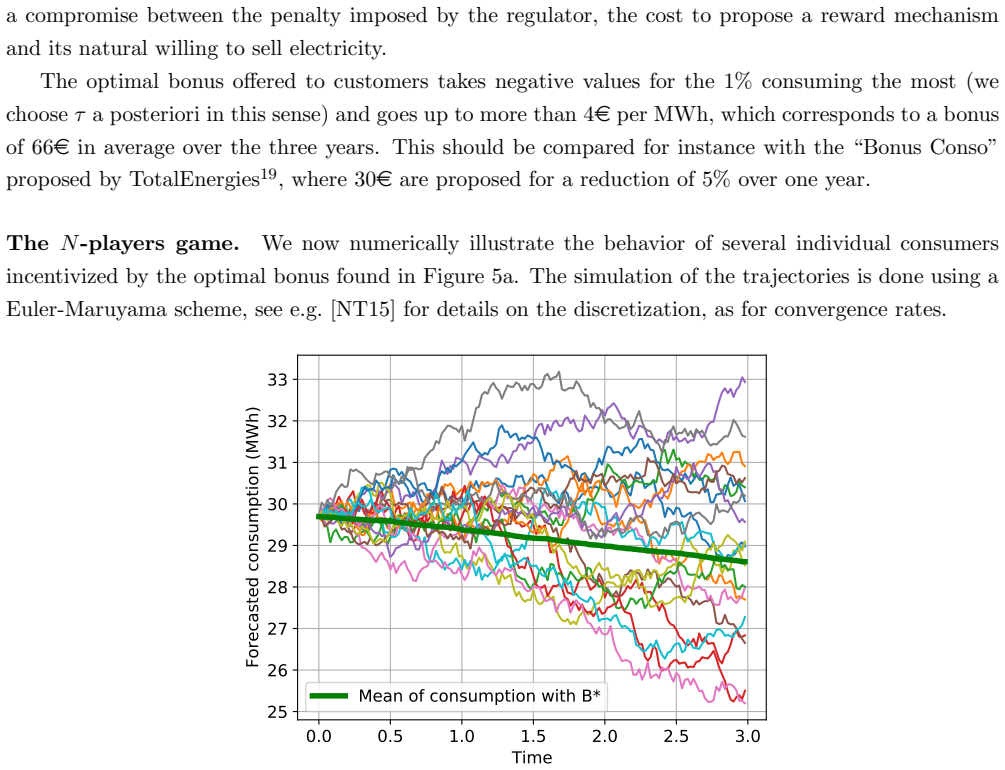
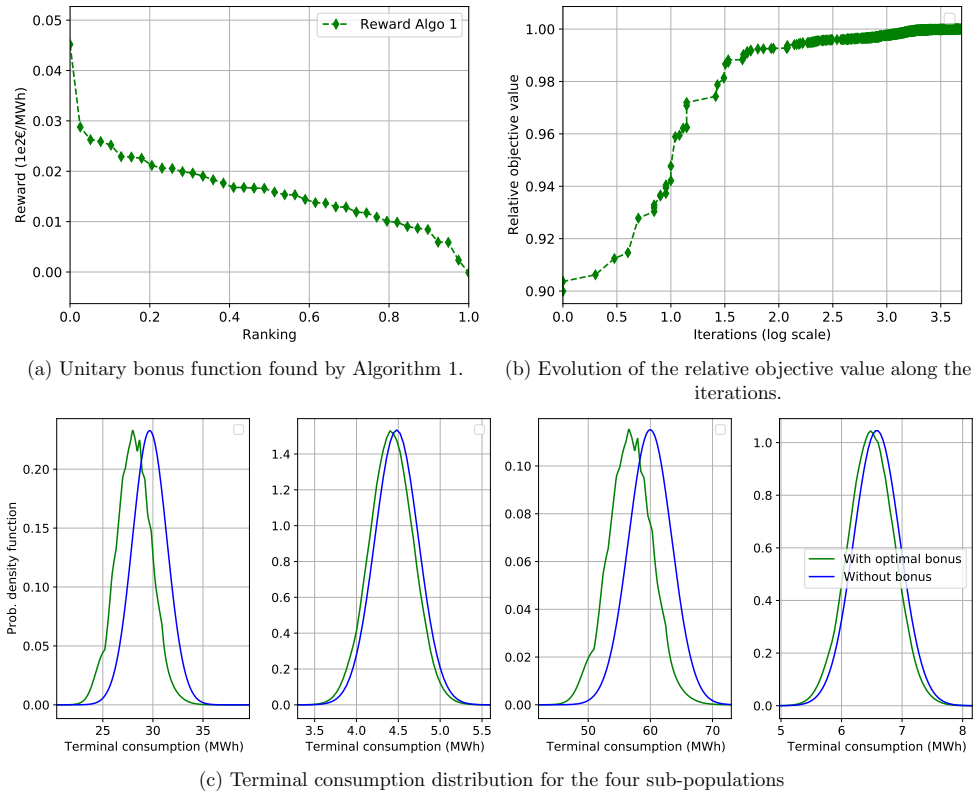
In this paper, we consider the problem of a Principal aiming at designing a reward function for a population of heterogeneous agents. We construct an incentive based on the ranking of the agents, so that a competition among the latter is initiated. We place ourselves in the limit setting of mean-field type interactions and prove the existence and uniqueness of the equilibrium distribution for a given reward, for which we can find an explicit representation. Focusing first on the homogeneous setting, we characterize the optimal reward function using a convex reformulation of the problem and provide an interpretation of its behaviour. We then show that this characterization still holds for a sub-class of heterogeneous populations. For the general case, we propose a convergent numerical method which fully exploits the characterization of the mean-field equilibrium. We develop a case study related to the French market of Energy Saving Certificates based on the use of realistic data, which shows that the ranking system allows to achieve the sobriety target imposed by the regulation.
Editorial analysis
A structured set of objections, weighed in public.
Referee Report
Summary. The paper studies a principal designing rank-based rewards to incentivize effort from a large population of heterogeneous agents under mean-field interactions. It proves existence and uniqueness of the mean-field equilibrium distribution together with an explicit representation, derives a convex reformulation that characterizes the optimal reward in the homogeneous case (and a subclass of heterogeneous cases), proposes a convergent numerical scheme for the general heterogeneous setting, and applies the framework to realistic French Energy Saving Certificates data to show that the ranking mechanism meets the regulatory sobriety target.
Significance. If the stated existence/uniqueness results, explicit representation, and convex reformulation hold, the work supplies a mathematically tractable incentive design tool that combines competition via ranks with mean-field equilibrium analysis. The explicit homogeneous solution, the extension to a subclass of heterogeneity, the convergent numerical method, and the data-driven validation on external regulatory data constitute concrete strengths for both theory and application in mean-field games and energy policy.
minor comments (3)
- [numerical method section] The transition from the homogeneous convex reformulation to the numerical scheme for general heterogeneity would benefit from an explicit statement of the convergence rate or error bound (e.g., in the section describing the algorithm).
- [model setup] Notation for the rank function and the associated distribution should be introduced with a single consistent symbol before the equilibrium equations are written.
- [case study] The case-study section would be strengthened by reporting the achieved aggregate energy saving relative to the regulatory target together with a brief sensitivity check on the rank-reward parameters.
Simulated Author's Rebuttal
We thank the referee for the positive assessment of our work and the recommendation of minor revision. The provided summary accurately captures the paper's contributions on rank-based incentives in mean-field games and the energy application.
Circularity Check
No significant circularity; derivations are self-contained within stated mean-field framework
full rationale
The paper's central results—existence/uniqueness of the mean-field equilibrium distribution, explicit representation in the homogeneous case, convex reformulation for optimality, and convergent numerical scheme—are presented as consequences of the modeling assumptions (mean-field interactions, rank-based incentives) and standard fixed-point arguments in the space of distributions. No step reduces by construction to a fitted parameter or self-citation chain; the case study applies the construction to external energy-certificate data. The provided abstract and skeptic analysis confirm the derivation chain does not collapse to its inputs.
Axiom & Free-Parameter Ledger
axioms (1)
- domain assumption Agents interact in the mean-field limit where each responds only to the population distribution of ranks and efforts.
Reference graph
Works this paper leans on
-
[1]
[AT14] Hunt Allcott and Rogers Todd. “The short-run and long-run effects of behavioral interventions: Exper- imental evidence from energy conservation”. In: American Economic Review 104.10 (2014), pp. 3003–
work page 2014
-
[2]
[DM15] Paul Dolan and Robert Metcalfe. “Neighbors, knowledge, and nuggets: two natural field experiments on the role of incentives on energy conservation”. In:Becker Friedman Institute for Research in Economics Working Paper (2015). [LL06a] Jean-Michel Lasry and Pierre-Louis Lions. “Jeux ` a champ moyen. I-Le cas stationnaire”. In: Comptes Rendus Math´ em...
-
[3]
A rank-based mean field game in the strong formulation
url: https://arxiv.org/abs/2112.11963. [BZ16] Erhan Bayraktar and Yuchong Zhang. “A rank-based mean field game in the strong formulation”. In: Electronic Communications in Probability 21 (2016), pp. 1–12. [BCZ19] Erhan Bayraktar, Jakˇ sa Cvitani´ c, and Yuchong Zhang. “Large tournament games”. In: The Annals of Applied Probability 29.6 (Dec. 2019). url: h...
-
[4]
Validation of the Ornstein-Uhlenbeck process for load modeling based on µPMU measurements
[RSM16] Ciaran Roberts, Emma M Stewart, and Federico Milano. “Validation of the Ornstein-Uhlenbeck process for load modeling based on µPMU measurements”. In: 2016 Power Systems Computation Conference (PSCC). IEEE. 2016, pp. 1–7. [APT22] Ren´ e A¨ ıd, Dylan Possama¨ ı, and Nizar Touzi. “Optimal Electricity Demand Response Contracting with Responsiveness In...
-
[5]
[HO97] Nikolaus Hansen and Andreas Ostermeier. “Convergence properties of evolution strategies with the derandomized covariance matrix adaptation: The (/I,)-ES”. In: Eufit 97 (1997), pp. 650–654. [NYK20] Amir Niromandfam, Ahmad Sadeghi Yazdankhah, and Rasool Kazemzadeh. “Modeling demand re- sponse based on utility function considering wind profit maximiza...
-
[6]
Decentralized Conver- gence to Nash Equilibria in Constrained Deterministic Mean Field Control
1016 % 2Fj. na .2006 . 03.012. [Gra+16] Sergio Grammatico, Francesca Parise, Marcello Colombino, and John Lygeros. “Decentralized Conver- gence to Nash Equilibria in Constrained Deterministic Mean Field Control”. In: IEEE Transactions on Automatic Control 61.11 (Nov. 2016), pp. 3315–3329. url: https://doi.org/10.1109%2Ftac. 2015.2513368. A Proofs In this ...
discussion (0)
Sign in with ORCID, Apple, or X to comment. Anyone can read and Pith papers without signing in.