Recognition: unknown
Evidence for room temperature superconductivity associated with a first-order phase transition
Pith reviewed 2026-05-06 19:41 UTC · model claude-opus-4-7
The pith
A perforated, partly oxidized niobium sheet shows zero resistance up to 290 K and a Meissner signal, which the author reads as room-temperature superconductivity in a Nb–O square lattice undergoing a first-order transition.
A machine-rendered reading of the paper's core claim, the machinery that carries it, and where it could break.
Core claim
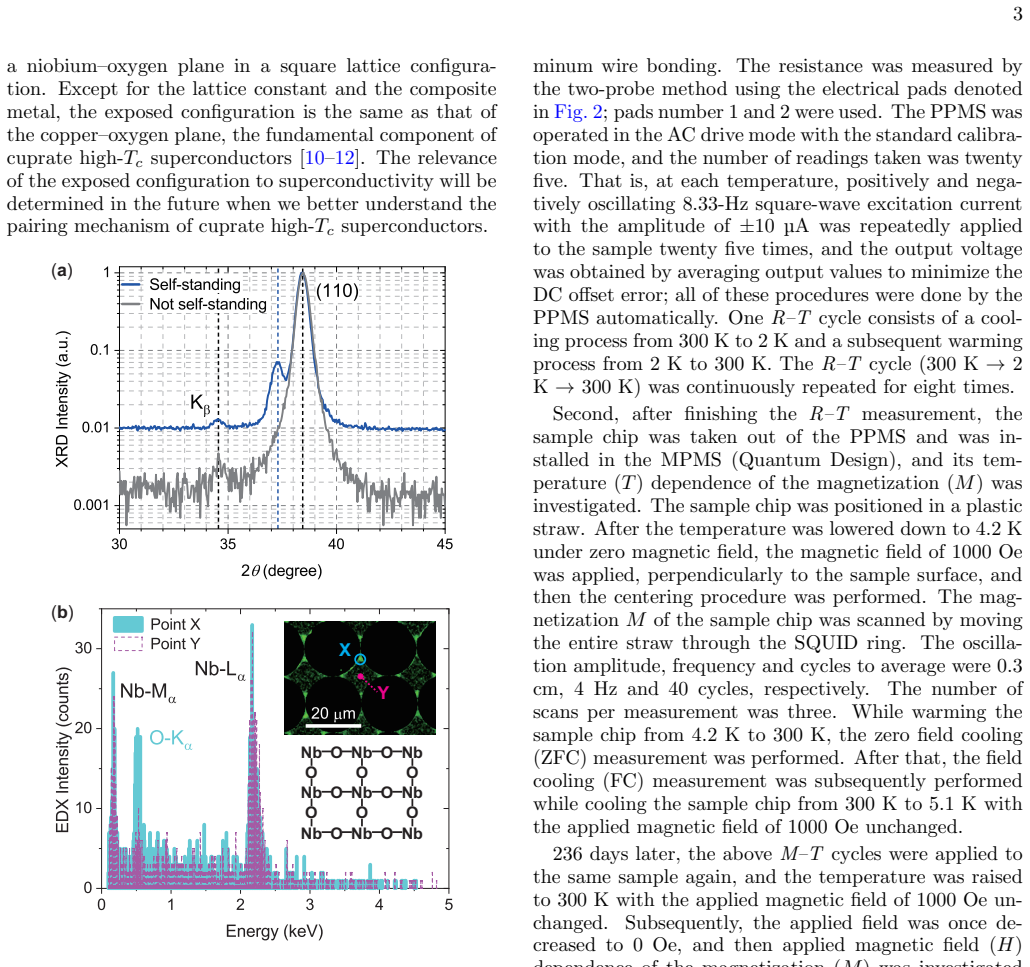
A suspended niobium sheet perforated with a periodic array of through-holes, originally fabricated to engineer its phonon spectrum, is reported to lose its electrical resistance at 175 K on cooling and to remain resistance-free up to 290 K on warming. The author argues that during processing the holey niobium has partially oxidized into a niobium–oxygen square lattice geometrically analogous to the copper–oxygen plane of cuprate superconductors, and that this Nb–O plane is the actual superconducting subsystem. Beyond zero resistance, the sample is reported to show a magnetization drop on cooling (Meissner effect) and a remnant magnetization at 300 K, which the author takes as together satisf
What carries the argument
A perforated (holey) niobium film whose surface is partly oxidized into a Nb–O square lattice posited to play the role of the cuprate Cu–O plane, combined with the Halperin–Lubensky–Ma argument that superconducting transitions are intrinsically first order due to fluctuating gauge fields. The structural analogy between the Nb–O and Cu–O planes is what carries the pairing-mechanism claim, and the HLM scenario is what carries the interpretation of the thermal hysteresis.
If this is right
- If the zero-resistance state at 290 K is genuine superconductivity, niobium oxides with an Nb–O square-lattice motif become a new family of high-Tc candidates worth systematic synthesis and doping studies.
- If a Nb–O plane pairs by the same mechanism as a Cu–O plane, then whatever theory eventually explains cuprate superconductivity must accommodate a 4d transition-metal–oxygen analog, constraining the pairing glue.
- If the observed hysteretic jump is the HLM first-order transition, then specific-heat, magnetization, and noise measurements should show the predicted latent heat and discontinuity, and HLM signatures should be sought in other quasi-2D superconductors.
- If hole-patterning and partial oxidation together produce the effect, then phonon engineering by perforation plus controlled oxidation becomes a design route for high-Tc materials rather than an incidental processing step.
- The conventional checklist for claiming superconductivity (zero R, Meissner, remnant magnetization) would be vindicated as sufficient even at temperatures where no prior superconductor exists.
Where Pith is reading between the lines
- The argument has two logically independent legs — a high-Tc claim and an HLM first-order claim — and either could in principle be confirmed without the other; an experiment isolating the hysteresis in a known low-Tc 2D superconductor would test the HLM leg cleanly without needing room-temperature superconductivity.
- If the active layer is truly a thin Nb–O surface reconstruction on a perforated film, the superconducting volume fraction should be small, so a Meissner shielding fraction far below unity is expected and should not by itself be taken against the claim — but it does mean the magnetic signal must be unambiguously diamagnetic and geometry-corrected.
- A direct structural test — surface-sensitive diffraction or STM on the oxidized region — would either confirm or rule out the asserted Nb–O square lattice and is arguably more decisive than further transport data.
- The mid-paper pivot from BCS to a cuprate-like mechanism is a hypothesis swap rather than a derivation; treating it as such, the natural next step is to ask whether any specific cuprate phenomenology (pseudogap, d-wave nodes, linear-in-T resistivity above Tc) is reproduced in this system.
Load-bearing premise
That the zero resistance and remnant magnetization actually come from bulk superconductivity in a Nb–O surface lattice, rather than from more mundane sources like ferromagnetic niobium-oxide phases, percolating contact shorts, or geometric artifacts of the patterned, partly oxidized film — and that a Nb–O plane really pairs electrons the way a Cu–O plane does, an analogy the paper asserts rather than derives.
What would settle it
An independent fabrication of the same holey, partly oxidized niobium film with four-probe transport measured through voltage leads that bypass any possible percolation path, together with AC susceptibility showing a clear diamagnetic shielding fraction approaching −1 in SI units and a critical-current density that scales with sample cross-section. Absence of a real shielding signal, or remnant magnetization that tracks a known ferromagnetic Nb-oxide phase rather than a superconducting loop, would settle the claim against. Confirmation by another group on an independently grown sample would se
Figures



read the original abstract
By making periodic thru-holes in a suspended film, the phonon system can be modified. Motivated by the BCS theory, the technique -- so-called phonon engineering -- was applied to a metallic niobium sheet. It was found that its electrical resistance dropped to zero at 175 K, and the zero-resistance state persisted up to 290 K in the subsequent warming process. Despite the initial motivation, neither these high transition temperatures nor the phase transition with thermal hysteresis can be accounted for by the BCS theory. Therefore, we abandon the BCS theory. Instead, it turns out that the metallic holey sheet is partly oxidized to form a niobium-oxygen square lattice, which has points of resemblance to a copper-oxygen plane, the fundamental component of cuprate high-$T_{c}$ superconductors. Therefore, the pairing mechanism underlying this study should be related to that of cuprate high-$T_{c}$ superconductors, which we may not yet understand. In addition to the electrical results of zero resistance, the holey sheet exhibited a decrease in magnetization upon cooling, i.e., the Meissner effect. Moreover, the remnant magnetization was clearly detected at 300 K, which can only be attributed to persistent currents flowing in a superconducting sample. Thus, this study meets the established criteria for a conclusive demonstration of true superconductivity. Finally, the superconducting transition with the unambiguous thermal hysteresis is discussed. According to Halperin, Lubensky, and Ma, or HLM for short, any superconducting transition must $always$ be first order with thermal hysteresis because of the intrinsic fluctuating magnetic field. The HLM theory is very compatible with the highly oriented system harboring two-dimensional superconductivity.
Editorial analysis
A structured set of objections, weighed in public.
Referee Report
Summary. The manuscript reports that a suspended niobium film perforated with a periodic array of through-holes ("phonon engineering") shows a drop of electrical resistance to zero at 175 K on cooling, with the zero-resistance state persisting up to 290 K on warming (thermal hysteresis). The authors initially motivate the work via BCS phonon engineering but then assert that BCS cannot account for the observed Tc and abandon it, proposing instead that partial oxidation of the film produces a Nb–O square lattice analogous to the CuO2 planes of cuprate superconductors and that the pairing mechanism is therefore "cuprate-like." The authors further report a decrease of magnetization on cooling (interpreted as a Meissner effect) and a remnant magnetization at 300 K (interpreted as persistent currents), and argue that the first-order character of the transition with thermal hysteresis is consistent with Halperin–Lubensky–Ma (HLM) theory of fluctuation-induced first-order transitions in 2D superconductors.
Significance. A reproducible demonstration of room-temperature superconductivity in any system would be of obvious and major significance, and the criteria the authors themselves invoke (zero resistance, Meissner effect, remnant magnetization, plus a thermodynamic transition signature) are the right criteria. The use of a perforated Nb film as a controlled platform and the explicit appeal to HLM as a framework for the first-order character are appropriate framings. However, the significance ultimately depends on whether each of the three claimed signatures is shown, quantitatively, to be free of conventional artifact explanations and whether all three co-localize in the same Nb–O phase. As presented in the abstract, none of the three signatures is accompanied by the quantitative diagnostic that would distinguish bulk superconductivity from instrumentation or impurity-phase artifacts, so the strength of the claim cannot be assessed without examining the full manuscript and supplementary data.
major comments (6)
- [Zero-resistance claim (abstract)] A 290 K zero-resistance state in a patterned film is the central electrical claim and requires more than a four-probe resistance reading. The standard discriminator is a family of I–V curves at fixed T showing V at instrumental noise up to a well-defined critical current Ic, followed by a sharp transition; without this, a low-current null voltage is also consistent with thermoelectric offsets, lock-in zero drift, or current bypass through voltage leads in a perforated geometry. The manuscript should report (i) I(V) at multiple T spanning the transition, (ii) Ic(T), and (iii) the absolute resistance noise floor and lead/contact configuration (preferably with a current-reversal or delta-mode protocol).
- [Meissner-effect claim (abstract)] A 'decrease in magnetization upon cooling' alone does not establish the Meissner effect. The load-bearing quantity is the shielding fraction: the volume of perfect diamagnet inferred from χ(T) compared to the geometrical sample volume, with explicit subtraction of holder/background and of any residual bulk Nb (Tc ≈ 9 K) and of paramagnetic Curie tails. The manuscript should give ZFC and FC curves, the demagnetization-corrected χ, and a quantitative shielding fraction; otherwise the Meissner claim is not separable from a few percent of conventional Nb plus a temperature-dependent background.
- [Remnant magnetization at 300 K (abstract)] Remnant magnetization at 300 K is in principle the strongest single signature, but it is also the signature most easily mimicked by ferromagnetic contamination — Nb sub-oxides, milling/handling debris (Fe, Ni from tooling), or magnetic particulates introduced during patterning can produce room-temperature remanence indistinguishable from persistent-current remanence in a single M(H) loop. The authors should provide M(H) hysteresis loops at multiple T (looking for the characteristic field- and temperature-dependence of a superconducting trapped-flux loop versus a soft/hard ferromagnet), trapped-flux relaxation M(t), and chemical/structural characterization (EDS, XPS, XRD) of the same region in which transport is measured.
- [Mechanism switch from BCS to 'cuprate-like'] The abstract abandons BCS and asserts a cuprate-like mechanism on the basis of a structural analogy between a Nb–O square lattice and a CuO2 plane. This is a load-bearing inference for the interpretation. A structural resemblance is not by itself evidence of a common pairing mechanism: the cuprate phenomenology involves a specific d⁹ Cu²⁺ Mott-insulating parent, charge-transfer gap, and doping-dependent phase diagram, none of which is established here for Nb–O. The manuscript should either (a) treat the cuprate analogy as a hypothesis and remove the claim that the pairing 'should be related to' that of cuprates, or (b) provide spectroscopic/structural evidence (stoichiometry, oxidation state, gap structure) supporting the analogy.
- [HLM and first-order transition] The thermal hysteresis (cooling 175 K vs warming 290 K) is invoked as evidence of the HLM-predicted first-order transition. A 115 K hysteresis width is extremely large compared to typical HLM predictions, which give a very weakly first-order transition. The authors should (i) quantify the predicted HLM hysteresis for their parameters and compare to the observed width, and (ii) rule out alternative origins of hysteresis such as a structural/oxidation phase transition in the Nb–O system or thermal lag in the cryostat. Without this, the HLM identification is qualitative.
- [Co-localization of signatures] The three claimed signatures (R=0, Meissner, 300 K remanence) must be shown to originate from the same material phase and same spatial region of the sample. Given that the film is described as 'partly oxidized,' a percolating metallic Nb network could produce transport features while a separate oxide phase produces magnetic features. Spatially resolved measurements (e.g., scanning SQUID, MFM, or at minimum transport and magnetization on the same piece with explicit mass and geometry accounting) are needed to support a joint interpretation.
minor comments (5)
- [Abstract phrasing] The sentence 'we abandon the BCS theory ... Therefore, the pairing mechanism ... should be related to that of cuprate high-Tc superconductors, which we may not yet understand' is logically weak; abandoning one mechanism does not entail another. Recommend rephrasing as a hypothesis to be tested.
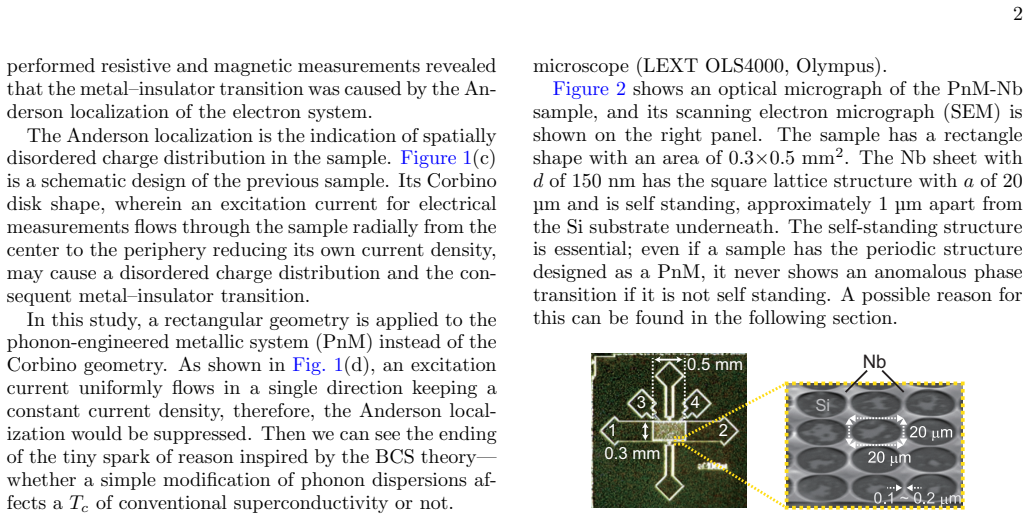
- [Terminology] 'Phonon engineering' is used without a quantitative phonon-spectrum calculation or measurement (e.g., modified Debye spectrum, expected change in λ or ωD). Either provide the calculation or down-weight the term.
- [Sample description] The hole geometry (pitch, diameter, film thickness, suspension method) and the oxidation protocol (intentional or incidental, atmosphere, temperature, time) should be stated explicitly in the abstract/introduction, since they are central to reproducibility.
- [References] Halperin–Lubensky–Ma should be cited with the original 1974 reference and with subsequent work quantifying the (typically very small) magnitude of the predicted first-order jump, so the reader can compare to the reported 115 K hysteresis.
- [Criteria for 'true superconductivity'] The phrase 'meets the established criteria for a conclusive demonstration' is strong; consider softening to 'is consistent with' pending the quantitative diagnostics requested above.
Simulated Author's Rebuttal
We thank the referee for a careful, constructive report that engages with the central claims of the manuscript on their own terms. The referee correctly identifies that the three signatures we invoke — zero resistance, Meissner effect, and 300 K remnant magnetization — are individually the correct criteria for superconductivity, and that the strength of any room-temperature claim rests on quantitative diagnostics that rule out conventional artifacts and on co-localization of the three signatures within a single phase. We accept this framing. In the revised manuscript we will (i) add I–V families, Ic(T), and an explicit description of the four-probe wiring and noise floor; (ii) report ZFC/FC χ(T) with background subtraction and an explicit shielding fraction; (iii) provide M(H) loops at several temperatures, trapped-flux relaxation M(t), and EDS/XPS/XRD on the measured region; (iv) downgrade the "cuprate-like pairing" statement to a structural-analogy hypothesis; (v) compare the observed hysteresis width quantitatively with HLM estimates for our parameters and explicitly address structural/oxidation and thermal-lag alternatives; and (vi) document the spatial relation between the transport and magnetization signals on the same specimen. Where we cannot at present supply a requested measurement (notably scanning SQUID/MFM imaging), we will say so plainly rather than overstate the evidence.
read point-by-point responses
-
Referee: Zero-resistance claim requires I–V families at fixed T, Ic(T), absolute noise floor, and lead/contact configuration; otherwise a null voltage is consistent with thermoelectric offsets, lock-in drift, or current bypass through the perforated geometry.
Authors: We agree. The abstract reports only that R drops to instrumental zero, which is insufficient on its own. In the revision we will (i) add I(V) curves at a set of temperatures spanning 100–310 K, identifying the linear ohmic regime, the Ic transition, and the dissipative branch; (ii) extract Ic(T) and report it explicitly; (iii) state the absolute voltage noise floor of our nanovoltmeter and the contact resistances; and (iv) describe the four-probe geometry on the perforated film and the current-reversal (delta-mode) protocol used to suppress thermoelectric offsets. We will also describe a control measurement on an unperforated companion film processed identically. We acknowledge that current bypass through voltage leads in a holey geometry is a legitimate concern and will document the lead placement relative to the hole array. revision: yes
-
Referee: A decrease of M on cooling is not a Meissner effect; the load-bearing quantity is the shielding fraction with background subtraction and removal of bulk-Nb (Tc≈9 K) and Curie contributions. Provide ZFC/FC, demagnetization-corrected χ, and a quantitative shielding fraction.
Authors: Accepted. The Meissner claim as written in the abstract is underspecified. The revised manuscript will present ZFC and FC χ(T) on the same specimen used for transport, with explicit subtraction of (a) the sample-holder background measured under identical conditions, (b) any 9 K bulk-Nb step, and (c) high-T Curie tails. We will quote a demagnetization-corrected χ and a shielding fraction referenced to the geometrical (solid) volume of the patterned film, and we will state the uncertainty arising from the perforation geometry. We agree that without these numbers the claim cannot be separated from a few percent of conventional Nb plus a T-dependent background. revision: yes
-
Referee: 300 K remanence is the strongest single signature but is easily mimicked by ferromagnetic contamination (Nb sub-oxides, Fe/Ni milling debris, magnetic particulates). Provide M(H) at multiple T, M(t) relaxation, and chemical/structural characterization (EDS, XPS, XRD) of the measured region.
Authors: We agree this is the most demanding requirement. The revised manuscript will include M(H) loops at several temperatures from 50 K to 310 K, with attention to the field- and temperature-dependence of the loop shape — specifically, we will examine whether the loop scales as expected for a superconducting trapped-flux response (Bean-like, Ic-controlled width) versus a soft- or hard-ferromagnetic loop. We will add trapped-flux relaxation M(t) at 300 K, and we will provide EDS, XPS (for oxidation state of Nb and detection of any Fe/Ni contaminants from the patterning tooling), and XRD on the same physical specimen used for the magnetic and transport measurements. We accept that without this characterization the persistent-current interpretation is not established. revision: yes
-
Referee: The switch from BCS to a 'cuprate-like' mechanism rests on a structural analogy and is overstated; cuprate phenomenology involves a specific d9 Mott parent, charge-transfer gap, and doping phase diagram, none of which is established for Nb–O.
Authors: We agree the wording is too strong. In the revision we will (a) reframe the Nb–O / CuO2 comparison explicitly as a structural-analogy hypothesis motivating further study, (b) remove the assertion that the pairing mechanism 'should be related to' that of cuprates, and (c) note plainly that no spectroscopic evidence (oxidation state, gap symmetry, doping-dependence) for such an analogy is presented here. The manuscript will retain the structural observation but will not draw a mechanistic conclusion from it. revision: yes
-
Referee: A 115 K hysteresis width is far larger than typical HLM predictions (which give a weakly first-order transition). Quantify the HLM-predicted hysteresis for the relevant parameters and rule out alternative origins (structural/oxidation transitions, thermal lag).
Authors: This is a fair criticism. HLM predicts a weakly first-order transition, and a 115 K hysteresis is in tension with a naive HLM estimate. In the revision we will (i) compute the HLM-predicted supercooling/superheating window using estimates of the penetration depth, coherence length, and Ginzburg parameter appropriate to the holey film, and compare it to the observed width; (ii) explicitly consider and test alternative origins — in particular a structural or oxidation-driven phase transition in Nb–O over this temperature range, and thermal lag of the sample relative to the thermometer (by varying sweep rate and by measuring sample-mounted thermometry); and (iii) soften the HLM identification to the level the data actually supports. If the quantitative HLM gap remains, we will state this honestly rather than claim agreement. revision: yes
-
Referee: Co-localization: the three signatures must be shown to originate from the same phase and spatial region. A percolating metallic Nb network could carry the transport while a separate oxide phase carries the magnetic features. Spatially resolved probes (scanning SQUID, MFM) or at minimum joint mass/geometry accounting are needed.
Authors: We accept the concern. In the revision we will (a) perform the transport, ZFC/FC, and M(H) measurements on the same physical specimen with documented mass, area, thickness, and perforation fraction, so that the inferred shielding fraction and trapped-flux density refer to the same volume that carries the zero-resistance signal; (b) provide EDS/XPS maps over the transport region to constrain the spatial distribution of the Nb–O phase versus residual metallic Nb. Scanning SQUID and MFM imaging are not currently available to us and we will not claim co-localization at that level; we will state this limitation explicitly and present the percolating-Nb-plus-separate-oxide scenario as an alternative the present data cannot fully exclude. revision: partial
- Spatially resolved magnetic imaging (scanning SQUID or MFM) co-registered with the transport region is not currently available to us; we cannot at present demonstrate co-localization of the Meissner and zero-resistance signals at the micron scale and will acknowledge this limitation in the revision rather than claim it.
- If the quantitative HLM estimate for our parameters yields a hysteresis window much smaller than the observed 115 K, we have no alternative quantitative theory to offer for the hysteresis width and will report the discrepancy openly.
Circularity Check
No significant circularity: claims are empirical and stand or fall on measurement quality, not on a self-referential derivation chain.
full rationale
This paper is an experimental claim, not a derivation. The load-bearing assertions — zero resistance to 290 K, Meissner-like magnetization drop, remnant magnetization at 300 K — are presented as direct measurements on a holey Nb film, not as outputs of a model fitted to those same data. There is no fitted parameter being renamed as a prediction, no self-citation chain importing a uniqueness theorem, and no ansatz smuggled in via the authors' own prior work. The two theoretical references invoked (BCS and HLM) are external; BCS is in fact explicitly discarded ("we abandon the BCS theory"), and HLM is cited only as post-hoc commentary on the observed thermal hysteresis, not as a derivation of any reported number. The cuprate analogy ("points of resemblance to a copper-oxygen plane") is asserted rather than derived, but an unsupported analogy is a correctness/mechanism gap, not circularity in the technical sense — the paper does not use the analogy to compute a quantity it then claims to have predicted. The real risks here, correctly identified by the reader, are artifact-vs-signal issues (I–V family, shielding fraction, ferromagnetic oxide impurities, percolation shorts). Those are correctness and falsifiability concerns and should be scored on those axes, not as circularity. The one mild self-referential element — invoking "phonon engineering" motivation from BCS, then discarding BCS when the data don't fit, then substituting an unspecified cuprate-like mechanism — is a shifting-mechanism problem, not a circular derivation. Score 1 reflects the absence of any specific quotable reduction of a prediction to its own input.
discussion (0)
Sign in with ORCID, Apple, or X to comment. Anyone can read and Pith papers without signing in.