Schur-Positivity of Short Chords in Matchings
Pith reviewed 2026-05-24 07:46 UTC · model grok-4.3
The pith
Matchings with a fixed number of unmatched vertices are Schur-positive when graded by the number of short chords.
A machine-rendered reading of the paper's core claim, the machinery that carries it, and where it could break.
Core claim
The set of matchings with a fixed number of unmatched vertices is Schur-positive with respect to the set of short chords. The Schur expansion coefficients are given explicitly by Bessel polynomials. A Knuth-like equivalence relation on matchings is defined such that each equivalence class corresponds to an irreducible representation. Various refined families, including matchings with fixed crossing number and matchings with a fixed number of pairs of intersecting chords, are also Schur-positive. All matchings m such that the m-avoiding matchings form a Schur-positive set are characterized.
What carries the argument
The short-chord statistic on matchings together with a combinatorial criterion for Schur-positivity.
Load-bearing premise
The new combinatorial criterion for Schur-positivity applies directly to the short-chord statistic on matchings without additional verification that the criterion's hypotheses hold in this setting.
What would settle it
A concrete counterexample would be any specific collection of matchings with a fixed number of unmatched vertices whose generating function by short chords has a negative coefficient when expanded in the Schur basis.
Figures
read the original abstract
We prove that the set of matchings with a fixed number of unmatched vertices is Schur-positive with respect to the set of short chords. Two proofs are presented. The first proof applies a new combinatorial criterion for Schur-positivity, while the second is bijective. The coefficients in the Schur expansion are derived, and interpreted in terms of Bessel polynomials. We present a Knuth-like equivalence relation on matchings, and show that every equivalence class corresponds to an irreducible representation. We proceed to find various refined Schur-positive sets, including the set of matchings with a prescribed crossing number and the set of matchings with a given number of pairs of intersecting chords. Finally, we characterize all the matchings $m$ such that the set of matchings avoiding $m$ is Schur-positive.
Editorial analysis
A structured set of objections, weighed in public.
Referee Report
Summary. The manuscript proves that the generating function over matchings with a fixed number of unmatched vertices, graded by the number of short chords, expands with nonnegative coefficients in the Schur basis. Two independent proofs are given: one via a new combinatorial criterion for Schur-positivity and one bijective. The Schur coefficients are identified with (signed) Bessel polynomials. A Knuth-like equivalence on matchings is introduced whose classes are in bijection with irreducible representations; refined Schur-positive subsets (fixed crossing number, fixed number of intersecting pairs) are exhibited; and a characterization is given of those matchings m for which the avoidance class is Schur-positive.
Significance. The result supplies new families of Schur-positive sets inside the matching lattice and links them to the representation theory of the symmetric group via an explicit Knuth equivalence. The existence of both a criterion proof and an independent bijective proof, together with the closed-form coefficient interpretation via Bessel polynomials, constitutes a solid combinatorial contribution. The avoidance characterization may be useful for further pattern-avoidance questions in this setting.
minor comments (4)
- [§1] §1: the definition of a 'short chord' (a chord connecting consecutive unmatched vertices or an edge of length 1 in the linear representation) should appear in the first paragraph rather than being deferred to the notation subsection.
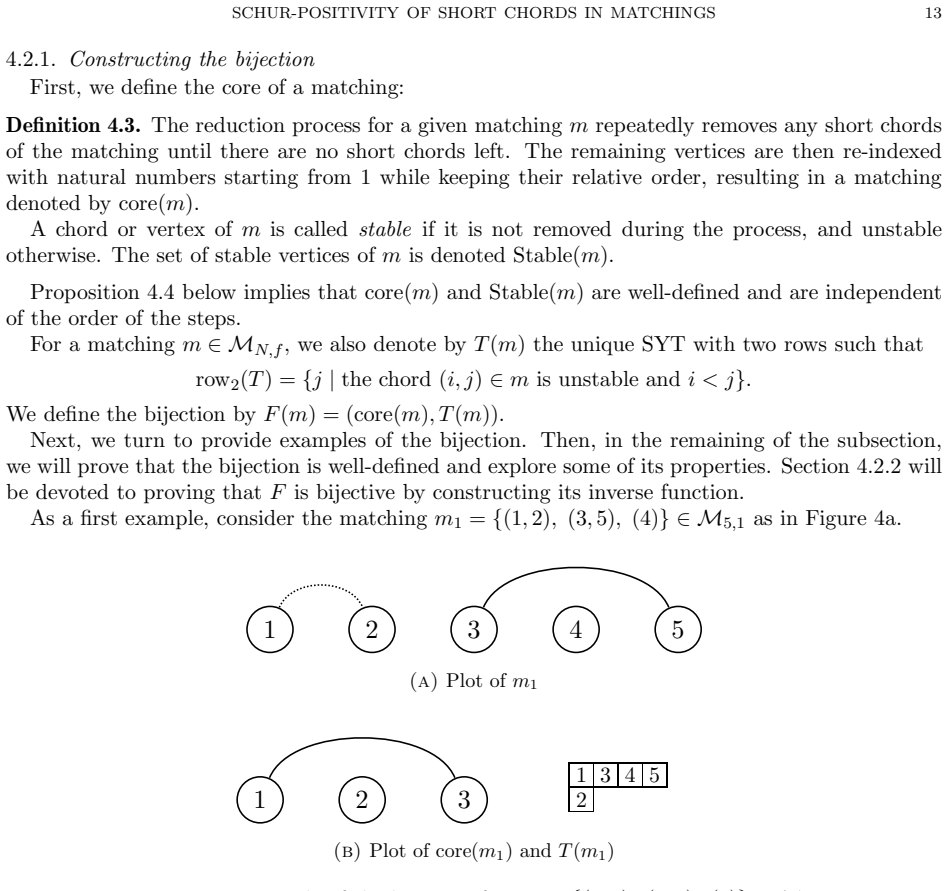
- [Theorem 3.2] Theorem 3.2 (bijective proof): the construction of the bijection is stated only in outline; a short diagram or explicit description of how the short-chord statistic is preserved under the map would make the argument easier to verify.
- [§4.1] §4.1: the statement that each Knuth class 'corresponds to an irreducible representation' should be accompanied by an explicit reference to the Young diagram or Specht module that is realized.
- [throughout] The paper uses both 'short chord' and 'short edge' interchangeably in the later sections; a single consistent term would reduce minor confusion.
Simulated Author's Rebuttal
We thank the referee for their positive assessment of the manuscript, the detailed summary, and the recommendation of minor revision. The report lists no specific major comments under the MAJOR COMMENTS section.
Circularity Check
No significant circularity; derivation self-contained via independent bijective proof
full rationale
The paper states two independent proofs of the central Schur-positivity claim: one via a new combinatorial criterion for Schur-positivity and one bijective. The bijective proof does not rely on the criterion's hypotheses, making the main result independent of any unverified application of the new criterion. Coefficients, Knuth equivalence, refined sets, and avoidance characterization are presented as consequences rather than inputs. No self-definitional reductions, fitted inputs renamed as predictions, or load-bearing self-citation chains appear in the claim structure. The derivation chain remains self-contained against external combinatorial benchmarks.
Axiom & Free-Parameter Ledger
Reference graph
Works this paper leans on
-
[1]
Combinatoria l gelfand models,
R. M. Adin, A. Postnikov, and Y. Roichman, “Combinatoria l gelfand models,” Journal of Algebra, vol. 320, pp. 1311–1325, 2008
work page 2008
-
[2]
Matrices, characters and des cents,
R. M. Adin and Y. Roichman, “Matrices, characters and des cents,” Linear Algebra and its Applications, vol. 469, pp. 381–418, 2015
work page 2015
-
[3]
A. Avni, “Matchings and permutations,” M.Sc. thesis, Ba r-Ilan University, 2013
work page 2013
-
[4]
A. Bj¨ orner and F. Brenti, Combinatorics of Coxeter groups . Springer, 2005, vol. 231
work page 2005
-
[5]
Pattern avoidance in matching s and partitions,
J. Bloom and S. Elizalde, “Pattern avoidance in matching s and partitions,” The Electronic Journal of Combinatorics , vol. 20, no. 2, P5, 2013
work page 2013
-
[6]
Revisiting pattern avoidanc e and quasisymmetric functions,
J. S. Bloom and B. E. Sagan, “Revisiting pattern avoidanc e and quasisymmetric functions,” Annals of Combinatorics , vol. 24, no. 2, pp. 337–361, 2020
work page 2020
-
[7]
M. Cervetti and L. Ferrari, “Enumeration of some classes of pattern avoiding matchings, with a glimpse into the matching pattern poset,” Annals of Combinatorics , vol. 26, no. 4, pp. 971– 995, 2022
work page 2022
-
[8]
R. S. Deodhar and M. K. Srinivasan, “A statistic on involu tions,” Journal of Algebraic Com- binatorics, vol. 13, no. 2, pp. 187–198, 2001
work page 2001
-
[9]
S. Elizalde and Y. Roichman, “Arc permutations,” Journal of Algebraic Combinatorics , vol. 39, no. 2, pp. 301–334, 2014
work page 2014
-
[10]
On pattern avoi dance in matchings and involu- tions,
J. J. Fang, Z. Hamaker, and J. M. Troyka, “On pattern avoi dance in matchings and involu- tions,” The Electronic Journal of Combinatorics , P1–39, 2022
work page 2022
-
[11]
Multipartite p-partitions and inner pro ducts of skew schur functions,
I. M. Gessel, “Multipartite p-partitions and inner pro ducts of skew schur functions,” Contemp. Math, vol. 34, pp. 289–301, 1984
work page 1984
-
[12]
Counting permutations with given cycle structure and descent set,
I. M. Gessel and C. Reutenauer, “Counting permutations with given cycle structure and descent set,” Journal of Combinatorial Theory, Series A , vol. 64, no. 2, pp. 189–215, 1993
work page 1993
-
[13]
E. Grosswald, Bessel polynomials. Springer, 2006, vol. 698
work page 2006
-
[14]
Pattern avoi dance and quasisymmetric func- tions,
Z. Hamaker, B. Pawlowski, and B. E. Sagan, “Pattern avoi dance and quasisymmetric func- tions,” Algebraic Combinatorics, vol. 3, no. 2, pp. 365–388, 2020
work page 2020
-
[15]
Twisted identities in coxeter groups,
A. Hultman, “Twisted identities in coxeter groups,” Journal of Algebraic Combinatorics , vol. 28, no. 2, pp. 313–332, 2008
work page 2008
-
[16]
Matchings and partial patt erns,
V. Jel ´ ınek and T. Mansour, “Matchings and partial patt erns,” the electronic journal of com- binatorics, R158, 2010
work page 2010
-
[17]
Statistics on linear chord diagrams,
K. Killpatrick and N. T. Cameron, “Statistics on linear chord diagrams,” Discrete Mathemat- ics & Theoretical Computer Science , vol. 21, no. 2, 2020
work page 2020
-
[18]
Partial matchings and patt ern avoidance,
T. Mansour and M. Shattuck, “Partial matchings and patt ern avoidance,” Applicable Analysis and Discrete Mathematics , pp. 25–50, 2013. REFERENCES 27
work page 2013
-
[19]
Tight lower bound for pattern avoidance sch ur-positivity,
A. Marmor, “Tight lower bound for pattern avoidance sch ur-positivity,” arxiv:2210.11858, 2022
-
[20]
Closures of o n-orbits in the flag variet y for gl n,
W. M. McGovern, “Closures of o n-orbits in the flag variet y for gl n,” Representations and nilpotent Orbits of Lie algebraic systems: In honour of the 75t h birthday of Tony Joseph , pp. 411–419, 2019
work page 2019
-
[21]
J. P. McSorley and P. Feinsilver, “A combinatorial inte rpretation of bessel polynomials and their first derivatives as ordered hit polynomials,” Journal of combinatorial mathematics and combinatorial computing, vol. 39, pp. 33–48, 2001
work page 2001
-
[22]
The bruhat order on symmetric varieties,
R. W. Richardson and T. A. Springer, “The bruhat order on symmetric varieties,” Geometriae Dedicata, vol. 35, no. 1-3, pp. 389–436, 1990
work page 1990
-
[23]
B. E. Sagan, The symmetric group: representations, combinatorial algor ithms, and symmetric functions. Springer Science & Business Media, 2001, vol. 203
work page 2001
-
[24]
Pattern avoidance and quasisymmetric fun ctions,
B. E. Sagan, “Pattern avoidance and quasisymmetric fun ctions,” in The 13th International Permutation Patterns Conference, London, UK , 2015
work page 2015
-
[25]
R. Simion and F. W. Schmidt, “Restricted permutations, ” European Journal of Combina- torics, vol. 6, no. 4, pp. 383–406, 1985
work page 1985
-
[26]
The on-line encyclopedia of integer se quences,
N. J. A. Sloane, “The on-line encyclopedia of integer se quences,” in Towards mechanized mathematical assistants, Springer, 2007, pp. 130–130
work page 2007
discussion (0)
Sign in with ORCID, Apple, or X to comment. Anyone can read and Pith papers without signing in.