Doubly Fair Parity Games
Pith reviewed 2026-05-24 06:32 UTC · model grok-4.3
The pith
Fair α/β games are determined, and fair parity/parity games reduce polynomially to ordinary parity games by a gadget construction.
A machine-rendered reading of the paper's core claim, the machinery that carries it, and where it could break.
Core claim
Fair α/β games are determined for any ω-regular α and β. Fair parity/parity games admit a polynomial reduction to standard parity games via a gadget construction that encodes the fairness constraints for both players; the same games are also solved by a direct symbolic fixpoint algorithm. The two solution methods are inter-translatable and expose the common algorithmic skeleton shared with stochastic parity games.
What carries the argument
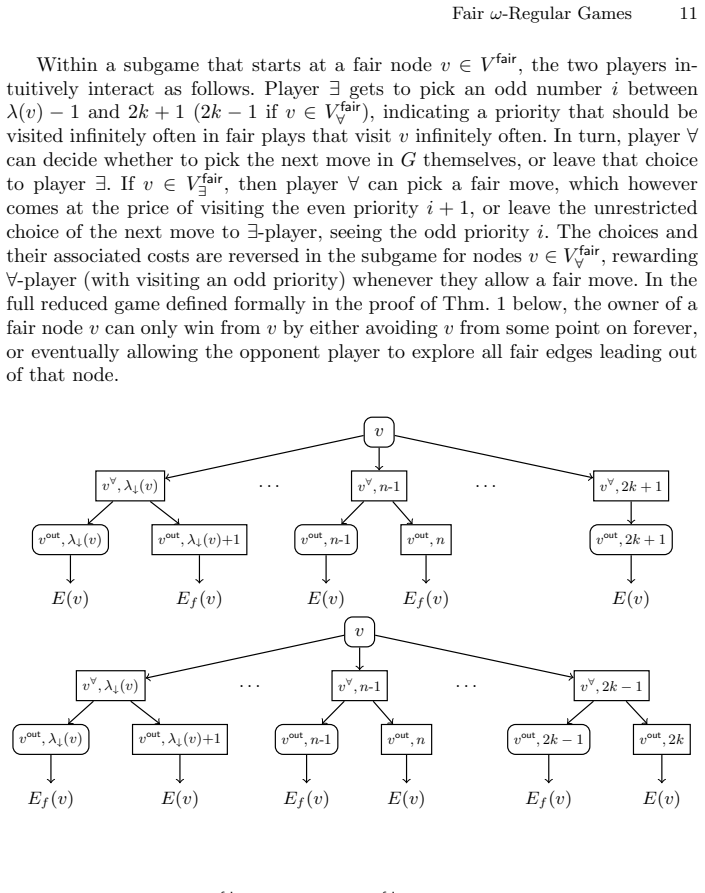
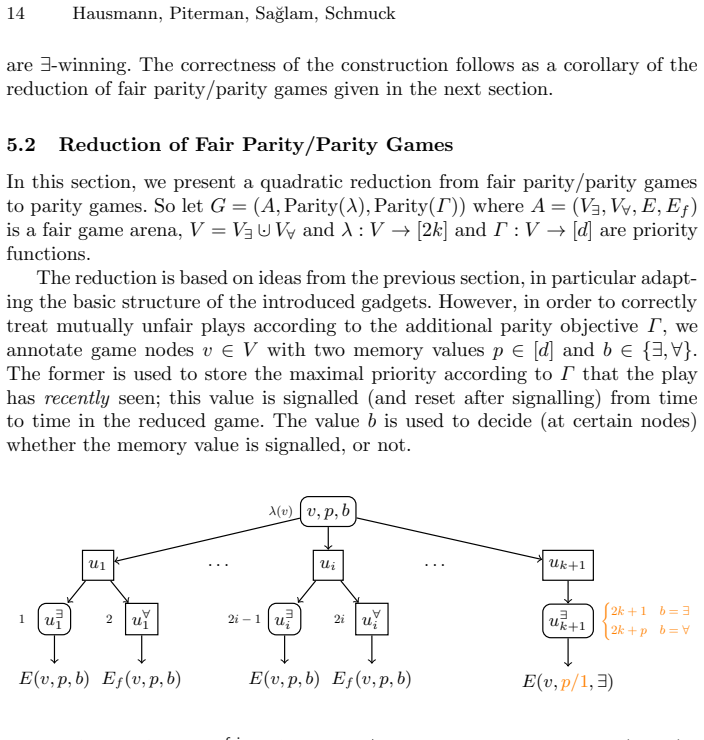
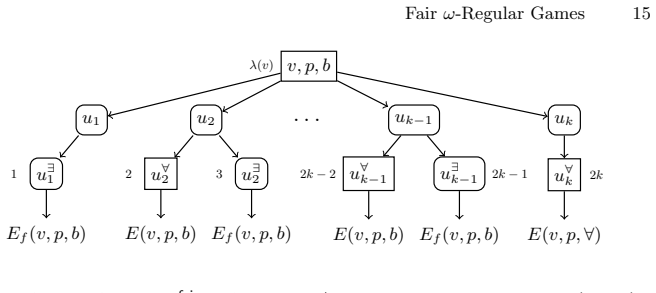
A gadget construction, modeled on the stochastic-parity reduction, that augments the original graph so fairness constraints are encoded as ordinary parity conditions while preserving the winner.
If this is right
- Existing parity-game solvers can be reused for fair parity/parity games after the polynomial gadget reduction.
- The determinacy result extends immediately to any pair of ω-regular conditions α and β.
- The direct symbolic algorithm provides an alternative route that avoids explicit graph transformation.
- The translation between gadget and fixpoint methods applies to the one-sided fairness variant as well.
Where Pith is reading between the lines
- The same gadget technique may extend to other ω-regular conditions beyond parity.
- Implementation of the reduction on small benchmark graphs would allow direct verification that the winner is unchanged.
- The shared structure with stochastic games suggests possible transfer of approximation or learning algorithms between the two settings.
Load-bearing premise
The gadget construction preserves the winner of the original fair parity game without adding or removing strategies for either player.
What would settle it
A concrete fair parity game instance whose winner differs from the winner of the game obtained after applying the described gadget reduction.
Figures
read the original abstract
We consider two-player games over finite graphs in which both players are restricted by fairness constraints on their moves. Given a two player game graph $G=(V,E)$ and a set of fair moves $E_f\subseteq E$ a player is said to play "fair" in $G$ if they choose an edge $e \in E_f$ infinitely often whenever the source vertex of $e$ is visited infinitely often. Otherwise, they play "unfair". We equip such games with two $\omega$-regular winning conditions $\alpha$ and $\beta$ deciding the winner of mutually fair and mutually unfair plays, respectively. Whenever one player plays fair and the other plays unfair, the fairly playing player wins the game. The resulting games are called "fair $\alpha/\beta$ games". We formalize fair $\alpha/\beta$ games and show that they are determined. For fair parity/parity games, i.e., fair $\alpha/\beta$ games where $\alpha$ and $\beta$ are given each by a parity condition over $G$, we provide a polynomial reduction to (normal) parity games via a gadget construction inspired by the reduction of stochastic parity games to parity games. We further give a direct symbolic fixpoint algorithm to solve fair parity/parity games. On a conceptual level, we illustrate the translation between the gadget-based reduction and the direct symbolic algorithm which uncovers the underlying similarities of solution algorithms for fair and stochastic parity games, as well as for the recently considered class of fair games where only one player is restricted by fair moves.
Editorial analysis
A structured set of objections, weighed in public.
Referee Report
Summary. The paper introduces fair α/β games on finite directed graphs, where each player is subject to a fairness constraint (must take fair edges infinitely often from infinitely visited sources) and the winner is decided by α on mutually fair plays, by β on mutually unfair plays, and by the fair player in mixed cases. It proves determinacy for general fair α/β games. Specializing to fair parity/parity games, it supplies a polynomial reduction to ordinary parity games via a gadget construction modeled on the known stochastic-parity reduction, an independent symbolic fixpoint algorithm, and an explicit translation establishing equivalence of the two solution methods at the level of attractors and parity conditions.
Significance. If the claims hold, the work extends the algorithmic theory of parity games to the doubly fair setting while preserving polynomial-time solvability. The explicit equivalence between the gadget reduction and the fixpoint algorithm, together with the connection to both stochastic parity games and one-sided fair games, supplies a conceptual unification that is likely to be useful for future extensions.
minor comments (3)
- [Abstract] The abstract refers to 'Section on the reduction' without a number; replace with the actual section number once the manuscript is typeset.
- [Reduction section] The description of the gadget is high-level in the abstract; ensure the main text supplies a self-contained diagram or pseudocode for the gadget so that the preservation argument can be checked without external references.
- [Conceptual translation subsection] The translation between the gadget reduction and the fixpoint algorithm is described as 'illustrat[ing] the underlying similarities'; add a short table or diagram that directly maps the attractor sets and parity priorities of one method onto the other.
Simulated Author's Rebuttal
We thank the referee for their positive assessment of the manuscript, accurate summary of the contributions on fair α/β games, and recommendation to accept. We are pleased that the connections to stochastic parity games and one-sided fair games are viewed as providing useful conceptual unification.
Circularity Check
No significant circularity; derivation is self-contained
full rationale
The paper proves determination of fair α/β games directly and reduces fair parity/parity games to ordinary parity games (known to be solvable in polynomial time) via an explicit gadget construction. The gadget is modeled on a cited external reduction for stochastic parity games rather than any author prior result. An independent symbolic fixpoint algorithm is supplied, with an explicit translation proving equivalence of the two solution methods at the level of attractors and parity conditions. No load-bearing step reduces by definition, by fitted parameter, or by self-citation chain to the paper's own inputs; the target parity games remain independently decidable.
Axiom & Free-Parameter Ledger
axioms (2)
- standard math Parity games are determined and solvable in polynomial time
- domain assumption The gadget construction preserves winning regions exactly as in the stochastic-parity reduction
Reference graph
Works this paper leans on
-
[1]
Aminof, B., Ball, T., Kupferman, O.: Reasoning about systems with transition fair- ness. In: Baader, F., Voronkov, A. (eds.) Logic for Programming, Artificial Intel- ligence, and Reasoning, 11th International Conference, LPAR 2004, Montevideo, Uruguay, March 14-18, 2005, Proceedings. Lecture Notes in Computer Science, vol. 3452, pp. 194–208. Springer (200...
-
[2]
In: Beck, J.C., Buffet, O., Hoffmann, J., Karpas, E., Sohrabi, S
Aminof, B., Giacomo, G.D., Rubin, S.: Stochastic fairness and language- theoretic fairness in planning in nondeterministic domains. In: Beck, J.C., Buffet, O., Hoffmann, J., Karpas, E., Sohrabi, S. (eds.) Proceedings of the Thirtieth International Conference on Automated Planning and Schedul- ing, Nancy, France, October 26-30, 2020. pp. 20–28. AAAI Press ...
work page 2020
-
[3]
Baldan, P., K¨ onig, B., Mika-Michalski, C., Padoan, T.: Fixpoint games on continuous lattices. Proc. ACM Program. Lang. 3(POPL), 26:1–26:29 (2019). https://doi.org/10.1145/3290339, https://doi.org/10.1145/3290339
-
[4]
Banerjee, T., Majumdar, R., Mallik, K., Schmuck, A., Soudjani, S.: Fast symbolic algorithms for omega-regular games under strong transi- tion fairness. TheoretiCS 2 (2023). https://doi.org/10.46298/theoretics.23.4, https://doi.org/10.46298/theoretics.23.4
-
[5]
B¨ uchi, J., Landweber, L.: Solving sequential conditions by finite-state strategies. Trans. Amer. Math. Soc. 138, 295–311 (1969)
work page 1969
-
[6]
Chatterjee, K., de Alfaro, L., Faella, M., Majumdar, R., Raman, V.: Code aware resource management. Formal Methods Syst. Des. 42(2), 146–174 (2013). https://doi.org/10.1007/s10703-012-0170-4, https://doi.org/10.1007/s10703-012- 0170-4
-
[7]
In: International Workshop on Computer Science Logic
Chatterjee, K., Jurdzi´ nski, M., Henzinger, T.A.: Simple stochastic parity games. In: International Workshop on Computer Science Logic. pp. 100–113. Springer (2003)
work page 2003
-
[8]
In: In Proceedings of the International Conference for Computer Science Logic (CSL)
Chatterjee, K., Jurdzinski, M., Henzinger, T.: Simple stochastic parity games. In: In Proceedings of the International Conference for Computer Science Logic (CSL). pp. 100–113 (2003), http://chess.eecs.berkeley.edu/pubs/729.html
work page 2003
-
[9]
Journal of Symbolic Logic 28(4) (1963)
Church, A.: Application of recursive arithmetic to the problem of circuit synthesis. Journal of Symbolic Logic 28(4) (1963)
work page 1963
-
[10]
D’Ippolito, N., Rodr´ ıguez, N., Sardi˜ na, S.: Fully observable non-deterministic plan- ning as assumption-based reactive synthesis. J. Artif. Intell. Res. 61, 593–621 (2018). https://doi.org/10.1613/jair.5562, https://doi.org/10.1613/jair.5562
-
[11]
Nonlinear Analysis: Hybrid Systems 51, 101430 (2024)
Majumdar, R., Mallik, K., Schmuck, A.K., Soudjani, S.: Symbolic control for stochastic systems via finite parity games. Nonlinear Analysis: Hybrid Systems 51, 101430 (2024). https://doi.org/https://doi.org/10.1016/j.nahs.2023.101430
-
[12]
Annals of Mathematics 65, 363–371 (1975)
Martin, D.: Borel determinacy. Annals of Mathematics 65, 363–371 (1975)
work page 1975
-
[13]
In: Gr¨ adel, E., Thomas, W., Wilke, T
Mazala, R.: Infinite games. In: Gr¨ adel, E., Thomas, W., Wilke, T. (eds.) Automata, Logics, and Infinite Games: A Guide to Current Research. Lecture Notes in Com- puter Science, vol. 2500, pp. 23–42. Springer (2001)
work page 2001
-
[14]
Lecture Notes in Computer Science, vol
Meyer, P.J., Sickert, S., Luttenberger, M.: Strix: Explicit reactive synthesis strikes back! In: 30th International Conference on Computer Aided Verification. Lecture Notes in Computer Science, vol. 10981, pp. 578–586. Springer (2018)
work page 2018
-
[15]
Nilsson, P., Ozay, N., Liu, J.: Augmented finite transition systems as abstrac- tions for control synthesis. Discret. Event Dyn. Syst. 27(2), 301–340 (2017). https://doi.org/10.1007/s10626-017-0243-z, https://doi.org/10.1007/s10626-017- 0243-z 20 Hausmann, Piterman, Sa˘ glam, Schmuck
-
[16]
Piterman, N., Pnueli, A., Sa’ar, Y.: Synthesis of reactive(1) designs. In: Proceedings of the 7th International Conference on Verification, Model Checking, and Abstract Interpretation. p. 364–380. VMCAI’06, Springer-Verlag, Berlin, Heidelberg (2006)
work page 2006
- [17]
-
[18]
Rabin, M.: Decidability of second order theories and automata on infinite trees. Trans. Amer. Math. Soc. 141, 1–35 (1969)
work page 1969
-
[19]
Sa˘ glam, I., Schmuck, A.K.: Solving odd-fair parity games. In: 42th IARCS Annual Conference on Foundations of Software Technology and Theoretical Computer Sci- ence (2023), (to appear)
work page 2023
-
[20]
Schewe, S., Finkbeiner, B.: Bounded synthesis. In: 4th Int. Symp. on Automated Technology for Verification and Analysis. Lecture Notes in Computer Science, vol. 4218, pp. 245–259. Springer (2006)
work page 2006
-
[21]
Systems & control letters 33(4), 265–274 (1998)
Thistle, J.G., Malham´ e, R.: Control of ω-automata under state fairness assump- tions. Systems & control letters 33(4), 265–274 (1998)
work page 1998
-
[22]
Handbook of Formal Language The- ory III, 389–455 (1997)
Thomas, W.: Languages, automata, and logic. Handbook of Formal Language The- ory III, 389–455 (1997)
work page 1997
-
[23]
Walukiewicz, I.: Monadic second-order logic on tree-like structures. Theor. Com- put. Sci. 275(1-2), 311–346 (2002). https://doi.org/10.1016/S0304-3975(01)00185- 2, https://doi.org/10.1016/S0304-3975(01)00185-2
-
[24]
Zielonka, W.: Infinite games on finitely coloured graphs with applications to automata on infinite trees. Theor. Comput. Sci. 200(1-2), 135–183 (1998). https://doi.org/10.1016/S0304-3975(98)00009-7, https://doi.org/10.1016/S0304- 3975(98)00009-7 Fair ω-Regular Games 21 A Full Proofs for Section 3 In this section we show equivalences of the winning conditi...
-
[25]
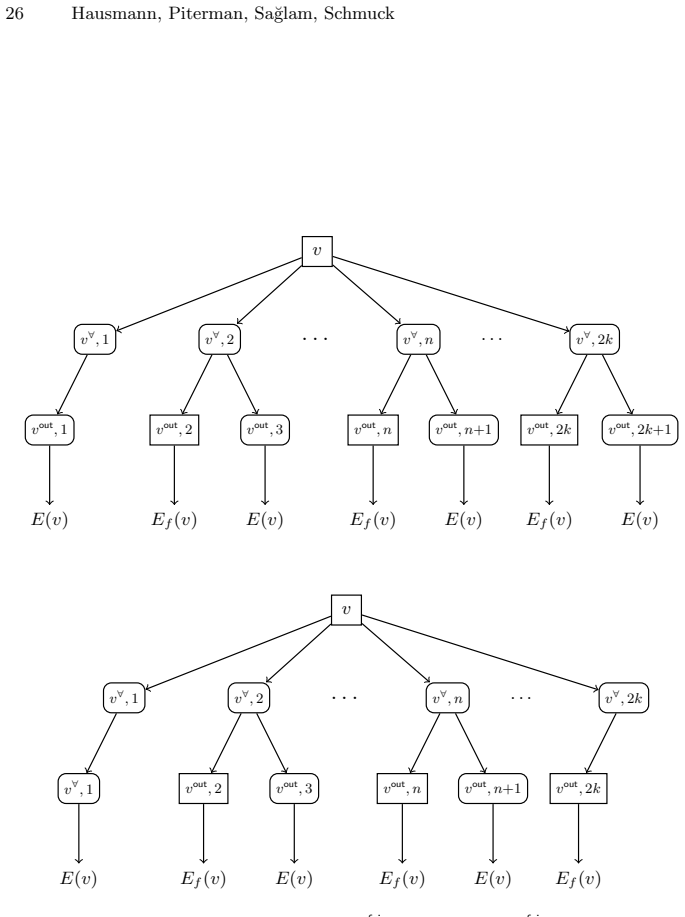
Moreover, this is exactly the reason why in Fig. 4, we start the children of v from (v∀, λ↓(v)) instead of (v∀, 1). We can do the latter as well, but we prefer to have a slightly reduced version of the gadgets by ignoring unnecessary branches. The universal gadgets for fair parity/⊥ are given in Fig. 9 in their “full version” instead of the “reduced versi...
discussion (0)
Sign in with ORCID, Apple, or X to comment. Anyone can read and Pith papers without signing in.