Exploring the Potential for Detecting Rotational Instabilities in Binary Neutron Star Merger Remnants with Gravitational Wave Detectors
Pith reviewed 2026-05-24 05:52 UTC · model grok-4.3
The pith
Third-generation gravitational wave detector networks could detect rotational instabilities in neutron star merger remnants at up to 200 Mpc.
A machine-rendered reading of the paper's core claim, the machinery that carries it, and where it could break.
Core claim
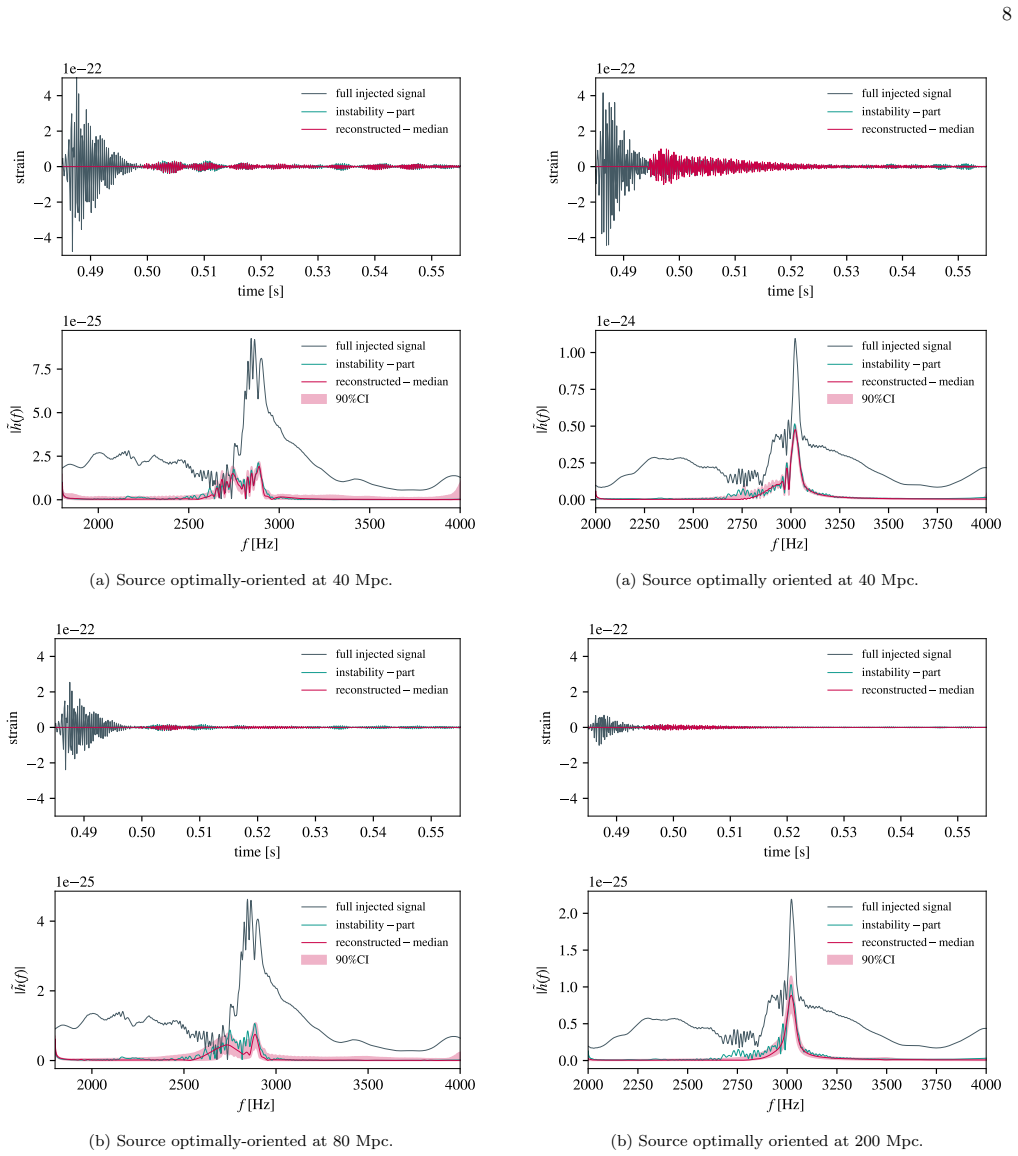
Numerically generated post-merger waveforms exhibit re-excitation of the l=m=2 f-mode at O(10) ms after merger due to rotational instabilities. When these waveforms are injected into colored Gaussian noise and reconstructed via Bayesian wavelet inference, the overlap computed on the instability portion alone shows that planned 3rd-generation detector networks can infer the presence of the instabilities, with detectability depending on total mass and distance; a high-frequency detector design reaches this threshold even at 200 Mpc.
What carries the argument
Wavelet-based Bayesian reconstruction of the post-merger signal, restricted to the O(10) ms instability window, used to compute overlap with injected numerical waveforms containing the re-excited l=m=2 f-mode.
If this is right
- Rotational instabilities become inferable from post-merger signals using networks of planned 3rd-generation detectors for sources of appropriate mass and distance.
- A high-frequency detector design extends detection of the instability part to 200 Mpc and thereby increases the expected detection rate.
- An upgraded HLV network at twice A+ sensitivity detects the peak frequency of the full post-merger emission at 40 Mpc with network signal-to-noise ratio of 8.
- The reconstruction method isolates the later instability signal from the earlier post-merger emission.
Where Pith is reading between the lines
- If the overlap threshold holds in real data, the approach could supply new constraints on the remnant's angular momentum evolution shortly after merger.
- Detector optimization should include high-frequency sensitivity to capture these late-time features at greater distances.
- Cross-checking reconstructed instability times against electromagnetic signals from the same event could test links between rotation and other remnant properties.
- Applying the same reconstruction pipeline to a broader set of numerical waveforms with different equations of state would test robustness.
Load-bearing premise
The numerical post-merger waveforms correctly capture the re-excitation of the l=m=2 f-mode from rotational instabilities at roughly 10 ms after merger, and the wavelet Bayesian reconstruction isolates this feature from noise without significant bias.
What would settle it
A real binary neutron star merger event at 200 Mpc observed with the high-frequency detector design where the Bayesian wavelet reconstruction of the post-merger segment yields an overlap with any expected instability feature below the threshold needed for positive inference.
Figures




read the original abstract
We explore the potential for detecting rotational instabilities in the post-merger phase of binary neutron star mergers using different network configurations of upgraded and next-generation gravitational wave detectors. Our study employs numerically generated post-merger waveforms, which reveal the re-excitation of the $l=m=2$ $f$-mode at a time of $O(10{\rm})$ms after merger. We evaluate the detectability of these signals by injecting them into colored Gaussian noise and performing a reconstruction as a sum of wavelets using Bayesian inference. Computing the overlap between the reconstructed and injected signal, restricted to the instability part of the post-merger phase, we find that one could infer the presence of rotational instabilities with a network of planned 3rd-generation detectors, depending on the total mass and distance to the source. For a recently suggested high-frequency detector design, we find that the instability part would be detectable even at 200 Mpc, significantly increasing the anticipated detection rate. For a network consisting of the existing HLV detectors, but upgraded to twice the A+ sensitivity, we confirm that the peak frequency of the whole post-merger gravitational-wave emission could be detectable with a network signal-to-noise ratio of 8 at a distance of 40Mpc.
Editorial analysis
A structured set of objections, weighed in public.
Referee Report
Summary. The manuscript explores the detectability of rotational instabilities in binary neutron star merger remnants using gravitational-wave signals. It employs numerically generated post-merger waveforms exhibiting re-excitation of the l=m=2 f-mode at O(10) ms after merger. These signals are injected into colored Gaussian noise for various detector networks (including planned 3G configurations and a high-frequency design), reconstructed as sums of wavelets via Bayesian inference, and assessed for detectability through overlap metrics restricted to the instability phase. The authors conclude that 3G networks could infer the presence of instabilities depending on total mass and distance, with the high-frequency design enabling detection even at 200 Mpc, while upgraded HLV detectors could detect the peak post-merger frequency at 40 Mpc with network SNR of 8.
Significance. If the NR waveforms faithfully capture the physical re-excitation feature and the reconstruction isolates it without significant bias, the results would strengthen the case for using future detector networks to probe post-merger dynamics, potentially raising the expected detection rate for rotational instability signals. The concrete overlap-based estimates for specific configurations provide actionable input for detector design studies.
major comments (2)
- [§2 (Numerical waveforms)] §2 (Numerical waveforms): The detectability claims at large distances (e.g., 200 Mpc) rest on the injected NR waveforms accurately containing a physical re-excitation of the l=m=2 f-mode at O(10) ms. No convergence tests, resolution studies, or cross-code comparisons are reported for this late-time window. Post-merger evolutions are sensitive to grid resolution, artificial viscosity, and omitted microphysics, so the absence of such validation directly affects whether the reported overlaps support the stated conclusions.
- [§3–4 (Reconstruction and overlap)] §3–4 (Reconstruction and overlap): The overlap is computed only on the instability-restricted portion after wavelet-based Bayesian reconstruction, but the manuscript provides insufficient detail on time-window selection, prior choices, number of wavelets, or tests for reconstruction bias/mismatch. Without these, it is unclear whether the quantitative detectability thresholds (SNR 8 at 40 Mpc, detection at 200 Mpc) are robust to analysis choices.
minor comments (2)
- [Abstract and §2] The abstract and methods should explicitly reference the specific NR simulations (codes, resolutions, EOS) used to generate the waveforms.
- [Figures and §4] Figure captions and text should clarify the exact time intervals used for the 'instability part' overlap calculation.
Simulated Author's Rebuttal
We thank the referee for their careful reading of the manuscript and for the constructive comments, which have helped us identify areas for improvement. We address each major comment below and indicate the changes planned for the revised version.
read point-by-point responses
-
Referee: §2 (Numerical waveforms): The detectability claims at large distances (e.g., 200 Mpc) rest on the injected NR waveforms accurately containing a physical re-excitation of the l=m=2 f-mode at O(10) ms. No convergence tests, resolution studies, or cross-code comparisons are reported for this late-time window. Post-merger evolutions are sensitive to grid resolution, artificial viscosity, and omitted microphysics, so the absence of such validation directly affects whether the reported overlaps support the stated conclusions.
Authors: We acknowledge that the current manuscript does not present dedicated convergence tests or resolution studies focused on the late-time re-excitation window. The waveforms originate from a published set of simulations whose early post-merger behavior has been cross-checked in prior work, and the re-excitation feature itself has been reported across multiple independent NR codes. Nevertheless, to directly address the referee’s concern we will add a dedicated paragraph in §2 that (i) specifies the grid resolutions and artificial-viscosity settings employed, (ii) cites supporting literature demonstrating the robustness of the l=m=2 f-mode re-excitation, and (iii) notes the absence of new cross-code comparisons as a limitation. These additions will make the numerical foundation of the detectability claims more transparent. revision: partial
-
Referee: §3–4 (Reconstruction and overlap): The overlap is computed only on the instability-restricted portion after wavelet-based Bayesian reconstruction, but the manuscript provides insufficient detail on time-window selection, prior choices, number of wavelets, or tests for reconstruction bias/mismatch. Without these, it is unclear whether the quantitative detectability thresholds (SNR 8 at 40 Mpc, detection at 200 Mpc) are robust to analysis choices.
Authors: We agree that the description of the Bayesian wavelet reconstruction is currently too terse. In the revised manuscript we will expand §§3–4 to report: the precise time intervals used to isolate the instability phase, the prior ranges and hyper-parameters for the wavelet amplitudes, phases and times, the typical number of wavelets retained by the nested-sampling algorithm, and the results of controlled injection-recovery tests that quantify any systematic bias or mismatch in the recovered overlap. These additions will allow readers to assess the robustness of the quoted SNR and distance thresholds. revision: yes
Circularity Check
No circularity; detectability follows from external NR injections plus standard wavelet Bayesian reconstruction
full rationale
The derivation injects externally generated post-merger NR waveforms (revealing f-mode re-excitation at O(10) ms) into colored Gaussian noise, reconstructs them as sums of wavelets via Bayesian inference, and computes restricted overlaps to assess detectability for different detector networks. No equation defines a parameter or output in terms of the reported detectability itself, no fitted quantity is relabeled as a prediction, and no load-bearing step reduces to a self-citation chain or ansatz smuggled from prior work by the same authors. The chain is self-contained against external benchmarks (NR waveforms and standard Bayesian methods) and does not exhibit any of the enumerated circularity patterns.
Axiom & Free-Parameter Ledger
axioms (2)
- domain assumption Numerical relativity simulations accurately reproduce the re-excitation of the l=m=2 f-mode due to rotational instabilities at O(10) ms post-merger.
- domain assumption Bayesian wavelet reconstruction can isolate the instability portion of the signal from detector noise without model mismatch that would invalidate the overlap metric.
Lean theorems connected to this paper
-
IndisputableMonolith/Foundation/RealityFromDistinction.leanreality_from_one_distinction unclear?
unclearRelation between the paper passage and the cited Recognition theorem.
We employ numerically generated post-merger waveforms... re-excitation of the l=m=2 f-mode at O(10) ms after merger... overlap between the reconstructed and injected signal, restricted to the instability part
-
IndisputableMonolith/Cost/FunctionalEquation.leanwashburn_uniqueness_aczel unclear?
unclearRelation between the paper passage and the cited Recognition theorem.
Computing the overlap... BayesWave pipeline... sum of wavelets using Bayesian inference
What do these tags mean?
- matches
- The paper's claim is directly supported by a theorem in the formal canon.
- supports
- The theorem supports part of the paper's argument, but the paper may add assumptions or extra steps.
- extends
- The paper goes beyond the formal theorem; the theorem is a base layer rather than the whole result.
- uses
- The paper appears to rely on the theorem as machinery.
- contradicts
- The paper's claim conflicts with a theorem or certificate in the canon.
- unclear
- Pith found a possible connection, but the passage is too broad, indirect, or ambiguous to say the theorem truly supports the claim.
Reference graph
Works this paper leans on
-
[1]
Abbott B.P., et al., Phys. Rev. Lett.116, 061102 (2016), arXiv:1602.03837 [gr-qc]
work page internal anchor Pith review Pith/arXiv arXiv 2016
-
[2]
Aasi J., et al., Classical and Quantum Gravity 32, 074001 (2015)
work page 2015
-
[3]
Acernese F., et al., Classical and Quantum Gravity 32, 024001 (2014)
work page 2014
-
[4]
Y. Aso, Y. Michimura, K. Somiya, M. Ando, O. Miyakawa, T. Sekiguchi, D. Tatsumi, and H. Yamamoto, Phys. Rev. D 88, 043007 (2013), arXiv:1306.6747 [gr-qc]
work page internal anchor Pith review Pith/arXiv arXiv 2013
-
[5]
(The KAGRA Collaboration), Phys
Aso Y., et al. (The KAGRA Collaboration), Phys. Rev. D 88, 043007 (2013)
work page 2013
- [6]
- [7]
-
[8]
(LIGO Scientific Collaboration and Virgo Collaboration), Phys
Abbott R., et al. (LIGO Scientific Collaboration and Virgo Collaboration), Phys. Rev. X 11, 021053 (2021)
work page 2021
-
[9]
Abbott R., et al., “Gwtc-2.1: Deep extended catalog of compact binary coalescences observed by ligo and virgo during the first half of the third observing run,” (2021)
work page 2021
-
[10]
Abbott R., et al., “Gwtc-3: Compact binary coales- cences observed by ligo and virgo during the second part of the third observing run,” (2021)
work page 2021
-
[11]
The population of merging com- pact binaries inferred using gravitational waves through gwtc-3,
Abbott R., et al., “The population of merging com- pact binaries inferred using gravitational waves through gwtc-3,” (2021)
work page 2021
-
[12]
A. H. Nitz, S. Kumar, Y.-F. Wang, S. Kastha, S. Wu, M. Sch¨ afer, R. Dhurkunde, and C. D. Capano, The Astrophysical Journal 946, 59 (2023)
work page 2023
- [13]
-
[14]
P., et al., The Astrophysical Journal Letters 892, L3 (2020)
Abbott B. P., et al., The Astrophysical Journal Letters 892, L3 (2020)
work page 2020
-
[15]
Baiotti, Arabian Journal of Mathematics 11 (2022), 10.1007/s40065-021-00357-7
L. Baiotti, Arabian Journal of Mathematics 11 (2022), 10.1007/s40065-021-00357-7
-
[16]
J. L. Friedman and N. Stergioulas, International Journal of Modern Physics D 29, 2041015 (2020)
work page 2020
-
[17]
N. Sarin and P. D. Lasky, General Relativity and Grav- itation 53, 59 (2021), arXiv:2012.08172 [astro-ph.HE]
-
[18]
Baiotti, Arabian Journal of Mathematics 11, 105–118 (2022)
L. Baiotti, Arabian Journal of Mathematics 11, 105–118 (2022)
work page 2022
- [19]
-
[20]
W. Del Pozzo, T. G. F. Li, M. Agathos, C. Van Den Broeck, and S. Vitale, Phys. Rev. Lett. 111, 071101 (2013)
work page 2013
-
[21]
Current-induced depairing in the Bi 2Te3/FeTe interfacial superconductor
K. Chatziioannou, K. Yagi, A. Klein, N. Cornish, and N. Yunes, Physical Review D 92 (2015), 10.1103/phys- revd.92.104008
-
[22]
B. D. Lackey and L. Wade, Phys. Rev. D 91, 043002 (2015)
work page 2015
-
[23]
F. Hernandez Vivanco, R. Smith, E. Thrane, P. D. Lasky, C. Talbot, and V. Raymond, Phys. Rev. D 100, 103009 (2019)
work page 2019
- [24]
- [25]
-
[26]
M. Breschi, S. Bernuzzi, D. Godzieba, A. Perego, and D. Radice, Phys. Rev. Lett. 128, 161102 (2022), arXiv:2110.06957 [gr-qc]
-
[27]
S. Blacker, N.-U. F. Bastian, A. Bauswein, D. B. Blaschke, T. Fischer, M. Oertel, T. Soultanis, and S. Typel, Phys. Rev. D 102, 123023 (2020)
work page 2020
-
[28]
K. W. Tsang, T. Dietrich, and C. Van Den Broeck, Phys. Rev. D 100, 044047 (2019)
work page 2019
-
[29]
A. Bauswein and S. Blacker, The European Physical Journal Special Topics 229, 3595–3604 (2020)
work page 2020
-
[30]
F. Iacovelli, M. Mancarella, C. Mondal, A. Puecher, T. Dietrich, F. Gulminelli, M. Maggiore, and M. Oertel, (2023), arXiv:2308.12378 [gr-qc]
- [31]
-
[32]
K. Chatziioannou, Phys. Rev. D 105, 084021 (2022), arXiv:2108.12368 [gr-qc]
-
[33]
K. Chatziioannou and W. M. Farr, Phys. Rev. D 102, 064063 (2020), arXiv:2005.00482 [astro-ph.HE]
- [34]
-
[35]
K. Chatziioannou and S. Han, Phys. Rev. D101, 044019 (2020), arXiv:1911.07091 [gr-qc]
-
[36]
A. Bauswein, O. Just, H.-T. Janka, and N. Stergioulas, The Astrophysical Journal Letters 850, L34 (2017)
work page 2017
- [37]
-
[38]
Chatziioannou, General Relativity and Gravitation 52 (2020), 10.1007/s10714-020-02754-3
K. Chatziioannou, General Relativity and Gravitation 52 (2020), 10.1007/s10714-020-02754-3
-
[39]
T. Dietrich, T. Hinderer, and A. Samajdar, General Relativity and Gravitation 53 (2021), 10.1007/s10714- 020-02751-6
-
[40]
R. Kashyap, A. Das, D. Radice, S. Padamata, A. Prakash, D. Logoteta, A. Perego, D. A. Godzieba, S. Bernuzzi, I. Bombaci, F. J. Fattoyev, B. T. Reed, and A. d. S. Schneider, Phys. Rev. D 105, 103022 (2022), arXiv:2111.05183 [astro-ph.HE]
-
[41]
W. Kastaun and F. Ohme, Phys. Rev. D 104, 023001 (2021), arXiv:2103.01586 [astro-ph.HE]
-
[42]
W. Kastaun and F. Ohme, Phys. Rev. D 100, 103023 (2019), arXiv:1909.12718 [gr-qc]
-
[43]
K. Chatziioannou, Gen. Rel. Grav. 52, 109 (2020), arXiv:2006.03168 [gr-qc]
-
[44]
P., et al., The Astrophysical Journal 848, L12 (2017)
Abbott B. P., et al., The Astrophysical Journal 848, L12 (2017)
work page 2017
-
[45]
GW170817: The Dawn of Multi- messenger Astronomy Including Gravitational Waves,
M. Branchesi, “GW170817: The Dawn of Multi- messenger Astronomy Including Gravitational Waves,” in Multiple Messengers and Challenges in Astroparticle Physics, edited by R. Aloiso, E. Coccia, and F. Vissani (2018) pp. 489–497
work page 2018
-
[46]
Troja E., et al., Nature 551, 71 (2017), arXiv:1710.05433 [astro-ph.HE]
work page internal anchor Pith review Pith/arXiv arXiv 2017
-
[47]
Savchenko V., et al., ApJ 848, L15 (2017), arXiv:1710.05449 [astro-ph.HE]
work page internal anchor Pith review Pith/arXiv arXiv 2017
-
[48]
A. Goldstein, P. Veres, E. Burns, M. S. Briggs, R. Ham- burg, D. Kocevski, C. A. Wilson-Hodge, R. D. Preece, S. Poolakkil, O. J. Roberts, C. M. Hui, V. Con- naughton, J. Racusin, A. von Kienlin, T. Dal Canton, N. Christensen, T. Littenberg, K. Siellez, L. Blackburn, 16 J. Broida, E. Bissaldi, W. H. Cleveland, M. H. Gibby, M. M. Giles, R. M. Kippen, S. McB...
work page internal anchor Pith review Pith/arXiv arXiv 2017
-
[49]
Colombo A., et al., The Astrophysical Journal 937, 79 (2022)
work page 2022
-
[50]
M. C. Miller, F. K. Lamb, A. J. Dittmann, S. Bogdanov, Z. Arzoumanian, K. C. Gendreau, S. Guillot, W. C. G. Ho, J. M. Lattimer, M. Loewenstein, S. M. Morsink, P. S. Ray, M. T. Wolff, C. L. Baker, T. Cazeau, S. Man- thripragada, C. B. Markwardt, T. Okajima, S. Pollard, I. Cognard, H. T. Cromartie, E. Fonseca, L. Guillemot, M. Kerr, A. Parthasarathy, T. T. ...
work page 2021
-
[51]
G. Raaijmakers, S. K. Greif, T. E. Riley, T. Hinderer, K. Hebeler, A. Schwenk, A. L. Watts, S. Nissanke, S. Guillot, J. M. Lattimer, and R. M. Ludlam, The Astrophysical Journal Letters 893, L21 (2020)
work page 2020
-
[52]
E. R. Most, L. R. Weih, L. Rezzolla, and J. Schaffner- Bielich, Phys. Rev. Lett. 120, 261103 (2018)
work page 2018
- [53]
-
[54]
S. Traversi, P. Char, and G. Pagliara, The Astrophysi- cal Journal 897, 165 (2020)
work page 2020
- [55]
-
[56]
T. Dietrich, M. W. Coughlin, P. T. H. Pang, M. Bulla, J. Heinzel, L. Issa, I. Tews, and S. Antier, Science 370, 1450 (2020)
work page 2020
- [57]
-
[58]
M. Breschi, Inferring the equation of state with multi- messenger signals from binary neutron star mergers , Ph.D. thesis, Friedrich-Schiller-Universit¨ at Jena, Jena U. (2023)
work page 2023
-
[59]
M. Breschi, R. Gamba, and S. Bernuzzi, Phys. Rev. D 104, 042001 (2021), arXiv:2102.00017 [gr-qc]
-
[60]
Abadie J., et al., Classical and Quantum Gravity 27, 173001 (2010)
work page 2010
- [61]
-
[62]
K. Chatziioannou, J. A. Clark, A. Bauswein, M. Mill- house, T. B. Littenberg, and N. Cornish, Physical Re- view D 96 (2017), 10.1103/physrevd.96.124035
-
[63]
A. Torres-Rivas, K. Chatziioannou, A. Bauswein, and J. A. Clark, Physical Review D 99 (2019), 10.1103/physrevd.99.044014
-
[64]
The effect of noise artefacts on gravitational-wave searches for neutron star post-merger remnants,
F. H. Panther and P. D. Lasky, “The effect of noise artefacts on gravitational-wave searches for neutron star post-merger remnants,” (2023), arXiv:2303.10847 [gr- qc]
-
[65]
P., et al., Classical and Quantum Gravity34, 044001 (2017)
Abbott B. P., et al., Classical and Quantum Gravity34, 044001 (2017)
work page 2017
-
[66]
N. Sarin and P. D. Lasky, Publications of the Astronom- ical Society of Australia39 (2022), 10.1017/pasa.2022.1
-
[67]
Martynov D., et al., Phys. Rev. D 99, 102004 (2019)
work page 2019
- [68]
-
[69]
Srivastava V., et al., The Astrophysical Journal 931, 22 (2022)
work page 2022
-
[70]
M. Breschi, R. Gamba, S. Borhanian, G. Carullo, and S. Bernuzzi, arXiv e-prints , arXiv:2205.09979 (2022), arXiv:2205.09979 [gr-qc]
-
[71]
T. Zhang, H. Yang, D. Martynov, P. Schmidt, and H. Miao, “A gravitational wave detector for post merger neutron stars: Beyond the quantum loss limit of michel- son fabry perot interferometer,” (2022)
work page 2022
-
[72]
S. D. Tootle, L. J. Papenfort, E. R. Most, and L. Rezzolla, The Astrophysical Journal Letters922, L19 (2021)
work page 2021
-
[73]
M. Shibata, K. Taniguchi, and K. b. o. Ury¯ u, Phys. Rev. D 71, 084021 (2005)
work page 2005
-
[74]
M. K¨ olsch, T. Dietrich, M. Ujevic, and B. Bruegmann, Phys. Rev. D 106, 044026 (2022), arXiv:2112.11851 [gr- qc]
-
[75]
M. Agathos, F. Zappa, S. Bernuzzi, A. Perego, M. Breschi, and D. Radice, Phys. Rev. D 101, 044006 (2020), arXiv:1908.05442 [gr-qc]
- [76]
-
[77]
T. W. Baumgarte, S. L. Shapiro, and M. Shibata, The Astrophysical Journal 528, L29 (1999)
work page 1999
-
[78]
K. Hotokezaka, K. Kiuchi, K. Kyutoku, T. Muranushi, Y.-i. Sekiguchi, M. Shibata, and K. Taniguchi, Phys. Rev. D 88, 044026 (2013)
work page 2013
- [79]
-
[80]
A. Bauswein, N. Stergioulas, and H.-T. Janka, The European Physical Journal A 52 (2016), 10.1140/epja/i2016-16056-7
discussion (0)
Sign in with ORCID, Apple, or X to comment. Anyone can read and Pith papers without signing in.