Geometric thermodynamics of reaction-diffusion systems: Thermodynamic trade-off relations and optimal transport for pattern formation
Pith reviewed 2026-05-24 06:12 UTC · model grok-4.3
The pith
A geometric decomposition of entropy production rate isolates the dissipation driving pattern formation in reaction-diffusion systems.
A machine-rendered reading of the paper's core claim, the machinery that carries it, and where it could break.
Core claim
We establish universal relations between pattern formation and dissipation with a geometric approach to nonequilibrium thermodynamics of deterministic reaction-diffusion systems. We first provide a way to systematically decompose the entropy production rate (EPR) based on the orthogonality of thermodynamic forces, in this way identifying the amount of dissipation caused by each factor. This enables us to extract the excess EPR that genuinely contributes to the time evolution of patterns. We also show that a similar geometric method further decomposes the EPR into detailed contributions. Second, we relate the excess EPR to the details of the change in patterns through two types of trade-off:,
What carries the argument
Orthogonality of thermodynamic forces in a geometric structure, used to decompose the entropy production rate and isolate the excess component that drives pattern formation.
If this is right
- Thermodynamic speed limits relate excess EPR directly to the speed of pattern formation.
- Thermodynamic uncertainty relations bound excess EPR using partial pattern information such as specific Fourier components.
- The optimal transport extension measures the speed of pattern evolution and solves for minimal-dissipation transitions between patterns.
- The relations apply to general deterministic reaction-diffusion systems.
Where Pith is reading between the lines
- The framework could be applied to experimental chemical systems to measure actual dissipation costs of observed patterns.
- Similar geometric decompositions might connect to pattern formation in fluid or biological systems with spatial structure.
- Minimal-dissipation protocols could inform design of energy-efficient synthetic chemical pattern generators.
Load-bearing premise
The chosen geometric structure makes thermodynamic forces orthogonal in a way that cleanly separates pattern-driving dissipation from other contributions.
What would settle it
A reaction-diffusion system where the extracted excess EPR does not satisfy the derived speed limits or uncertainty relations, or where the decomposition fails to uniquely attribute dissipation to pattern evolution.
Figures




read the original abstract
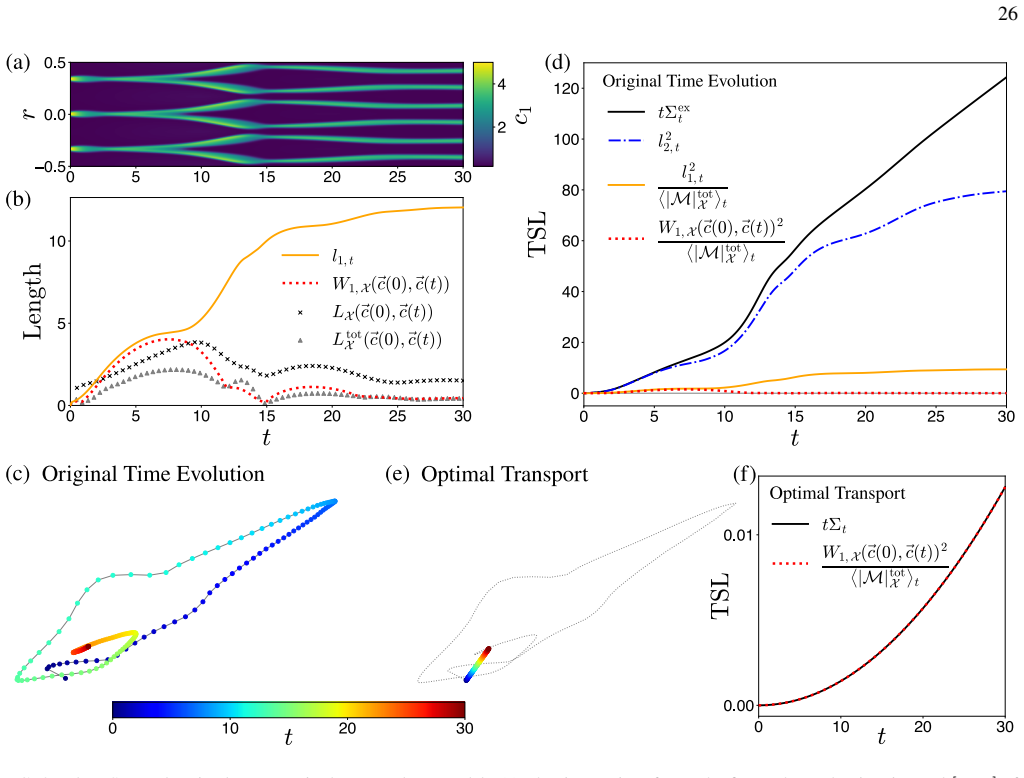
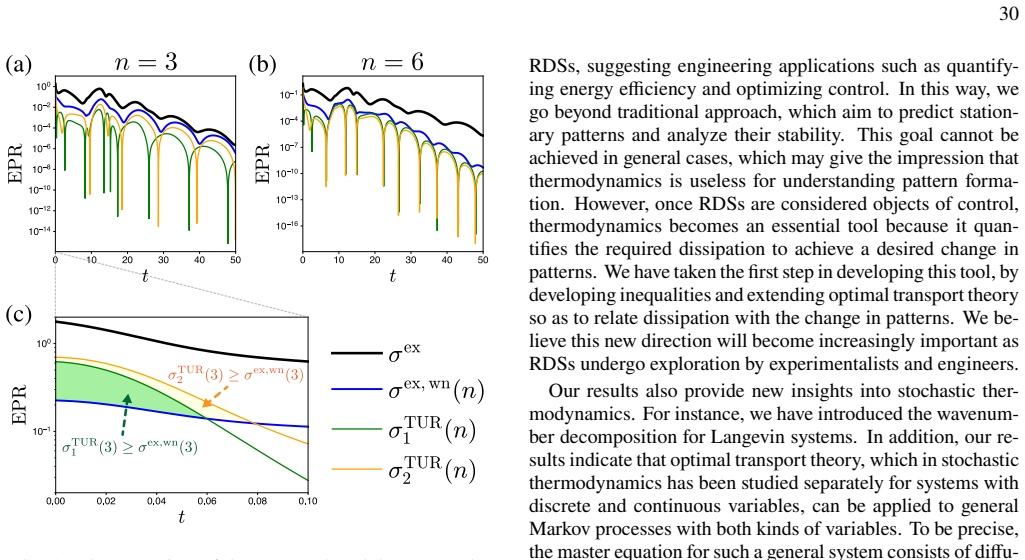
We establish universal relations between pattern formation and dissipation with a geometric approach to nonequilibrium thermodynamics of deterministic reaction-diffusion systems. We first provide a way to systematically decompose the entropy production rate (EPR) based on the orthogonality of thermodynamic forces, in this way identifying the amount of dissipation caused by each factor. This enables us to extract the excess EPR that genuinely contributes to the time evolution of patterns. We also show that a similar geometric method further decomposes the EPR into detailed contributions, e.g., the dissipation from each point in real or wavenumber space. Second, we relate the excess EPR to the details of the change in patterns through two types of thermodynamic trade-off relations for reaction-diffusion systems: thermodynamic speed limits and thermodynamic uncertainty relations. The former relates dissipation and the speed of pattern formation, and the latter bounds the excess EPR with partial information on patterns, such as specific Fourier components of concentration distributions. In connection with the derivation of the thermodynamic speed limits, we also extend optimal transport theory to reaction-diffusion systems, which enables us to measure the speed of the time evolution. This extension of optimal transport also solves the minimization problem of the dissipation associated with the transition between two patterns, and it constructs energetically efficient protocols for pattern formation. We numerically demonstrate our results using chemical traveling waves in the Fisher-Kolmogorov-Petrovsky-Piskunov equation and changes in symmetry in the Brusselator model. Our results apply to general reaction-diffusion systems and contribute to understanding the relations between pattern formation and unavoidable dissipation.
Editorial analysis
A structured set of objections, weighed in public.
Referee Report
Summary. The manuscript develops a geometric framework for nonequilibrium thermodynamics of deterministic reaction-diffusion systems. It decomposes the entropy production rate (EPR) by projecting thermodynamic forces onto orthogonal components in a chosen inner product, thereby isolating an 'excess' EPR that drives pattern evolution. From this decomposition the authors derive thermodynamic speed limits and uncertainty relations that bound the excess EPR in terms of pattern speed or partial pattern information (e.g., selected Fourier modes). They further extend optimal-transport theory to reaction-diffusion dynamics, obtaining both a speed measure and a variational principle for minimal-dissipation protocols between prescribed patterns. The claims are illustrated numerically on traveling waves in the Fisher-KPP equation and on symmetry-breaking transitions in the Brusselator model.
Significance. If the orthogonality-based decomposition is robust and the resulting trade-off relations hold for general reaction-diffusion systems, the work supplies a concrete, geometrically motivated link between dissipation and pattern dynamics together with a practical optimal-transport construction for low-dissipation control. The numerical demonstrations on two canonical models provide initial evidence of applicability, and the optimal-transport extension is a clear methodological advance.
major comments (2)
- [§3, Eqs. (8)–(12)] §3 (geometric EPR decomposition, Eqs. (8)–(12)): The excess EPR is defined via orthogonality in a specific inner product on the space of thermodynamic forces. The manuscript does not demonstrate that this partitioning is independent of the choice of inner product or of the grouping of reaction versus diffusion contributions. An alternative but equally admissible splitting (for example, a wavenumber-dependent weighting) would in general produce a quantitatively different excess term, undermining the claimed model-independent status of the subsequent speed limits and TURs.
- [§4.2] §4.2 (thermodynamic speed limits): The derivation of the speed limit relies on the excess EPR identified in the preceding decomposition. Because the uniqueness of that excess term has not been established, the speed-limit inequality is at present tied to one particular geometric splitting rather than being a universal feature of reaction-diffusion dynamics.
minor comments (3)
- [§2] Notation for the inner product and the projection operator is introduced without an explicit statement of the underlying Hilbert space; a short paragraph clarifying the domain and the precise definition of orthogonality would improve readability.
- [Figure 3] Figure 3 (Brusselator symmetry change): the color scale for the excess-EPR density is not labeled with units; adding the units and a brief caption explaining how the density is obtained from the local force projection would aid interpretation.
- [§5] The optimal-transport extension is presented as solving a minimization problem, yet the manuscript does not compare the obtained dissipation cost against any existing variational bounds for reaction-diffusion systems; a short remark on this point would strengthen the claim of energetic efficiency.
Simulated Author's Rebuttal
We thank the referee for the careful reading and constructive comments, which help clarify the scope of the geometric decomposition. We respond to each major comment below and will revise the manuscript to address the points raised.
read point-by-point responses
-
Referee: [§3, Eqs. (8)–(12)] §3 (geometric EPR decomposition, Eqs. (8)–(12)): The excess EPR is defined via orthogonality in a specific inner product on the space of thermodynamic forces. The manuscript does not demonstrate that this partitioning is independent of the choice of inner product or of the grouping of reaction versus diffusion contributions. An alternative but equally admissible splitting (for example, a wavenumber-dependent weighting) would in general produce a quantitatively different excess term, undermining the claimed model-independent status of the subsequent speed limits and TURs.
Authors: We agree that the decomposition is performed with respect to a specific inner product and that the manuscript does not establish independence from this choice. The inner product is the one naturally induced by the thermodynamic forces and the Onsager structure of the reaction-diffusion system, which makes the projection onto the excess component correspond to the part driving pattern evolution. Alternative inner products (such as wavenumber-dependent weightings) would indeed produce different numerical values for the excess term. We will revise §3 to state this dependence explicitly, justify the canonical choice of inner product on physical grounds, and qualify the subsequent claims so that the speed limits and TURs are understood to hold within this geometrically defined framework rather than as fully inner-product-independent results. revision: yes
-
Referee: [§4.2] §4.2 (thermodynamic speed limits): The derivation of the speed limit relies on the excess EPR identified in the preceding decomposition. Because the uniqueness of that excess term has not been established, the speed-limit inequality is at present tied to one particular geometric splitting rather than being a universal feature of reaction-diffusion dynamics.
Authors: The speed-limit derivation in §4.2 is indeed based on the excess EPR obtained from the decomposition in §3. We will revise §4.2 to make this dependence explicit and to clarify that the resulting inequalities characterize the trade-off for the chosen geometric splitting. The language regarding universality will be adjusted to reflect that the relations are universal for reaction-diffusion systems when the excess dissipation is identified via this orthogonality projection. revision: yes
Circularity Check
No circularity: geometric decomposition and OT extension are definitional constructions, not reductions to inputs
full rationale
The abstract and description present a geometric decomposition of EPR via orthogonality of thermodynamic forces as a systematic choice that isolates an 'excess' component by definition; this is not a fit to pattern data nor a renaming of an input quantity. The speed limits and TURs are derived from this decomposition, and the optimal-transport extension is framed as solving a minimization problem rather than reproducing a pre-specified result. No self-citation load-bearing steps, no fitted parameters relabeled as predictions, and no uniqueness theorems imported from the authors' prior work are visible in the provided text. The central claims therefore remain independent of the target quantities they relate to pattern formation.
Axiom & Free-Parameter Ledger
axioms (2)
- domain assumption Thermodynamic forces admit an orthogonal decomposition with respect to a suitable inner product that isolates the component driving pattern evolution.
- domain assumption The systems are deterministic reaction-diffusion equations without stochastic fluctuations.
Lean theorems connected to this paper
-
IndisputableMonolith/Cost/FunctionalEquation.leanwashburn_uniqueness_aczel echoes?
echoesECHOES: this paper passage has the same mathematical shape or conceptual pattern as the Recognition theorem, but is not a direct formal dependency.
the geometric excess/housekeeping decomposition... obtained by projecting the thermodynamic force onto the space of conservative forces... σex = inf F′|(∇†MF′)X=(∇†MF)X ⟪F′,F′⟫M
-
IndisputableMonolith/Foundation/AlphaCoordinateFixation.leanalpha_pin_under_high_calibration echoes?
echoesECHOES: this paper passage has the same mathematical shape or conceptual pattern as the Recognition theorem, but is not a direct formal dependency.
Although such a decomposition is not unique [59–61], we mainly focus on the geometric decomposition because it enables us to extract the part that essentially contributes to time evolution as excess EPR
What do these tags mean?
- matches
- The paper's claim is directly supported by a theorem in the formal canon.
- supports
- The theorem supports part of the paper's argument, but the paper may add assumptions or extra steps.
- extends
- The paper goes beyond the formal theorem; the theorem is a base layer rather than the whole result.
- uses
- The paper appears to rely on the theorem as machinery.
- contradicts
- The paper's claim conflicts with a theorem or certificate in the canon.
- unclear
- Pith found a possible connection, but the passage is too broad, indirect, or ambiguous to say the theorem truly supports the claim.
Forward citations
Cited by 2 Pith papers
-
Infinite variety of thermodynamic speed limits with general activities
A unified framework based on generalized means derives an infinite family of thermodynamic speed limits for Markov jump processes and chemical reaction networks, each giving a lower bound on entropy production.
-
Generalized free energy and excess/housekeeping decomposition in nonequilibrium systems: from large deviations to thermodynamic speed limits
Generalized free energy from large deviations enables excess/housekeeping decomposition of fluxes and dissipation plus thermodynamic speed limits in driven nonequilibrium systems.
Reference graph
Works this paper leans on
-
[1]
Sufficiency of Eq. (9) for orthogonality, and the uniqueness of its solution Letting F ∗ be the gradient of a potential as F ∗ = ∇rϕ∗, we can rewrite the inner product between F ∗ and F − F ∗ as ⟪F ∗, F − F ∗⟫M = ⟪∇rϕ∗, F − ∇rϕ∗⟫M = Z Rd dr ∇rϕ∗ · M(F − ∇rϕ∗) = − Z Rd dr ϕ∗∇r · [M(F − ∇rϕ∗)], (A1) where we used the boundary condition for p(r; t) to ignore...
-
[2]
(11) and (13)] The condition in Eq
The derivation of minimization problems [Eqs. (11) and (13)] The condition in Eq. (9) also leads to the orthogonality ⟪F ∗, F ′ − F ∗⟫M = 0, (A4) where F ′ satisfies the condition in Eq. (11). We can check it by calculating in a similar way as in Eq. (A1). Using the orthogonality in Eq. (A4), we obtain the inequality ⟪F ′, F ′⟫M = ⟪F ∗, F ∗⟫M + ⟪F ′ − F ∗...
-
[3]
(9) as the Euler–Lagrange equation We remark that the conditions Eq
The derivation of the condition Eq. (9) as the Euler–Lagrange equation We remark that the conditions Eq. (9) and F ∗ = ∇rϕ∗ are conversely obtained from two variational problems Eqs. (12) and (14). By considering the action functionals Ihk[ϕ] := 1 2 ⟪F − ∇rϕ, F − ∇rϕ⟫M = Z dr Ihk, (A8) Iex[F ′, ϕ] := 1 2 ⟪F ′, F ′⟫M + Z dr ϕ{∇r · [M(F − F ′)]} = Z dr Iex ...
-
[4]
The Euler–Lagrange equation for the projection and the uniqueness of the projected conservative force First, we derive Eq. (85) from Eq. (84). We define a func- tional to minimize as Ihk[→ϕ] := ⟪F − ∇ →ϕ, F − ∇ →ϕ⟫ M /2 =R V drIhk with Ihk :=1 2 h →F − ∇r →ϕ i⊤↔M h →F − ∇r →ϕ i + 1 2 h f − ∇s →ϕ i⊤ m h f − ∇s →ϕ i . (B1) 33 The functional derivative of Ih...
-
[5]
The Euler–Lagrange equation for the minimum dissipation We derive the condition (85) from the minimization problem in Eq. (87). To solve this constraint minimization problem, we execute the method of Lagrange multiplier with the multiplier→ϕ, whose external part is the zero vector as →ϕY = →0Y. Then, the functional to optimize is Iex[F ′, →ϕ] := 1 2 ⟪F ′,...
-
[6]
Relaxation to equilibrium and gradient flow of the ideal solutions We consider relaxation to the equilibrium of a closed ideal dilute solution without mechanical forces, where the chemical potential is written as µid α = µ◦ α + ln cα. Since the system is closed and there is no mechanical force applied to the system, there exists an equilibrium concentrati...
-
[7]
III E, we decompose the force at timet as F = ∇→ϕ(t) + Fnc
Relaxation due to the conservative force In Sec. III E, we decompose the force at timet as F = ∇→ϕ(t) + Fnc. (C7) Note that F and Fnc also depend on time, and the external part of the potential →ϕ(t) is the zero vector. Using the potential →ϕ(t), we can introduce a pseudo- canonical distribution corresponding to →ϕ [45] as cpcan α (r; t) := cα(r; t)eϕα(r;...
-
[8]
In the following, →ϕ∗(t) indicates the poten- tial for the excess EPR at time t
The excess entropy production rate and gradient flow To obtain the geometric excess/housekeeping EPR, we de- compose the force as F = ∇→ϕ∗ + (F − F ∗), (C13) where F ∗ = ∇→ϕ∗. In the following, →ϕ∗(t) indicates the poten- tial for the excess EPR at time t. Using the pseudo-canonical distribution corresponding to →ϕ∗(t), we can rewrite the RD equation for ...
-
[9]
In the following, J ⋄ = →J ⋄, j⋄ denotes an optimizer of Eq
Reduction of computational complexity of the 1-Wasserstein distance Here, we derive the reduced form of the 1-Wasserstein dis- tance (118) from the original definition (115). In the following, J ⋄ = →J ⋄, j⋄ denotes an optimizer of Eq. (115). Letting U ⋄ = →U ⋄, u⋄ be the optimizer of the right-hand side in Eq. (118), the following inequality holds, inf U...
-
[10]
Note that these conditions indicate that the gradient of a potential determines the direction of the optimal current. In addition, these conditions lead to a new expression, W1,X (→c(0), →c(τ)) = |U ⋄|RD = Z V dr X α∈X U ⋄ (α) + X ρ∈RX u⋄ ρ = Z V dr X α∈X ∇rϕ⋄ α · U ⋄ (α) + X ρ∈RX ∇s →ϕ⋄ ρ u⋄ ρ . (E11) 37 This expression shows that the value ...
-
[11]
Kantorovich–Rubinstein duality of the 1-Wasserstein distance We here verify the Kantorovich–Rubinstein duality, D→ϕ•, →c(τ) − →c(0) E = |U ⋄|RD , (E12) where U ⋄ = →U ⋄, u⋄ and →ϕ• denote the optimizer of Eq. (118) and Eq. (120), respectively. To obtain Eq. (E12), we show the inequalities D→ϕ•, →c(τ) − →c(0) E ≤ |U ⋄|RD , (E13) and D→ϕ•, →c(τ) − →c(0) E ≥...
-
[12]
The optimizer of the 2-Wasserstein distance We can rewrite the optimization problem in Eq. (122) using Lagrange multiplier →ϕ as W2,X (→c(0), →c(τ)|→bY)2 = inf→c,F sup→ϕ| →ϕY=→0Y τ I2,X h→c, F , →ϕ i , (E26) where I2,X is the functional defined as I2,X h→c, F , →ϕ i := Z τ 0 dt h ⟪F , F ⟫M→c + 2 D→ϕ, ∂t →c − ∇†M→cF Ei . (E27) Here, we consider the supremu...
-
[13]
The condition for the optimal force in Eq
Reformulations of the 2-Wasserstein distance Here, we introduce two reformulations of the2-Wasserstein distance. The condition for the optimal force in Eq. (E31) let us rewrite the 2-Wasserstein distance as the form in Eq. (126), W2,X (→c(0), →c(τ)|→bY)2 = inf→c, →ϕ| →ϕY=→0Y τ Z τ 0 dt ⟪∇→ϕ, ∇→ϕ⟫ M→c , (E32) with the conditions ∂t →cX = ∇†M→c∇→ϕ X , →cY(t...
-
[14]
First, we prove the nondegenerateness of the Wasserstein distances
Axioms of Distance Here, we confirm that the Wasserstein distances satisfy the axioms of distance: nondegenerateness, symmetry, and the triangle inequality. First, we prove the nondegenerateness of the Wasserstein distances. The nondegenerateness of the 1-Wasserstein dis- tance is W1,X (→c(0), →c(τ)) = 0 ⇔ →cX (0) = →cX (τ). Letting W1,X (→c(0), →c(τ)) = ...
-
[15]
Derivation of the inequality between the Wasserstein distances Here, we derive the inequality between the 1- and 2- Wasserstein distances (134). In the following, we let(→c⋆, F ⋆) denote the optimizer of the minimization problem for the 2- Wasserstein distance (122). The corresponding current J ⋆ = →J ⋆, j⋆ is defined as J ⋆ = M→c⋆ F ⋆. We use a new cur- ...
-
[16]
Derivation of thermodynamic speed limit based on the 1-Wasserstein distance Here, we derive the TSLs in Eq. (145) and Eq. (146) from the inequality between the Wasserstein distances in Eq. (134). Substituting →cA = →c(t), →cB = →c(t + ∆t), and →bY = →cY(t) with ∆t ≪ 1 into Eq. (134), we obtain W1,X (→c(t), →c(t + ∆t))2 1 ∆t R t+∆t t ds |M|tot X ≤ W2,X (→c...
-
[17]
Details of the minimum dissipation formula with the 1-Wasserstein distance (157) a. Derivation of the minimum dissipation formula with the 1-Wasserstein distance(157) Here, we prove the minimum dissipation formula with the 1-Wasserstein distance (157). First, we verify that the right-hand side in Eq. (157) provides a lower bound of the EP under the condit...
-
[18]
This method is used to visualize the similarity of a data set in a low-dimensional Euclidean space
Embedding time series of concentration distributions into Euclidean space by multidimensional scaling We introduce the procedure of the multidimensional scal- ing [113]. This method is used to visualize the similarity of a data set in a low-dimensional Euclidean space. Let[0, τ] be the time interval of the reaction-diffusion dynamics. We used the multidim...
-
[19]
The property of the 1-Wasserstein distance for the Fisher–KPP equation a. The equivalence of the lengths in the Fisher–KPP equation and other simple reaction-diffusion systems In this section, we consider an RDS in V ⊂ Rd, which satisfies X = {1} and RX = {1}. The dynamics of the concentration distribution of the internal species Z1 is given by a simple R...
-
[20]
satisfies ∂tc(r; t) = −∇r · J ′ (1)(r; t) + j′ 1(r; t). (E99) We can obtain the lower bound of v1 as v1(t) ≥ Z V dr |∂tc1(r; t)| , (E100) by replacing (0, τ) with (t, t + ∆t) in Eq. (E96), dividing this equation by ∆t, and taking the limit ∆t → 0. This lower bound is achievable by taking J ′ (1) = 0 and j′ 1 = ∂tc1 in Eq. (E98). Here, we can easily verify...
-
[21]
J. E. Pearson, Complex patterns in a simple system, Science 261, 189 (1993)
work page 1993
-
[22]
B. P. Belousov, A periodic reaction and its mechanism, Ref. Radiats. Med. (1958)
work page 1958
-
[23]
K. C. Huang, Y. Meir, and N. S. Wingreen, Dynamic structures in escherichia coli: spontaneous formation of mine rings and mind polar zones, Proceedings of the National Academy of Sciences 100, 12724 (2003)
work page 2003
-
[24]
S. Kondo and T. Miura, Reaction-diffusion model as a frame- work for understanding biological pattern formation, science 329, 1616 (2010)
work page 2010
-
[25]
J. D. Murray, Mathematical Biology: II: Spatial Models and Biomedical Applications (Springer New York, 2003)
work page 2003
-
[26]
R. S. Cantrell and C. Cosner, Spatial ecology via reaction- diffusion equations (John Wiley & Sons, 2004)
work page 2004
-
[27]
R. A. Fisher, The wave of advance of advantageous genes, Annals of eugenics 7, 355 (1937)
work page 1937
-
[28]
A. M. Turing, The chemical basis of morphogenesis, Philo- sophical Transactions of the Royal Society of London. Series B, Biological Sciences 237, 37 (1952)
work page 1952
-
[29]
L. Wolpert, Positional information and the spatial pattern of cellular differentiation, Journal of theoretical biology 25, 1 (1969)
work page 1969
-
[30]
S. F. Banani, H. O. Lee, A. A. Hyman, and M. K. Rosen, Biomolecular condensates: organizers of cellular biochem- istry, Nature reviews Molecular cell biology18, 285 (2017)
work page 2017
-
[31]
M. Castellana, M. Z. Wilson, Y. Xu, P. Joshi, I. M. Cristea, J. D. Rabinowitz, Z. Gitai, and N. S. Wingreen, Enzyme cluster- ing accelerates processing of intermediates through metabolic channeling, Nature biotechnology 32, 1011 (2014)
work page 2014
-
[32]
R. Yoshida, Self-oscillating gels driven by the belousov– zhabotinsky reaction as novel smart materials, Advanced Ma- terials 22, 3463 (2010)
work page 2010
-
[33]
A. Adamatzky, B. D. L. Costello, and T. Asai, Reaction- diffusion computers (Elsevier, 2005)
work page 2005
-
[34]
J. Gorecki, K. Gizynski, J. Guzowski, J. N. Gorecka, P. Garstecki, G. Gruenert, and P. Dittrich, Chemical computing with reaction–diffusion processes, Philosophical Transactions of the Royal Society A: Mathematical, Physical and Engineer- ing Sciences 373, 20140219 (2015)
work page 2015
-
[35]
J. M. Parrilla-Gutierrez, A. Sharma, S. Tsuda, G. J. Cooper, G. Aragon-Camarasa, K. Donkers, and L. Cronin, A pro- grammable chemical computer with memory and pattern recognition, Nature communications 11, 1442 (2020)
work page 2020
-
[36]
Y. Chen and T. Pock, Trainable nonlinear reaction diffusion: A flexible framework for fast and effective image restoration, IEEE transactions on pattern analysis and machine intelligence 39, 1256 (2016)
work page 2016
-
[37]
Qian, Phosphorylation energy hypothesis: open chemical systems and their biological functions, Annu
H. Qian, Phosphorylation energy hypothesis: open chemical systems and their biological functions, Annu. Rev. Phys. Chem. 58, 113 (2007). 47
work page 2007
-
[38]
B. R. Irvin and J. Ross, Calculation of the rate of entropy pro- duction for a model chemical reaction, The Journal of Chemical Physics 89, 1064 (1988)
work page 1988
-
[39]
M. P. Hanson, Spatial structures in dissipative systems, The Journal of Chemical Physics 60, 3210 (1974)
work page 1974
- [40]
-
[41]
H. Mahara and T. Yamaguchi, Entropy balance in distributed reversible gray–scott model, Physica D: Nonlinear Phenomena 239, 729 (2010)
work page 2010
-
[42]
P. Glansdorff and I. Prigogine,Thermodynamic theory of struc- ture, stability and fluctuations (John Wiley and Sons Ltd, 1971)
work page 1971
-
[43]
G. Nicolis and I. Prigogine, Self-Organization in Nonequilib- rium Systems: From Dissipative Structures to Order Through Fluctuations (Wiley-Blackwell, 1977)
work page 1977
-
[44]
F. Avanzini, T. Aslyamov,´E. Fodor, and M. Esposito, Nonequi- librium thermodynamics of non-ideal reaction-diffusion sys- tems: Implications for active self-organization, arXiv preprint arXiv:2407.09128 (2024)
-
[45]
Kuramoto, Chemical Oscillations, Waves, and Turbulence (Springer Berlin Heidelberg, 1984)
Y. Kuramoto, Chemical Oscillations, Waves, and Turbulence (Springer Berlin Heidelberg, 1984)
work page 1984
-
[46]
M. C. Cross and P. C. Hohenberg, Pattern formation outside of equilibrium, Reviews of modern physics65, 851 (1993)
work page 1993
-
[47]
A. Rupe and J. P. Crutchfield, On principles of emergent orga- nization, Physics Reports 1071, 1 (2024)
work page 2024
-
[48]
C. Jarzynski, Nonequilibrium equality for free energy differ- ences, Physical Review Letters78, 2690 (1997)
work page 1997
-
[49]
Sekimoto, Stochastic Energetics (Springer Berlin Heidel- berg, 2010)
K. Sekimoto, Stochastic Energetics (Springer Berlin Heidel- berg, 2010)
work page 2010
-
[50]
U. Seifert, Stochastic thermodynamics, fluctuation theorems and molecular machines, Reports on progress in physics 75, 126001 (2012)
work page 2012
-
[51]
K. Proesmans, Y. Dreher, M. Gavrilov, J. Bechhoefer, and C. Van den Broeck, Brownian duet: a novel tale of thermody- namic efficiency, Physical Review X6, 041010 (2016)
work page 2016
-
[52]
T. R. Gingrich, G. M. Rotskoff, G. E. Crooks, and P. L. Geissler, Near-optimal protocols in complex nonequilibrium transfor- mations, Proceedings of the National Academy of Sciences 113, 10263 (2016)
work page 2016
-
[53]
G. M. Rotskoff, G. E. Crooks, and E. Vanden-Eijnden, Geomet- ric approach to optimal nonequilibrium control: Minimizing dissipation in nanomagnetic spin systems, Physical Review E 95, 012148 (2017)
work page 2017
-
[54]
S. J. Large and D. A. Sivak, Optimal discrete control: min- imizing dissipation in discretely driven nonequilibrium sys- tems, Journal of Statistical Mechanics: Theory and Experi- ment 2019, 083212 (2019)
work page 2019
-
[55]
B. Remlein and U. Seifert, Optimality of nonconservative driv- ing for finite-time processes with discrete states, Physical Re- view E 103, L050105 (2021)
work page 2021
- [56]
-
[57]
S. Blaber and D. A. Sivak, Optimal control in stochastic ther- modynamics, Journal of Physics Communications 7, 033001 (2023)
work page 2023
-
[58]
M. C. Engel, J. A. Smith, and M. P. Brenner, Optimal control of nonequilibrium systems through automatic differentiation, Physical Review X13, 041032 (2023)
work page 2023
- [59]
- [60]
-
[61]
M. Nakazato and S. Ito, Geometrical aspects of entropy pro- duction in stochastic thermodynamics based on wasserstein distance, Physical Review Research3, 043093 (2021)
work page 2021
-
[62]
T. Van Vu and Y. Hasegawa, Geometrical bounds of the irre- versibility in markovian systems, Physical Review Letters126, 010601 (2021)
work page 2021
-
[63]
A. Dechant, Minimum entropy production, detailed balance and wasserstein distance for continuous-time markov pro- cesses, Journal of Physics A: Mathematical and Theoretical 55, 094001 (2022)
work page 2022
-
[64]
T. Van Vu and K. Saito, Thermodynamic unification of opti- mal transport: thermodynamic uncertainty relation, minimum dissipation, and thermodynamic speed limits, Physical Review X 13, 011013 (2023)
work page 2023
-
[65]
K. Yoshimura, A. Kolchinsky, A. Dechant, and S. Ito, House- keeping and excess entropy production for general nonlinear dynamics, Physical Review Research5, 013017 (2023)
work page 2023
-
[66]
A. Zhong and M. R. DeWeese, Beyond linear response: Equiv- alence between thermodynamic geometry and optimal trans- port, Physical Review Letters 133, 057102 (2024)
work page 2024
-
[67]
G. Falasco, R. Rao, and M. Esposito, Information thermody- namics of turing patterns, Physical review letters 121, 108301 (2018)
work page 2018
- [68]
- [69]
-
[70]
F. Avanzini, G. Falasco, and M. Esposito, Thermodynamics of chemical waves, The Journal of Chemical Physics151 (2019)
work page 2019
-
[71]
A. M. Miangolarra and M. Castellana, On non-ideal chemical- reaction networks and phase separation, Journal of Statistical Physics 190, 23 (2023)
work page 2023
- [72]
-
[73]
A. Mielke, A gradient structure for reaction–diffusion systems and for energy-drift-diffusion systems, Nonlinearity 24, 1329 (2011)
work page 2011
-
[74]
S. Riaz, S. Banarjee, S. Kar, and D. Ray, Pattern formation in reaction-diffusion system in crossed electric and magnetic fields, The European Physical Journal B-Condensed Matter and Complex Systems 53, 509 (2006)
work page 2006
-
[75]
J. W. Cahn and J. E. Hilliard, Free energy of a nonuniform sys- tem. i. interfacial free energy, The Journal of chemical physics 28, 258 (1958)
work page 1958
-
[76]
F. Avanzini, E. Penocchio, G. Falasco, and M. Esposito, Nonequilibrium thermodynamics of non-ideal chemical reac- tion networks, The Journal of Chemical Physics 154 (2021)
work page 2021
-
[77]
T. Aslyamov, F. Avanzini, ´E. Fodor, and M. Esposito, Non- ideal reaction-diffusion systems: Multiple routes to instability, Physical Review Letters131, 138301 (2023)
work page 2023
-
[78]
Y. Oono and M. Paniconi, Steady state thermodynamics, Progress of Theoretical Physics Supplement 130, 29 (1998)
work page 1998
-
[79]
T. Hatano and S.-i. Sasa, Steady-state thermodynamics of langevin systems, Physical review letters86, 3463 (2001)
work page 2001
-
[80]
M. Esposito and C. Van den Broeck, Three detailed fluctuation theorems, Physical review letters 104, 090601 (2010). 48
work page 2010
discussion (0)
Sign in with ORCID, Apple, or X to comment. Anyone can read and Pith papers without signing in.