Hole doping and electronic correlations in Cr-substituted BaFe₂As₂
Pith reviewed 2026-05-24 04:33 UTC · model grok-4.3
The pith
Cr substitution in BaFe2As2 adds holes near the Fermi surface and creates Hund's correlations that leave the spin-density-wave suppression mechanism unchanged.
A machine-rendered reading of the paper's core claim, the machinery that carries it, and where it could break.
Core claim
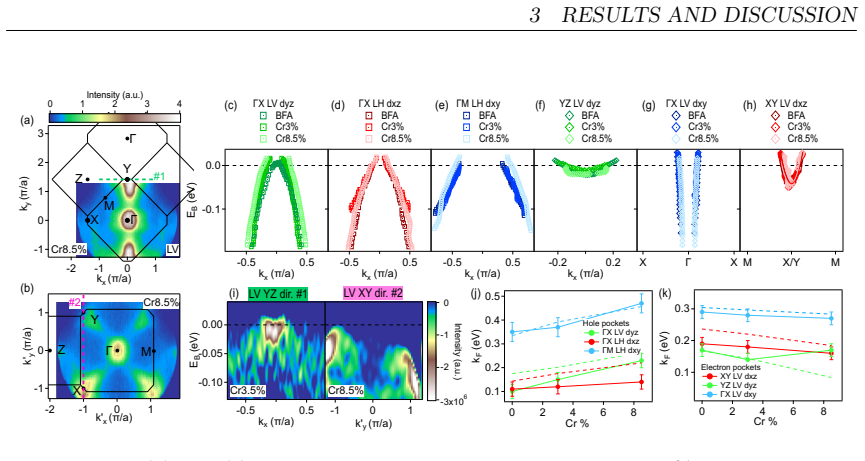
Incorporating Cr leads to an effective hole doping of the states near the FS, which is well described within the virtual crystal approximation. The electronic band spectra with main d_yz-orbital character exhibit a fractional scaling of the imaginary part of self-energy as a function of the binding energy, a signature of Hund's correlations. CrBFA is therefore a correlated electron system in which the changes in the FS as a function of Cr are unrelated to the suppression of T_SDW. The absence of SC is primarily due to the competition between Cr local moments and the Fe-derived itinerant spin fluctuations.
What carries the argument
Fractional scaling of the imaginary self-energy versus binding energy on the d_yz bands, which marks Hund's correlations, together with virtual crystal approximation modeling of the hole doping.
If this is right
- Fermi-surface modifications with Cr content do not drive the observed reduction in spin-density-wave transition temperature.
- CrBFA remains a correlated electron system controlled by Hund's physics.
- Superconductivity is absent because chromium local moments compete directly with iron-derived itinerant spin fluctuations.
- The matching T_SDW suppression curves for Cr and Mn substitutions occur through unrelated microscopic processes.
Where Pith is reading between the lines
- Local moments introduced by substituents can block superconductivity even when they produce doping levels comparable to non-magnetic dopants.
- Applying the same ARPES and self-energy analysis to other transition-metal substitutions would test whether Hund's correlations routinely decouple Fermi-surface evolution from magnetic ordering.
- If moment competition dominates, external suppression of the Cr moment size could restore superconductivity at fixed hole doping.
Load-bearing premise
The observed self-energy scaling and Fermi-surface evolution suffice to rule out any Fermi-surface role in suppressing the spin-density-wave order, and moment competition is the main reason superconductivity is missing.
What would settle it
Observation of superconductivity in Cr-substituted samples in which the chromium local moments are quenched (for example by pressure or co-doping) while the hole doping level at the Fermi surface stays the same.
Figures




read the original abstract
Superconductivity (SC) is absent in Cr-substituted BaFe$_{2}$As$_{2}$ (CrBFA), a well-established but poorly understood topic. Additionally, the suppression of the spin density wave transition temperature ($T_{\text{SDW}}$) in CrBFA and Mn-substituted BaFe$_{2}$As$_{2}$ (MnBFA) coincides as a function of Cr/Mn content, despite the distinct electronic effects of these substitutions. In this work, we employ angle-resolved photoemission spectroscopy (ARPES) and combined density functional theory plus dynamical mean field theory calculations (DFT+DMFT) to address the evolution of the Fermi surface (FS) and electronic correlations in CrBFA. Our findings reveal that incorporating Cr leads to an effective hole doping of the states near the FS, which is well described within the virtual crystal approximation (VCA). We analyzed the electronic band spectra with main $d_{yz}$-orbital character and found a fractional scaling of the imaginary part of self-energy as a function of the binding energy, a signature property of Hund's correlations. We conclude that CrBFA is a correlated electron system and the changes in the FS as a function of Cr are unrelated to the suppression of $T_{\text{SDW}}$. We suggest that the absence of SC is primarily due to the competition between Cr local moments and the Fe-derived itinerant spin fluctuations.
Editorial analysis
A structured set of objections, weighed in public.
Referee Report
Summary. The manuscript reports ARPES spectra and DFT+DMFT calculations on Cr-substituted BaFe₂As₂. It finds that Cr substitution produces an effective hole doping of states near the Fermi surface that is captured by the virtual crystal approximation, observes a fractional power-law scaling ImΣ(ω) ~ ω^α on the d_yz bands as a signature of Hund's correlations, concludes that the system remains a correlated metal, and states that the observed Fermi-surface evolution is unrelated to the suppression of T_SDW. The authors suggest that the absence of superconductivity is due to competition between Cr local moments and Fe-derived itinerant spin fluctuations.
Significance. The ARPES+DMFT results on the applicability of VCA and the presence of Hund's scaling provide concrete data on how Cr substitution modifies the electronic structure of BaFe₂As₂. If the interpretive link between these observations and the absence of superconductivity can be strengthened, the work would help distinguish local-moment versus Fermi-surface mechanisms in iron pnictides.
major comments (2)
- [Abstract / final paragraph] Abstract and final paragraph: the suggestion that absent superconductivity is 'primarily due to the competition between Cr local moments and the Fe-derived itinerant spin fluctuations' is presented without any calculation of moment-fluctuation coupling, scattering rates, or comparison to a model in which local-moment scattering suppresses Tc. The ARPES/DMFT data establish hole doping and self-energy scaling but do not quantitatively test this mechanism.
- [Discussion of T_SDW suppression] Discussion of T_SDW(x): the claim that Fermi-surface changes are unrelated to T_SDW suppression rests on the observation that T_SDW(x) tracks MnBFA, yet the manuscript does not show a direct mapping of the VCA hole-doping level onto the doping scale at which T_SDW is suppressed in other series (e.g., K- or Co-doped BaFe₂As₂) or demonstrate that the observed doping shift is too small to account for the measured T_SDW reduction.
minor comments (1)
- [Self-energy analysis] The exponent α in the reported ImΣ(ω) ~ ω^α scaling is not stated numerically, nor is its doping dependence or uncertainty shown; adding these values would clarify the strength of the Hund's-correlation claim.
Simulated Author's Rebuttal
We thank the referee for the careful reading and constructive comments on our manuscript. We address each major comment below and indicate the revisions made to the manuscript.
read point-by-point responses
-
Referee: [Abstract / final paragraph] Abstract and final paragraph: the suggestion that absent superconductivity is 'primarily due to the competition between Cr local moments and the Fe-derived itinerant spin fluctuations' is presented without any calculation of moment-fluctuation coupling, scattering rates, or comparison to a model in which local-moment scattering suppresses Tc. The ARPES/DMFT data establish hole doping and self-energy scaling but do not quantitatively test this mechanism.
Authors: We agree that the proposed mechanism for the absence of superconductivity is interpretive and lacks a quantitative calculation of moment-fluctuation coupling or scattering rates within this study. The ARPES and DFT+DMFT results establish the hole doping via VCA and the Hund's scaling of the self-energy, while the similarity of T_SDW suppression to Mn substitution (despite different electronic effects) supports that Fermi-surface evolution is not the driver. In the revised manuscript we have rephrased the abstract and final paragraph to present the local-moment competition as a plausible interpretation consistent with our data and prior reports of Cr local moments, while explicitly noting that a microscopic model of the interaction would be required for quantitative confirmation. revision: yes
-
Referee: [Discussion of T_SDW suppression] Discussion of T_SDW(x): the claim that Fermi-surface changes are unrelated to T_SDW suppression rests on the observation that T_SDW(x) tracks MnBFA, yet the manuscript does not show a direct mapping of the VCA hole-doping level onto the doping scale at which T_SDW is suppressed in other series (e.g., K- or Co-doped BaFe₂As₂) or demonstrate that the observed doping shift is too small to account for the measured T_SDW reduction.
Authors: The referee is correct that a direct comparison of the VCA-derived hole-doping level to the critical doping scales in K- and Co-substituted series would strengthen the argument. We have added to the revised manuscript an explicit mapping of the effective hole doping obtained from VCA in CrBFA onto the doping axis of K- and Co-doped BaFe₂As₂. This shows that the VCA hole doping remains well below the level at which T_SDW is suppressed in those series, even at Cr concentrations where T_SDW has already dropped substantially. The discussion section has been updated to include this comparison and to clarify why the observed Fermi-surface shift cannot account for the measured T_SDW reduction. revision: yes
Circularity Check
No significant circularity; key claims are interpretive inferences from ARPES and DFT+DMFT data
full rationale
The paper's derivation chain consists of ARPES measurements of the Fermi surface and band dispersions in Cr-substituted BaFe2As2, combined with standard DFT+DMFT calculations under the virtual crystal approximation to model effective hole doping. The observed fractional scaling ImΣ(ω) ~ ω^α for d_yz bands is reported as a direct signature of Hund's correlations from the computed self-energy, and the conclusion that FS evolution is unrelated to T_SDW suppression follows as an interpretation of these independent data sets. The suggestion regarding competition between Cr local moments and Fe fluctuations is explicitly labeled as such in the abstract and final paragraph, without any fitted parameter, self-citation chain, or ansatz that reduces the result to its own inputs by construction. No load-bearing steps match the enumerated circularity patterns.
Axiom & Free-Parameter Ledger
Reference graph
Works this paper leans on
-
[1]
Y. Kamihara, T. Watanabe, M. Hirano and H. Hosono, Iron-Based Layered Superconductor La[O1-xFx]FeAs (x = 0.05-0.12) with Tc = 26 K, J. Am. Chem. Soc. 130(11), 3296 (2008), doi:10.1021/ja800073m
-
[2]
R. Zhi-An, L. Wei, Y. Jie, Y. Wei, S. Xiao-Li, Zheng-Cai, C. Guang-Can, D. Xiao- Li, S. Li-Ling, Z. Fang and Z. Zhong-Xian,Superconductivity at 55 K in Iron-Based F-Doped Layered Quaternary Compound Sm[O1-xFx] FeAs, Chinese Physics Letters 25(6), 2215 (2008), doi:10.1088/0256-307X/25/6/080
-
[3]
H. Hosono and K. Kuroki, Iron-based superconductors: Current status of materials and pairing mechanism, Physica C: Superconductivity and its Applications514, 399 (2015), doi:https://doi.org/10.1016/j.physc.2015.02.020, Superconducting Materials: Conventional, Unconventional and Undetermined
-
[4]
M. Rotter, M. Tegel, D. Johrendt, I. Schellenberg, W. Hermes and R. Pöttgen,Spin- density-wave anomaly at 140 k in the ternary iron arsenide bafe2as2, Phys. Rev. B 78, 020503(R) (2008), doi:10.1103/PhysRevB.78.020503
-
[5]
M. G. Kim, R. M. Fernandes, A. Kreyssig, J. W. Kim, A. Thaler, S. L. Bud’ko, P. C. Canfield, R. J. McQueeney, J. Schmalian and A. I. Goldman, Character of the structural and magnetic phase transitions in the parent and electron-doped BaFe2As2 compounds, Physical Review B 83(13), 134522 (2011), doi:10.1103/PhysRevB.83.134522
-
[6]
N. Ni, A. Thaler, A. Kracher, J. Q. Yan, S. L. Bud’ko and P. C. Canfield,Phase diagrams of Ba(Fe1−xMx)2As2 single crystals (M = Rh and Pd), Physical Review B 80(2), 024511 (2009), doi:10.1103/PhysRevB.80.024511
-
[7]
A. S. Sefat, R. Jin, M. A. McGuire, B. C. Sales, D. J. Singh and D. Mandrus, Superconductivity at 22 K in co-doped BaFe2As2 crystals, Phys. Rev. Lett. 101, 117004 (2008), doi:10.1103/PhysRevLett.101.117004
-
[8]
L. J. Li, Y. K. Luo, Q. B. Wang, H. Chen, Z. Ren, Q. Tao, Y. K. Li, X. Lin, M. He, Z. W. Zhu, G. H. Cao and Z. A. Xu, Superconductivity induced by Ni doping in BaFe2As2 singlecrystals, New Journal of Physics 11(2), 025008 (2009), doi:10.1088/1367-2630/11/2/025008
-
[9]
J.-H. Chu, J. G. Analytis, C. Kucharczyk and I. R. Fisher,Determination of the phase diagram of the electron-doped superconductor Ba(Fe1−xCox)2As2, Phys. Rev. B 79, 014506 (2009), doi:10.1103/PhysRevB.79.014506. 12 REFERENCES REFERENCES
-
[10]
S. Jiang, H. Xing, G. Xuan, C. Wang, Z. Ren, C. Feng, J. Dai, Z. Xu and G. Cao, Superconductivity up to 30 k in the vicinity of the quantum critical point in BaFe2(As1−xPx)2, Journal of Physics: Condensed Matter21(38), 382203 (2009), doi:10.1088/0953-8984/21/38/382203
-
[11]
S. R. Saha, T. Drye, K. Kirshenbaum, N. P. Butch, P. Y. Zavalij and J. Paglione, Superconductivity at 23 K in Pt doped BaFe2As2 single crystals, Journal of Physics: Condensed Matter22(7), 072204 (2010), doi:10.1088/0953-8984/22/7/072204
-
[12]
M. Rotter, M. Tegel and D. Johrendt, Superconductivity at 38 K in the iron arsenide (Ba1−xKx)Fe2As2, Phys. Rev. Lett. 101, 107006 (2008), doi:10.1103/PhysRevLett.101.107006
-
[13]
K. Sasmal, B. Lv, B. Lorenz, A. M. Guloy, F. Chen, Y.-Y. Xue and C.-W. Chu, Superconducting fe-based compounds (A1−xSrx)Fe2As2 with A = K and cs with transition temperatures up to 37 K, Phys. Rev. Lett. 101, 107007 (2008), doi:10.1103/PhysRevLett.101.107007
-
[15]
R. M. Fernandes and A. V. Chubukov,Low-energy microscopic models for iron-based superconductors: a review, Rep. Prog. Phys.80(1), 014503 (2016), doi:10.1088/1361- 6633/80/1/014503
-
[16]
A. Chubukov, Pairing Mechanism in Fe-Based Superconductors, Annual Review of Condensed Matter Physics3(1), 57 (2012), doi:10.1146/annurev-conmatphys-020911- 125055
-
[17]
K. Haule and G. Kotliar,Coherence–incoherence crossover in the normal state of iron oxypnictides and importance of Hund’s rule coupling, New Journal of Physics11(2), 025021 (2009), doi:10.1088/1367-2630/11/2/025021
-
[18]
Z. P. Yin, K. Haule and G. Kotliar,Kinetic frustration and the nature of the magnetic and paramagnetic states in iron pnictides and iron chalcogenides, Nature Materials 10(12), 932 (2011), doi:10.1038/NMAT3120
-
[19]
Z. P. Yin, K. Haule and G. Kotliar,Magnetism and charge dynamics in iron pnictides, Nature Physics7(4), 294 (2011), doi:10.1038/NPHYS1923
-
[20]
E. Bascones, B. Valenzuela and M. Jose Calderon, Magnetic interactions in iron superconductors: A review, Comptes Rendus Physique 17(1-2), 36 (2016), doi:10.1016/j.crhy.2015.05.004
-
[21]
R. M. Fernandes, A. I. Coldea, H. Ding, I. R. Fisher, P. J. Hirschfeld and G. Kotliar, Iron pnictides and chalcogenides: a new paradigm for superconductivity, Nature 601(7891), 35 (2022), doi:10.1038/s41586-021-04073-2
-
[22]
T.-H. Lee, A. Chubukov, H. Miao and G. Kotliar, Pairing Mechanism in Hund’s Metal Superconductors and the Universality of the Superconducting Gap to Critical Temperature Ratio, Physical Review Letters 121(18), 187003 (2018), doi:10.1103/PhysRevLett.121.187003. 13 REFERENCES REFERENCES
-
[23]
A. S. Sefat, D. J. Singh, L. H. VanBebber, Y. Mozharivskyj, M. A. McGuire, R. Jin, B. C. Sales, V. Keppens and D. Mandrus, Absence of superconductivity in hole-doped BaFe2−xCrxAs2 single crystals, Phys. Rev. B 79, 224524 (2009), doi:10.1103/PhysRevB.79.224524
-
[24]
A. Thaler, H. Hodovanets, M. S. Torikachvili, S. Ran, A. Kracher, W. Straszheim, J. Q. Yan, E. Mun and P. C. Canfield, Physical and magnetic properties of Ba(Fe1−xMnx)2As2 single crystals, Physical Review B 84(14), 144528 (2011), doi:10.1103/PhysRevB.84.144528
-
[25]
Spectral analysis of finite-time correlation matrices near equilibrium phase transitions
X.-G. Li, J.-M. Sheng, C.-K. Tian, Y.-Y. Wang, T.-L. Xia, L. Wang, F. Ye, W. Tian, J.-C. Wang, J.-J. Liu, H.-X. Zhang, W. Baoet al., Effects of vanadium doping on BaFe2As2, Europhysics Letters 122(6), 67006 (2018), doi:10.1209/0295- 5075/122/67006
-
[26]
Y. Texier, Y. Laplace, P. Mendels, J. T. Park, G. Friemel, D. L. Sun, D. S. Inosov, C. T. Lin and J. Bobroff, Mn local moments prevent superconductivity in iron pnictides Ba(Fe1−xMnx)2As2, EPL (Europhysics Letters)99(1), 17002 (2012), doi:10.1209/0295-5075/99/17002
-
[27]
H. Suzuki, T. Yoshida, S. Ideta, G. Shibata, K. Ishigami, T. Kadono, A. Fujimori, M. Hashimoto, D. H. Lu, Z.-X. Shen, K. Ono, E. Sakai et al., Absence of superconductivity in the hole-doped Fe pnictide Ba(Fe1−xMnx)2As2: Photoemission and x-ray absorption spectroscopy studies, Physical Review B 88(10), 100501(R) (2013), doi:10.1103/PhysRevB.88.100501
-
[28]
G. S. Tucker, D. K. Pratt, M. G. Kim, S. Ran, A. Thaler, G. E. Granroth, K. Marty, W. Tian, J. L. Zarestky, M. D. Lumsden, S. L. Bud’ko, P. C. Canfield et al., Competition between stripe and checkerboard magnetic instabilities in Mn-doped BaFe2As2, Physical Review B 86(2), 020503(R) (2012), doi:10.1103/PhysRevB.86.020503
-
[29]
F. A. Garcia, O. Ivashko, D. E. McNally, L. Das, M. M. Piva, C. Adriano, P. G. Pagliuso, J. Chang, T. Schmitt and C. Monney, Anisotropic magnetic excitations and incipient Néel order in Ba(Fe1−xMnx)2As2, Phys. Rev. B 99, 115118 (2019), doi:10.1103/PhysRevB.99.115118
-
[30]
M. R. Cantarino, K. R. Pakuszewski, B. Salzmann, P. H. A. Moya, W. R. d. S. Neto, G. S. Freitas, P. G. Pagliuso, W. H. Brito, C. Monney, C. Adriano and F. A. Garcia, Incoherent electronic band states in Mn-substituted BaFe2As2, Phys. Rev. B 108, 245124 (2023), doi:10.1103/PhysRevB.108.245124
-
[31]
R. M. Fernandes and A. J. Millis, Suppression of Superconductivity by Néel-Type Magnetic Fluctuations in the Iron Pnictides, Physical Review Letters110(11), 117004 (2013), doi:10.1103/PhysRevLett.110.117004
-
[32]
M. N. Gastiasoro and B. M. Andersen, Enhancement of Magnetic Stripe Order in Iron-Pnictide Superconductors from the Interaction between Conduction Electrons and Magnetic Impurities, Physical Review Letters113(6), 067002 (2014), doi:10.1103/PhysRevLett.113.067002
-
[33]
M. N. Gastiasoro, F. Bernardini and B. M. Andersen,Unconventional Disorder Effects in Correlated Superconductors, Physical Review Letters 117(25), 257002 (2016), doi:10.1103/PhysRevLett.117.257002. 14 REFERENCES REFERENCES
-
[34]
T. Kobayashi, M. Nakajima, S. Miyasaka and S. Tajima,Carrier localization due to local magnetic order induced by magnetic impurities in Ba(Fe1−xT Mx)2As2 (T M = Mn and Cr) as seen via optical spectra, Physical Review B 94(22), 224516 (2016), doi:10.1103/PhysRevB.94.224516
-
[35]
J. P. Clancy, B. D. Gaulin and A. S. Sefat,High-resolution x-ray scattering studies of structural phase transitions in Ba(Fe1−xCrx)2As2, Physical Review B85(5), 054115 (2012), doi:10.1103/PhysRevB.85.054115
-
[36]
K. Marty, A. D. Christianson, C. H. Wang, M. Matsuda, H. Cao, L. H. VanBebber, J. L. Zarestky, D. J. Singh, A. S. Sefat and M. D. Lumsden, Competing magnetic ground states in nonsuperconducting Ba(Fe1−xCrx)2As2 as seen via neutron diffraction, Phys. Rev. B83, 060509(R) (2011), doi:10.1103/PhysRevB.83.060509
-
[37]
K. A. Filsinger, W. Schnelle, P. Adler, G. H. Fecher, M. Reehuis, A. Hoser, J.-U. Hoffmann, P. Werner, M. Greenblatt and C. Felser,Antiferromagnetic structure and electronic properties of BaCr2As2 and BaCrFeAs2, Physical Review B95(18), 184414 (2017), doi:10.1103/PhysRevB.95.184414
-
[38]
Q. Zou, M. Fu, Z. Wu, L. Li, D. S. Parker, A. S. Sefat and Z. Gai,Competitive and cooperative electronic states in Ba(Fe1−xTx)2As2 with T = Co, Ni, Cr, npj Quantum Materials 6(1), 1 (2021), doi:10.1038/s41535-021-00385-8
-
[39]
D. Gong, T. Xie, R. Zhang, J. Birk, C. Niedermayer, F. Han, S. H. Lapidus, P. Dai, S. Li and H. Luo, Doping effects of cr on the physical properties of BaFe1.9−xNi0.1CrxAs2, Phys. Rev. B 98, 014512 (2018), doi:10.1103/PhysRevB.98.014512
-
[40]
R. Zhang, D. Gong, X. Lu, S. Li, M. Laver, C. Niedermayer, S. Danilkin, G. Deng, P. Dai and H. Luo,Doping evolution of antiferromagnetism and transport properties in nonsuperconducting BaFe2−2xNixCrxAs2, Phys. Rev. B 91, 094506 (2015), doi:10.1103/PhysRevB.91.094506
-
[41]
D. Gong, M. Yi, M. Wang, T. Xie, W. Zhang, S. Danilkin, G. Deng, X. Liu, J. T. Park, K. Ikeuchi, K. Kamazawa, S.-K. Moet al., Nematic fluctuations in the non- superconducting iron pnictide BaFe1.9−xNi0.1CrxAs2, Frontiers in Physics10 (2022), doi:10.3389/fphy.2022.886459
-
[42]
W. Zhang, Y. Wei, T. Xie, Z. Liu, D. Gong, X. Ma, D. Hu, P. Čermák, A. Schneidewind, G. Tucker, S. Meng, Z. Huesges et al., Unconventional antiferromagnetic quantum critical point in Ba(Fe0.97Cr0.03)2(As1−xPx)2, Phys. Rev. Lett. 122, 037001 (2019), doi:10.1103/PhysRevLett.122.037001
-
[43]
D. S. Inosov, G. Friemel, J. T. Park, A. C. Walters, Y. Texier, Y. Laplace, J. Bobroff, V. Hinkov, D. L. Sun, Y. Liu, R. Khasanov, K. Sedlaket al., Possible realization of an antiferromagnetic griffiths phase in Ba(Fe1−xMnx)2As2, Phys. Rev. B87, 224425 (2013), doi:10.1103/PhysRevB.87.224425
-
[44]
S. J. Li, D. Zhao, S. Wang, S. T. Cui, N. Z. Wang, J. Li, D. W. Song, B. L. Kang, L. X. Zheng, L. P. Nie, Z. M. Wu, Y. B. Zhou et al., Emergent spin- glass state in the doped hund’s metal CsFe2As2, Phys. Rev. B 107, 115144 (2023), doi:10.1103/PhysRevB.107.115144. 15 REFERENCES REFERENCES
-
[45]
C. Liu, G. D. Samolyuk, Y. Lee, N. Ni, T. Kondo, A. F. Santander-Syro, S. L. Bud’ko, J.L.McChesney, E.Rotenberg, T.Valla, A.V.Fedorov, P.C.Canfield et al., K-doping dependence of the fermi surface of the iron-arsenic Ba1−xKxFe2As2 superconductor using angle-resolved photoemission spectroscopy, Phys. Rev. Lett.101, 177005 (2008), doi:10.1103/PhysRevLett.101.177005
-
[46]
K. M. Stadler, G. Kotliar, S.-S. B. Lee, A. Weichselbaum and J. von Delft, Differentiating Hund from Mott physics in a three-band Hubbard-Hund model: Temperature dependence of spectral, transport, and thermodynamic properties , Physical Review B104(11), 115107 (2021), doi:10.1103/PhysRevB.104.115107
-
[47]
T. M. Garitezi, C. Adriano, P. F. S. Rosa, E. M. Bittar, L. Bufaiçal, R. L. d. Almeida, E. Granado, T. Grant, Z. Fisk, M. A. Avila, R. A. Ribeiro, P. L. Kuhns et al., Synthesis and Characterization of BaFe2As2 Single Crystals Grown by In-flux Technique, Brazilian Journal of Physics43(4), 223 (2013), doi:10.1007/s13538-013- 0144-z
-
[48]
K. Haule, C.-H. Yee and K. Kim,Dynamical mean-field theory within the full-potential methods: Electronic structure of CeIrIn5, CeCoIn5, and CeRhIn5, Phys. Rev. B81, 195107 (2010), doi:10.1103/PhysRevB.81.195107
-
[49]
J. P. Perdew, K. Burke and M. Ernzerhof,Generalized gradient approximation made simple, Phys. Rev. Lett.77, 3865 (1996), doi:10.1103/PhysRevLett.77.3865
- [50]
-
[51]
K. Haule, Quantum monte carlo impurity solver for cluster dynamical mean-field theory and electronic structure calculations with adjustable cluster base, Phys. Rev. B 75, 155113 (2007), doi:10.1103/PhysRevB.75.155113
-
[52]
V. I. Anisimov, F. Aryasetiawan and A. I. Lichtenstein,First-principles calculations of the electronic structure and spectra of strongly correlated systems: the lda+ u method, Journal of Physics: Condensed Matter9(4), 767 (1997), doi:10.1088/0953- 8984/9/4/002
-
[53]
M. Fuglsang Jensen, V. Brouet, E. Papalazarou, A. Nicolaou, A. Taleb-Ibrahimi, P. Le Fèvre, F. Bertran, A. Forget and D. Colson,Angle-resolved photoemission study of the role of nesting and orbital orderings in the antiferromagnetic phase of BaFe2As2, Physical Review B84(1), 014509 (2011), doi:10.1103/PhysRevB.84.014509
-
[54]
V. Brouet, M. F. Jensen, P.-H. Lin, A. Taleb-Ibrahimi, P. Le Fèvre, F. Bertran, C.-H. Lin, W. Ku, A. Forget and D. Colson,Impact of the two Fe unit cell on the electronic structure measured by ARPES in iron pnictides, Physical Review B 86(7), 075123 (2012), doi:10.1103/PhysRevB.86.075123
-
[55]
M. Yi, Y. Zhang, Z.-X. Shen and D. Lu,Role of the orbital degree of freedom in iron- based superconductors, npj Quantum Materials2(1), 57 (2017), doi:10.1038/s41535- 017-0059-y
-
[56]
H. Pfau, C. R. Rotundu, J. C. Palmstrom, S. D. Chen, M. Hashimoto, D. Lu, A. F. Kemper, I.R.FisherandZ.-X.Shen, Detailed band structure of twinned and detwinned BaFe2As2 studied with angle-resolved photoemission spectroscopy, Phys. Rev. B 99, 035118 (2019), doi:10.1103/PhysRevB.99.035118. 16 REFERENCES REFERENCES
-
[57]
Y. Zhang, F. Chen, C. He, B. Zhou, B. P. Xie, C. Fang, W. F. Tsai, X. H. Chen, H. Hayashi, J. Jiang, H. Iwasawa, K. Shimadaet al., Orbital characters of bands in the iron-based superconductor BaFe1.85Co0.15As2, Phys. Rev. B83(5), 054510 (2011), doi:10.1103/PhysRevB.83.054510
-
[58]
A. G. de Figueiredo, M. R. Cantarino, W. R. da Silva Neto, K. R. Pakuszewski, R. Grossi, D. S. Christovam, J. C. Souza, M. M. Piva, G. S. Freitas, P. G. Pagliuso, C. Adriano and F. A. Garcia, Orbital localization and the role of the fe and as 4p orbitals in BaFe2As2 probed by xanes, Phys. Rev. B 105, 045130 (2022), doi:10.1103/PhysRevB.105.045130
-
[59]
J. A. Sobota, Y. He and Z.-X. Shen, Angle-resolved photoemission studies of quantum materials , Reviews of Modern Physics 93(2), 025006 (2021), doi:10.1103/RevModPhys.93.025006
-
[60]
R. Kurleto and J. Fink,About two-dimensional fits for the analysis of the scattering rates and renormalization functions from angle-resolved photoelectron spectroscopy data, Journal of Electron Spectroscopy and Related Phenomena253, 147127 (2021), doi:10.1016/j.elspec.2021.147127
-
[61]
J. Fink, E. D. L. Rienks, M. Yao, R. Kurleto, J. Bannies, S. Aswartham, I. Morozov, S. Wurmehl, T. Wolf, F. Hardy, C. Meingast, H. S. Jeevanet al., Linkage between scattering rates and superconductivity in doped ferropnictides, Physical Review B 103(15), 155119 (2021), doi:10.1103/PhysRevB.103.155119
-
[62]
J. Fink, E. D. L. Rienks, S. Thirupathaiah, J. Nayak, A. van Roekeghem, S. Biermann, T. Wolf, P. Adelmann, H. S. Jeevan, P. Gegenwart, S. Wurmehl, C. Felseret al., Experimental evidence for importance of Hund’s exchange interaction for incoherence of charge carriers in iron-based superconductors, Phys. Rev. B 95, 144513 (2017), doi:10.1103/PhysRevB.95.144513
-
[63]
Z. P. Yin, K. Haule and G. Kotliar, Fractional power-law behavior and its origin in iron-chalcogenide and ruthenate superconductors: Insights from first-principles calculations, Physical Review B 86(19), 195141 (2012), doi:10.1103/PhysRevB.86.195141
-
[64]
L.FanfarilloandE.Bascones, Electronic correlations in Hund metals, PhysicalReview B 92(7), 075136 (2015), doi:10.1103/PhysRevB.92.075136
-
[65]
M. Xu, J. Schmidt, E. Gati, L. Xiang, W. R. Meier, V. G. Kogan, S. L. Bud’ko and P. C. Canfield,Superconductivity and phase diagrams of CaK(Fe1−xMnx)4As4 single crystals, Phys. Rev. B105, 214526 (2022), doi:10.1103/PhysRevB.105.214526
-
[66]
M. Xu, J. Schmidt, M. A. Tanatar, R. Prozorov, S. L. Bud’ko and P. C. Canfield, Superconductivity and magnetic and transport properties of single-crystalline CaK (Fe1−xCrx)4As4, Phys. Rev. B 107, 134511 (2023), doi:10.1103/PhysRevB.107.134511
-
[67]
M. Crispino, P. V. Arribi, A. Shukla, F. Hardy, A.-A. Haghighirad, T. Wolf, R. Heid, C. Meingast, T. Gorni, A. Avella and L. d. Medici,Paradigm for finding d-electron heavy fermions: the case of Cr-doped CsFe2As2, arXiv (arXiv:2312.06511) (2023), doi:10.48550/arXiv.2312.06511, 2312.06511[cond-mat]. 17 REFERENCES REFERENCES
-
[68]
S. Graser, A. F. Kemper, T. A. Maier, H.-P. Cheng, P. J. Hirschfeld and D. J. Scalapino, Spin fluctuations and superconductivity in a three- dimensional tight-binding model for BaFe2As2, Phys. Rev. B 81, 214503 (2010), doi:10.1103/PhysRevB.81.214503. 18
discussion (0)
Sign in with ORCID, Apple, or X to comment. Anyone can read and Pith papers without signing in.