REVIEW 3 major objections 5 minor 2 cited by
Kronos: A Foundation Model for the Language of Financial Markets
T0 review · 3 major / 5 minor · reviewed 2026-08-06 · deepseek-v4-flash
Pith's one-line read Kronos treats candlestick records as a discrete market language: a tokenizer-plus-Transformer trained on 12 billion bars claims 93% higher price-forecast RankIC than leading time-series foundation models, in zero-shot settings.
desk verdict Kronos is a substantial and potentially useful financial K-line foundation model, but its headline RankIC gains are inflated by an asymmetric ensembling protocol that the paper never matches against baselines. read the letter →
The pith
A machine-rendered reading of the paper's core claim, the machinery that carries it, and where it could break.
The reading
What carries the argument
The central mechanism is the hierarchical K-line tokenizer combined with coarse-to-fine autoregressive decoding. A Transformer autoencoder projects each bar onto a learnable codebook via Binary Spherical Quantization (BSQ), producing a 20-bit token factorized into a coarse 10-bit subtoken and a fine 10-bit subtoken; a two-level reconstruction loss forces the coarse subtoken to reconstruct the principal structure and the fine subtoken to supply the residual. The autoregressive model then predicts the next token with the chain-rule factorization $p(b_t|b_{<t}) = p(b^c_t|b_{<t}) \cdot p(b^f_t|b_{<t}, b^c_t)$, which keeps the effective vocabulary at $2^{10}$ per step instead of $2^{20}$, and uses the model's own sampled coarse subtoken (not teacher forcing) to condition the fine prediction. This machinery is what lets a large but tractable discrete vocabulary, high codebook utilization (97.66% coarse, 85.25% fine), and multi-scale market dynamics coexist in one model.
What would settle it
Re-run the price-series and return-forecasting benchmarks giving every baseline the same inference budget — for example, Kronos with a single sample at its tuned temperature versus baselines at their best settings, and separately Kronos with one deterministic decode — and check whether the 93%/87% RankIC margins survive; if they collapse to near-parity, the reported advantage is mostly test-time ensembling rather than a better learned representation.
Extended reading notes
Core claim
On its own terms, the paper establishes that market data can be modeled as a discrete, hierarchical language. Kronos quantizes continuous OHLCVA observations into binary codes, each split into a coarse subtoken that captures the dominant price-volume structure and a fine subtoken that encodes the residual, and pre-trains a decoder-only Transformer to predict these subtokens sequentially, coarse before fine. The claim is that this discretize-and-generate scheme, trained on an exclusively financial corpus of 12 billion records, yields representations that transfer zero-shot to price forecasting, return forecasting, realized-volatility estimation, synthetic K-line generation, and a long-only portfolio backtest, outperforming both general time-series foundation models and full-shot specialized baselines in every task.
Load-bearing premise
The headline gains rest on comparing Kronos's forecasts averaged over 10 stochastic rollouts (temperature 0.6, top-p 0.9) against single deterministic forecasts from every baseline, and the paper does not report a matched-inference comparison.
Editorial extensions
If this is right
- One pre-trained backbone covers forecasting, volatility estimation, generation, and portfolio signals without task-specific training, so a single model could replace bespoke pipelines in quantitative finance.
- Bigger Kronos models (24.7M to 499.2M parameters) improve on every task, extending scaling-law behavior to financial time series.
- Larger codebook vocabularies (up to $2^{20}$) improve both tokenizer reconstruction and downstream forecasting, tying representational precision to predictive skill.
- Averaging more stochastic rollouts at inference consistently raises IC and RankIC, giving practitioners a tunable compute-accuracy trade-off without retraining.
- Because the model is released openly, downstream teams can fine-tune or prompt the same backbone for tasks the paper did not test.
Reading between the lines
- The 93% and 87% headline margins compare Kronos's 10-rollout ensemble against single deterministic baseline forecasts; a single-sample or matched-inference comparison would show how much of the gain is genuine modeling rather than ensembling.
- The coarse-to-fine token hierarchy is not tied to OHLCVA semantics, so the same tokenizer-plus-autoregressive recipe could transfer to other noisy, fat-tailed multivariate series such as sensor streams, energy loads, or order-flow data.
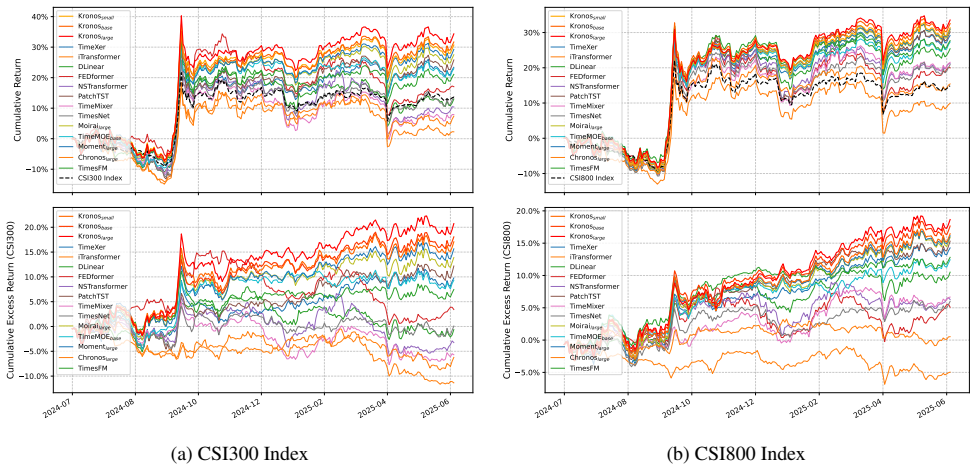
- The investment-simulation results, however strong, cover roughly one year on two Chinese indices with fixed transaction-cost assumptions; whether the edge persists across market regimes and after costs is an open question the paper does not address.
- The 512-token context cap means long-horizon modeling relies on choosing a coarser frequency; pushing context length upward is a natural, untested extension.
Editorial analysis
A structured set of objections, weighed in public.
Referee Report
Summary. The paper introduces Kronos, a two-stage foundation model for financial K-line (OHLCVA) data: a BSQ-based tokenizer that discretizes each multivariate K-line record into coarse and fine subtokens, followed by a decoder-only Transformer pre-trained with a hierarchical autoregressive objective on a corpus of roughly 12 billion K-line records from 45 global exchanges. The authors evaluate zero-shot performance on price series forecasting, return forecasting, realized volatility forecasting, synthetic K-line generation, and an investment simulation, comparing against 25 baselines. The central claim is that Kronos improves price-series RankIC by 93% over the leading TSFM and 87% over the best non-pre-trained baseline, with additional gains in volatility forecasting and generative fidelity.
Significance. If the reported results hold under a matched evaluation protocol, Kronos would be a significant contribution: it is an open-weights, domain-specific financial K-line foundation model with a clean temporal holdout (pre-training through June 2024, evaluation from July 2024), a broad multi-asset corpus, and coverage of tasks beyond point forecasting, including volatility and synthetic generation. The paper also includes extensive appendices with full per-exchange results, sensitivity analyses, and architectural justifications, which is exemplary for reproducibility. The main uncertainty is not circularity, since test labels are not used in training; it is whether the headline gains reflect a genuinely superior model or an asymmetric inference protocol with N=10 stochastic rollouts versus single deterministic baselines.
major comments (3)
- [Abstract; §3 (Inference); Table 6; Figure 7] The headline RankIC improvements (93% over Time-MOE-base and 87% over TimesNet) are computed under an asymmetric inference protocol: Table 6 specifies N=10 Monte Carlo rollouts at temperature 0.6 and top-p 0.9 for price and return forecasting, while all baselines produce a single deterministic forecast. Figure 7 shows that IC and RankIC improve monotonically with the number of rollout samples, so a material part of the reported advantage may be attributable to ensembling rather than to the learned model itself. The paper never reports a matched single-rollout (N=1) comparison for Kronos. The authors should report N=1 results at the same temperature/top-p, report ensemble-averaged results for stochastic baselines where applicable, and qualify the abstract's percentages with the inference budget used.
- [Appendix E, Figure 8; Table 6] The inference hyperparameters (temperature, top-p, and sample count N) are tuned per task, and the sensitivity analysis in Figure 8 appears to be computed on the same July 2024 test period on which the final numbers are reported. Because the paper advertises zero-shot performance, selecting these hyperparameters on the test tasks is a mild but real form of test-set adaptation. The authors should clarify whether a separate temporal validation split was used for hyperparameter selection and should report results with fixed, default hyperparameters as a robustness check.
- [Table 9; §3 (K-line Tokenization)] The tokenizer ablation in Table 9 shows that the hierarchical reconstruction loss achieves reconstruction MAE/MSE nearly identical to a standard-loss Transformer tokenizer (0.0785 vs 0.0781 MAE), but no downstream comparison is provided for tokenizers trained with and without the hierarchical loss. Since the coarse-to-fine hierarchy is described as "central to our design" and is the basis for the sequential subtoken prediction in Equation (4), the authors should either supply a downstream forecasting/generation comparison that isolates the hierarchical loss, or temper the claim that this loss is necessary for the reported forecasting gains.
minor comments (5)
- [Figure 1 caption] The caption states that a greater distance from the center signifies superior performance, but several metrics in the radar chart are lower-is-better (e.g., MAE); the figure should clarify how the axes are scaled or inverted.
- [§4, Forecasting Task Setup] The test period is described only as starting in July 2024; the authors should state the exact end date and confirm that all assets and frequencies share the same calendar window so the temporal holdout is fully specified.
- [Tables 14–21] All forecasting and generation results are reported as point estimates without error bars or significance tests; given the heterogeneity across exchanges and frequencies, the authors should add confidence intervals or a statistical test to support claims of consistent superiority.
- [Throughout] Minor typographical and formatting issues include inconsistent spacing in model names (e.g., "Kronoslarge", "Time-MOEbase"), the rendering "V olume" in figure axis labels, and the phrase "Kronos’s" appearing with mixed apostrophe styles; these should be cleaned up in a final revision.
- [Appendix H, Q1] The discussion of whether K-line data embeds enough information for short-term price movement ends with "The detail discussion about the above empirical evidences is beyond the scope of this paper"; either provide the relevant citations and a brief synthesis in the main text or remove this subsection, as the current treatment is too cursory to support the design rationale.
Circularity Check
No significant circularity: Kronos's reported gains are empirical, test labels are withheld, and no fitted parameter or self-citation forces the central results.
full rationale
Kronos's derivation chain is empirical rather than derivational. The tokenizer and autoregressive model are trained on pre-June-2024 data with standard reconstruction and next-token objectives; the reported IC, RankIC, MAE, and discriminative scores are measured on a post-June-2024 test window (Appendix D), so test labels do not enter training. No equation in the paper defines a predicted quantity in terms of the evaluation metric, and no fitted parameter is relabeled as a prediction. The design choices (BSQ tokenization, n=2 factorization, coarse-to-fine chain rule) are justified by external citations such as Zhao et al. 2024, Yu et al. 2023, and Wang et al. 2025, not by the paper's own unpublished results; the paper contains no load-bearing self-citation. The only substantive concern, an asymmetric inference protocol in which Kronos averages N=10 stochastic rollouts while baselines produce single deterministic forecasts (Table 6 and Figure 7), affects the fairness of the comparison and the attribution of the 93%/87% gains, but it is not circularity: the model's outputs are not constructed from the baseline numbers or from the evaluation labels. Under the specified taxonomy, no step reduces by definition to its inputs.
Assumptions & free parameters
free parameters (5)
- Inference sample count N =
10
- Temperature T =
0.6 for price/return; 0.9 for volatility; 1.0 for generation
- Top-p =
0.90 or 0.95
- Data cleaning thresholds =
See Table 4
- Hierarchical loss weight lambda =
1
assumptions (3)
- standard math BSQ projection onto unit sphere gives bounded expected distortion
- domain assumption OHLCVA K-line data contains sufficient information for short-term price movement
- ad hoc to paper Coarse-to-fine subtoken hierarchy improves autoregressive prediction
Cite this review
Pith. "Pith review of Kronos: A Foundation Model for the Language of Financial Markets." pith.science (2026). https://pith.science/paper/23K44RTU
@misc{pith2026250802739,
  author       = {Pith},
  title        = {Pith review of: Kronos: A Foundation Model for the Language of Financial Markets},
  year         = {2026},
  howpublished = {\url{https://pith.science/paper/23K44RTU}},
  note         = {Machine review of arXiv:2508.02739}
}
read the original abstract
The success of large-scale pre-training paradigm, exemplified by Large Language Models (LLMs), has inspired the development of Time Series Foundation Models (TSFMs). However, their application to financial candlestick (K-line) data remains limited, often underperforming non-pre-trained architectures. Moreover, existing TSFMs often overlook crucial downstream tasks such as volatility prediction and synthetic data generation. To address these limitations, we propose Kronos, a unified, scalable pre-training framework tailored to financial K-line modeling. Kronos introduces a specialized tokenizer that discretizes continuous market information into token sequences, preserving both price dynamics and trade activity patterns. We pre-train Kronos using an autoregressive objective on a massive, multi-market corpus of over 12 billion K-line records from 45 global exchanges, enabling it to learn nuanced temporal and cross-asset representations. Kronos excels in a zero-shot setting across a diverse set of financial tasks. On benchmark datasets, Kronos boosts price series forecasting RankIC by 93% over the leading TSFM and 87% over the best non-pre-trained baseline. It also achieves a 9% lower MAE in volatility forecasting and a 22% improvement in generative fidelity for synthetic K-line sequences. These results establish Kronos as a robust, versatile foundation model for end-to-end financial time series analysis. Our pre-trained model is publicly available at https://github.com/shiyu-coder/Kronos.
Figures


Figures from the paper (15 more)




Forward citations
Cited by 2 Pith papers
-
Forecasting Realized Volatility with Time Series Foundation Models: A Comparison with Econometric Benchmarks
Zero-shot time series foundation models largely fail to beat econometric benchmarks for realized volatility forecasting, with only TTM achieving a narrow, calibration-driven edge.
-
WindFM: An Open-Source Foundation Model for Zero-Shot Wind Power Forecasting
A wind-specific foundation model, WindFM, uses hierarchical tokenization and autoregressive pre-training on the NREL WIND Toolkit to achieve state-of-the-art zero-shot wind power forecasts.
Reference graph
Works this paper leans on
-
[4]
arXiv preprint arXiv:2210.02186
Timesnet: Temporal 2d-variation modeling for gen- eral time series analysis. arXiv preprint arXiv:2210.02186. Xiaoming, S.; Shiyu, W.; Yuqi, N.; Dianqi, L.; Zhou, Y .; Qingsong, W.; and Jin, M. 2025. Time-MoE: Billion-Scale Time Series Foundation Models with Mixture of Experts. In ICLR 2025: The Thirteenth International Conference on Learning Representati...
arXiv 2025
-
[6]
Fedformer: Frequency enhanced decomposed trans- former for long-term series forecasting. In International conference on machine learning, 27268–27286. PMLR. Zhu, Y .; Li, B.; Xin, Y .; and Xu, L. 2024. Addressing repre- sentation collapse in vector quantized models with one lin- ear layer. arXiv preprint arXiv:2411.02038. Overview of Appendix This appendi...
arXiv 2024
-
[2019]
arXiv preprint arXiv:1904.09751
The curious case of neural text degeneration. arXiv preprint arXiv:1904.09751. Kaplan, J.; McCandlish, S.; Henighan, T.; Brown, T. B.; Chess, B.; Child, R.; Gray, S.; Radford, A.; Wu, J.; and Amodei, D. 2020. Scaling laws for neural language mod- els. arXiv preprint arXiv:2001.08361. Kim, O.; and Verrecchia, R. E. 1991. Trading volume and price reactions ...
arXiv 1904
-
[2022]
arXiv preprint arXiv:2211.14730
A time series is worth 64 words: Long-term forecast- ing with transformers. arXiv preprint arXiv:2211.14730. Nison, S. 2001. Japanese candlestick charting techniques: a contemporary guide to the ancient investment techniques of the Far East. Penguin. Ozenbas, D.; et al. 2008. Intra-day trading volume patterns of equity markets: A study of US and European ...
arXiv 2001
-
[2024]
Yang, X.; Liu, W.; Zhou, D.; Bian, J.; and Liu, T.-Y
PLUTUS: A Well Pre-trained Large Unified Trans- former can Unveil Financial Time Series Regularities.arXiv preprint arXiv:2408.10111. Yang, X.; Liu, W.; Zhou, D.; Bian, J.; and Liu, T.-Y . 2020. Qlib: An ai-oriented quantitative investment platform.arXiv preprint arXiv:2009.11189. Yao, Q.; Yang, C.-H. H.; Jiang, R.; Liang, Y .; Jin, M.; and Pan, S. 2024. ...
-
[2025]
Scalable Image Tokenization with Index Backpropa- gation Quantization. arXiv:2412.02692. Su, J.; Ahmed, M.; Lu, Y .; Pan, S.; Bo, W.; and Liu, Y . 2024. Roformer: Enhanced transformer with rotary position em- bedding. Neurocomputing, 568: 127063. Talukder, S.; Yue, Y .; and Gkioxari, G. 2024. Totem: Tok- enized time series embeddings for general time seri...
arXiv 2024
Reviewed August 6, 2026 · model on record in the stance chip above.
Discussion (0). Sign in to comment.