pith. machine review for the scientific record. sign in

q-fin.ST

Statistical Finance

Statistical, econometric and econophysics analyses with applications to financial markets and economic data

0
q-fin.ST 2026-04-22

Quantile battery trades miss price time links and honest forecast rewards

Probabilistic Forecasting for Day-ahead Electricity Prices, Battery Trading Strategies and the Economic Evaluation of Predictive Accuracy

Stochastic programs using full price distributions tie forecast accuracy more reliably to trading profits than quantile rules on German day-

Figure from the paper full image
abstract click to expand
Electricity price forecasting supports decision-making in energy markets and asset operation. Probabilistic forecasts are increasingly adopted to explicitly quantify uncertainty, typically issued as quantile predictions or ensembles of the full predictive distribution. However, how improvements in statistical forecast quality translate into economic value remains unclear. Battery storage arbitrage in day-ahead markets is a popular application-based benchmark for this purpose. We analyze quantile-based trading strategies (QBTS) and identify two critical flaws: they do not incentivize honest probabilistic forecasting and they ignore the intertemporal dependence structure of electricity prices. We therefore frame battery optimization as a stochastic program based on fully probabilistic forecasts and examine decision quality measurement for risk-neutral and risk-averse settings under different uncertainty models. Our discussion touches both sides of the coin: How reliable is the economic evaluation of forecasting models though (simplified) application studies - and how do improvements in statistical forecast quality for stochastic programs relate to the decision-quality and economic performance? We provide theoretical justification and empirical evidence from a case study on the German electricity market. Our results highlight the pitfalls of ranking forecasting models through battery trading strategies. We conclude with implications for evaluation practice and directions for future research in application-based forecast assessment.
0
0
q-fin.ST 2026-04-22

Markets collapse to single dominant mode during shocks

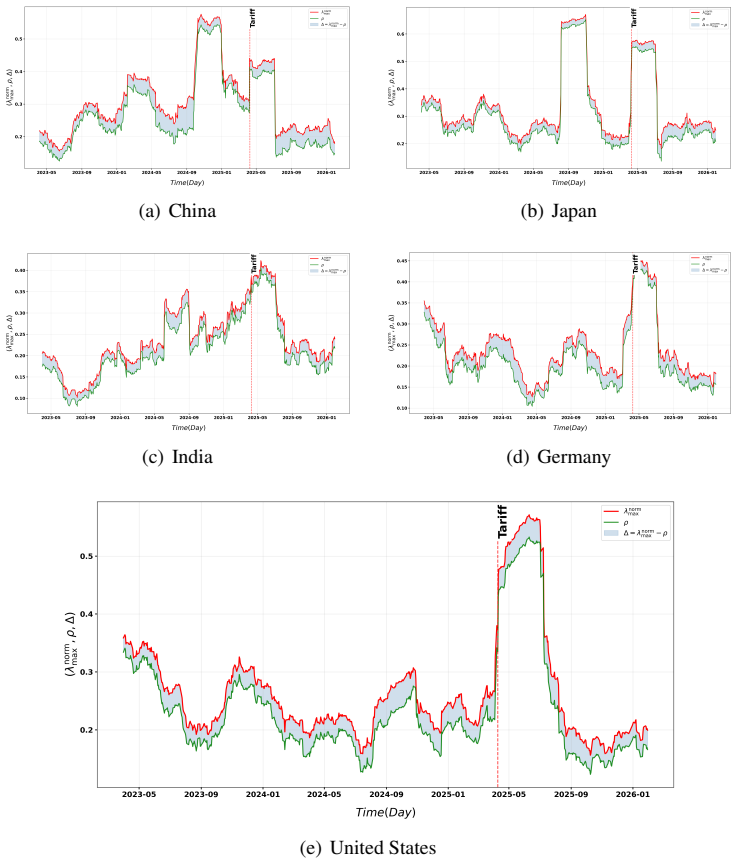
Structural Dynamics of G5 Stock Markets During Exogenous Shocks: A Random Matrix Theory-Based Complexity Gap Approach

A complexity gap from correlation matrices shows a repeatable three-phase pattern that predicts higher future portfolio volatility.

Figure from the paper full image
abstract click to expand
We identify a robust structural signature of stock markets during exogenous shock events by analyzing collective return dynamics across G5 countries. Using Random Matrix Theory, we introduce the complexity gap, defined as the difference between the normalized largest eigenvalue and the average pairwise correlation, to quantify changes in market structure. This measure reveals a consistent three-phase pattern across multiple shocks, including the 2025 U.S. tariff event, the COVID-19 crisis, and country-specific shocks in Japan and China during 2024. Before a shock, markets show a positive complexity gap, reflecting a rich structure with multiple interacting factors. During shocks, the gap collapses to near zero, signaling strong synchronization under a single dominant mode. Post-shock recovery follows a nonmonotonic path: an initial widening (a false recovery), a temporary recollapse, and final sustained restoration. This pattern holds at both market and sector levels and across global and local shocks. Ordinal entropy analysis confirms the same sequence of collapse and false recovery in directional diversity. We further demonstrate that lower complexity gap values predict higher future portfolio volatility, especially after shocks, establishing its value as a state-dependent risk indicator. For investors, initial gap widening may mislead, while sustained widening signals genuine structural stabilization. These findings reveal a robust structural signature governing financial market dynamics during crisis and recovery periods.
0
0
q-fin.ST 2026-04-20

CTLNet hybrid model outperforms baselines for Shanghai index prediction

The CTLNet for Shanghai Composite Index Prediction

Combining CNN feature extraction, transformer attention, and LSTM memory yields higher accuracy than single-model methods on stock data.

abstract click to expand
Shanghai Composite Index prediction has become a hot issue for many investors and academic researchers. Deep learning models are widely applied in multivariate time series forecasting, including recurrent neural networks (RNN), convolutional neural networks (CNN), and transformers. Specifically, the Transformer encoder, with its unique attention mechanism and parallel processing capabilities, has become an important tool in time series prediction, and has an advantage in dealing with long sequence dependencies and multivariate data correlations. Drawing on the strengths of various models, we propose the CNN-Transformer-LSTM Networks (CTLNet). This paper explores the application of CTLNet for Shanghai Composite Index prediction and the comparative experiments show that the proposed model outperforms state-of-the-art baselines.
0
0
q-fin.ST 2026-04-17

Financial ML backtests often detect nonexistent predictability

Spurious Predictability in Financial Machine Learning

A new audit runs complete workflows on synthetic martingales and placebos, rejecting those that still show significant walk-forward results.

Figure from the paper full image
abstract click to expand
Adaptive specification search generates statistically significant backtests even under martingale-difference nulls. We introduce a falsification audit testing complete predictive workflows against synthetic reference classes, including zero-predictability environments and microstructure placebos. Workflows generating significant walk-forward evidence in these environments are falsified. For passing workflows, we quantify selection-induced performance inflation using an absolute magnitude gap linking optimized in-sample evidence to disjoint walk-forward realizations, adjusted for effective multiplicity. Simulations validate extreme-value scaling under correlated searches and demonstrate detection power under genuine structure. Empirical case studies confirm that many apparent findings represent methodological artifacts rather than genuine predictability.
0
0
q-fin.ST 2026-04-17

Stock return variance scales linearly despite asymmetry

Broken Symmetry, Conservation Law, and Scaling in Accumulated Stock Returns -- a Modified Jones-Faddy Skew t-Distribution Perspective

S&P500 data shows both variance and mean maintain linear growth with accumulation days even as gains and losses break symmetry.

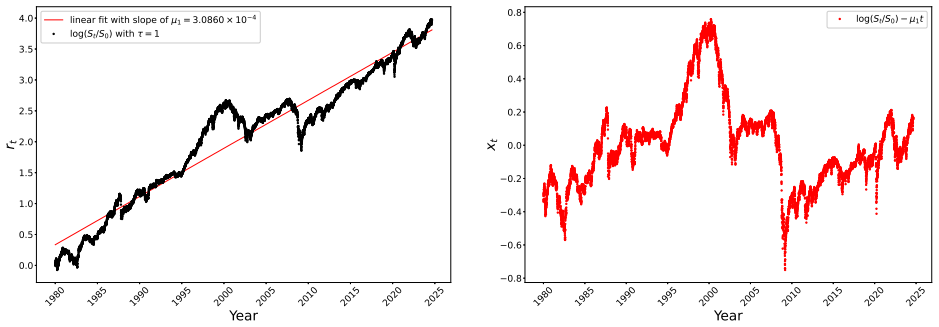
Figure from the paper full image
abstract click to expand
We analyze historic S&P500 multi-day returns: from daily returns to those accumulated over up to ten days. Despite symmetry breaking between gains and losses in the distribution of returns, resulting in its positive mean and negative skew, realized variance (volatility squared) exhibits remarkably good linear dependence on the number of days of accumulation. Mean of the distribution also shows near perfect linear dependence as well. We analyze this phenomenon both analytically and numerically using a modified Jones-Faddy skew t-distribution.
0
0
q-fin.ST 2026-04-14

GANs conditioned on sentiment improve volatile market forecasts

Beyond Sequential Prediction: Learning Financial Market Dynamics in Volatile and Non-Stationary Environments through Sentiment-Conditioned Generative Modelling

The hybrid model combines adversarial training on price sequences with text sentiment to better handle shifting conditions and external data

abstract click to expand
The problem of time-series forecasting in non-stationary and complex environments is a challenging task in machine learning, especially with heterogeneous numerical and textual data present. Traditional statistical models like AutoRegressive Integrated Moving Average (ARIMA) are based on the assumptions of linearity and stationarity, whereas recurrent neural networks like Long Short-Term Memory (LSTM) models do not necessarily represent distributional properties in highly volatile settings. This paper proposes a hybrid model that combines Generative Adversarial Networks (GANs) with Natural Language Processing (NLP)-based sentiment analysis to enable sentiment-conditioned time-series prediction. The model integrates adversarial learning on numerical sequences with contextual sentiment representations derived from unstructured text, enabling them to be jointly modelled to capture temporal dynamics and exogenous information. These results demonstrate the promise of hybrid generative and language-aware methods to enhance prediction robustness in non-stationary environments.
0
0
q-fin.ST 2026-04-14

Herding process drives nonlinear productivity catch-up

A Herding-Based Model of Technological Transfer and Economic Convergence: Evidence from Central and Eastern Europe

A model of technology adoption through peer effects and incentives yields explicit solutions that match data from Central and Eastern Europe

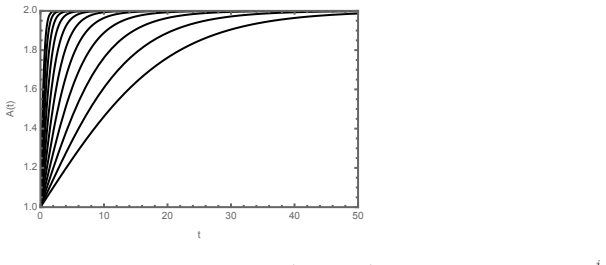
Figure from the paper full image
abstract click to expand
The long-run convergence of developing economies toward advanced countries exhibits robust empirical regularities, yet the mechanisms underlying technological diffusion remain insufficiently specified in standard growth models. In this paper, we extend the neoclassical framework by introducing a micro-founded mechanism of technological transfer as a driver of total factor productivity. Rather than treating technological progress as exogenous or purely innovation-driven, we model productivity growth as a process of adopting existing technologies from the global frontier. The diffusion process is described using a herding-type interaction mechanism, in which agents transition from non-adopters to adopters under the combined influence of individual incentives and peer effects. This approach yields a tractable aggregate representation of TFP dynamics characterized by nonlinear convergence toward a moving technological frontier. We derive an explicit analytical solution and provide an interpretation of model parameters in terms of initial productivity, convergence limits, and diffusion speed. The model is evaluated using OECD productivity data for Central and Eastern European economies.
0
0
q-fin.ST 2026-04-13

Routing volatility models by market state cuts high-vol errors 24%

Risk-Sensitive Specialist Routing for Volatility Forecasting

Specialist selection via real-time risk evaluation beats the rolling-best baseline during stressed ETF conditions.

Figure from the paper full image
abstract click to expand
Volatility forecasting becomes challenging when market conditions shift and model performance varies across market states. Motivated by this instability, we develop a risk-sensitive specialist routing framework for ETF volatility forecasting. The framework uses online risk-sensitive evaluation and state-dependent gating to combine different forecasting specialists across calm and stressed market states. Using a daily panel of six ETFs under a rolling walk-forward design, we find that the strongest forecaster is regime-dependent rather than stable across all states. Relative to the rolling-best baseline, the proposed routing framework reduces high-volatility forecast loss by about 24% and underprediction loss by about 22%. These results suggest that specialist routing provides a practical forecasting architecture that adapts to changing market conditions.
0
0
q-fin.ST 2026-04-13 Recognition

Equity shocks stop at one or two asset failures

Systemic Risk and Default Cascades in Global Equity Markets: A Network and Tail-Risk Approach Based on the Gai Kapadia Framework

Simulations on 30 Brazilian and developed-market assets reveal global resilience but local amplification inside high-clustering clusters.

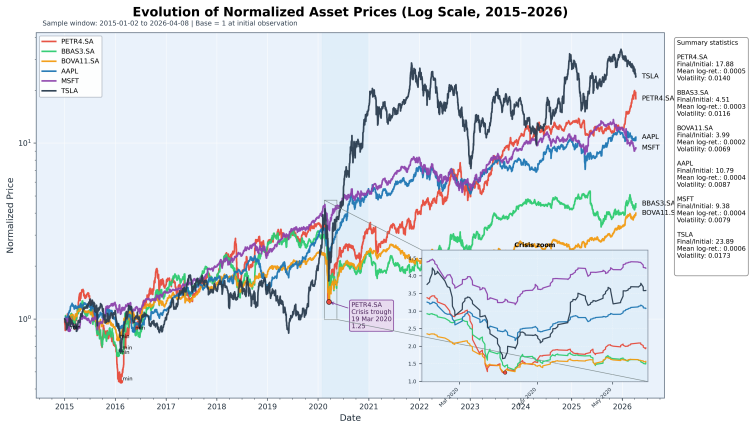
Figure from the paper full image
abstract click to expand
This study extends the Gai-Kapadia framework, originally developed for interbank contagion, to assess systemic risk and default cascades in global equity markets. We analyze a 30 asset network comprising Brazilian and developed market equities over the period 2015-2026, constructing exposure based financial networks from price co-movements. Threshold filtering (theta = 0.3 and theta = 0.5) is applied to isolate significant interconnections. Cascade dynamics are analyzed through a combination of deterministic propagation and stochastic Monte Carlo simulations (n = 1000) under varying shock intensities. The results show that the system exhibits strong global resilience, with a negligible probability of large scale failure, while maintaining localized vulnerability within highly clustered subnetworks. In particular, shocks lead to an average of 1.0 failed asset for single shocks and 2.0 for simultaneous shocks, indicating limited propagation below a critical threshold. Network analysis reveals a clear structural asymmetry: Brazilian assets display high clustering (Ci approx 0.8-1.0) and dense connectivity, which amplifies local shock propagation, whereas developed market assets exhibit lower connectivity (Ci approx 0.2-0.5), limiting systemic spread. Tail risk analysis, based on empirical CCDF and Hill estimators, confirms the presence of heavy tailed loss distributions, particularly in emerging markets, reinforcing their exposure to extreme events. These findings demonstrate that systemic risk arises from the interaction between network topology and tail behavior, rather than from isolated asset characteristics. The proposed framework provides a scalable and empirically grounded approach for stress testing and systemic risk assessment, offering relevant insights for regulators and portfolio managers in increasingly interconnected financial markets.
0
0
q-fin.ST 2026-04-08 Recognition

Sequential audit sampling controls error rates exactly in finite populations

Sequential Audit Sampling with Statistical Guarantees

Exact boundaries from finite-population error probabilities let auditors stop early while keeping decision errors under target levels.

Figure from the paper full image
abstract click to expand
Financial statement auditing is conducted under a risk-based evidence approach to obtain reasonable assurance. In practice, auditors often perform additional sampling or related procedures when an initial sample does not provide a sufficient basis for a conclusion. Across jurisdictions, current standards and practice manuals acknowledge such extensions, while the statistical design of sequential audit procedures has not been fully explored. This study formulates audit sampling with additional, sequentially collected items as a sequential testing problem for a finite population under sampling without replacement. We define null and alternative hypotheses in terms of a tolerable deviation rate, specify stopping and decision rules, and formulate exact sequential boundary conditions in terms of finite-population error probabilities. For practical implementation, we calibrate those boundaries by Monte Carlo simulation at least-favorable deviation rates. The exact design yields ex ante control of decision error probabilities, and the simulation-based implementation approximates that design while allowing the computation of expected stopping times. The framework is most naturally suited to attribute auditing and deviation-rate auditing, especially tests of controls, and it can be extended to one-sided, two-stage, and truncated designs.
0
0
q-fin.ST 2026-04-03 2 theorems

Neural nets and topology flag Canadian market stress best

Financial Anomaly Detection for the Canadian Market

TDA and selected neural models outperform PCA on TSX-60 returns by using global shape properties of the data.

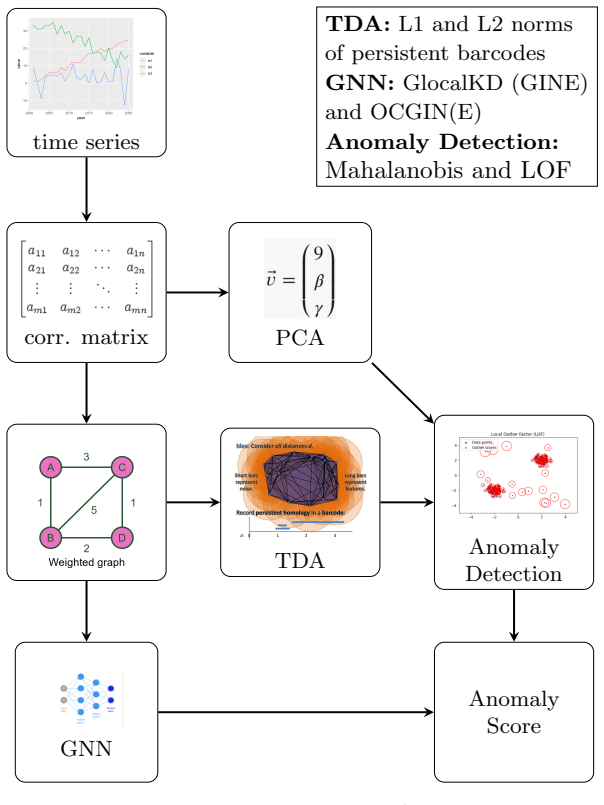
Figure from the paper full image
abstract click to expand
In this work we evaluate the performance of three classes of methods for detecting financial anomalies: topological data analysis (TDA), principal component analyis (PCA), and Neural Network-based approaches. We apply these methods to the TSX-60 data to identify major financial stress events in the Canadian stock market. We show how neural network-based methods (such as GlocalKD and One-Shot GIN(E)) and TDA methods achieve the strongest performance. The effectiveness of TDA in detecting financial anomalies suggests that global topological properties are meaningful in distinguishing financial stress events.
0

browse all of q-fin.ST → full archive · search · sub-categories