Phase-shifted remote photoplethysmography for estimating heart rate and blood pressure from facial video
Pith reviewed 2026-05-24 04:37 UTC · model grok-4.3
The pith
Phase discrepancy between acral and facial rPPG signals extracted from video enables estimation of both heart rate and blood pressure.
A machine-rendered reading of the paper's core claim, the machinery that carries it, and where it could break.
Core claim
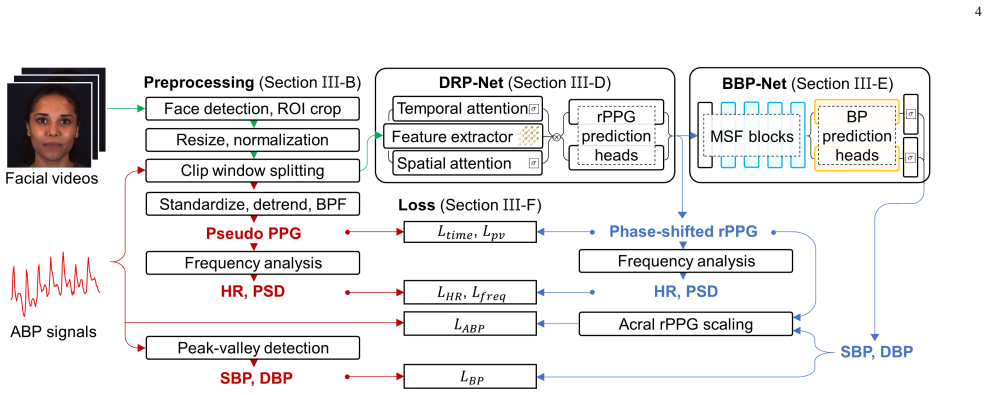
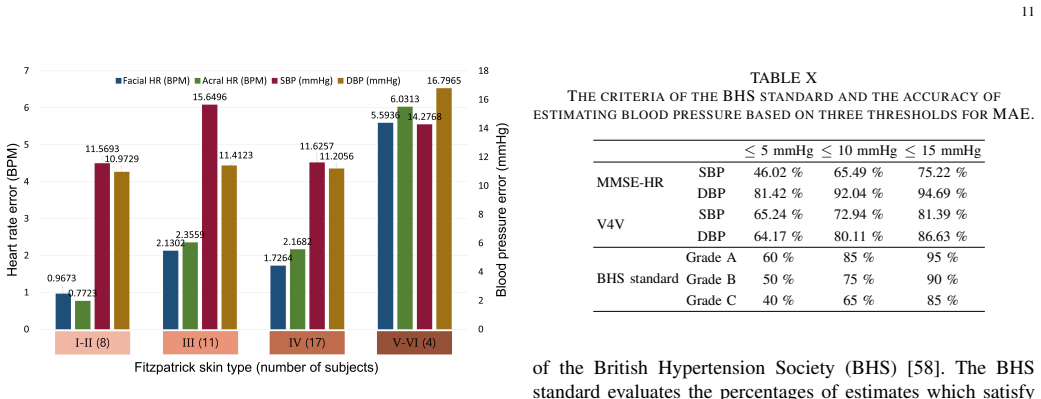
The paper establishes a 2-stage deep learning framework where DRP-Net infers phase-shifted rPPG signals from acral and facial regions to estimate heart rate, and BBP-Net analyzes the phase discrepancy along with temporal features to estimate SBP and DBP within bounded ranges using a scaled sigmoid. Data augmentation via frame interpolation is used to improve heart rate accuracy. On the MMSE-HR dataset, this yields a heart rate MAE of 1.78 BPM, a 34.31% reduction over the recent method, with SBP and DBP MAEs of 10.19 mmHg and 7.09 mmHg; on V4V the corresponding errors are 3.83 BPM, 13.64 mmHg, and 9.4 mmHg.
What carries the argument
The phase discrepancy between acral and facial rPPG signals, which BBP-Net analyzes to regress systolic and diastolic blood pressure beyond heart rate correlation.
If this is right
- Heart rate can be estimated from facial video with reduced mean absolute error using dual-region rPPG extraction.
- Systolic and diastolic blood pressure can be inferred from the same video signals without contact sensors.
- A scaled sigmoid activation constrains blood pressure outputs to predefined physiological ranges.
- Frame interpolation augmentation improves rPPG signal quality for more accurate heart rate tracking.
- The framework shows consistent results on both the MMSE-HR and V4V datasets.
Where Pith is reading between the lines
- The method could support continuous monitoring in telehealth or driver-assist scenarios where contact sensors are impractical.
- Phase timing differences might be further analyzed to derive additional cardiovascular metrics such as pulse transit time.
- Performance on larger and more diverse populations would be required to establish broader reliability.
- Smartphone-camera deployment could increase accessibility of frequent checks but would need robustness to variable lighting and motion.
Load-bearing premise
The phase discrepancy between acral and facial rPPG waveforms supplies independent information sufficient to regress continuous SBP and DBP values rather than merely correlating with heart rate.
What would settle it
Train BBP-Net without the phase discrepancy input between the two rPPG signals and measure whether blood pressure estimation error rises to match or exceed a heart-rate-only baseline.
Figures



read the original abstract
Human health can be critically affected by cardiovascular diseases, such as hypertension, arrhythmias, and stroke. Heart rate and blood pressure are important biometric information for the monitoring of cardiovascular system and early diagnosis of cardiovascular diseases. Existing methods for estimating the heart rate are based on electrocardiography and photoplethyomography, which require contacting the sensor to the skin surface. Moreover, catheter and cuff-based methods for measuring blood pressure cause inconvenience and have limited applicability. Therefore, in this thesis, we propose a vision-based method for estimating the heart rate and blood pressure. This thesis proposes a 2-stage deep learning framework consisting of a dual remote photoplethysmography network (DRP-Net) and bounded blood pressure network (BBP-Net). In the first stage, DRP-Net infers remote photoplethysmography (rPPG) signals for the acral and facial regions, and these phase-shifted rPPG signals are utilized to estimate the heart rate. In the second stage, BBP-Net integrates temporal features and analyzes phase discrepancy between the acral and facial rPPG signals to estimate SBP and DBP values. To improve the accuracy of estimating the heart rate, we employed a data augmentation method based on a frame interpolation model. Moreover, we designed BBP-Net to infer blood pressure within a predefined range by incorporating a scaled sigmoid function. Our method resulted in estimating the heart rate with the mean absolute error (MAE) of 1.78 BPM, reducing the MAE by 34.31 % compared to the recent method, on the MMSE-HR dataset. The MAE for estimating the systolic blood pressure (SBP) and diastolic blood pressure (DBP) were 10.19 mmHg and 7.09 mmHg. On the V4V dataset, the MAE for the heart rate, SBP, and DBP were 3.83 BPM, 13.64 mmHg, and 9.4 mmHg, respectively.
Editorial analysis
A structured set of objections, weighed in public.
Referee Report
Summary. The paper proposes a two-stage deep learning framework for non-contact estimation of heart rate (HR) and blood pressure (BP) from facial video. DRP-Net extracts phase-shifted remote photoplethysmography (rPPG) signals from acral and facial regions to estimate HR (with data augmentation via frame interpolation), while BBP-Net analyzes temporal features and the phase discrepancy between these signals to regress systolic (SBP) and diastolic (DBP) blood pressure values, using a scaled sigmoid to bound outputs. On the MMSE-HR dataset it reports HR MAE of 1.78 BPM (34.31% reduction vs. a recent method), SBP MAE 10.19 mmHg and DBP MAE 7.09 mmHg; on V4V the corresponding MAEs are 3.83 BPM, 13.64 mmHg and 9.4 mmHg.
Significance. If the phase-discrepancy cue can be shown to carry BP information independent of HR correlation, the approach would offer a concrete advance in vision-based cardiovascular monitoring by avoiding contact sensors. The reported MAEs are competitive with prior rPPG work, but the absence of any ablation isolating the phase component or external validation leaves the incremental contribution unverified.
major comments (2)
- [BBP-Net description] Description of BBP-Net and the scaled-sigmoid bound: the central premise that phase discrepancy between acral and facial rPPG streams supplies information usable for continuous SBP/DBP regression beyond what HR alone provides is invoked to motivate the second-stage network, yet no ablation (e.g., single-stream input, time-shifted streams to null lag, or direct HR-regressor baseline for the BP task) is reported; without such a controlled comparison the end-to-end MAEs cannot be attributed to the phase cue.
- [Experimental results] Results on MMSE-HR and V4V: the claimed 34.31 % MAE reduction and the absolute MAEs for HR/SBP/DBP are presented without error bars, subject-wise cross-validation protocol, or re-implementation details of the baseline method, rendering the quantitative claims difficult to interpret or reproduce.
minor comments (2)
- [Abstract] Abstract contains the typo 'photoplethyomography' (should be photoplethysmography) and refers to the work as 'this thesis' while the submission is an arXiv paper.
- [Methods] Notation for the scaled sigmoid bound and the precise definition of 'phase discrepancy' feature fed to BBP-Net should be formalized with an equation rather than left descriptive.
Simulated Author's Rebuttal
We thank the referee for the detailed and constructive feedback on our manuscript. We address the major comments point by point below, agreeing where the manuscript requires strengthening and outlining the specific revisions we will implement.
read point-by-point responses
-
Referee: [BBP-Net description] Description of BBP-Net and the scaled-sigmoid bound: the central premise that phase discrepancy between acral and facial rPPG streams supplies information usable for continuous SBP/DBP regression beyond what HR alone provides is invoked to motivate the second-stage network, yet no ablation (e.g., single-stream input, time-shifted streams to null lag, or direct HR-regressor baseline for the BP task) is reported; without such a controlled comparison the end-to-end MAEs cannot be attributed to the phase cue.
Authors: We agree that the absence of ablation studies isolating the contribution of the phase discrepancy is a limitation in the current manuscript. To address this, the revised version will include new experiments: (1) BBP-Net with only temporal features from a single rPPG stream, (2) a variant with artificially time-shifted streams to remove phase information, and (3) a direct baseline regressing SBP/DBP from the estimated HR alone. These controlled comparisons will quantify the incremental value of the phase cue and support the motivation for the two-stage design. revision: yes
-
Referee: [Experimental results] Results on MMSE-HR and V4V: the claimed 34.31 % MAE reduction and the absolute MAEs for HR/SBP/DBP are presented without error bars, subject-wise cross-validation protocol, or re-implementation details of the baseline method, rendering the quantitative claims difficult to interpret or reproduce.
Authors: We acknowledge that the experimental reporting can be improved for reproducibility and statistical rigor. In the revision we will: add error bars (standard deviations across folds or subjects) to all MAE results; provide a detailed description of the subject-wise cross-validation protocol (including number of folds and how subjects are partitioned); and clarify the source of the baseline numbers (re-implementation details or values taken from the original publication) along with any hyperparameter or preprocessing differences. revision: yes
Circularity Check
No significant circularity in claimed derivation chain.
full rationale
The paper proposes an empirical two-stage supervised deep learning pipeline (DRP-Net for dual rPPG extraction followed by BBP-Net for BP regression) and reports MAEs obtained by training and testing on the MMSE-HR and V4V datasets. No first-principles mathematical derivation, uniqueness theorem, or parameter-free prediction is asserted that reduces by construction to its own inputs or to a self-citation. The phase-discrepancy premise is introduced as an architectural design choice rather than a derived result, and the scaled-sigmoid bound is a simple output-range constraint. Standard ML evaluation on held-out splits does not constitute the enumerated circularity patterns; therefore the score is 0 and the steps list remains empty.
Axiom & Free-Parameter Ledger
free parameters (2)
- DRP-Net and BBP-Net weights
- BP range bounds and sigmoid scaling factors
axioms (2)
- domain assumption Subtle skin color variations in video faithfully encode pulsatile blood volume changes (rPPG principle)
- domain assumption Phase and shape discrepancy between acral and facial rPPG waveforms contains usable information about arterial blood pressure
Reference graph
Works this paper leans on
-
[1]
Global cardiovascular diseases death rate prediction,
O. Gaidai, Y . Cao, and S. Loginov, “Global cardiovascular diseases death rate prediction,” Current Problems in Cardiology , p. 101622, 2023. Fig. 10. Visualization of spatial attention αs. The highlighted areas illustrate regions with higher attention scores
work page 2023
-
[2]
S. Aggarwal and K. Pandey, “Early identification of pcos with commonly known diseases: obesity, diabetes, high blood pressure and heart disease using machine learning techniques,” Expert Systems with Applications , vol. 217, p. 119532, 2023
work page 2023
-
[3]
Heart rate variability for medical decision support systems: A review,
O. Faust, W. Hong, H. W. Loh, S. Xu, R.-S. Tan, S. Chakraborty, P. D. Barua, F. Molinari, and U. R. Acharya, “Heart rate variability for medical decision support systems: A review,” Computers in biology and medicine, vol. 145, p. 105407, 2022
work page 2022
-
[4]
Wrist pulse signal acquisition and analysis for disease diagnosis: A review,
C. Guo, Z. Jiang, H. He, Y . Liao, and D. Zhang, “Wrist pulse signal acquisition and analysis for disease diagnosis: A review,” Computers in Biology and Medicine , vol. 143, p. 105312, 2022
work page 2022
-
[5]
A support system for automatic classification of hypertension using bcg signals,
K. Gupta, V . Bajaj, and I. A. Ansari, “A support system for automatic classification of hypertension using bcg signals,” Expert Systems with Applications, vol. 214, p. 119058, 2023
work page 2023
-
[6]
Heart rate as a risk factor for cardiovascular disease,
C. Perret-Guillaume, L. Joly, and A. Benetos, “Heart rate as a risk factor for cardiovascular disease,”Progress in cardiovascular diseases, vol. 52, no. 1, pp. 6–10, 2009
work page 2009
-
[7]
High blood pressure and cardiovascular disease,
F. D. Fuchs and P. K. Whelton, “High blood pressure and cardiovascular disease,” Hypertension, vol. 75, no. 2, pp. 285–292, 2020
work page 2020
-
[8]
Pulse transit time as an indicator of arterial blood pressure,
L. Geddes, M. V oelz, C. Babbs, J. Bourland, and W. Tacker, “Pulse transit time as an indicator of arterial blood pressure,” psychophysiology, vol. 18, no. 1, pp. 71–74, 1981
work page 1981
-
[9]
D. Barvik, M. Cerny, M. Penhaker, and N. Noury, “Noninvasive contin- uous blood pressure estimation from pulse transit time: A review of the calibration models,” IEEE Reviews in Biomedical Engineering , vol. 15, pp. 138–151, 2021
work page 2021
-
[10]
Wearable cuff-less blood pressure estimation at home via pulse transit time,
V . G. Ganti, A. M. Carek, B. N. Nevius, J. A. Heller, M. Etemadi, and O. T. Inan, “Wearable cuff-less blood pressure estimation at home via pulse transit time,” IEEE journal of biomedical and health informatics , vol. 25, no. 6, pp. 1926–1937, 2020
work page 1926
-
[11]
Deepphys: Video-based physiological mea- surement using convolutional attention networks,
W. Chen and D. McDuff, “Deepphys: Video-based physiological mea- surement using convolutional attention networks,” in Proceedings of the european conference on computer vision (ECCV) , 2018, pp. 349–365
work page 2018
-
[12]
Physformer: Facial video-based physiological measurement with temporal difference transformer,
Z. Yu, Y . Shen, J. Shi, H. Zhao, P. H. Torr, and G. Zhao, “Physformer: Facial video-based physiological measurement with temporal difference transformer,” in Proceedings of the IEEE/CVF conference on computer vision and pattern recognition , 2022, pp. 4186–4196
work page 2022
-
[13]
Y . Ouzar, D. Djeldjli, F. Bousefsaf, and C. Maaoui, “X-ippgnet: A novel one stage deep learning architecture based on depthwise separable con- volutions for video-based pulse rate estimation,” Computers in Biology and Medicine, vol. 154, p. 106592, 2023
work page 2023
-
[14]
Un- supervised skin tissue segmentation for remote photoplethysmography,
S. Bobbia, R. Macwan, Y . Benezeth, A. Mansouri, and J. Dubois, “Un- supervised skin tissue segmentation for remote photoplethysmography,” Pattern Recognition Letters, vol. 124, pp. 82–90, 2019
work page 2019
-
[15]
Vipl-hr: A multi-modal database for pulse estimation from less-constrained face video,
X. Niu, H. Han, S. Shan, and X. Chen, “Vipl-hr: A multi-modal database for pulse estimation from less-constrained face video,” in Computer Vision–ACCV 2018: 14th Asian Conference on Computer Vision, Perth, Australia, December 2–6, 2018, Revised Selected Papers, Part V 14 . Springer, 2019, pp. 562–576
work page 2018
-
[16]
Multimodal spontaneous emotion corpus for human behavior analysis,
Z. Zhang, J. M. Girard, Y . Wu, X. Zhang, P. Liu, U. Ciftci, S. Canavan, M. Reale, A. Horowitz, H. Yang et al. , “Multimodal spontaneous emotion corpus for human behavior analysis,” in Proceedings of the 13 IEEE conference on computer vision and pattern recognition , 2016, pp. 3438–3446
work page 2016
-
[17]
The first vision for vitals (v4v) challenge for non-contact video-based physiological estimation,
A. Revanur, Z. Li, U. A. Ciftci, L. Yin, and L. A. Jeni, “The first vision for vitals (v4v) challenge for non-contact video-based physiological estimation,” in Proceedings of the IEEE/CVF International Conference on Computer Vision , 2021, pp. 2760–2767
work page 2021
-
[18]
Dual-gan: Joint bvp and noise modeling for remote physiological measurement,
H. Lu, H. Han, and S. K. Zhou, “Dual-gan: Joint bvp and noise modeling for remote physiological measurement,” in Proceedings of the IEEE/CVF conference on computer vision and pattern recognition, 2021, pp. 12 404–12 413
work page 2021
-
[19]
J. Speth, N. Vance, B. Sporrer, L. Niu, P. Flynn, and A. Czajka, “Mspm: a multi-site physiological monitoring dataset for remote pulse, respiration, and blood pressure estimation,” IEEE Transactions on In- strumentation and Measurement , 2024
work page 2024
-
[20]
Realistic pulse waveforms estimation via contrastive learning in remote photoplethysmography,
B. Dong, Y . Liu, K. Yang, and J. Cao, “Realistic pulse waveforms estimation via contrastive learning in remote photoplethysmography,” IEEE Transactions on Instrumentation and Measurement , 2024
work page 2024
-
[21]
Y . Huang, D. Huang, J. Huang, G. Wang, L. Pan, H. Lu, M. He, and W. Wang, “Camera-based blood pressure monitoring based on multi-site and multi-wavelength pulse transit time features,” IEEE Transactions on Instrumentation and Measurement , 2024
work page 2024
-
[22]
Exploiting multi-wavelength morphological features of camera-ppg for blood pressure estimation,
Z. Hou, D. Huang, Y . Huang, J. Huang, N. Zhao, L. Pan, H. Lu, C. Shan, and W. Wang, “Exploiting multi-wavelength morphological features of camera-ppg for blood pressure estimation,” IEEE Transactions on Instrumentation and Measurement , 2025
work page 2025
-
[23]
Advancements in non- contact, multiparameter physiological measurements using a webcam,
M.-Z. Poh, D. J. McDuff, and R. W. Picard, “Advancements in non- contact, multiparameter physiological measurements using a webcam,” IEEE transactions on biomedical engineering , vol. 58, no. 1, pp. 7–11, 2010
work page 2010
-
[24]
Measuring pulse rate with a webcam—a non-contact method for evaluating car- diac activity,
M. Lewandowska, J. Rumi ´nski, T. Kocejko, and J. Nowak, “Measuring pulse rate with a webcam—a non-contact method for evaluating car- diac activity,” in 2011 federated conference on computer science and information systems (FedCSIS). IEEE, 2011, pp. 405–410
work page 2011
-
[25]
Robust pulse rate from chrominance-based rppg,
G. De Haan and V . Jeanne, “Robust pulse rate from chrominance-based rppg,” IEEE Transactions on Biomedical Engineering , vol. 60, no. 10, pp. 2878–2886, 2013
work page 2013
-
[26]
Algorithmic principles of remote ppg,
W. Wang, A. C. Den Brinker, S. Stuijk, and G. De Haan, “Algorithmic principles of remote ppg,” IEEE Transactions on Biomedical Engineer- ing, vol. 64, no. 7, pp. 1479–1491, 2016
work page 2016
-
[27]
E. M. Nowara, D. McDuff, and A. Veeraraghavan, “The benefit of distraction: Denoising camera-based physiological measurements using inverse attention,” in Proceedings of the IEEE/CVF international con- ference on computer vision , 2021, pp. 4955–4964
work page 2021
-
[28]
arXiv preprint arXiv:1905.02419 , year =
Z. Yu, X. Li, and G. Zhao, “Remote photoplethysmograph signal measurement from facial videos using spatio-temporal networks,” arXiv preprint arXiv:1905.02419, 2019
-
[29]
Z. Yu, Y . Shen, J. Shi, H. Zhao, Y . Cui, J. Zhang, P. Torr, and G. Zhao, “Physformer++: Facial video-based physiological measurement with slowfast temporal difference transformer,” International Journal of Computer Vision, vol. 131, no. 6, pp. 1307–1330, 2023
work page 2023
-
[30]
F. Miao, B. Wen, Z. Hu, G. Fortino, X.-P. Wang, Z.-D. Liu, M. Tang, and Y . Li, “Continuous blood pressure measurement from one-channel electrocardiogram signal using deep-learning techniques,” Artificial In- telligence in Medicine , vol. 108, p. 101919, 2020
work page 2020
-
[31]
Pp-net: A deep learning framework for ppg-based blood pressure and heart rate estimation,
M. Panwar, A. Gautam, D. Biswas, and A. Acharyya, “Pp-net: A deep learning framework for ppg-based blood pressure and heart rate estimation,” IEEE Sensors Journal , vol. 20, no. 17, pp. 10 000–10 011, 2020
work page 2020
-
[32]
B. Huang, W. Chen, C.-L. Lin, C.-F. Juang, and J. Wang, “Mlp-bp: A novel framework for cuffless blood pressure measurement with ppg and ecg signals based on mlp-mixer neural networks,” Biomedical Signal Processing and Control, vol. 73, p. 103404, 2022
work page 2022
-
[33]
C. Ma, P. Zhang, H. Zhang, Z. Liu, F. Song, Y . He, and G. Zhang, “Stp: Self-supervised transfer learning based on transformer for noninvasive blood pressure estimation using photoplethysmography,” Expert Systems with Applications, vol. 249, p. 123809, 2024
work page 2024
-
[34]
A facial-image- based blood pressure measurement system without calibration,
B.-F. Wu, B.-J. Wu, B.-R. Tsai, and C.-P. Hsu, “A facial-image- based blood pressure measurement system without calibration,” IEEE Transactions on Instrumentation and Measurement , vol. 71, pp. 1–13, 2022
work page 2022
-
[35]
F. Bousefsaf, T. Desquins, D. Djeldjli, Y . Ouzar, C. Maaoui, and A. Pruski, “Estimation of blood pressure waveform from facial video using a deep u-shaped network and the wavelet representation of imaging photoplethysmographic signals,” Biomedical Signal Processing and Control, vol. 78, p. 103895, 2022
work page 2022
-
[36]
Remote blood pressure estimation via the spatiotemporal mapping of facial videos,
Y . Chen, J. Zhuang, B. Li, Y . Zhang, and X. Zheng, “Remote blood pressure estimation via the spatiotemporal mapping of facial videos,” Sensors, vol. 23, no. 6, p. 2963, 2023
work page 2023
-
[37]
Joint face detection and alignment using multitask cascaded convolutional networks,
K. Zhang, Z. Zhang, Z. Li, and Y . Qiao, “Joint face detection and alignment using multitask cascaded convolutional networks,” IEEE signal processing letters , vol. 23, no. 10, pp. 1499–1503, 2016
work page 2016
-
[38]
An advanced detrending method with application to hrv analysis,
M. P. Tarvainen, P. O. Ranta-Aho, and P. A. Karjalainen, “An advanced detrending method with application to hrv analysis,” IEEE transactions on biomedical engineering , vol. 49, no. 2, pp. 172–175, 2002
work page 2002
-
[39]
A. C. Guyton, Text book of medical physiology . China, 2006
work page 2006
-
[40]
Film: Frame interpolation for large motion,
F. Reda, J. Kontkanen, E. Tabellion, D. Sun, C. Pantofaru, and B. Cur- less, “Film: Frame interpolation for large motion,” in European Confer- ence on Computer Vision . Springer, 2022, pp. 250–266
work page 2022
-
[41]
Autohr: A strong end-to- end baseline for remote heart rate measurement with neural searching,
Z. Yu, X. Li, X. Niu, J. Shi, and G. Zhao, “Autohr: A strong end-to- end baseline for remote heart rate measurement with neural searching,” IEEE Signal Processing Letters , vol. 27, pp. 1245–1249, 2020
work page 2020
-
[42]
And-rppg: A novel denoising-rppg network for improving remote heart rate estimation,
B. Lokendra and G. Puneet, “And-rppg: A novel denoising-rppg network for improving remote heart rate estimation,” Computers in biology and medicine, vol. 141, p. 105146, 2022
work page 2022
-
[43]
Facial video-based remote physiolog- ical measurement via self-supervised learning,
Z. Yue, M. Shi, and S. Ding, “Facial video-based remote physiolog- ical measurement via self-supervised learning,” IEEE Transactions on Pattern Analysis and Machine Intelligence , 2023
work page 2023
-
[44]
BAM: Bottleneck Attention Module
J. Park, S. Woo, J.-Y . Lee, and I. S. Kweon, “Bam: Bottleneck attention module,” arXiv preprint arXiv:1807.06514 , 2018
work page internal anchor Pith review Pith/arXiv arXiv 2018
-
[45]
Q. Hu, D. Wang, and C. Yang, “Ppg-based blood pressure estimation can benefit from scalable multi-scale fusion neural networks and multi- task learning,” Biomedical Signal Processing and Control , vol. 78, p. 103891, 2022
work page 2022
-
[46]
Robust estimation of a location parameter in the presence of asymmetry,
J. R. Collins, “Robust estimation of a location parameter in the presence of asymmetry,” The Annals of Statistics , pp. 68–85, 1976
work page 1976
-
[47]
Heart rate estimation network from facial videos using spatiotemporal feature image,
K. B. Jaiswal and T. Meenpal, “Heart rate estimation network from facial videos using spatiotemporal feature image,” Computers in Biology and Medicine, vol. 151, p. 106307, 2022
work page 2022
-
[48]
Efficientphys: Enabling simple, fast and accurate camera-based vitals measurement,
X. Liu, B. L. Hill, Z. Jiang, S. Patel, and D. McDuff, “Efficientphys: Enabling simple, fast and accurate camera-based vitals measurement,” arXiv preprint arXiv:2110.04447 , 2021
-
[49]
Using high-fidelity avatars to advance camera-based cardiac pulse measure- ment,
D. McDuff, J. Hernandez, X. Liu, E. Wood, and T. Baltrusaitis, “Using high-fidelity avatars to advance camera-based cardiac pulse measure- ment,” IEEE Transactions on Biomedical Engineering , vol. 69, no. 8, pp. 2646–2656, 2022
work page 2022
-
[50]
Channel-wise interactive learning for remote heart rate estimation from facial video,
Q. Li, D. Guo, W. Qian, X. Tian, X. Sun, H. Zhao, and M. Wang, “Channel-wise interactive learning for remote heart rate estimation from facial video,” IEEE Transactions on Circuits and Systems for Video Technology, 2023
work page 2023
-
[51]
W. Qian, D. Guo, K. Li, X. Zhang, X. Tian, X. Yang, and M. Wang, “Dual-path tokenlearner for remote photoplethysmography-based phys- iological measurement with facial videos,” IEEE Transactions on Com- putational Social Systems , 2024
work page 2024
-
[52]
M. Rong and K. Li, “A blood pressure prediction method based on imaging photoplethysmography in combination with machine learning,” Biomedical Signal Processing and Control , vol. 64, p. 102328, 2021
work page 2021
-
[53]
F. Schrumpf, P. Frenzel, C. Aust, G. Osterhoff, and M. Fuchs, “As- sessment of non-invasive blood pressure prediction from ppg and rppg signals using deep learning,” Sensors, vol. 21, no. 18, p. 6022, 2021
work page 2021
-
[54]
D.-Y . Kim, S.-Y . Cho, K. Lee, and C.-B. Sohn, “A study of projection- based attentive spatial–temporal map for remote photoplethysmography measurement,” Bioengineering, vol. 9, no. 11, p. 638, 2022
work page 2022
-
[55]
B. Hamoud, A. Kashevnik, W. Othman, and N. Shilov, “Neural network model combination for video-based blood pressure estimation: New approach and evaluation,” Sensors, vol. 23, no. 4, p. 1753, 2023
work page 2023
-
[56]
The validity and practicality of sun-reactive skin types i through vi,
T. B. Fitzpatrick, “The validity and practicality of sun-reactive skin types i through vi,” Archives of dermatology , vol. 124, no. 6, pp. 869–871, 1988
work page 1988
-
[57]
Multi-task temporal shift attention networks for on-device contactless vitals measurement,
X. Liu, J. Fromm, S. Patel, and D. McDuff, “Multi-task temporal shift attention networks for on-device contactless vitals measurement,” Ad- vances in Neural Information Processing Systems , vol. 33, pp. 19 400– 19 411, 2020
work page 2020
-
[58]
E. O’Brien, J. Petrie, W. Littler, M. de Swiet, P. L. Padfield, K. O’Malley, M. Jamieson, D. Altman, M. Bland, and N. Atkins, “The british hypertension society protocol for the evaluation of automated and semi- automated blood pressure measuring devices with special reference to ambulatory systems,” Journal of hypertension , vol. 8, no. 7, pp. 607– 619, 1990
work page 1990
discussion (0)
Sign in with ORCID, Apple, or X to comment. Anyone can read and Pith papers without signing in.