Time series generation for option pricing on quantum computers using tensor network
Pith reviewed 2026-05-24 03:58 UTC · model grok-4.3
The pith
Matrix product states can be trained to generate asset price paths matching the Heston model.
A machine-rendered reading of the paper's core claim, the machinery that carries it, and where it could break.
Core claim
The authors demonstrate that an MPS can be trained to generate paths in the Heston model. This shows the capability of the MPS to reproduce the joint distribution of asset prices at multiple time points and thereby supports its use for preparing quantum states in path-dependent option pricing on quantum computers.
What carries the argument
The matrix product state (MPS) encoded as a qubit state and trained as a generative model to capture the joint distribution across time steps.
If this is right
- The MPS model generates paths in the Heston model.
- This supports preparation of quantum states encoding joint distributions for path-dependent options.
- The training procedure for the MPS generative model is provided in detail.
Where Pith is reading between the lines
- Classical training of the MPS could precede loading the distribution into a quantum circuit, separating the heavy computation from the quantum device.
- The same MPS construction might apply to other stochastic processes used in derivative pricing.
- The method could combine with quantum amplitude estimation to form end-to-end quantum workflows for complex options.
Load-bearing premise
An MPS with practical bond dimension can be trained to faithfully reproduce the joint distribution of asset prices across multiple time steps in the Heston model.
What would settle it
Numerical tests in which the statistical properties of paths produced by the trained MPS, such as volatility or correlations, deviate from those of direct Heston model simulations.
Figures
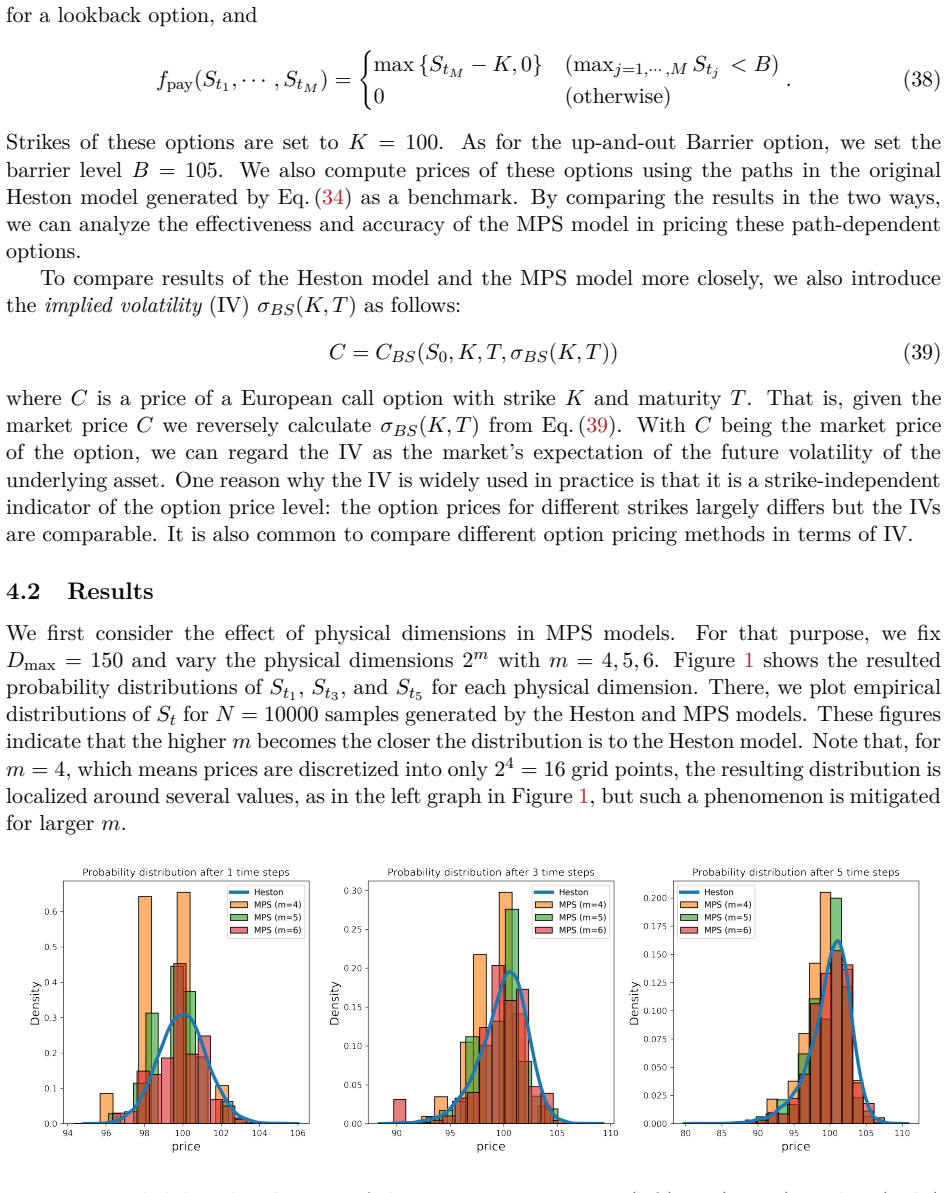

read the original abstract
Finance, especially option pricing, is a promising industrial field that might benefit from quantum computing. While quantum algorithms for option pricing have been proposed, it is desired to devise more efficient implementations of costly operations in the algorithms, one of which is preparing a quantum state that encodes a probability distribution of the underlying asset price. In particular, in pricing a path-dependent option, we need to generate a state encoding a joint distribution of the underlying asset price at multiple time points, which is more demanding. To address these issues, we propose a novel approach that uses a Matrix Product State (MPS), which can be encoded into a state of qubits, as a generative model for time series generation. We focus on the training of such an MPS and present its procedure in detail. To validate our approach, taking the Heston model as a target, we conduct numerical experiments to generate time series in the model. Our findings demonstrate the capability of the MPS model to generate paths in the Heston model, highlighting its potential for path-dependent option pricing on quantum computers.
Editorial analysis
A structured set of objections, weighed in public.
Referee Report
Summary. The manuscript proposes training a matrix product state (MPS) classically as a generative model to produce time series paths distributed according to the Heston stochastic volatility model. The trained MPS is then to be encoded as a quantum state for use in quantum algorithms that price path-dependent options. The training procedure is described in detail, and numerical experiments on the Heston model are presented to demonstrate that the MPS can generate such paths, with the goal of highlighting potential advantages for quantum finance applications.
Significance. If the numerical results establish that an MPS with modest bond dimension can faithfully reproduce the joint distribution over multiple time steps, the approach would supply a concrete classical pre-processing route to the state-preparation step that is otherwise costly in quantum option-pricing algorithms. This would constitute a practical bridge between tensor-network methods and quantum finance, provided the bond-dimension scaling and training cost remain manageable.
major comments (2)
- [Numerical Experiments] Numerical Experiments section: the central claim that the MPS model demonstrates capability for Heston path generation rests on the assertion that a practical bond dimension suffices to reproduce the joint distribution. The manuscript must report the bond dimension(s) employed, the number of time steps, the volatility discretization, and at least one quantitative fidelity metric (KL divergence, total variation, or moment errors with error bars) so that the stress-test concern can be evaluated directly.
- [Training procedure] Training procedure (around the description of the MPS generative model): it is not shown whether the optimization converges to a distribution whose marginals and correlations match those of the Heston process to within a tolerance that would be acceptable for option pricing. Without these diagnostics the claim that the method is ready for path-dependent pricing remains unsupported.
minor comments (1)
- [Abstract] The abstract states that experiments 'demonstrate the capability' but supplies none of the quantitative results; moving at least the bond dimension and a representative error metric into the abstract would strengthen the summary.
Simulated Author's Rebuttal
We thank the referee for their constructive comments, which help clarify the presentation of our results. We address each major comment below and will revise the manuscript to incorporate the requested details and diagnostics.
read point-by-point responses
-
Referee: [Numerical Experiments] Numerical Experiments section: the central claim that the MPS model demonstrates capability for Heston path generation rests on the assertion that a practical bond dimension suffices to reproduce the joint distribution. The manuscript must report the bond dimension(s) employed, the number of time steps, the volatility discretization, and at least one quantitative fidelity metric (KL divergence, total variation, or moment errors with error bars) so that the stress-test concern can be evaluated directly.
Authors: We agree that these parameters and metrics are essential for evaluating the results. In the revised manuscript we will explicitly state the bond dimensions employed in the numerical experiments, the number of time steps, the discretization scheme used for the volatility process, and quantitative fidelity measures (including KL divergence and moment errors with error bars obtained from repeated training runs). These additions will directly address the concern about whether a modest bond dimension suffices. revision: yes
-
Referee: [Training procedure] Training procedure (around the description of the MPS generative model): it is not shown whether the optimization converges to a distribution whose marginals and correlations match those of the Heston process to within a tolerance that would be acceptable for option pricing. Without these diagnostics the claim that the method is ready for path-dependent pricing remains unsupported.
Authors: We acknowledge the value of explicit convergence diagnostics. The revised version will include additional figures and tables that track the evolution of marginal distributions and pairwise correlations during training, together with quantitative comparisons (e.g., total variation distance on marginals and absolute error on correlations) against the Heston reference. These will demonstrate that the trained MPS reproduces the target statistics to a level suitable for the intended path-dependent pricing application. revision: yes
Circularity Check
No significant circularity; MPS training and Heston validation are independent of definitional reduction
full rationale
The paper proposes training an MPS generative model for multi-step asset price paths in the Heston model, then validates the approach via numerical experiments on path generation. No equations, fitted parameters, or self-citations are shown that would make the reported capability equivalent to its inputs by construction. The central claim rests on external numerical checks of distribution reproduction rather than internal redefinition or renaming of known results. This is the most common honest finding for a methods-plus-numerics paper.
Axiom & Free-Parameter Ledger
Reference graph
Works this paper leans on
-
[1]
Quantum computing for finance: Overview and prospects,
R. Orús, S. Mugel, and E. Lizaso, “Quantum computing for finance: Overview and prospects,” Reviews in Physics, vol. 4, p. 100028, 2019
work page 2019
-
[2]
Prospects and challenges of quantum finance,
A. Bouland, W. van Dam, H. Joorati, I. Kerenidis, and A. Prakash, “Prospects and challenges of quantum finance,”arXiv preprint arXiv:2011.06492, 2020
-
[3]
Quantum computing for finance: State-of-the-art and future prospects,
D. J. Egger, C. Gambella, J. Marecek, S. McFaddin, M. Mevissen, R. Raymond, A. Simonetto, S. Woerner, and E. Yndurain, “Quantum computing for finance: State-of-the-art and future prospects,”IEEE Transactions on Quantum Engineering, vol. 1, pp. 1–24, 2020
work page 2020
-
[4]
A survey of quantum computing for finance,
D. Herman, C. Googin, X. Liu, A. Galda, I. Safro, Y. Sun, M. Pistoia, and Y. Alexeev, “A survey of quantum computing for finance,”arXiv preprint arXiv:2201.02773, 2022
-
[5]
Quantum computing for finance,
D. Herman, C. Googin, X. Liu, Y. Sun, A. Galda, I. Safro, M. Pistoia, and Y. Alexeev, “Quantum computing for finance,”Nature Reviews Physics, vol. 5, no. 8, pp. 450–465, 2023
work page 2023
-
[6]
Quantum speedup of monte carlo methods,
A. Montanaro, “Quantum speedup of monte carlo methods,”Proceedings of the Royal Society A: Mathematical, Physical and Engineering Sciences, vol. 471, no. 2181, p. 20150301, 2015
work page 2015
-
[7]
Quantum amplitude amplification and esti- mation,
G. Brassard, P. Hoyer, M. Mosca, and A. Tapp, “Quantum amplitude amplification and esti- mation,”Contemporary Mathematics, vol. 305, pp. 53–74, 2002
work page 2002
-
[8]
Quantum computational finance: Monte carlo pricing of financial derivatives,
P. Rebentrost, B. Gupt, and T. R. Bromley, “Quantum computational finance: Monte carlo pricing of financial derivatives,”Physical Review A, vol. 98, no. 2, p. 022321, 2018
work page 2018
-
[9]
Option pricing using quantum computers,
N. Stamatopoulos, D. J. Egger, Y. Sun, C. Zoufal, R. Iten, N. Shen, and S. Woerner, “Option pricing using quantum computers,”Quantum, vol. 4, p. 291, 2020
work page 2020
-
[10]
Quantum pricing with a smile: imple- mentation of local volatility model on quantum computer,
K. Kaneko, K. Miyamoto, N. Takeda, and K. Yoshino, “Quantum pricing with a smile: imple- mentation of local volatility model on quantum computer,”EPJ Quantum Technology, vol. 9, pp. 1–32, 2022
work page 2022
-
[11]
Creating superpositions that correspond to efficiently integrable probability distributions
L. Grover and T. Rudolph, “Creating superpositions that correspond to efficiently integrable probability distributions,”arXiv preprint quant-ph/0208112, 2002
work page internal anchor Pith review Pith/arXiv arXiv 2002
-
[12]
Everything you always wanted to know about quantum circuits,
E. Muñoz Coreas and H. Thapliyal, “Everything you always wanted to know about quantum circuits,”Wiley Encyclopedia of Electrical and Electronics Engineering, pp. 1–17, 2022
work page 2022
-
[13]
Black-box quantum state preparation without arithmetic,
Y. R. Sanders, G. H. Low, A. Scherer, and D. W. Berry, “Black-box quantum state preparation without arithmetic,”Phys. Rev. Lett., vol. 122, p. 020502, Jan 2019. 13
work page 2019
-
[14]
Fast black-box quantum state preparation based on linear combination of unitaries,
S. Wang, Z. Wang, G. Cui, S. Shi, R. Shang, L. Fan, W. Li, Z. Wei, and Y. Gu, “Fast black-box quantum state preparation based on linear combination of unitaries,”Quantum Information Processing, vol. 20, no. 8, p. 270, 2021
work page 2021
-
[15]
Fast Black-Box Quantum State Preparation,
J. Bausch, “Fast Black-Box Quantum State Preparation,”Quantum, vol. 6, p. 773, Aug. 2022
work page 2022
-
[16]
Inverse-coefficient black-box quantum state preparation,
S. Wang, Z. Wang, R. He, S. Shi, G. Cui, R. Shang, J. Li, Y. Li, W. Li, Z. Wei, and Y. Gu, “Inverse-coefficient black-box quantum state preparation,”New Journal of Physics, vol. 24, p. 103004, oct 2022
work page 2022
-
[17]
Quantum state preparation without coherent arith- metic,
S. McArdle, A. Gilyén, and M. Berta, “Quantum state preparation without coherent arith- metic,”arXiv preprint arXiv:2210.14892, 2022
-
[18]
Preparing arbitrary continuous functions in quantum registers with logarithmic complexity,
A. G. Rattew and B. Koczor, “Preparing arbitrary continuous functions in quantum registers with logarithmic complexity,”arXiv preprint arXiv:2205.00519, 2022
-
[19]
Quantum algorithms for approximate function loading,
G. Marin-Sanchez, J. Gonzalez-Conde, and M. Sanz, “Quantum algorithms for approximate function loading,”Phys. Rev. Res., vol. 5, p. 033114, Aug 2023
work page 2023
-
[20]
Linear-depth quantum circuits for loading fourier approximations of arbitrary functions,
M. Moosa, T. W. Watts, Y. Chen, A. Sarma, and P. L. McMahon, “Linear-depth quantum circuits for loading fourier approximations of arbitrary functions,”Quantum Science and Tech- nology, vol. 9, p. 015002, oct 2023
work page 2023
-
[21]
Quantum generative adversarial networks for learning and loading random distributions,
C. Zoufal, A. Lucchi, and S. Woerner, “Quantum generative adversarial networks for learning and loading random distributions,”npj Quantum Information, vol. 5, no. 1, p. 103, 2019
work page 2019
-
[22]
J.J.García-Ripoll, “Quantum-inspiredalgorithmsformultivariateanalysis: frominterpolation to partial differential equations,”Quantum, vol. 5, p. 431, Apr. 2021
work page 2021
-
[23]
Quantum self-learning monte carlo and quantum-inspired fourier transform sampler,
K. Endo, T. Nakamura, K. Fujii, and N. Yamamoto, “Quantum self-learning monte carlo and quantum-inspired fourier transform sampler,”Phys. Rev. Res., vol. 2, p. 043442, Dec 2020
work page 2020
-
[24]
Efficient quantum circuits for accurate state preparation of smooth, differentiable functions,
A. Holmes and A. Y. Matsuura, “Efficient quantum circuits for accurate state preparation of smooth, differentiable functions,” in2020 IEEE International Conference on Quantum Com- puting and Engineering (QCE), pp. 169–179, 2020
work page 2020
-
[25]
A hybrid quantum wasserstein gan with applications to option pricing,
F. Fuchs and B. Horvath, “A hybrid quantum wasserstein gan with applications to option pricing,”Available at SSRN 4514510, 2023
work page 2023
-
[26]
A. Novikov, M. Trofimov, and I. Oseledets, “Exponential machines,” arXiv preprint arXiv:1605.03795, 2016
work page internal anchor Pith review Pith/arXiv arXiv 2016
-
[27]
Supervised learning with tensor networks,
E. Stoudenmire and D. J. Schwab, “Supervised learning with tensor networks,”Advances in neural information processing systems, vol. 29, 2016
work page 2016
-
[28]
Towards quan- tum machine learning with tensor networks,
W. Huggins, P. Patil, B. Mitchell, K. B. Whaley, and E. M. Stoudenmire, “Towards quan- tum machine learning with tensor networks,”Quantum Science and technology, vol. 4, no. 2, p. 024001, 2019
work page 2019
-
[29]
Unsupervised generative modeling using matrix product states,
Z.-Y. Han, J. Wang, H. Fan, L. Wang, and P. Zhang, “Unsupervised generative modeling using matrix product states,”Physical Review X, vol. 8, no. 3, p. 031012, 2018
work page 2018
-
[30]
Tree tensor networks for generative modeling,
S. Cheng, L. Wang, T. Xiang, and P. Zhang, “Tree tensor networks for generative modeling,” Physical Review B, vol. 99, no. 15, p. 155131, 2019. 14
work page 2019
-
[31]
Tensor networks for unsupervised machine learning,
J. Liu, S. Li, J. Zhang, and P. Zhang, “Tensor networks for unsupervised machine learning,” Physical Review E, vol. 107, no. 1, p. L012103, 2023
work page 2023
-
[32]
Encoding of matrix product states into quantum circuits of one-and two-qubit gates,
S.-J. Ran, “Encoding of matrix product states into quantum circuits of one-and two-qubit gates,”Physical Review A, vol. 101, no. 3, p. 032310, 2020
work page 2020
-
[33]
M. S. Rudolph, J. Miller, D. Motlagh, J. Chen, A. Acharya, and A. Perdomo-Ortiz, “Synergy between quantum circuits and tensor networks: Short-cutting the race to practical quantum advantage,”arXiv preprint arXiv:2208.13673, 2022
-
[34]
Decomposition of matrix product states into shallow quantum circuits,
M. S. Rudolph, J. Chen, J. Miller, A. Acharya, and A. Perdomo-Ortiz, “Decomposition of matrix product states into shallow quantum circuits,”Quantum Science and Technology, vol. 9, no. 1, p. 015012, 2023
work page 2023
-
[35]
S. L. Heston, “A closed-form solution for options with stochastic volatility with applications to bond and currency options,”The review of financial studies, vol. 6, no. 2, pp. 327–343, 1993
work page 1993
-
[36]
Hull, Options, futures, and other derivative securities, vol
J. Hull, Options, futures, and other derivative securities, vol. 7. Prentice Hall Englewood Cliffs, NJ, 1993
work page 1993
-
[37]
Shreve,Stochastic calculus for finance I: the binomial asset pricing model
S. Shreve,Stochastic calculus for finance I: the binomial asset pricing model. Springer Science & Business Media, 2005
work page 2005
-
[38]
S. E. Shreveet al., Stochastic calculus for finance II: Continuous-time models, vol. 11. Springer, 2004
work page 2004
-
[39]
The pricing of options and corporate liabilities,
F. Black and M. Scholes, “The pricing of options and corporate liabilities,”Journal of political economy, vol. 81, no. 3, pp. 637–654, 1973
work page 1973
-
[40]
Theory of rational option pricing,
R. C. Merton, “Theory of rational option pricing,”The Bell Journal of Economics and Man- agement Science, vol. 4, no. 1, pp. 141–183, 1973
work page 1973
-
[41]
B. Dupireet al., “Pricing with a smile,”Risk, vol. 7, no. 1, pp. 18–20, 1994
work page 1994
-
[42]
A theory of the term structure of interest rates,
J. C. Cox, J. E. Ingersoll Jr, and S. A. Ross, “A theory of the term structure of interest rates,” in Theory of valuation, pp. 129–164, World Scientific, 2005
work page 2005
-
[43]
Continuous markov processes and stochastic equations,
G. Maruyama, “Continuous markov processes and stochastic equations,”Rend. Circ. Mat. Palermo, vol. 4, pp. 48–90, 1955
work page 1955
-
[44]
B. W. Silverman,Density estimation for statistics and data analysis. Routledge, 2018
work page 2018
-
[45]
The constant elasticity of variance option pricing model,
J. C. Cox, “The constant elasticity of variance option pricing model,”Journal of Portfolio Management, p. 15, 1996
work page 1996
-
[46]
P. S. Hagan, D. Kumar, A. S. Lesniewski, and D. E. Woodward, “Managing smile risk,” Wilmott, vol. 1, pp. 84—-108, 2002. 15
work page 2002
discussion (0)
Sign in with ORCID, Apple, or X to comment. Anyone can read and Pith papers without signing in.