Simulating Chemistry on Bosonic Quantum Devices
Pith reviewed 2026-05-24 02:30 UTC · model grok-4.3
The pith
Bosonic quantum devices simulate chemistry by mapping molecular Hamiltonians to operators on quantum harmonic oscillators.
A machine-rendered reading of the paper's core claim, the machinery that carries it, and where it could break.
Core claim
Bosonic quantum devices offer a novel approach to realize quantum computations for chemistry, where the quantum two-level system is replaced with the quantum (an)harmonic oscillator as the fundamental building block; simulation of chemical structure and dynamics is then achieved by representing or mapping the system Hamiltonians in terms of bosonic operators.
What carries the argument
The quantum (an)harmonic oscillator (qumode) as the basic computational unit, with molecular Hamiltonians mapped to bosonic operators.
If this is right
- Molecular vibronic spectra can be calculated by direct bosonic-operator mappings.
- Adiabatic and nonadiabatic chemical dynamics in gas and solution phases become simulable.
- Molecular graph-theory problems admit efficient solutions on the same hardware.
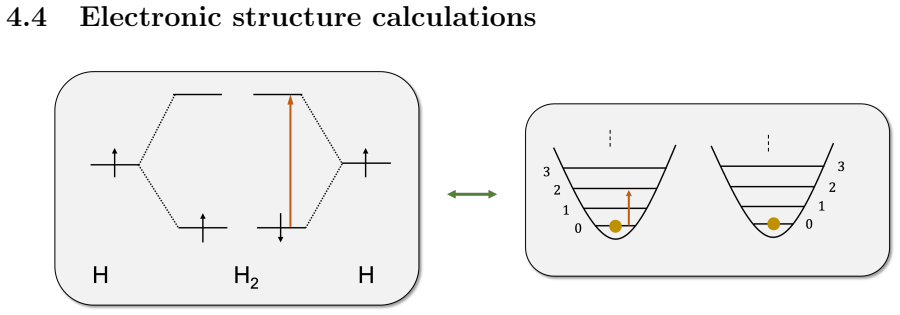
- Electronic-structure calculations can be performed via the same bosonic representation.
Where Pith is reading between the lines
- Bosonic encodings may reduce the overhead of representing vibrational degrees of freedom compared with qubit mappings.
- Hybrid qubit-qumode architectures could combine the strengths of both for mixed electronic-vibrational problems.
- Progress in qumode coherence times would translate directly into larger accessible molecular systems.
Load-bearing premise
Recent experimental progress on bosonic devices can be extended to the scale and fidelity needed for the listed chemical applications without fundamental hardware barriers.
What would settle it
A controlled demonstration that error rates on current bosonic hardware prevent accurate reproduction of the vibronic spectrum of a small molecule such as water or formaldehyde at chemically useful precision.
Figures







read the original abstract
Bosonic quantum devices offer a novel approach to realize quantum computations, where the quantum two-level system (qubit) is replaced with the quantum (an)harmonic oscillator (qumode) as the fundamental building block of the quantum simulator. The simulation of chemical structure and dynamics can then be achieved by representing or mapping the system Hamiltonians in terms of bosonic operators. In this perspective, we review recent progress and future potential of using bosonic quantum devices for addressing a wide range of challenging chemical problems, including the calculation of molecular vibronic spectra, the simulation of gas-phase and solution-phase adiabatic and nonadiabatic chemical dynamics, the efficient solution of molecular graph theory problems, and the calculations of electronic structure.
Editorial analysis
A structured set of objections, weighed in public.
Referee Report
Summary. This perspective reviews mappings of chemical Hamiltonians to bosonic operators on quantum devices that use qumodes (anharmonic oscillators) in place of qubits. It surveys recent progress and outlines potential applications to molecular vibronic spectra, gas- and solution-phase adiabatic/nonadiabatic dynamics, molecular graph-theory problems, and electronic-structure calculations.
Significance. If the reviewed mappings are accurate and the hardware trajectory continues, the work identifies a distinct continuous-variable route to quantum chemistry simulation that may represent certain vibrational and photonic degrees of freedom more compactly than qubit encodings. The synthesis of external experimental and theoretical results is a useful service to the community.
minor comments (3)
- [Introduction] The abstract and introduction list four application areas; each should be explicitly cross-referenced to the corresponding subsection so readers can locate the supporting mappings and cited experiments without searching.
- When discussing experimental progress with bosonic devices, include a short table or paragraph that tabulates reported gate fidelities, coherence times, and mode counts from the cited works so the gap to the listed chemical applications is quantitatively visible.
- Notation for bosonic operators (creation/annihilation, displacement, etc.) should be standardized in a single preliminary section and used consistently thereafter; occasional redefinition of symbols across subsections reduces readability.
Simulated Author's Rebuttal
We thank the referee for their positive assessment of our perspective on bosonic quantum devices for chemical simulations. The recommendation for minor revision is noted, and we appreciate the recognition of the work's potential utility to the community. No specific major comments were raised in the report.
Circularity Check
No significant circularity identified
full rationale
This is a perspective/review paper summarizing external literature on bosonic quantum devices for chemistry. No new derivations, equations, fitted parameters, or primary quantitative claims are advanced. All content refers to cited external work without self-referential reductions or load-bearing self-citations that close a loop. The paper is self-contained against external benchmarks.
Axiom & Free-Parameter Ledger
Forward citations
Cited by 1 Pith paper
-
Characterizing conical intersections of nucleobases on quantum computers
First quantum simulation of conical intersections in cytosine via CQE and VQD on a noisy superconducting quantum computer, with accuracy compared to exact diagonalization.
Reference graph
Works this paper leans on
-
[1]
(1) Feynman, R. P. Feynman and computation ; CRC Press, 2018; pp 133–153. 30 (2) Lidar, D. A.; Wang, H. Calculating the thermal rate constant with exponential speedup on a quantum computer. Phys. Rev. E 1999, 59,
work page 2018
-
[2]
(3) Cao, Y.; Romero, J.; Olson, J. P.; Degroote, M.; Johnson, P. D.; Kieferov´ a, M.; Kivlichan, I. D.; Menke, T.; Peropadre, B.; Sawaya, N. P. D.; Sim, S.; Veis, L.; Aspuru-Guzik, A. Quantum Chemistry in the Age of Quantum Computing. Chem. Rev. 2019, 119, 10856. (4) Bauer, B.; Bravyi, S.; Motta, M.; Chan, G. K.-L. Quantum algorithms for quantum chemistry...
work page 2019
-
[3]
(8) Grimsley, H. R.; Economou, S. E.; Barnes, E.; Mayhall, N. J. An adaptive variational algorithm for exact molecular simulations on a quantum computer. Nat. Commun. 2019, 10 . (9) McArdle, S.; Jones, T.; Endo, S.; Li, Y.; Benjamin, S. C.; Yuan, X. Variational ansatz- based quantum simulation of imaginary time evolution. npj Quantum Inf. 2019, 5,
work page 2019
-
[4]
(10) Motta, M.; Sun, C.; Tan, A. T.; O’Rourke, M. J.; Ye, E.; Minnich, A. J.; Bran- dao, F. G.; Chan, G. K.-L. Determining eigenstates and thermal states on a quantum computer using quantum imaginary time evolution. Nat. Phys. 2020, 16,
work page 2020
-
[5]
31 (11) Smart, S. E.; Mazziotti, D. A. Quantum solver of contracted eigenvalue equations for scalable molecular simulations on quantum computing devices. Phys. Rev. Lett. 2021, 126, 070504. (12) Kyaw, T. H.; Soley, M. B.; Allen, B.; Bergold, P.; Sun, C.; Batista, V. S.; Aspuru- Guzik, A. Boosting quantum amplitude exponentially in variational quantum algo...
work page 2021
-
[6]
(14) Wang, Y.; Mulvihill, E.; Hu, Z.; Lyu, N.; Shivpuje, S.; Liu, Y.; Soley, M. B.; Geva, E.; Batista, V. S.; Kais, S. Simulating open quantum system dynamics on NISQ computers with generalized quantum master equations.J. Chem. Theory Comput. 2023, 19,
work page 2023
-
[7]
(15) Copetudo, A.; Fontaine, C. Y.; Valadares, F.; Gao, Y. Y. Shaping photons: quantum computation with bosonic cQED. Appl. Phys. Lett. 2024, 124, 080502. (16) Deleglise, S.; Dotsenko, I.; Sayrin, C.; Bernu, J.; Brune, M.; Raimond, J.-M.; Haroche, S. Reconstruction of non-classical cavity field states with snapshots of their decoherence. Nature 2008, 455,
work page 2024
-
[8]
Determin- istic creation of entangled atom–light Schr¨ odinger-cat states
(17) Hacker, B.; Welte, S.; Daiss, S.; Shaukat, A.; Ritter, S.; Li, L.; Rempe, G. Determin- istic creation of entangled atom–light Schr¨ odinger-cat states. Nature Photon. 2019, 13,
work page 2019
-
[9]
W.; Ofek, N.; Sliwa, K.; Holland, E.; Wang, C.; Blumoff, J.; Chou, K.; Hatridge, M
(18) Reagor, M.; Pfaff, W.; Axline, C.; Heeres, R. W.; Ofek, N.; Sliwa, K.; Holland, E.; Wang, C.; Blumoff, J.; Chou, K.; Hatridge, M. J.; Frunzio, L.; Devoret, M. H.; Jiang, L.; Schoelkopf, R. J. Quantum memory with millisecond coherence in circuit QED. Phys. Rev. B 2016, 94, 014506. 32 (19) Bruzewicz, C. D.; Chiaverini, J.; McConnell, R.; Sage, J. M. Tr...
work page 2016
-
[10]
A perspective on hybrid quantum opto- and electromechanical systems
(22) Chu, Y.; Gr¨ oblacher, S. A perspective on hybrid quantum opto- and electromechanical systems. Appl. Phys. Lett. 2020, 117 . (23) Wang, C. S.; Curtis, J. C.; Lester, B. J.; Zhang, Y.; Gao, Y. Y.; Freeze, J.; Batista, V. S.; Vaccaro, P. H.; Chuang, I. L.; Frunzio, L.; Jiang, L.; Girvin, S. M.; Schoelkopf, R. J. Efficient Multiphoton Sampling of Molecu...
work page 2020
-
[11]
G.; Jung, K.; Wang, Y.; Hu, Z.; Geva, E.; Kais, S.; Batista, V
(25) Lyu, N.; Miano, A.; Tsioutsios, I.; Corti˜ nas, R. G.; Jung, K.; Wang, Y.; Hu, Z.; Geva, E.; Kais, S.; Batista, V. S. Mapping Molecular Hamiltonians into Hamiltonians of Modular cQED Processors. J. Chem. Theory Comput. 2023, 19,
work page 2023
-
[12]
(26) Weedbrook, C.; Pirandola, S.; Garc´ ıa-Patr´ on, R.; Cerf, N. J.; Ralph, T. C.; Shapiro, J. H.; Lloyd, S. Gaussian quantum information. Rev. Mod. Phys. 2012, 84, 621–669. (27) Braunstein, S. L.; Van Loock, P. Quantum information with continuous variables.Rev. Mod. Phys. 2005, 77,
work page 2012
-
[13]
Superconducting Qubits: A Short Review
33 (28) Stavenger, T. J.; Crane, E.; Smith, K. C.; Kang, C. T.; Girvin, S. M.; Wiebe, N. C2QA-bosonic qiskit. 2022 IEEE High Performance Extreme Computing Conference (HPEC). 2022; pp 1–8. (29) Megrant, A.; Neill, C.; Barends, R.; Chiaro, B.; Chen, Y.; Feigl, L.; Kelly, J.; Lucero, E.; Mariantoni, M.; O’Malley, P. J.; others Planar superconducting resonato...
work page internal anchor Pith review Pith/arXiv arXiv 2022
-
[14]
(39) Barone, V.; Alessandrini, S.; Biczysko, M.; Cheeseman, J. R.; Clary, D. C.; Mc- Coy, A. B.; DiRisio, R. J.; Neese, F.; Melosso, M.; Puzzarini, C. Computational molecular spectroscopy. Nat. Rev. Methods Primers 2021, 1,
work page 2021
-
[15]
(40) Dierksen, M.; Grimme, S. The vibronic structure of electronic absorption spectra of large molecules: a time-dependent density functional study on the influence of “Exact” Hartree–Fock exchange. J. Phys. Chem. A 2004, 108, 10225. (41) Quesada, N. Franck-Condon factors by counting perfect matchings of graphs with loops. J. Chem. Phys. 2019, 150 . (42) ...
work page 2004
-
[16]
P.; Winnewisser, M.; Medvedev, I
(47) Winnewisser, B. P.; Winnewisser, M.; Medvedev, I. R.; Behnke, M.; De Lucia, F. C.; Ross, S. C.; Koput, J. Experimental Confirmation of Quantum Monodromy: The Mil- limeter Wave Spectrum of Cyanogen Isothiocyanate NCNCS. Phys. Rev. Lett. 2005, 95, 243002. (48) Tokaryk, D. W.; Ross, S. C.; Winnewisser, M.; Winnewisser, B. P.; De Lucia, F. C.; Billinghur...
work page 2005
-
[17]
Excited-state quantum phase transi- tions
(50) Cejnar, P.; Str´ ansk´ y, P.; Macek, M.; Kloc, M. Excited-state quantum phase transi- tions. J. Phys. A 2021, 54, 133001. (51) Sachdev, S. Quantum Phase Transitions , 2nd ed.; Cambridge University Press,
work page 2021
-
[18]
(52) Wu, L.-A.; Sarandy, M. S.; Lidar, D. A. Quantum Phase Transitions and Bipartite Entanglement. Phys. Rev. Lett. 2004, 93, 250404. (53) Larese, D.; Iachello, F. A study of quantum phase transitions and quantum mon- odromy in the bending motion of non-rigid molecules. J. Mol. Struct. 2011, 1006, 611 –
work page 2004
-
[19]
(54) Larese, D.; P´ erez-Bernal, F.; Iachello, F. Signatures of quantum phase transitions and excited state quantum phase transitions in the vibrational bending dynamics of triatomic molecules. J. Mol. Struct. 2013, 1051, 310 –
work page 2013
-
[20]
(55) Winnewisser, M.; Winnewisser, B. P.; Medvedev, I. R.; De Lucia, F. C.; Ross, S. C.; 36 Bates, L. M. The hidden kernel of molecular quasi-linearity: Quantum monodromy. J. Mol. Struct. 2006, 798, 1–26. (56) Khalouf-Rivera, J.; P´ erez-Bernal, F.; Carvajal, M. Excited state quantum phase tran- sitions in the bending spectra of molecules. J. Quant. Spect...
-
[21]
Exciton dynamics in chromophore aggregates with correlated environment fluctuations
(62) Abramavicius, D.; Mukamel, S. Exciton dynamics in chromophore aggregates with correlated environment fluctuations. J. Chem. Phys. 2011, 134 . 37 (63) Hu, Z.; Engel, G. S.; Kais, S. Double-excitation manifold’s effect on exciton transfer dynamics and the efficiency of coherent light harvesting. Phys. Chem. Chem. Phys. 2018, 20, 30032–30040. (64) Hu, Z...
work page 2011
-
[22]
W.; Head-Marsden, K.; Sager, L
(65) Schlimgen, A. W.; Head-Marsden, K.; Sager, L. M.; Narang, P.; Mazziotti, D. A. Quantum simulation of open quantum systems using a unitary decomposition of op- erators. Phys. Rev. Lett. 2021, 127, 270503. (66) Schlimgen, A. W.; Head-Marsden, K.; Sager-Smith, L. M.; Narang, P.; Mazz- iotti, D. A. Quantum state preparation and nonunitary evolution with ...
work page 2021
-
[23]
(84) Sayer, T.; Montoya-Castillo, A. Efficient formulation of multitime generalized quantum master equations: Taming the cost of simulating 2D spectra. J. Chem. Phys. 2024, 160 . (85) Tanimura, Y.; Kubo, R. Time Evolution of a Quantum System in Contact with a Nearly Gaussian-Markoffian Noise Bath. J. Phys. Soc. Jpn. 1989, 58, 101–114. (86) Tanimura, Y. St...
-
[24]
Reviews in Computational Chemistry ; John Wiley & Sons, Ltd, 2007; Chapter 2, pp 83–124
(103) Matsika, S. Reviews in Computational Chemistry ; John Wiley & Sons, Ltd, 2007; Chapter 2, pp 83–124. (104) Domcke, W.; Yarkony, D. R. Role of conical intersections in molecular spectroscopy and photoinduced chemical dynamics. Annu. Rev. Phys. Chem. 2012, 63,
work page 2007
-
[25]
(105) Wang, C. S.; Frattini, N. E.; Chapman, B. J.; Puri, S.; Girvin, S. M.; Devoret, M. H.; Schoelkopf, R. J. Observation of wave-packet branching through an engineered conical intersection. Phys. Rev. X 2023, 13, 011008. (106) Novak, B.; Hudlicky, T.; Reed, J.; Mulzer, J.; Trauner, D. Morphine Synthesis and Biosynthesis-An Update. Curr. Org. Chem. 2000, 4,
work page 2023
-
[26]
42 (107) Kim, S.; Chen, J.; Cheng, T.; Gindulyte, A.; He, J.; He, S.; Li, Q.; Shoemaker, B. A.; Thiessen, P. A.; Yu, B.; Zaslavsky, J., Leonidand Zhang; Bolton, E. E. PubChem 2023 update. Nucleic Acids Res. 2023, 51, D1373–D1380. (108) Berman, H. M.; Westbrook, J.; Feng, Z.; Gilliland, G.; Bhat, T. N.; Weissig, H.; Shindyalov, I. N.; Bourne, P. E. The Pro...
work page 2023
-
[27]
S.; Laudenbach, F.; Askarani, M
(112) Madsen, L. S.; Laudenbach, F.; Askarani, M. F.; Rortais, F.; Vincent, T.; Bulmer, J. F. F.; Miatto, F. M.; Neuhaus, L.; Helt, L. G.; Collins, M. J.; Lita, A. E.; Gerrits, T.; Nam, S. W.; Vaidya, V. D.; Menotti, M.; Dhand, I.; Vernon, Z.; Quesada, N.; Lavoie, J. Quantum computational advantage with a programmable photonic processor. Nature 2022, 606,...
work page 2022
-
[28]
(118) Arrazola, J. M.; Bromley, T. R.; Rebentrost, P. Quantum Approximate Optimization with Gaussian Boson Sampling. Phys. Rev. A 2018, 98, 012322. (119) Head-Marsden, K.; Flick, J.; Ciccarino, C. J.; Narang, P. Quantum Information and Algorithms for Correlated Quantum Matter. Chem. Rev. 2021, 121, 3061–3120. (120) Lyu, N.; Bergold, P.; Soley, M.; Wang, C...
-
[29]
P.; Lyu, N.; Wang, C.; Batista, V
(124) Dutta, R.; Vu, N. P.; Lyu, N.; Wang, C.; Batista, V. S. Simulating electronic structure on bosonic quantum computers. arXiv preprint arXiv:2404.10222 2024, (125) Dhar, A.; Mandal, G.; Suryanarayana, N. V. Exact operator bosonization of finite number of fermions in one space dimension. J. High Energy Phys. 2006, 2006,
-
[30]
Boson sampling enhanced quantum chemistry
(126) Shang, Z.-X.; Zhong, H.-S.; Zhang, Y.-K.; Yu, C.-C.; Yuan, X.; Lu, C.-Y.; Pan, J.- W.; Chen, M.-C. Boson sampling enhanced quantum chemistry. arXiv preprint arXiv:2403.16698 2024, 44 (127) Wang, Y.; Hu, Z.; Sanders, B. C.; Kais, S. Qudits and high-dimensional quantum computing. Frontiers in Physics 2020, 8,
work page internal anchor Pith review arXiv 2024
-
[31]
Quantum circuits based on qutrits as a tool for solving systems of linear equations
(128) Parasa, V.; Perkowski, M. Quantum Phase Estimation Using Multivalued Logic. 2011 41st IEEE International Symposium on Multiple-Valued Logic. 2011; pp 224–229. (129) Sawerwain, M.; Leo´ nski, W. Quantum circuits based on qutrits as a tool for solving systems of linear equations. arXiv:1309.0800 2013, (130) Fox, A. Quantum Optics: An Introduction ; Ox...
work page internal anchor Pith review Pith/arXiv arXiv 2011
-
[32]
(131) Lu, H.-H.; Hu, Z.; Alshaykh, M. S.; Moore, A. J.; Wang, Y.; Imany, P.; Weiner, A. M.; Kais, S. Quantum Phase Estimation with Time-Frequency Qudits in a Single Photon. Adv. Quantum Technol. 2019, 0, 1900074. (132) Eickbusch, A.; Sivak, V.; Ding, A. Z.; Elder, S. S.; Jha, S. R.; Venkatraman, J.; Royer, B.; Girvin, S. M.; Schoelkopf, R. J.; Devoret, M....
-
[33]
(142) Singkanipa, P.; Kasatkin, V.; Zhou, Z.; Quiroz, G.; Lidar, D. A. Demonstration of Al- gorithmic Quantum Speedup for an Abelian Hidden Subgroup Problem.arXiv preprint arXiv:2401.07934 2024, (143) Ng, H. K.; Lidar, D. A.; Preskill, J. Combining dynamical decoupling with fault- tolerant quantum computation. Phys. Rev. A 2011, 84, 012305. (144) Killoran...
-
[34]
(145) Bromley, T. R.; Arrazola, J. M.; Jahangiri, S.; Izaac, J.; Quesada, N.; Gran, A. D.; Schuld, M.; Swinarton, J.; Zabaneh, Z.; Killoran, N. Applications of near-term pho- 46 tonic quantum computers: software and algorithms. Quantum Science and Technology 2020, 5, 034010. (146) Stavenger, T. J.; Crane, E.; Smith, K.; Kang, C. T.; Girvin, S. M.; Wiebe, ...
discussion (0)
Sign in with ORCID, Apple, or X to comment. Anyone can read and Pith papers without signing in.