Characterizing conical intersections of nucleobases on quantum computers
Pith reviewed 2026-05-23 19:19 UTC · model grok-4.3
The pith
Superconducting quantum computers can resolve conical intersections in cytosine.
A machine-rendered reading of the paper's core claim, the machinery that carries it, and where it could break.
Core claim
The authors report the first quantum simulation of conical intersections in cytosine, using the Contracted Quantum Eigensolver on a superconducting processor to compute the ground and first excited states at the intersection geometry. Both the Contracted Quantum Eigensolver and Variational Quantum Deflation produce results close to exact diagonalization despite device noise.
What carries the argument
The Contracted Quantum Eigensolver, an ansatz that is exact for many-electron systems in the absence of noise, applied to extract the two lowest states whose surfaces touch at the conical intersection.
If this is right
- The method supplies state characters and energy gaps at conical intersections that enter models of DNA damage and repair.
- The same workflow can be repeated for other nucleobases or for geometries away from the intersection.
- Hybrid quantum-classical runs become feasible for molecules whose active spaces exceed the reach of full classical diagonalization.
- Noise resilience of the ansatz suggests it can be used for other near-degenerate electronic-structure problems.
Where Pith is reading between the lines
- Extending the calculation to include nuclear motion would test whether the same hardware can capture non-adiabatic dynamics.
- If the approach scales to larger active spaces, it could address conical intersections in systems where classical multireference methods already struggle.
- The reported accuracy sets a benchmark for testing future error-mitigation techniques on similar photochemical problems.
Load-bearing premise
The quantum algorithm still separates the nearly degenerate states with enough accuracy on noisy hardware to be chemically useful.
What would settle it
A direct comparison in which the quantum-computed energy gap or state overlap at the cytosine intersection geometry differs from exact diagonalization by more than the reported error bars.
Figures



read the original abstract
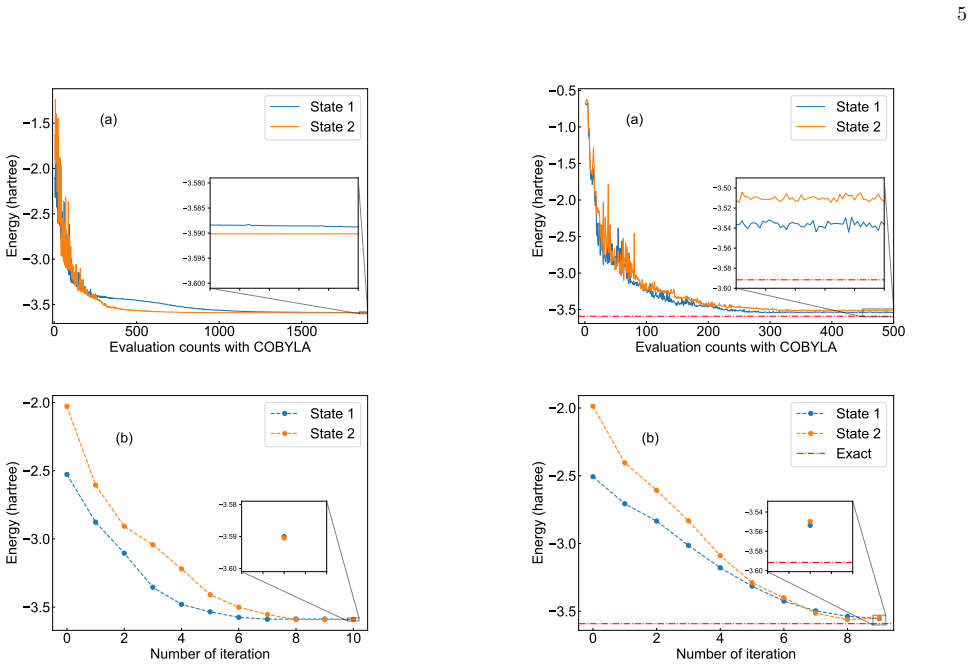
Hybrid quantum-classical computing algorithms offer significant potential for accelerating the calculation of the electronic structure of strongly correlated molecules. In this work, we present the first quantum simulation of conical intersections (CIs) in a biomolecule, cytosine, using a superconducting quantum computer. We apply the Contracted Quantum Eigensolver (CQE) -- with comparisons to conventional Variational Quantum Deflation (VQD) -- to compute the near-degenerate ground and excited states associated with the conical intersection, a key feature governing the photostability of DNA and RNA. The CQE is based on an exact ansatz for many-electron molecules in the absence of noise -- a critically important property for resolving strongly correlated states at CIs. Both methods demonstrate promising accuracy when compared with exact diagonalization, even on noisy intermediate-scale quantum computers, highlighting their potential for advancing the understanding of photochemical and photobiological processes. The ability to simulate these intersections is critical for advancing our knowledge of biological processes like DNA repair and mutation, with potential implications for molecular biology and medical research.
Editorial analysis
A structured set of objections, weighed in public.
Referee Report
Summary. The manuscript claims to present the first quantum simulation of conical intersections in cytosine (a nucleobase) on a superconducting quantum computer. It applies the Contracted Quantum Eigensolver (CQE) — with comparisons to Variational Quantum Deflation (VQD) — to the near-degenerate ground and excited states at the CI geometry, asserting that both methods achieve promising accuracy versus exact diagonalization even on NISQ hardware, thereby demonstrating potential for photochemical and photobiological applications.
Significance. If the quantitative results hold, the work would constitute a notable early demonstration of quantum hardware applied to a biomolecular CI, a feature central to DNA/RNA photostability. The emphasis on an exact (noiseless) ansatz for strongly correlated states is a methodological strength that could help address degeneracy issues, provided noise effects are rigorously bounded.
major comments (2)
- [Abstract] Abstract: the assertion of 'promising accuracy' versus exact diagonalization is presented without any numerical metrics, error bars, energy-gap values, or hardware-error comparisons; this is load-bearing for the central claim that CQE resolves the near-degenerate CI states on noisy superconducting hardware.
- [Methods/Results] Methods/Results (CQE implementation): because the CQE ansatz is exact only in the noiseless limit, the manuscript must supply a concrete demonstration (e.g., computed gap size at the cytosine CI geometry versus measured hardware error rates or state-vector fidelity) showing that noise does not collapse or mix the degenerate pair beyond utility; absent this bound, the noise-resilience claim remains unverified.
minor comments (2)
- All result figures should include direct overlays or tables comparing CQE, VQD, and exact-diagonalization energies with error bars; axis labels and units must be unambiguous.
- Clarify the active-space size, qubit mapping, and number of shots used in the superconducting-device experiments so that reproducibility is immediate.
Simulated Author's Rebuttal
We thank the referee for their thoughtful review and for highlighting areas where the manuscript can be strengthened. We address each major comment below and will incorporate revisions to improve the clarity and rigor of our claims regarding the quantum simulation of conical intersections in cytosine.
read point-by-point responses
-
Referee: [Abstract] Abstract: the assertion of 'promising accuracy' versus exact diagonalization is presented without any numerical metrics, error bars, energy-gap values, or hardware-error comparisons; this is load-bearing for the central claim that CQE resolves the near-degenerate CI states on noisy superconducting hardware.
Authors: We agree that the abstract would benefit from explicit quantitative support for the 'promising accuracy' claim. The revised manuscript will update the abstract to include the specific energy gap values computed via CQE and VQD on hardware, along with their deviations from exact diagonalization and brief comparisons to hardware noise characteristics. revision: yes
-
Referee: [Methods/Results] Methods/Results (CQE implementation): because the CQE ansatz is exact only in the noiseless limit, the manuscript must supply a concrete demonstration (e.g., computed gap size at the cytosine CI geometry versus measured hardware error rates or state-vector fidelity) showing that noise does not collapse or mix the degenerate pair beyond utility; absent this bound, the noise-resilience claim remains unverified.
Authors: We acknowledge that an explicit bound relating the CI energy gap to hardware error rates would strengthen the noise-resilience discussion. The manuscript already reports direct energy comparisons to exact diagonalization obtained on the superconducting device, which demonstrate resolvability of the states. In revision we will add a targeted analysis (in the main text or supplementary information) that quantifies the gap size against observed hardware error rates and state fidelities to make this bound explicit. revision: yes
Circularity Check
No circularity: standard application of CQE/VQD to cytosine CI with external benchmarks
full rationale
The paper applies the established Contracted Quantum Eigensolver (CQE) and Variational Quantum Deflation (VQD) to compute near-degenerate states at the cytosine conical intersection on superconducting hardware, reporting comparisons to exact diagonalization. The CQE is described as based on an exact ansatz in the noiseless limit, but this is a stated property of the method rather than a derivation within the paper. No load-bearing steps reduce by construction to the paper's own inputs or fitted parameters; no self-citations form a chain that justifies the central simulation result; and the work is benchmarked against independent exact diagonalization. This is a normal application paper with self-contained content against external references.
Axiom & Free-Parameter Ledger
Reference graph
Works this paper leans on
-
[1]
A. Aspuru-Guzik, A. D. Dutoi, P. J. Love, and M. Head- Gordon, Simulated quantum computation of molecular energies, Science 309, 1704 (2005)
work page 2005
-
[2]
Y. Cao, J. Romero, J. P. Olson, M. Degroote, P. D. John- son, M. Kieferov´ a, I. D. Kivlichan, T. Menke, B. Per- opadre, N. P. Sawaya, et al. , Quantum chemistry in the age of quantum computing, Chem. Rev. 119, 10856 (2019)
work page 2019
- [3]
-
[4]
Simulating Chemistry on Bosonic Quantum Devices
R. Dutta, D. G. Cabral, N. Lyu, N. P. Vu, Y. Wang, B. Allen, X. Dan, R. G. Corti˜ nas, P. Khazaei, S. E. Smart, et al. , Simulating chemistry on bosonic quantum devices, arXiv preprint arXiv:2404.10214 10.48550/arXiv.2404.10214 (2024)
work page internal anchor Pith review Pith/arXiv arXiv doi:10.48550/arxiv.2404.10214 2024
-
[5]
Preskill, Quantum computing in the nisq era and be- yond, Quantum 2, 79 (2018)
J. Preskill, Quantum computing in the nisq era and be- yond, Quantum 2, 79 (2018)
work page 2018
-
[6]
A. Kandala, A. Mezzacapo, K. Temme, M. Takita, M. Brink, J. M. Chow, and J. M. Gambetta, Hardware- efficient variational quantum eigensolver for small molecules and quantum magnets, Nature 549, 242 (2017)
work page 2017
-
[7]
A. E. Russo, K. M. Rudinger, B. C. Morrison, and A. D. Baczewski, Evaluating energy differences on a quantum computer with robust phase estimation, Phys. Rev. Lett. 126, 210501 (2021)
work page 2021
-
[8]
H. L. Tang, V. Shkolnikov, G. S. Barron, H. R. Grim- sley, N. J. Mayhall, E. Barnes, and S. E. Economou, qubit-adapt-vqe: An adaptive algorithm for construct- ing hardware-efficient ans¨ atze on a quantum processor, PRX Quantum 2, 020310 (2021)
work page 2021
-
[9]
S. H. Sureshbabu, M. Sajjan, S. Oh, and S. Kais, Im- plementation of quantum machine learning for electronic structure calculations of periodic systems on quantum computing devices, J. Chem. Inf. Model. 61, 2667 (2021)
work page 2021
-
[11]
P.; Lyu, N.; Wang, C.; Batista, V
R. Dutta, N. P. Vu, N. Lyu, C. Wang, and V. S. Batista, Simulating electronic structure on bosonic quantum com- puters, arXiv preprint arXiv:2404.10222 (2024)
- [12]
-
[13]
Y. Cao, J. Romero, and A. Aspuru-Guzik, Potential of quantum computing for drug discovery, IBM Journal of Research and Development 62, 6:1 (2018)
work page 2018
-
[14]
A. M. Smaldone and V. S. Batista, Quantum-to-classical neural network transfer learning applied to drug toxicity prediction, J. Chem. Theory Comput. , 4901
-
[15]
D. Varsano, R. Di Felice, M. A. Marques, and A. Rubio, A TDDFT study of the excited states of DNA bases and their assemblies, J. Phys. Chem. B 110, 7129 (2006)
work page 2006
- [16]
-
[17]
L. Marrot and J.-R. Meunier, Skin dna photodamage and its biological consequences, J. Am. Acad. Dermatol. 58, S139 (2008)
work page 2008
-
[18]
H. Kang, K. T. Lee, B. Jung, Y. J. Ko, and S. K. Kim, Intrinsic lifetimes of the excited state of DNA and RNA bases, J. Am. Chem. Soc. 124, 12958 (2002)
work page 2002
-
[19]
R. J. Malone, A. M. Miller, and B. Kohler, Singlet 8 excited-state lifetimes of cytosine derivatives measured by femtosecond transient absorption, Photochem. Pho- tobiol. 77, 158 (2003)
work page 2003
-
[20]
A. Sharonov, T. Gustavsson, V. Carr´ e, E. Renault, and D. Markovitsi, Cytosine excited state dynamics studied by femtosecond fluorescence upconversion and transient absorption spectroscopy, Chem. Phys. Lett. 380, 173 (2003)
work page 2003
-
[21]
M. Merch´ an and L. Serrano-Andr´ es, Ultrafast internal conversion of excited cytosine via the lowest ππ* elec- tronic singlet state, J. Am. Chem. Soc. 125, 8108 (2003)
work page 2003
-
[22]
L. Blancafort and M. A. Robb, Key role of a threefold state crossing in the ultrafast decay of electronically ex- cited cytosine, J. Phys. Chem. A 108, 10609 (2004)
work page 2004
-
[23]
Matsika, Three-state conical intersections in nucleic acid bases, J
S. Matsika, Three-state conical intersections in nucleic acid bases, J. Phys. Chem. A 109, 7538 (2005)
work page 2005
-
[24]
K. A. Kistler and S. Matsika, Three-state conical inter- sections in cytosine and pyrimidinone bases, J. Chem. Phys. 128, 215102 (2008)
work page 2008
-
[25]
J. Gonz´ alez-V´ azquez and L. Gonz´ alez, A time- dependent picture of the ultrafast deactivation of keto-cytosine including three-state conical intersections, ChemPhysChem 11, 3617 (2010)
work page 2010
-
[26]
M. Barbatti, A. J. Aquino, J. J. Szymczak, D. Nachti- gallova, and H. Lischka, Photodynamical simulations of cytosine: characterization of the ultrafast bi-exponential uv deactivation, Phys. Chem. Chem. Phys. 13, 6145 (2011)
work page 2011
-
[27]
M. Richter, P. Marquetand, J. Gonzalez-Vazquez, I. Sola, and L. Gonz´ alez, Femtosecond intersystem crossing in the DNA nucleobase cytosine, J. Phys. Chem. Lett 3, 3090 (2012)
work page 2012
- [28]
-
[29]
M. A. Trachsel, S. Blaser, S. Lobsiger, L. Siffert, H.-M. Frey, L. Blancafort, and S. Leutwyler, Locating cytosine conical intersections by laser experiments and ab initio calculations, J. Phys. Chem. Lett. 11, 3203 (2020)
work page 2020
-
[30]
L. Shahrokh, R. Omidyan, and G. Azimi, Theoretical insights on the excited-state-deactivation mechanisms of protonated thymine and cytosine, Phys. Chem. Chem. Phys. 23, 8916 (2021)
work page 2021
-
[31]
D. R. Yarkony, Diabolical conical intersections, Rev. Mod. Phys. 68, 985 (1996)
work page 1996
- [32]
-
[33]
B. G. Levine and T. J. Mart´ ınez, Isomerization through conical intersections, Annu. Rev. Phys. Chem. 58, 613 (2007)
work page 2007
-
[34]
S. Matsika and P. Krause, Nonadiabatic events and coni- cal intersections, Annu. Rev. Phys. Chem.62, 621 (2011)
work page 2011
-
[35]
J. C. Tully, Perspective: Nonadiabatic dynamics theory, J. Chem. Phys. 137 (2012)
work page 2012
- [36]
-
[37]
D. R. Yarkony, C. Xie, X. Zhu, Y. Wang, C. L. Mal- bon, and H. Guo, Diabatic and adiabatic representations: Electronic structure caveats, Comput. Theor. Chem. 1152, 41 (2019)
work page 2019
- [38]
-
[39]
P. J. Ollitrault, G. Mazzola, and I. Tavernelli, Nonadia- batic molecular quantum dynamics with quantum com- puters, Phys. Rev. Lett. 125, 260511 (2020)
work page 2020
-
[40]
Y. Wang and D. A. Mazziotti, Quantum simulation of conical intersections, Phys. Chem. Chem. Phys. 26, 11491 (2024)
work page 2024
-
[41]
E. Koridon, J. Fraxanet, A. Dauphin, L. Visscher, T. E. O’Brien, and S. Polla, A hybrid quantum algorithm to detect conical intersections, Quantum 8, 1259 (2024)
work page 2024
-
[42]
S. Zhao, D. Tang, X. Xiao, R. Wang, Q. Sun, Z. Chen, X. Cai, Z. Li, H. Yu, and W.-H. Fang, Quantum compu- tation of conical intersections on a programmable super- conducting quantum processor, J. Phys. Chem. Lett. 15, 7244
-
[43]
O. Higgott, D. Wang, and S. Brierley, Variational quan- tum computation of excited states, Quantum 3, 156 (2019)
work page 2019
-
[44]
S. E. Smart and D. A. Mazziotti, Quantum solver of con- tracted eigenvalue equations for scalable molecular simu- lations on quantum computing devices, Phys. Rev. Lett. 126, 070504 (2021)
work page 2021
-
[45]
S. E. Smart, J.-N. Boyn, and D. A. Mazziotti, Resolving correlated states of benzyne with an error-mitigated con- tracted quantum eigensolver, Phys. Rev. A 105, 022405 (2022)
work page 2022
-
[46]
Y. Wang, L. M. Sager-Smith, and D. A. Mazziotti, Quan- tum simulation of bosons with the contracted quantum eigensolver, New J. Phys. 25, 103005 (2023)
work page 2023
- [47]
-
[48]
D. A. Mazziotti, Contracted Schr¨ odinger equation: De- termining quantum energies and two-particle density ma- trices without wave functions, Phys. Rev. A 57, 4219 (1998)
work page 1998
-
[49]
D. A. Mazziotti, Anti-hermitian contracted Schr¨ odinger equation: Direct determination of the two-electron re- duced density matrices of many-electron molecules, Phys. Rev. Lett. 97, 143002 (2006)
work page 2006
-
[50]
Nakatsuji, Equation for the direct determination of the density matrix, Phys
H. Nakatsuji, Equation for the direct determination of the density matrix, Phys. Rev. A 14, 41 (1976)
work page 1976
-
[51]
C. L. Benavides-Riveros, Y. Wang, S. Warren, and D. A. Mazziotti, Quantum simulation of excited states from parallel contracted quantum eigensolvers, New J. Phys. 26, 033020 (2024)
work page 2024
-
[52]
Y. Wang and D. A. Mazziotti, Electronic excited states from a variance-based contracted quantum eigensolver, Phys. Rev. A , 022814 (2023)
work page 2023
- [53]
-
[54]
D. R. Alcoba, L. Lain, A. Torre, T. R. Ayala, O. B. O˜ na, G. E. Massaccesi, J. E. Peralta, and J. I. Melo, Generalized spin in the variance-based wave function optimization method within the doubly occupied con- figuration interaction framework, J. Phys. Chem. A 10.1021/acs.jpca.4c02742 (2024)
-
[55]
K. M. Nakanishi, K. Mitarai, and K. Fujii, Subspace- search variational quantum eigensolver for excited states, Phys. Rev. Res. 1, 033062 (2019)
work page 2019
-
[56]
H. Lischka, T. M¨ uller, P. G. Szalay, I. Shavitt, R. M. 9 Pitzer, and R. Shepard, Columbus—a program system for advanced multireference theory calculations, Wiley Interdiscip. Rev. Comput. Mol. Sci. 1, 191 (2011)
work page 2011
-
[57]
H. Lischka, R. Shepard, T. M¨ uller, P. G. Szalay, R. M. Pitzer, A. J. Aquino, M. M. Ara´ ujo do Nascimento, M. Barbatti, L. T. Belcher, J.-P. Blaudeau, et al. , The generality of the guga mrci approach in columbus for treating complex quantum chemistry, J. Chem. Phys. 152 (2020)
work page 2020
-
[58]
M. R. Manaa and D. R. Yarkony, On the intersection of two potential energy surfaces of the same symmetry. systematic characterization using a lagrange multiplier constrained procedure, J. Chem. Phys. 99, 5251 (1993)
work page 1993
-
[59]
J. Cu´ ellar-Zuquin, A. J. Pepino, I. F. Galv´ an, I. Rivalta, F. Aquilante, M. Garavelli, R. Lindh, and J. Segarra- Mart´ ı, Characterising conical intersections in DNA/RNA nucleobases with multiconfigurational wave functions of varying active space size, J. Chem. Theory Comput. 19, 8258 (2024)
work page 2024
-
[60]
Qiskit contributors, Qiskit: An open-source framework for quantum computing (2024)
work page 2024
-
[61]
P. Jordan and E. Wigner, ¨Uber das paulische ¨Aquivalenzverbot, Z. Physik 47, 631–651 (1928)
work page 1928
-
[62]
IBM-Quantum, https://quantum-computing.ibm.com/ (2024)
work page 2024
-
[63]
S. E. Smart and D. A. Mazziotti, Verifiably exact solu- tion of the electronic schr¨ odinger equation on quantum devices, Phys. Rev. A 109, 022802 (2024)
work page 2024
-
[64]
D. A. Mazziotti, Anti-Hermitian part of the contracted Schr¨ odinger equation for the direct calculation of two- electron reduced density matrices, Phys. Rev. A 75, 022505 (2007)
work page 2007
-
[65]
D. A. Mazziotti, Exactness of wave functions from two- body exponential transformations in many-body quan- tum theory, Physical Review A 69, 012507 (2004)
work page 2004
-
[66]
M. R. Hoffmann and J. Simons, A unitary multiconfig- urational coupled-cluster method: Theory and applica- tions, J. Chem. Phys. 88, 993–1002 (1988)
work page 1988
- [67]
-
[68]
X. Bonet-Monroig, R. Babbush, and T. E. O’Brien, Nearly optimal measurement scheduling for partial to- mography of quantum states, Phys. Rev. X 10, 031064 (2020)
work page 2020
-
[69]
Y. Wang, I. Avdic, and D. A. Mazziotti, Shadow ansatz for the many-fermion wave function in scalable molec- ular simulations on quantum computing devices, arXiv preprint arXiv:2408.11026 10.48550/arXiv.2408.11026 (2024)
-
[70]
J. C. Spall, Implementation of the simultaneous per- turbation algorithm for stochastic optimization, IEEE Trans. Aerosp. Electron. Syst. 34, 817 (1998)
work page 1998
discussion (0)
Sign in with ORCID, Apple, or X to comment. Anyone can read and Pith papers without signing in.