GSDeformer: Direct, Real-time and Extensible Cage-based Deformation for 3D Gaussian Splatting
Pith reviewed 2026-05-24 00:40 UTC · model grok-4.3
The pith
Cage-based deformations apply directly to any 3D Gaussian Splatting model in real time via a proxy point cloud without retraining.
A machine-rendered reading of the paper's core claim, the machinery that carries it, and where it could break.
Core claim
The central claim is that cage deformations defined on a 3D Gaussian Splatting scene can be realized by first generating a proxy point cloud from the Gaussians, applying the cage transformation to the points, and transferring the resulting changes back to the Gaussian parameters, with splitting used to handle any bending; cage construction itself is automated by a render-and-reconstruct procedure, and the entire pipeline operates without modifying the underlying 3DGS formulation.
What carries the argument
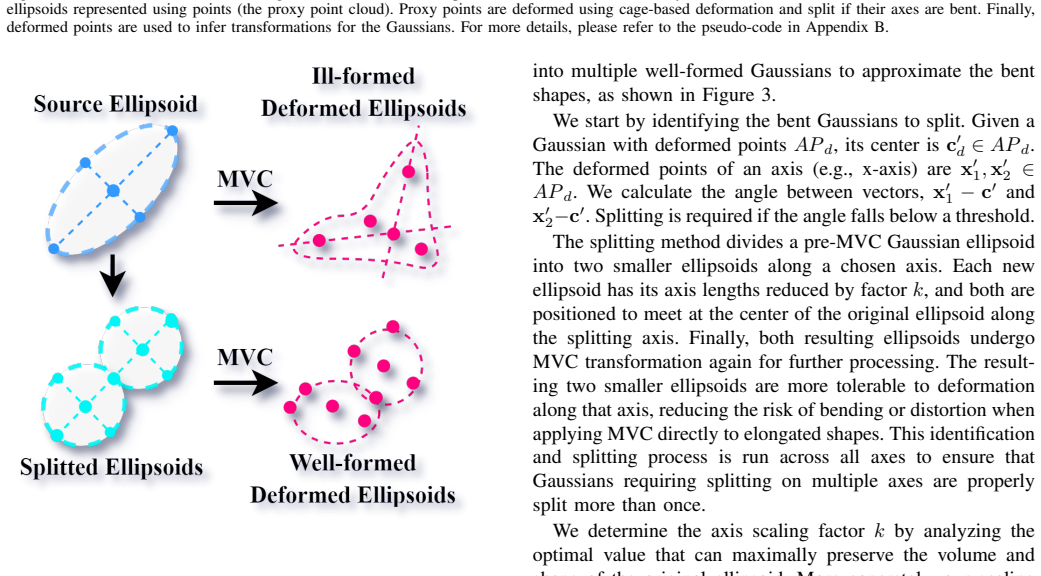
proxy point-cloud representation generated from the 3D Gaussians that carries the cage deformation and maps it back, together with a splitting process to approximate bending
If this is right
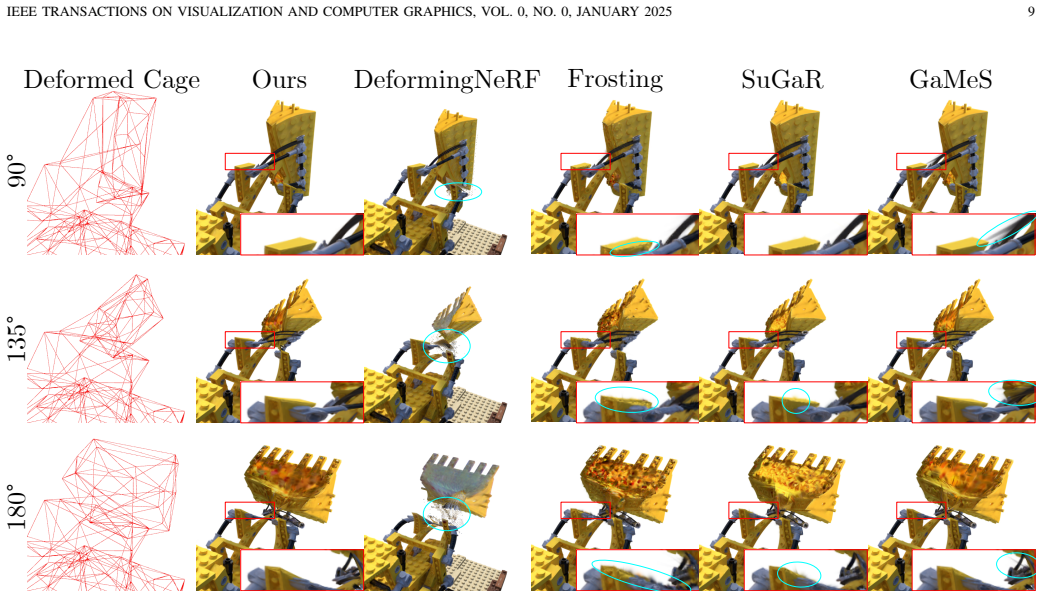
- Delivers superior deformation results compared to existing methods.
- Remains robust under extreme deformations.
- Requires no retraining for editing.
- Runs in real-time.
- Can be extended to other 3DGS variants.
Where Pith is reading between the lines
- The real-time property could support interactive editing sessions in animation or design software.
- Extensibility to variants suggests the same proxy approach may transfer to other point-based scene representations.
- Automated cage generation could shorten setup time when applying the method to new captured scenes.
- No-retraining requirement may reduce total compute cost for repeated edits on the same base model.
Load-bearing premise
The proxy point cloud extracted from the Gaussians is faithful enough that deformations applied to it translate back to the Gaussians without unacceptable quality loss.
What would settle it
Apply an extreme cage deformation to a captured scene and observe whether visible artifacts, blurring, or geometric errors remain after the splitting step, or measure whether frame rates stay above real-time thresholds on standard hardware.
Figures






read the original abstract
We present GSDeformer, a method that enables cage-based deformation on 3D Gaussian Splatting (3DGS). Our approach bridges cage-based deformation and 3DGS by using a proxy point-cloud representation. This point cloud is generated from 3D Gaussians, and deformations applied to the point cloud are translated into transformations on the 3D Gaussians. To handle potential bending caused by deformation, we incorporate a splitting process to approximate it. Our method does not modify or extend the core architecture of 3D Gaussian Splatting, making it compatible with any trained vanilla 3DGS or its variants. Additionally, we automate cage construction for 3DGS and its variants using a render-and-reconstruct approach. Experiments demonstrate that GSDeformer delivers superior deformation results compared to existing methods, is robust under extreme deformations, requires no retraining for editing, runs in real-time, and can be extended to other 3DGS variants. Project Page: https://jhuangbu.github.io/gsdeformer/
Editorial analysis
A structured set of objections, weighed in public.
Referee Report
Summary. The paper presents GSDeformer, a cage-based deformation technique for 3D Gaussian Splatting that generates a proxy point cloud from the trained Gaussians, applies cage deformations to the proxy, maps the results back to the Gaussians, and uses a splitting heuristic to approximate bending effects. It further automates cage construction via render-and-reconstruct and asserts compatibility with any vanilla 3DGS or variant without modifying the underlying representation. The central claims are that the approach yields superior deformation quality, remains robust under extreme edits, requires no retraining, runs in real time, and extends to other 3DGS methods.
Significance. If the performance and fidelity claims are substantiated, the work would offer a practical, training-free editing pipeline for 3DGS scenes that preserves the original splatting pipeline, which could be useful for interactive graphics applications. The automated cage construction and extensibility are potentially valuable additions, but the absence of supporting quantitative evidence limits the assessed impact.
major comments (2)
- [Abstract and experimental claims] The manuscript provides no quantitative tables, error metrics (e.g., PSNR, SSIM, or deformation-specific measures), or implementation details to support the abstract's assertions of superior results, real-time performance, and robustness. This absence prevents verification of the central performance claims.
- [Method description (proxy mapping and splitting)] The proxy-point-cloud mapping and splitting heuristic are presented as sufficient to lift cage deformations to the full set of Gaussian attributes (position, covariance, opacity, SH coefficients), yet no analysis or bound is given on the resulting approximation error for anisotropic distributions. The skeptic concern that non-rigid transforms on the proxy may not preserve radiance-field consistency therefore remains unaddressed.
minor comments (1)
- [Abstract] The abstract states that experiments demonstrate superiority and real-time behavior, but the provided text contains no corresponding figures, tables, or timing breakdowns.
Simulated Author's Rebuttal
We thank the referee for the constructive comments. We agree that quantitative metrics and further analysis of the approximation would strengthen the manuscript and plan to incorporate them. Below we respond point by point.
read point-by-point responses
-
Referee: [Abstract and experimental claims] The manuscript provides no quantitative tables, error metrics (e.g., PSNR, SSIM, or deformation-specific measures), or implementation details to support the abstract's assertions of superior results, real-time performance, and robustness. This absence prevents verification of the central performance claims.
Authors: We acknowledge that the current version relies on qualitative visual comparisons and timing statements in the text rather than tabulated metrics. While the visual results and real-time claims are supported by the experiments shown, we agree that explicit quantitative evaluation (PSNR/SSIM on rendered views before/after deformation, timing benchmarks, and implementation details) would allow direct verification. In the revision we will add a quantitative evaluation section with the requested metrics and tables. revision: yes
-
Referee: [Method description (proxy mapping and splitting)] The proxy-point-cloud mapping and splitting heuristic are presented as sufficient to lift cage deformations to the full set of Gaussian attributes (position, covariance, opacity, SH coefficients), yet no analysis or bound is given on the resulting approximation error for anisotropic distributions. The skeptic concern that non-rigid transforms on the proxy may not preserve radiance-field consistency therefore remains unaddressed.
Authors: The proxy mapping transfers the cage-induced affine transform from the nearest proxy point to each Gaussian while the splitting heuristic subdivides Gaussians that would otherwise undergo non-rigid bending. We recognize that no explicit error bound or analysis for highly anisotropic Gaussians is provided. In revision we will add a dedicated paragraph discussing the approximation, its empirical behavior on anisotropic cases, and the conditions under which radiance consistency is approximately preserved. revision: partial
Circularity Check
No significant circularity detected
full rationale
The paper presents an explicit algorithmic construction (proxy point-cloud extraction from 3D Gaussians, cage deformation on the proxy, back-mapping with a splitting heuristic for bending, and render-and-reconstruct cage automation) whose steps are defined independently of the evaluation data. No equations or claims reduce a reported performance metric to a quantity fitted from the same scenes used for testing; the method is presented as a self-contained procedure compatible with any pre-trained 3DGS model. No self-citation load-bearing steps, uniqueness theorems, or ansatz smuggling appear in the derivation chain.
Axiom & Free-Parameter Ledger
axioms (1)
- domain assumption Deformations applied to the point cloud generated from 3D Gaussians can be translated into transformations on the 3D Gaussians.
Forward citations
Cited by 1 Pith paper
-
One-shot Compositional 3D Head Avatars with Deformable Hair
A single-image method builds 3D head avatars by lifting the photo and a hair-removed version to Gaussian splats, rigging the face to a FLAME mesh, and driving isolated hair Gaussians with a physics cage.
Reference graph
Works this paper leans on
-
[1]
3d gaussian splatting for real-time radiance field rendering,
B. Kerbl, G. Kopanas, T. Leimk ¨uhler, and G. Drettakis, “3d gaussian splatting for real-time radiance field rendering,”ACM Transactions on Graphics, vol. 42, no. 4, July 2023. [Online]. Available: https://repo-sam.inria.fr/fungraph/3d-gaussian-splatting/
work page 2023
-
[2]
Deforming radiance fields with cages,
T. Xu and T. Harada, “Deforming radiance fields with cages,” inECCV, 2022
work page 2022
-
[3]
Cagenerf: Cage-based neural radiance fields for genrenlized 3d deformation and animation,
Y . Peng, Y . Yan, S. Liu, Y . Cheng, S. Guan, B. Pan, G. Zhai, and X. Yang, “Cagenerf: Cage-based neural radiance fields for genrenlized 3d deformation and animation,” inThirty-Sixth Conference on Neural Information Processing Systems, 2022
work page 2022
-
[4]
Nerfshop: Interactive editing of neural radiance fields
C. Jambon, B. Kerbl, G. Kopanas, S. Diolatzis, T. Leimk ¨uhler, and G. Drettakis, “Nerfshop: Interactive editing of neural radiance fields”,”Proceedings of the ACM on Computer Graphics and Interactive Techniques, vol. 6, no. 1, May 2023. [Online]. Available: https://repo-sam.inria.fr/fungraph/nerfshop/
work page 2023
-
[5]
A. Gu ´edon and V . Lepetit, “Sugar: Surface-aligned gaussian splatting for efficient 3d mesh reconstruction and high-quality mesh rendering,” arXiv preprint arXiv:2311.12775, 2023. IEEE TRANSACTIONS ON VISUALIZATION AND COMPUTER GRAPHICS, VOL. 0, NO. 0, JANUARY 2025 15 k=0.1 k=0.3 k=0.5 k=1.0k=cbrt(0.5) Fig. 16. Ablation study results for the split facto...
-
[6]
Gaussian frosting: Editable complex radiance fields with real- time rendering,
——, “Gaussian frosting: Editable complex radiance fields with real- time rendering,”arXiv preprint arXiv:2403.14554, 2024
-
[7]
Sc-gs: Sparse-controlled gaussian splatting for editable dynamic scenes,
Y .-H. Huang, Y .-T. Sun, Z. Yang, X. Lyu, Y .-P. Cao, and X. Qi, “Sc-gs: Sparse-controlled gaussian splatting for editable dynamic scenes,”arXiv preprint arXiv:2312.14937, 2023
-
[8]
Vr-gs: A physical dynamics-aware interactive gaussian splatting system in virtual reality,
Y . Jiang, C. Yu, T. Xie, X. Li, Y . Feng, H. Wang, M. Li, H. Lau, F. Gao, Y . Yang, and C. Jiang, “Vr-gs: A physical dynamics-aware interactive gaussian splatting system in virtual reality,”arXiv preprint arXiv:2401.16663, 2024
-
[9]
2d gaussian splatting for geometrically accurate radiance fields,
B. Huang, Z. Yu, A. Chen, A. Geiger, and S. Gao, “2d gaussian splatting for geometrically accurate radiance fields,” inSIGGRAPH 2024 Conference Papers. Association for Computing Machinery, 2024
work page 2024
-
[10]
Gaussianeditor: Swift and controllable 3d editing with gaussian splatting,
Y . Chen, Z. Chen, C. Zhang, F. Wang, X. Yang, Y . Wang, Z. Cai, L. Yang, H. Liu, and G. Lin, “Gaussianeditor: Swift and controllable 3d editing with gaussian splatting,”2024 IEEE/CVF Conference on Computer Vision and Pattern Recognition (CVPR), pp. 21 476–21 485, 2023
work page 2024
-
[11]
View-consistent 3d editing with gaussian splatting,
Y . Wang, X. Yi, Z. Wu, N. Zhao, L. Chen, and H. Zhang, “View-consistent 3d editing with gaussian splatting,”ArXiv, vol. abs/2403.11868, 2024
-
[12]
Gaussctrl: Multi-view consistent text-driven 3d gaussian splatting editing,
J. Wu, J. Bian, X. Li, G. Wang, I. D. Reid, P. Torr, and V . A. Prisacariu, “Gaussctrl: Multi-view consistent text-driven 3d gaussian splatting editing,”ArXiv, vol. abs/2403.08733, 2024
-
[13]
Games: Mesh-based adapting and modification of gaussian splatting,
J. Waczy ´nska, P. Borycki, S. Tadeja, J. Tabor, and P. Spurek, “Games: Mesh-based adapting and modification of gaussian splatting,” 2024
work page 2024
-
[14]
Mesh-based gaussian splatting for real-time large-scale deformation,
L. Gao, J. Yang, B.-T. Zhang, J. Sun, Y .-J. Yuan, H. Fu, and Y .-K. Lai, “Mesh-based gaussian splatting for real-time large-scale deformation,” ArXiv, vol. abs/2402.04796, 2024
-
[15]
Mani-gs: Gaussian splatting manipulation with triangular mesh,
X. Gao, X. Li, Y . Zhuang, Q. Zhang, W. Hu, C. Zhang, Y . Yao, Y . Shan, and L. Quan, “Mani-gs: Gaussian splatting manipulation with triangular mesh,”arXiv preprint arXiv:2405.17811, 2024
-
[16]
Neus: Learning neural implicit surfaces by volume rendering for multi-view reconstruction,
P. Wang, L. Liu, Y . Liu, C. Theobalt, T. Komura, and W. Wang, “Neus: Learning neural implicit surfaces by volume rendering for multi-view reconstruction,”NeurIPS, 2021
work page 2021
-
[17]
Physgaussian: Physics-integrated 3d gaussians for generative dynam- ics,
T. Xie, Z. Zong, Y . Qiu, X. Li, Y . Feng, Y . Yang, and C. Jiang, “Physgaussian: Physics-integrated 3d gaussians for generative dynam- ics,”arXiv preprint arXiv:2311.12198, 2023
-
[18]
The material point method for simulating continuum materials,
C. Jiang, C. Schroeder, J. Teran, A. Stomakhin, and A. Selle, “The material point method for simulating continuum materials,” inACM SIGGRAPH 2016 Courses, ser. SIGGRAPH ’16. New York, NY , USA: Association for Computing Machinery, 2016. [Online]. Available: https://doi.org/10.1145/2897826.2927348
-
[19]
Gaussian splashing: Unified particles for versatile motion synthesis and rendering,
Y . Feng, X. Feng, Y . Shang, Y . Jiang, C. Yu, Z. Zong, T. Shao, H. Wu, K. Zhou, C. Jiang, and Y . Yang, “Gaussian splashing: Unified particles for versatile motion synthesis and rendering,” 2025 IEEE/CVF Conference on Computer Vision and Pattern Recognition (CVPR), pp. 518–529, 2024. [Online]. Available: https: //api.semanticscholar.org/CorpusID:271333936
work page 2025
-
[20]
Xpbd: position-based simulation of compliant constrained dynamics,
M. Macklin, M. M ¨uller, and N. Chentanez, “Xpbd: position-based simulation of compliant constrained dynamics,”Proceedings of the 9th International Conference on Motion in Games, 2016
work page 2016
-
[21]
D-miso: Editing dynamic 3d scenes using multi-gaussians soup,
J. Waczy ´nska, P. Borycki, J. Kaleta, S. a. Tadeja, and P. a. Spurek, “D-miso: Editing dynamic 3d scenes using multi-gaussians soup,” in Advances in Neural Information Processing Systems, A. Globerson, L. Mackey, D. Belgrave, A. Fan, U. Paquet, J. Tomczak, and C. Zhang, Eds., vol. 37. Curran Associates, Inc., 2024, pp. 107 865–107 889. [Online]. Availabl...
work page 2024
-
[22]
As-Rigid-As- Possible Deformation of Gaussian Radiance Fields ,
X. Tong, T. Shao, Y . Weng, Y . Yang, and K. Zhou, “ As-Rigid-As- Possible Deformation of Gaussian Radiance Fields ,”IEEE Transactions on Visualization & Computer Graphics, no. 01, pp. 1–13, Mar. 5555. [Online]. Available: https://doi.ieeecomputersociety.org/10.1109/TVCG. 2025.3555404
-
[23]
M. S. Floater, “Mean value coordinates,”Comput. Aided Geom. Des., vol. 20, 2003
work page 2003
-
[24]
Mean value coordinates for closed triangular meshes,
T. Ju, S. Schaefer, and J. D. Warren, “Mean value coordinates for closed triangular meshes,”ACM SIGGRAPH 2005 Papers, 2005
work page 2005
-
[25]
T. DeRose and M. Meyer, “Harmonic coordinates,” Pixar Animation Studios, Pixar Technical Memo 06-02, 2006. [Online]. Available: http://graphics.pixar.com/library/HarmonicCoordinates/paper.pdf
work page 2006
-
[26]
Harmonic coordinates for character articulation,
P. Joshi, M. Meyer, T. DeRose, B. Green, and T. Sanocki, “Harmonic coordinates for character articulation,”ACM Trans. Graph., vol. 26, no. 3, p. 71–es, jul 2007. [Online]. Available: https://doi.org/10.1145/1276377.1276466
-
[27]
Y . Lipman, D. Levin, and D. Cohen-Or, “Green coordinates,”ACM SIGGRAPH 2008 papers, 2008
work page 2008
-
[28]
Interactive geometry editing of neural radiance fields,
S. Li and Y . Pan, “Interactive geometry editing of neural radiance fields,” ArXiv, vol. abs/2303.11537, 2023
-
[29]
V oltemorph: Real-time, controllable and generalizable animation of volumetric representations,
S. J. Garbin, M. Kowalski, V . Estellers, S. Szymanowicz, S. Rezaeifar, J. Shen, M. A. Johnson, and J. Valentin, “V oltemorph: Real-time, controllable and generalizable animation of volumetric representations,” Computer Graphics F orum, vol. 43, no. 6, p. e15117, 2024. [Online]. Available: https://onlinelibrary.wiley.com/doi/abs/10.1111/cgf.15117
-
[30]
W. Zielonka, T. Bagautdinov, S. Saito, M. Zollh ¨ofer, J. Thies, and J. Romero, “Drivable 3d gaussian avatars,” 2023
work page 2023
-
[31]
Bounding proxies for shape approxima- tion,
S. Calderon and T. Boubekeur, “Bounding proxies for shape approxima- tion,”ACM Transactions on Graphics (Proc. SIGGRAPH 2017), vol. 36, no. 5, july 2017
work page 2017
-
[32]
High-quality surface reconstruction using gaussian surfels,
P. Dai, J. Xu, W. Xie, X. Liu, H. Wang, and W. Xu, “High-quality surface reconstruction using gaussian surfels,” inACM SIGGRAPH 2024 Conference Papers. Association for Computing Machinery, 2024
work page 2024
-
[33]
Neural cages for detail-preserving 3d deformations,
W. Yifan, N. Aigerman, V . G. Kim, S. Chaudhuri, and O. Sorkine- Hornung, “Neural cages for detail-preserving 3d deformations,” in CVPR, 2020
work page 2020
-
[34]
Mean value coordinates for closed triangular meshes,
T. Ju, S. Schaefer, and J. Warren, “Mean value coordinates for closed triangular meshes,” inACM Siggraph 2005 Papers, 2005, pp. 561–566
work page 2005
-
[35]
Surface simplification using quadric error metrics,
M. Garland and P. S. Heckbert, “Surface simplification using quadric error metrics,”Proceedings of the 24th annual conference on Computer graphics and interactive techniques, 1997. [Online]. Available: https://api.semanticscholar.org/CorpusID:621181
work page 1997
-
[36]
Kinectfusion: Real-time dense surface mapping and tracking,
R. A. Newcombe, S. Izadi, O. Hilliges, D. Molyneaux, D. Kim, A. J. Davison, P. Kohli, J. Shotton, S. Hodges, and A. W. Fitzgibbon, “Kinectfusion: Real-time dense surface mapping and tracking,”2011 10th IEEE International Symposium on Mixed and Augmented Reality, pp. 127–136, 2011. [Online]. Available: https://api.semanticscholar.org/CorpusID:11830123
work page 2011
-
[37]
Flod: Integrating flexible level of detail into 3d gaussian splatting for customizable rendering,
Y . Seo, Y . S. Choi, H. S. Son, and Y . Uh, “Flod: Integrating flexible level of detail into 3d gaussian splatting for customizable rendering,”
-
[38]
Available: https://arxiv.org/abs/2408.12894
[Online]. Available: https://arxiv.org/abs/2408.12894
-
[39]
Open3D: A Modern Library for 3D Data Processing
Q.-Y . Zhou, J. Park, and V . Koltun, “Open3D: A modern library for 3D data processing,”arXiv:1801.09847, 2018
work page internal anchor Pith review Pith/arXiv arXiv 2018
-
[40]
Nerf: Representing scenes as neural radiance fields for view synthesis,
B. Mildenhall, P. P. Srinivasan, M. Tancik, J. T. Barron, R. Ramamoorthi, and R. Ng, “Nerf: Representing scenes as neural radiance fields for view synthesis,” inECCV, 2020
work page 2020
-
[41]
Mip-nerf 360: Unbounded anti-aliased neural radiance fields,
J. T. Barron, B. Mildenhall, D. Verbin, P. P. Srinivasan, and P. Hedman, “Mip-nerf 360: Unbounded anti-aliased neural radiance fields,”CVPR, 2022
work page 2022
-
[42]
D-nerf: Neural radiance fields for dynamic scenes.arXiv preprint arXiv:2011.13961, 2020
A. Pumarola, E. Corona, G. Pons-Moll, and F. Moreno-Noguer, “D- nerf: Neural radiance fields for dynamic scenes,”arXiv preprint arXiv:2011.13961, 2020
-
[43]
L. Liu, J. Gu, K. Z. Lin, T.-S. Chua, and C. Theobalt, “Neural sparse voxel fields,”NeurIPS, 2020. IEEE TRANSACTIONS ON VISUALIZATION AND COMPUTER GRAPHICS, VOL. 0, NO. 0, JANUARY 2025 16
work page 2020
- [44]
-
[45]
I. Adobe. (2024) Mixamo: Animate 3d characters for games, film, and more. https://www.mixamo.com
work page 2024
-
[46]
V . Rong, J. Chen, S. Bahmani, K. N. Kutulakos, and D. B. Lindell, “Gstex: Per-primitive texturing of 2d gaussian splatting for decoupled appearance and geometry modeling,”arXiv preprint arXiv:2409.12954, 2024
-
[47]
Instruct-nerf2nerf: Editing 3d scenes with instructions,
A. Haque, M. Tancik, A. Efros, A. Holynski, and A. Kanazawa, “Instruct-nerf2nerf: Editing 3d scenes with instructions,” inProceedings of the IEEE/CVF International Conference on Computer Vision, 2023. VII. BIOGRAPHYSECTION Jiajun HuangJiajun Huang is a Ph.D student at the National Centre for Computer Animation (NCCA) of Bournemouth University. He obtained...
work page 2023
discussion (0)
Sign in with ORCID, Apple, or X to comment. Anyone can read and Pith papers without signing in.