Contextuality in anomalous heat flow
Pith reviewed 2026-05-24 00:07 UTC · model grok-4.3
The pith
Anomalous heat flow occurs in quantum protocols only when noncontextuality inequalities are violated before a critical time.
A machine-rendered reading of the paper's core claim, the machinery that carries it, and where it could break.
Core claim
In a class of quantum prepare-transform-measure protocols, anomalous heat flow occurs exclusively within the time interval from zero to a critical time τ_c if and only if the corresponding noncontextuality inequality is violated. This follows from extending standard noncontextuality inequalities to sequential transformations and applying them directly to the observables that quantify heat exchange between initially correlated thermal states.
What carries the argument
The noncontextuality inequality extended to sequential transformations, which acts as a witness that anomalous heat flow requires contextuality in the given time window.
If this is right
- Absence of a noncontextuality violation rules out anomalous heat flow for all times before τ_c.
- The critical time τ_c computed from experimental parameters marks the upper limit of the claimed implication.
- The same necessity holds when the systems are two qutrits rather than two qubits.
- The published parameters of one earlier heat-flow experiment determine a concrete value of τ_c.
Where Pith is reading between the lines
- Thermodynamic heat-flow measurements could function as a practical test for contextuality.
- Analogous critical times might appear when contextuality is linked to other thermodynamic quantities such as extractable work.
- The prepare-transform-measure structure could be used to search for similar necessity relations in open quantum systems.
Load-bearing premise
The known noncontextuality inequalities extend to sequential transformations and apply to heat flow observables without further assumptions on the initial state or dynamics.
What would settle it
An experiment that records anomalous heat flow in the interval (0, τ_c) while satisfying every noncontextuality inequality would falsify the claimed necessity.
Figures

read the original abstract
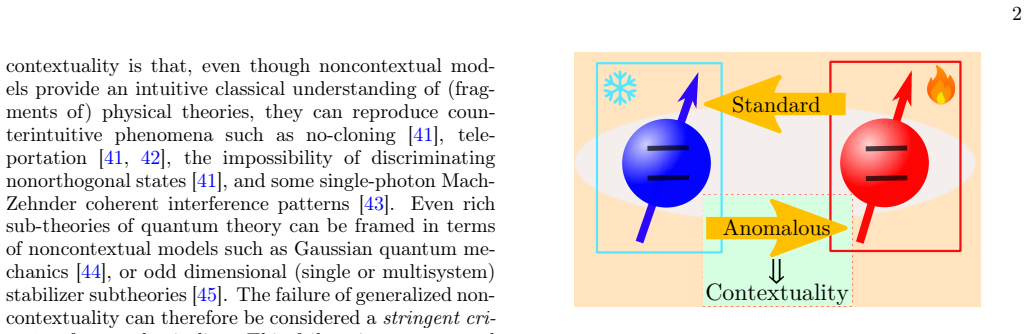
In classical thermodynamics, heat must spontaneously flow from hot to cold systems. In quantum thermodynamics, the same law applies when considering multipartite product thermal states evolving unitarily. If initial correlations are present, anomalous heat flow can happen, temporarily making cold thermal states colder and hot thermal states hotter. Such effect can happen due to entanglement, but also because of classical randomness, hence lacking a direct connection with nonclassicality. In this work, we introduce scenarios where anomalous heat flow \emph{does} have a direct link to nonclassicality, defined to be the failure of noncontextual models to explain experimental data. We start by extending known noncontextuality inequalities to a setup where sequential transformations are considered. We then show a class of quantum prepare-transform-measure protocols, characterized by time intervals $(0,\tau_c)$ for a given critical time $\tau_c$, where anomalous heat flow happens only if a noncontextuality inequality is violated. We also analyze a recent experiment from Micadei et. al. [Nat. Commun. 10, 2456 (2019)] and find the critical time $\tau_c$ based on their experimental parameters. We conclude by investigating heat flow in the evolution of two qutrit systems, showing that our findings are not an artifact of using two-qubit systems.
Editorial analysis
A structured set of objections, weighed in public.
Referee Report
Summary. The paper claims that in a class of quantum prepare-transform-measure protocols, anomalous heat flow occurs only if a noncontextuality inequality is violated, specifically for time intervals (0, τ_c) where τ_c is a critical time derived from experimental parameters. The authors extend existing noncontextuality inequalities to setups involving sequential transformations, apply the framework to reanalyze the Micadei et al. (2019) experiment, and verify that the findings hold for two-qutrit systems rather than being limited to qubits.
Significance. If the central claim is correct, the result is significant because it identifies a direct connection between anomalous heat flow and nonclassicality (defined via failure of noncontextual models), distinguishing these scenarios from cases explainable by entanglement or classical randomness alone. The explicit link to an existing experiment via computation of τ_c and the check for qutrits provide concrete applicability and generality.
major comments (2)
- [Section introducing sequential noncontextuality inequalities] The extension of noncontextuality inequalities to sequential transformations (detailed in the section introducing the prepare-transform-measure protocols) requires explicit verification that the heat-flow observables can be substituted without additional assumptions on the initial state or unitary dynamics; the 'only if' direction of the claim rests on this step.
- [Section analyzing the Micadei et al. experiment] In the analysis of the Micadei et al. experiment, the computation of τ_c from the reported parameters must be shown to be robust to small variations in the measured temperatures or coupling strengths, as this value demarcates the regime where the contextuality link holds.
minor comments (2)
- [Abstract and introduction] Notation for the critical time τ_c and the time intervals should be introduced with a clear definition in the abstract and introduction to avoid ambiguity when first referenced.
- [Section on two-qutrit systems] The two-qutrit numerical results would benefit from an explicit statement of the Hilbert-space dimension and the form of the initial thermal states used in the simulation.
Simulated Author's Rebuttal
We thank the referee for their careful review and constructive comments on our manuscript. We address each of the major comments below and will incorporate revisions to strengthen the paper.
read point-by-point responses
-
Referee: [Section introducing sequential noncontextuality inequalities] The extension of noncontextuality inequalities to sequential transformations (detailed in the section introducing the prepare-transform-measure protocols) requires explicit verification that the heat-flow observables can be substituted without additional assumptions on the initial state or unitary dynamics; the 'only if' direction of the claim rests on this step.
Authors: We thank the referee for highlighting this point. The derivation in the manuscript relies on the fact that the heat-flow observables are linear combinations of the prepare-transform-measure probabilities, which are the operational quantities in the noncontextuality framework. The substitution follows directly from the definition without requiring extra assumptions on the state or dynamics beyond the unitary evolution and thermal initial states specified. However, to make this verification explicit as requested, we will add a dedicated paragraph or appendix subsection detailing the substitution step and confirming the absence of additional assumptions. This will clarify the 'only if' direction. revision: yes
-
Referee: [Section analyzing the Micadei et al. experiment] In the analysis of the Micadei et al. experiment, the computation of τ_c from the reported parameters must be shown to be robust to small variations in the measured temperatures or coupling strengths, as this value demarcates the regime where the contextuality link holds.
Authors: We agree that demonstrating robustness enhances the reliability of the result. In the current manuscript, τ_c is computed using the reported experimental parameters from Micadei et al. To address this concern, we will perform and include a sensitivity analysis in the revised version, showing how τ_c varies with small perturbations (e.g., 1-10% changes) in temperatures and coupling strengths. This will confirm that the existence of the interval (0, τ_c) remains valid under reasonable experimental uncertainties. revision: yes
Circularity Check
Derivation is self-contained with no circular reductions
full rationale
The paper extends known noncontextuality inequalities to sequential transformations in prepare-transform-measure protocols and shows that anomalous heat flow occurs in (0, τ_c) only upon violation of the extended inequality. τ_c is computed from the parameters of the externally cited Micadei et al. experiment rather than fitted to the target observable. No load-bearing step reduces the claimed link to a self-definition, a renamed empirical pattern, or a self-citation chain; the central result follows from the stated structure and the inequality extension without circularity.
Axiom & Free-Parameter Ledger
axioms (2)
- domain assumption Noncontextuality inequalities can be extended to sequential prepare-transform-measure protocols while preserving their validity as tests for nonclassicality.
- standard math The initial states and unitary evolution are described by standard quantum mechanics.
Reference graph
Works this paper leans on
-
[1]
Noncontextuality inequalities for the average of theory-independent observables In any operational theory, there is a specific transfor- mation procedure denotedTid that denotes the ‘identity’ transformation. Its action is operationally characterized by p(k|M, Tid, P) = p(k|M, P ) (14) for all possible preparation procedures P ∈ P and all possible measure...
-
[2]
Non-resonant case (HA ̸= HB): There exists a quantum channel C such that 1 2 UI + 1 2 U † I = (1 − pd)id + pdC (28) where UI(·) = UI(t)(·)UI(t)†, UI(t) = e−itHI, and 0 ≤ pd ≤ 1
-
[3]
We prove this result in Appendix C
Resonant case (HA = HB): The unitary evolution UI(t) can be written as a composition of two other unitaries UI(t) = U2 ◦ U1, and there exist quantum channels C1, C2 such that 1 2 U1 + 1 2 U † 1 = (1 − pd1)id + pd1 C1, (29) 1 2 U2 + 1 2 U † 2 = (1 − pd2)id + pd2 C2, (30) where Ui(·) = Ui(·)U † i, and0 ≤ pdi ≤ 1 for i = 1, 2. We prove this result in Appendi...
-
[4]
Generalized contextuality without measurement incompatibility The above calculations allow us to draw a simple yet remarkable conclusion. We can consider a frag- ment of quantum theory that has (i) unitary evolutions U(t), U(t)†, together with the identity map and some other channel C, for a fixed time t, (ii) a single mea- surement protocolcharacterized ...
-
[5]
Contextuality as a resource for anomalous heat flow We will now show that contextuality allows for anoma- lous quantum heat transfer beyond whatany noncontex- tual model is capable of. Using Theorem 3, we now study violations of the generalized noncontextuality obtained when there is heat exchanged between two qubits,HA = C2 = HB. They are described local...
-
[6]
Connection with experimental results We claimed that for fixed values ofg there are critical times τc that can be found, such that for any0 < t < τ c the noncontextual inequality is violated for this class of two-qubit interactions we have just studied. Small gt 9 〈QA〉 ℬnc 0.05 0.1 0.15 τc 0.2 0.05 0.1 0.15 0.2 0.25 Interaction time (ms) Heat (peV) Figure...
-
[7]
A simple family of unitary evolutions satisfying stochastic reversibility We say that a Hermitian operator K = K † is also involutory when K2 = 1. From Stones theorem, any family of unitary operators {U(t)}t can be written as U = e−itK for some K self-adjoint, and for the cases when K is also involutory we can show that it satisfies stochastic reversibili...
-
[8]
Partial SWAP A unitary that satisfies this condition and energy con- servation (Eq. (2)) is thepartial SWAPdefined as UP S(t) := e−igtS , (43) where S is the SWAP operator [80], andg > 0. Since the SWAP operator is described by an involutory matrix, i.e., S2 = 1, Proposition 1 applies toe−igtS, where UP S(t) = cos(gt)1 − i sin(gt)S. (44) By direct calcula...
-
[9]
Heat flow during a partial SWAP of two qutrits The partial SWAP unitary can be useful to obtain non- contextuality inequalities for higher dimensional systems since it satisfies the stochastic reversibility condition in any dimension where S is well-defined. An intriguing model for examination involves the interplay between two qutrits mediated by a SWAP ...
work page 2020
-
[10]
Callen,Thermodynamics & an Introduction to Ther- mostatistics, Student Edition (Wiley India Pvt
H. Callen,Thermodynamics & an Introduction to Ther- mostatistics, Student Edition (Wiley India Pvt. Limited, 2006)
work page 2006
-
[11]
S. Blundell and K. Blundell, Concepts in Thermal Physics (OUP Oxford, 2010)
work page 2010
-
[12]
Eddington, The Nature of the Physical World(Cre- ative Media Partners, LLC, 2018)
A. Eddington, The Nature of the Physical World(Cre- ative Media Partners, LLC, 2018)
work page 2018
-
[13]
D. Jennings and T. Rudolph, Entanglement and the ther- modynamic arrow of time, Phys. Rev. E 81, 061130 (2010)
work page 2010
-
[14]
The Arrow of Time and Correlations in Quantum Physics
V. Vedral, The Arrow of Time an d Correlations in Quan- tum Physics, arXiv:1605.00926 [quant-ph] (2016)
work page internal anchor Pith review Pith/arXiv arXiv 2016
-
[15]
P. Lipka-Bartosik, G. F. Diotallevi, and P. Bakhshinezhad, Fundamental limits on anoma- lous energy flows in correlated quantum systems, Phys. Rev. Lett.132, 140402 (2024)
work page 2024
-
[16]
H. Leff and A. Rex,Maxwell’s Demon: Entropy, Infor- mation, Computing (Adam Hilger, 1990)
work page 1990
-
[17]
H. Leff and A. Rex,Maxwell’s Demon 2 Entropy, Classi- cal and Quantum Information, Computing(CRC Press, 2002)
work page 2002
-
[18]
Rex, Maxwell’s Demon—A Historical Review, En- tropy 19, 240 (2017)
A. Rex, Maxwell’s Demon—A Historical Review, En- tropy 19, 240 (2017)
work page 2017
-
[19]
S. Lloyd, Use of mutual information to decrease entropy: Implicationsforthesecondlawofthermodynamics,Phys. Rev. A39, 5378 (1989)
work page 1989
-
[20]
M. H. Partovi, Entanglement versus stosszahlansatz: Disappearance of the thermodynamic arrow in a high- correlation environment, Phys. Rev. E77, 021110 (2008)
work page 2008
-
[21]
M. N. Bera, A. Riera, M. Lewenstein, and A. Winter, Generalized laws of thermodynamics in the presence of correlations, Nature Communications8, 2180 (2017)
work page 2017
- [22]
-
[23]
A. Levy and M. Lostaglio, Quasiprobability distribution for heat fluctuations in the quantum regime, PRX Quan- tum 1, 010309 (2020)
work page 2020
- [24]
-
[25]
T. Sagawa and M. Ueda, Fluctuation theorem with in- formation exchange: Role of correlations in stochastic thermodynamics, Phys. Rev. Lett.109, 180602 (2012)
work page 2012
-
[26]
J. V. Koski, V. F. Maisi, T. Sagawa, and J. P. Pekola, Experimental observation of the role of mutual informa- tion in the nonequilibrium dynamics of a maxwell demon, Phys. Rev. Lett.113, 030601 (2014)
work page 2014
- [27]
-
[28]
I. Henao and R. M. Serra, Role of quantum coherence in the thermodynamics of energy transfer, Physical Review E 97, 10.1103/physreve.97.062105 (2018)
-
[29]
K. Micadei, J. P. S. Peterson, A. M. Souza, R. S. Sarthour, I. S. Oliveira, G. T. Landi, T. B. Batalhão, R. M. Serra, and E. Lutz, Reversing the direction of heat flow using quantum correlations, Nature Commu- nications 10, 2456 (2019)
work page 2019
-
[30]
R. W. Spekkens, Contextuality for preparations, trans- formations, and unsharp measurements, Phys. Rev. A 71, 052108 (2005)
work page 2005
- [31]
-
[32]
R. D. Baldijão, R. Wagner, C. Duarte, B. Amaral, and M. T. Cunha, Emergence of Noncontextuality under Quantum Darwinism, PRX Quantum2, 030351 (2021)
work page 2021
-
[33]
C. Budroni, A. Cabello, O. Gühne, M. Kleinmann, and J.-A. Larsson, Kochen–Specker contextuality, Rev. Mod. Phys. 94, 045007 (2022)
work page 2022
-
[34]
Kunjwal, Contextuality beyond the Kochen-Specker theorem, arXiv:1612.07250 [quant-ph] (2016)
R. Kunjwal, Contextuality beyond the Kochen-Specker theorem, arXiv:1612.07250 [quant-ph] (2016)
-
[35]
M. S. Leifer and O. J. E. Maroney, Maximally Epistemic Interpretations of the Quantum State and Contextuality, Phys. Rev. Lett.110, 120401 (2013)
work page 2013
-
[36]
M. Lostaglio, Certifying Quantum Signatures in Thermo- dynamics and Metrology via Contextuality of Quantum Linear Response, Phys. Rev. Lett.125, 230603 (2020)
work page 2020
-
[37]
R.W.Spekkens,NegativityandContextualityareEquiv- alent Notions of Nonclassicality, Phys. Rev. Lett.101, 020401 (2008)
work page 2008
-
[38]
D.Schmid, J.H.Selby, M.F.Pusey,andR.W.Spekkens, A structure theorem for generalized-noncontextual onto- logical models, Quantum8, 1283 (2024)
work page 2024
- [39]
-
[40]
M. Khoshbin, L. Catani, and M. Leifer, Alternative ro- bust ways of witnessing nonclassicality in the simplest scenario, Phys. Rev. A109, 032212 (2024)
work page 2024
-
[41]
J. H. Selby, E. Wolfe, D. Schmid, A. B. Sainz, and V. P. Rossi, Linear program for testing nonclassicality and an open-source implementation, Phys. Rev. Lett. 132, 050202 (2024)
work page 2024
-
[42]
V. P. Rossi, D. Schmid, J. H. Selby, and A. B. Sainz, Contextuality with vanishing coherence and maximal ro- bustness to dephasing, Phys. Rev. A108, 032213 (2023). 13
work page 2023
- [43]
-
[44]
M. D. Mazurek, M. F. Pusey, R. Kunjwal, K. J. Resch, and R. W. Spekkens, An experimental test of noncontex- tuality without unphysical idealizations, Nature commu- nications 7, 1 (2016)
work page 2016
-
[45]
M. D. Mazurek, M. F. Pusey, K. J. Resch, and R. W. Spekkens, Experimentally Bounding Deviations From Quantum Theory in the Landscape of Generalized Prob- abilistic Theories, PRX Quantum2, 020302 (2021)
work page 2021
-
[46]
T. Giordani, R. Wagner, C. Esposito, A. Camillini, F. Hoch, G. Carvacho, C. Pentangelo, F. Ceccarelli, S. Piacentini, A. Crespi, N. Spagnolo, R. Osellame, E. F. Galvão, and F. Sciarrino, Experimental certifi- cation of contextuality, coherence, and dimension in a programmable universal photonic processor, Science Ad- vances9, eadj4249 (2023)
work page 2023
-
[47]
C. Duarte and B. Amaral, Resource theory of contex- tuality for arbitrary prepare-and-measure experiments, Journal of Mathematical Physics59, 062202 (2018)
work page 2018
-
[48]
R.Wagner, R.D.Baldijão, A.Tezzin,andB.Amaral,Us- ing a resource theoretic perspective to witness and engi- neer quantum generalized contextuality for prepare-and- measure scenarios, Journal of Physics A: Mathematical and Theoretical56, 505303 (2023)
work page 2023
-
[49]
Resource-theoretic hierarchy of contextuality for general probabilistic theories
L. Catani, T. D. Galley, and T. Gonda, Resource- theoretic hierarchy of contextuality for general proba- bilistic theories, arXiv:2406.00717 [quant-ph] (2024)
work page internal anchor Pith review Pith/arXiv arXiv 2024
-
[50]
R. W. Spekkens, Evidence for the epistemic view of quan- tum states: A toy theory, Phys. Rev. A 75, 032110 (2007)
work page 2007
-
[51]
Disentangling Nonlocality and Teleportation
L. Hardy, Disentangling Nonlocality and Teleportation, arXiv:quant-ph/9906123 (1999)
work page internal anchor Pith review Pith/arXiv arXiv 1999
- [52]
-
[53]
S. D. Bartlett, T. Rudolph, and R. W. Spekkens, Recon- struction of Gaussian quantum mechanics from Liouville mechanics with an epistemic restriction, Phys. Rev. A 86, 012103 (2012)
work page 2012
- [54]
-
[55]
S. Deffner and S. Campbell, Quantum Thermodynam- ics: An introduction to the thermodynamics of quantum information, arXiv:1907.01596 [quant-ph] (2019)
- [56]
- [57]
-
[58]
S. Vinjanampathy and J. Anders, Quantum thermody- namics, Contemporary Physics57, 545–579 (2016)
work page 2016
-
[59]
Introduction to Quantum Thermodynamics: History and Prospects
R. Alicki and R. Kosloff, Introduction to Quantum Ther- modynamics: History and Prospects, arXiv:1801.08314 [quant-ph] (2018)
work page internal anchor Pith review Pith/arXiv arXiv 2018
-
[60]
Kosloff, Quantum thermodynamics: A dynamical viewpoint, Entropy15, 2100–2128 (2013)
R. Kosloff, Quantum thermodynamics: A dynamical viewpoint, Entropy15, 2100–2128 (2013)
work page 2013
-
[61]
J. Millen and A. Xuereb, Perspective on quantum ther- modynamics, New Journal of Physics18, 011002 (2016)
work page 2016
-
[62]
T. Upadhyaya, J. a. William F. Braasch, G. T. Landi, and N. Y. Halpern, What happens to entropy produc- tion when conserved quantities fail to commute with each other, arXiv:2305.15480 [quant-ph] (2023)
-
[63]
Lostaglio, Quantum fluctuation theorems, contextu- ality, and work quasiprobabilities, Phys
M. Lostaglio, Quantum fluctuation theorems, contextu- ality, and work quasiprobabilities, Phys. Rev. Lett.120, 040602 (2018)
work page 2018
-
[64]
M. Lostaglio, An introductory review of the resource the- ory approach to thermodynamics, Reports on Progress in Physics 82, 114001 (2019)
work page 2019
-
[65]
G.T.LandiandM.Paternostro,Irreversibleentropypro- duction: From classical to quantum, Rev. Mod. Phys.93, 035008 (2021)
work page 2021
-
[66]
R. Clausius, Ueber eine veränderte form des zweiten hauptsatzes der mechanischen wärmetheorie, Annalen der Physik169, 481–506 (1854)
-
[67]
R. Clausius, Ueber verschiedene für die anwendung be- queme formen der hauptgleichungen der mechanischen wärmetheorie, Annalen der Physik201, 353–400 (1865)
-
[68]
N. Harrigan and R. W. Spekkens, Einstein, Incomplete- ness, and the Epistemic View of quantum states, Found. Phys. 40, 125 (2010)
work page 2010
-
[69]
R. Kunjwal, Beyond the Cabello-Severini-Winter frame- work: Making sense of contextuality without sharpness of measurements, Quantum3, 184 (2019)
work page 2019
- [70]
- [71]
- [72]
- [73]
-
[74]
M. F. Pusey, Robust preparation noncontextuality in- equalities in the simplest scenario, Phys. Rev. A 98, 022112 (2018)
work page 2018
-
[75]
M. Nielsen and I. Chuang,Quantum Computation and Quantum Information: 10th Anniversary Edition(Cam- bridge University Press, 2010)
work page 2010
-
[76]
M. M. Wilde,Quantum information theory(Cambridge university press, 2013)
work page 2013
-
[77]
R. W. Spekkens, D. H. Buzacott, A. J. Keehn, B. Toner, and G. J. Pryde, Preparation Contextuality Powers Parity-Oblivious Multiplexing, Phys. Rev. Lett. 102, 010401 (2009)
work page 2009
-
[78]
D. Saha and A. Chaturvedi, Preparation contextuality as an essential feature underlying quantum communication advantage, Phys. Rev. A100, 022108 (2019)
work page 2019
-
[79]
D. Schmid and R. W. Spekkens, Contextual advantage for state discrimination, Phys. Rev. X8, 011015 (2018)
work page 2018
- [80]
discussion (0)
Sign in with ORCID, Apple, or X to comment. Anyone can read and Pith papers without signing in.