Localized subspace iteration methods for elliptic multiscale problems
Pith reviewed 2026-05-24 00:03 UTC · model grok-4.3
The pith
Localized subspace iteration builds basis functions for elliptic multiscale problems by localizing operators and iterating on local spectral problems.
A machine-rendered reading of the paper's core claim, the machinery that carries it, and where it could break.
Core claim
The localized subspace iteration methods localize the differential operator by enforcing homogeneous Dirichlet conditions and partition of unity functions, then apply subspace iteration (standard or Krylov) to the local spectral problems in order to generate the basis functions. The paper shows that several existing multiscale techniques correspond to a single iteration step under this construction, presents convergence results, and demonstrates through examples that the new procedures are effective and exhibit clear advantages over other multiscale methods when the domain contains long channels.
What carries the argument
Localized subspace iteration on local spectral problems obtained after Dirichlet localization and partition-of-unity weighting.
If this is right
- Existing multiscale methods correspond to one-step approximations of the local eigenspace under the proposed localization.
- The LSSI and LKSI procedures produce basis functions that reproduce the multiscale solution behavior.
- Convergence of the constructed bases follows from the supplied analysis.
- The methods achieve superior accuracy relative to other well-known multiscale techniques on long-channel problems.
Where Pith is reading between the lines
- The iteration perspective supplies a systematic route for increasing basis quality simply by taking additional steps rather than redesigning the localization.
- The same localization-plus-iteration pattern may be examined on other classes of partial differential equations that admit local spectral characterizations.
Load-bearing premise
Localizing the operator with homogeneous Dirichlet conditions and partition of unity functions produces local spectral problems whose iterated subspaces yield basis functions that capture the global multiscale solution.
What would settle it
A numerical test on a standard multiscale elliptic benchmark in which the approximation error obtained with the LSI bases remains above a fixed tolerance even after several iterations or fails to beat competing methods on a long-channel geometry.
Figures



read the original abstract
This paper proposes localized subspace iteration (LSI) methods to construct generalized finite element basis functions for elliptic problems with multiscale coefficients. The key components of the proposed method consist of the localization of the original differential operator and the subspace iteration of the corresponding local spectral problems, where the localization is conducted by enforcing the local homogeneous Dirichlet condition and the partition of the unity functions. From a novel perspective, some multiscale methods can be regarded as one iteration step under approximating the eigenspace of the corresponding local spectral problems. Vice versa, new multiscale methods can be designed through subspaces of spectral problem algorithms. Then, we propose the efficient localized standard subspace iteration (LSSI) method and the localized Krylov subspace iteration (LKSI) method based on the standard subspace and Krylov subspace, respectively. Convergence analysis is carried out for the proposed method. Various numerical examples demonstrate the effectiveness of our methods. In addition, the proposed methods show significant superiority in treating long-channel cases over other well-known multiscale methods.
Editorial analysis
A structured set of objections, weighed in public.
Referee Report
Summary. The paper proposes localized subspace iteration (LSI) methods, specifically the localized standard subspace iteration (LSSI) and localized Krylov subspace iteration (LKSI) variants, for constructing generalized finite element basis functions for elliptic multiscale problems. Localization is performed by imposing local homogeneous Dirichlet conditions together with partition-of-unity functions; subspace iteration is then applied to the resulting local spectral problems. Existing multiscale methods are interpreted as single-iteration approximations to the eigenspace of these local problems. The manuscript supplies a convergence analysis together with numerical examples that demonstrate effectiveness and, in particular, superiority over several well-known multiscale methods for long-channel configurations.
Significance. If the convergence analysis is valid and the reported numerical comparisons hold, the work supplies a systematic, iteration-based route to improved multiscale basis functions that directly extends the spectral-problem perspective already present in the literature. The explicit framing of prior methods as one-step approximations, the provision of both standard and Krylov variants, and the comparative experiments on long-channel cases constitute concrete strengths that could be useful for practitioners dealing with high-contrast or channel-dominated coefficients.
minor comments (3)
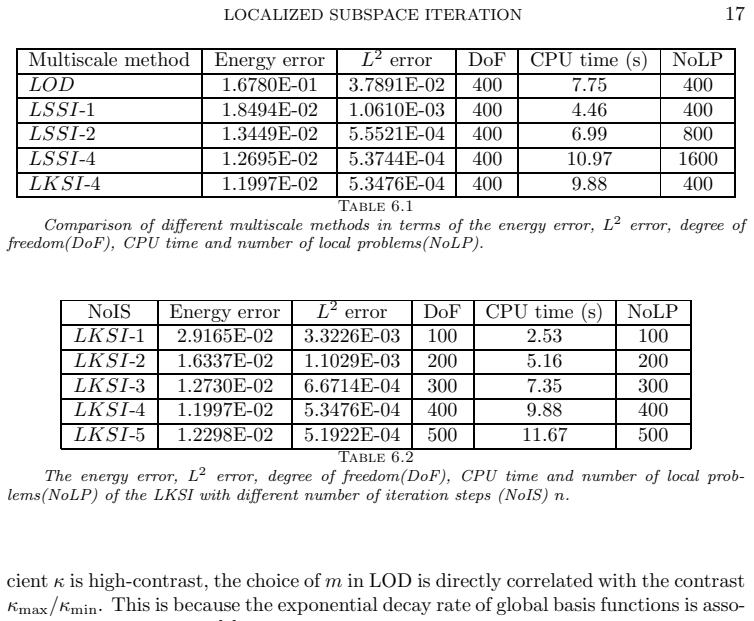
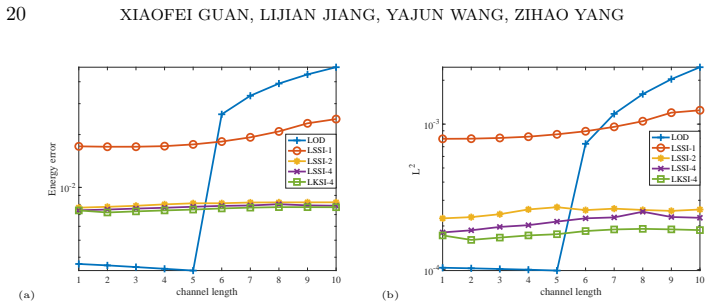
- [Abstract and Numerical Experiments] The abstract states that the proposed methods show 'significant superiority' for long-channel cases; the corresponding numerical section should state the precise error measures, the set of competing methods, and the number of degrees of freedom used in each comparison so that the claim can be verified directly from the tables or figures.
- [Section 2] Notation for the localized operator, the partition-of-unity functions, and the local spectral problems should be introduced once in a dedicated preliminary subsection and then used consistently; several symbols appear to be redefined in later sections without cross-reference.
- [Convergence Analysis] The convergence theorem should explicitly list the assumptions on the coefficient (e.g., boundedness, contrast ratio) under which the stated rate holds; the current statement appears to omit the dependence on the localization radius.
Simulated Author's Rebuttal
We thank the referee for the careful reading and positive assessment of our manuscript on localized subspace iteration methods for elliptic multiscale problems. The recommendation for minor revision is noted. Since no specific major comments were provided in the report, we have no points to address point-by-point at this stage and will incorporate any minor editorial suggestions in the revised version.
Circularity Check
No significant circularity; derivation is self-contained
full rationale
The paper defines LSI methods explicitly via localization (Dirichlet conditions + partition of unity) followed by subspace iteration on local spectral problems, then supplies independent convergence analysis plus numerical comparisons. Existing methods are reframed as single-iteration approximations, but this is presented as interpretive perspective rather than a definitional reduction; new methods are constructed and validated externally without any fitted parameter renamed as prediction, self-citation load-bearing the central claim, or ansatz smuggled via prior work. The derivation chain remains open to external benchmarks.
Axiom & Free-Parameter Ledger
Reference graph
Works this paper leans on
-
[1]
J. E. Aarnes, Y. Efendiev, and L. Jiang , Mixed multiscale finite element methods using limited global information , Multiscale Modeling & Simulation, 7 (2008), pp. 655–676
work page 2008
-
[2]
G. Allaire , Homogenization and two-scale convergence , SIAM Journal on Mathematical Analysis, 23 (1992), pp. 1482–1518
work page 1992
-
[3]
R. Altmann, P. Henning, and D. Peterseim , Numerical homogenization beyond scale sepa- ration, Acta Numerica, 30 (2021), pp. 1–86
work page 2021
-
[4]
T. Arbogast, G. Pencheva, M. F. Wheeler, and I. Yotov , A multiscale mortar mixed finite element method , Multiscale Modeling & Simulation, 6 (2007), pp. 319–346
work page 2007
-
[5]
I. Babuˇska, G. Caloz, and J. E. Osborn , Special finite element methods for a class of second order elliptic problems with rough coefficients , SIAM Journal on Numerical Analysis, 31 (1994), pp. 945–981
work page 1994
-
[7]
I. Babuska and R. Lipton , Optimal local approximation spaces for generalized finite e lement methods with application to multiscale problems , Multiscale Modeling & Simulation, 9 (2011), pp. 373–406
work page 2011
-
[8]
I. Babu ˇska, R. Lipton, P. Sinz, and M. Stuebner , Multiscale-spectral gfem and optimal oversampling, Computer Methods in Applied Mechanics and Engineering, 36 4 (2020), p. 112960
work page 2020
-
[9]
I. Babu ˇska and J. E. Osborn , Generalized finite element methods: their performance and their relation to mixed methods , SIAM Journal on Numerical Analysis, 20 (1983), pp. 510– 536
work page 1983
-
[10]
I. Babuˇska and J. E. Osborn , Can a finite element method perform arbitrarily badly? , Math- ematics of computation, 69 (2000), pp. 443–462
work page 2000
-
[11]
M. A. Biot , Mechanics of deformation and acoustic propagation in porou s media , Journal of applied physics, 33 (1962), pp. 1482–1498
work page 1962
-
[12]
H. Br ´ezis, Functional analysis, Sobolev spaces and partial differenti al equations , New York: Springer, 2011
work page 2011
-
[13]
E. T. Chung, Y. Efendiev, and W. T. Leung , Constraint energy minimizing generalized mul- tiscale finite element method , Computer Methods in Applied Mechanics and Engineering, 339 (2018), pp. 298–319
work page 2018
-
[14]
Y. Efendiev, J. Galvis, and T. Y. Hou , Generalized multiscale finite element methods (gms- fem), Journal of computational physics, 251 (2013), pp. 116–135
work page 2013
-
[15]
Y. Efendiev, J. Galvis, and T. Y. Hou , Generalized multiscale finite element methods (gms- fem), Journal of computational physics, 251 (2013), pp. 116–135 . This manuscript is for review purposes only. LOCALIZED SUBSPACE ITERATION 23
work page 2013
-
[16]
Y. Efendiev and T. Y. Hou , Multiscale finite element methods: theory and applications , vol. 4, Springer Science & Business Media, 2009
work page 2009
-
[17]
X. Guan, L. Jiang, and Y. W ang , Multiscale model reduction for stochastic elasticity prob - lems using ensemble variable-separated method , Journal of Computational and Applied Mathematics, 421 (2023), p. 114895
work page 2023
-
[18]
X. Guan, L. Jiang, and Y. W ang , Regularized coupling multiscale method for thermomechan- ical coupled problems , Journal of Computational Physics, 499 (2024), p. 112737
work page 2024
-
[19]
P. Henning and A. M ˚alqvist, Localized orthogonal decomposition techniques for bounda ry value problems , SIAM Journal on Scientific Computing, 36 (2014), pp. A1609– A1634
work page 2014
-
[20]
P. Henning and D. Peterseim , Oversampling for the multiscale finite element method , Mul- tiscale Modeling & Simulation, 11 (2013), pp. 1149–1175
work page 2013
-
[21]
U. Hornung and R. E. Show alter , Diffusion models for fractured media , Journal of mathe- matical analysis and applications, 147 (1990), pp. 69–80
work page 1990
-
[22]
T. Y. Hou and X.-H. Wu , A multiscale finite element method for elliptic problems in c omposite materials and porous media , Journal of computational physics, 134 (1997), pp. 169–189
work page 1997
-
[23]
T. Y. Hou, X.-H. Wu, and Y. Zhang , Removing the cell resonance error in the multiscale finite element method via a petrov-galerkin formulation , Communications in Mathematical Sciences, 2 (2004), pp. 185–205
work page 2004
-
[25]
T. J. Hughes, G. R. Feij ´oo, L. Mazzei, and J.-B. Quincy , The variational multiscale method—a paradigm for computational mechanics , Computer methods in applied mechan- ics and engineering, 166 (1998), pp. 3–24
work page 1998
-
[26]
M. G. Larson and A. M ˚alqvist, Adaptive variational multiscale methods based on a posteri - ori error estimation: energy norm estimates for elliptic pr oblems, Computer methods in applied mechanics and engineering, 196 (2007), pp. 2313–23 24
work page 2007
-
[27]
M. Li, E. Chung, and L. Jiang , A constraint energy minimizing generalized multiscale fini te element method for parabolic equations , Multiscale Modeling & Simulation, 17 (2019), pp. 996–1018
work page 2019
-
[28]
J. Liesen and Z. Strakos , Krylov subspace methods: principles and analysis , Numerical Mathematics and Scie, 2013
work page 2013
-
[29]
C. Ma, R. Scheichl, and T. Dodwell , Novel design and analysis of generalized finite element methods based on locally optimal spectral approximations , SIAM Journal on Numerical Analysis, 60 (2022), pp. 244–273
work page 2022
-
[30]
A. M˚alqvist and D. Peterseim , Localization of elliptic multiscale problems , Mathematics of Computation, 83 (2014), pp. 2583–2603
work page 2014
-
[31]
A. M˚alqvist and D. Peterseim , Numerical homogenization by localized orthogonal decompo - sition, SIAM, 2020
work page 2020
-
[32]
H. Owhadi and C. Scovel , Operator-Adapted Wavelets, Fast Solvers, and Numerical Ho mog- enization: From a Game Theoretic Approach to Numerical Appr oximation and Algorithm Design, vol. 35, Cambridge University Press, 2019
work page 2019
-
[33]
H. Owhadi and L. Zhang , Metric-based upscaling , Communications on Pure and Applied Mathematics, 60 (2007), pp. 675–723
work page 2007
-
[34]
Saad , Iterative methods for sparse linear systems , SIAM, 2003
Y. Saad , Iterative methods for sparse linear systems , SIAM, 2003
work page 2003
-
[35]
Saad , Numerical methods for large eigenvalue problems: revised e dition, SIAM, 2011
Y. Saad , Numerical methods for large eigenvalue problems: revised e dition, SIAM, 2011
work page 2011
-
[36]
G. L. Sleijpen and H. A. V an der Vorst , A jacobi–davidson iteration method for linear eigenvalue problems , SIAM review, 42 (2000), pp. 267–293
work page 2000
-
[37]
E. Weinan and B. Engquist , The heterognous multiscale methods , Communications in Math- ematical Sciences, 1 (2003), pp. 87–132
work page 2003
-
[38]
X.-H. Wu, Y. Efendiev, and T. Y. Hou , Analysis of upscaling absolute permeability , Discrete and Continuous Dynamical Systems Series B, 2 (2002), pp. 185 –204. This manuscript is for review purposes only
work page 2002
discussion (0)
Sign in with ORCID, Apple, or X to comment. Anyone can read and Pith papers without signing in.