REVIEW 2 major objections 1 minor 64 references
MoCo uses machine learning ensembles on all participants to estimate motion-standardized functional connectivity differences between autistic and non-ASD children with large-sample efficiency and multiple robustness.
Reviewed by Pith at T0; open to challenge. T0 means a machine referee read the full paper against a public rubric. the ladder, T0–T4 →
T0 review · grok-4.3
2026-05-23 23:58 UTC
load-bearing objection The paper defines a motion-standardized estimand for ASD functional connectivity and proposes the MoCo estimator to avoid exclusion bias while claiming efficiency and multiple robustness, but those claims rest on unverified nuisance rates in a small QC-passing sample. the 2 major comments →
Nonparametric Motion Control in Functional Connectivity Studies in Children with Autism Spectrum Disorder
The pith
A machine-rendered reading of the paper's core claim, the machinery that carries it, and where it could break.
Core claim
The MoCo nonparametric estimator achieves large-sample efficiency and multiple robustness for the motion-standardized functional connectivity difference by using an ensemble of machine learning methods to model the conditional effects of motion and other features on functional connectivity while standardizing to the low-motion distribution among quality-control-passing scans.
What carries the argument
The MoCo estimator, a multiply robust, asymptotically efficient nonparametric procedure that employs machine-learning ensembles to model conditional effects of motion and covariates on the functional connectivity outcome.
Load-bearing premise
An ensemble of machine learning methods can flexibly model the conditional effects of motion and other features on functional connectivity well enough to deliver the claimed efficiency and multiple robustness in finite samples, and standardizing to the low-motion distribution among QC-passing scans is the scientifically relevant target.
What would settle it
A simulation in which the true conditional expectation of connectivity given motion is known but the machine-learning ensemble produces estimates whose bias does not vanish at the rate required for large-sample efficiency, or an empirical check in which MoCo estimates differ materially from those obtained by restricting analysis to the low-motion subsample in a manner inconsistent with multiple robustness.
If this is right
- All participants can be retained rather than excluded on the basis of motion, reducing selection bias.
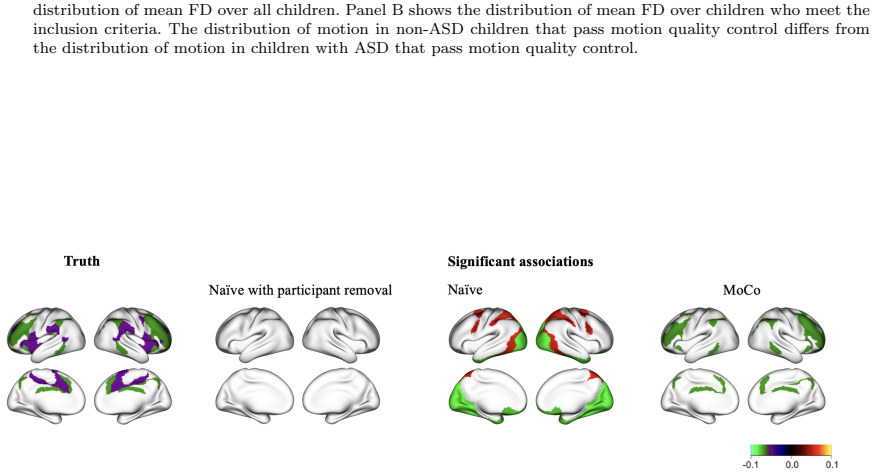
- Motion artifacts are reduced relative to a standard linear regression applied without participant removal.
- The estimator remains consistent if any one of several nuisance models is correctly specified.
- Asymptotic efficiency implies that the estimator attains the lowest possible variance among regular estimators of the target parameter.
- The same standardization and robustness properties apply to the difference in functional connectivity between the two diagnostic groups.
Where Pith is reading between the lines
- Existing high-motion datasets could be re-analyzed with MoCo to recover connectivity estimates that were previously discarded.
- The approach could be tested by applying it to other neuroimaging contrasts where motion correlates with the exposure of interest.
- If the ensemble performs as claimed, the method might extend directly to continuous exposures or to additional confounders such as age or sex.
- A direct comparison of MoCo variance with the variance of the low-motion-only estimator in a large external sample would quantify the efficiency gain.
Editorial analysis
A structured set of objections, weighed in public.
Referee Report
Summary. The paper defines a motion-standardized functional connectivity (FC) difference estimand between autistic and non-ASD children, targeting the low-motion distribution among QC-passing scans. It proposes the MoCo nonparametric estimator that employs an ensemble of machine learning methods to model nuisance functions without participant exclusion, and asserts that this estimator attains large-sample efficiency and multiple robustness. The method is applied to a sample of 377 children (132 ASD, 245 non-ASD; 34 and 126 QC passers respectively), claiming reduced motion artifacts relative to unadjusted or exclusion-based approaches.
Significance. If the efficiency and multiple-robustness claims hold under the stated standardization target, the approach would allow fuller use of neuroimaging data while mitigating selection bias from motion QC exclusions and relaxing linearity assumptions common in FC studies. This could improve power and validity in pediatric ASD connectivity research where motion is a pervasive confounder.
major comments (2)
- [Abstract] Abstract: the central claim that MoCo 'establishes large-sample efficiency and multiple robustness' requires the ML ensemble nuisance estimators (conditional expectations of FC and the density/propensity for the low-motion QC-passing law) to satisfy product-rate conditions faster than n^{-1/4}. No rate conditions, cross-fitting protocol, or simulation verification of these rates are supplied for the n=377 regime (only 160 QC passers), leaving the semiparametric efficiency bound unverified.
- [Application] Application (data description): the target distribution is the empirical low-motion law among the 160 QC-passing scans; the manuscript does not demonstrate that estimation error in this empirical measure is negligible relative to the efficiency bound or that the standardization remains scientifically interpretable when the QC-passing subsample is small and potentially non-representative.
minor comments (1)
- Notation for the estimand and nuisance functions should be introduced with explicit definitions before the efficiency claim is stated.
Simulated Author's Rebuttal
We thank the referee for the constructive comments on the efficiency claims and the target distribution. We agree that additional details are needed to support the semiparametric claims and to clarify the empirical target. Below we respond point by point and indicate the revisions we will make.
read point-by-point responses
-
Referee: [Abstract] Abstract: the central claim that MoCo 'establishes large-sample efficiency and multiple robustness' requires the ML ensemble nuisance estimators (conditional expectations of FC and the density/propensity for the low-motion QC-passing law) to satisfy product-rate conditions faster than n^{-1/4}. No rate conditions, cross-fitting protocol, or simulation verification of these rates are supplied for the n=377 regime (only 160 QC passers), leaving the semiparametric efficiency bound unverified.
Authors: We acknowledge that the manuscript states the efficiency and multiple-robustness results under standard semiparametric conditions but does not explicitly verify the product-rate requirements or provide a cross-fitting protocol for the ensemble in the n=377 setting. In the revision we will add a dedicated subsection describing the cross-fitting procedure used with the ML ensemble and include finite-sample simulation studies that confirm the nuisance estimators achieve rates faster than n^{-1/4} in regimes matching our data (approximately 377 observations with 160 QC passers). These additions will make the attainment of the efficiency bound explicit for the relevant sample size. revision: yes
-
Referee: [Application] Application (data description): the target distribution is the empirical low-motion law among the 160 QC-passing scans; the manuscript does not demonstrate that estimation error in this empirical measure is negligible relative to the efficiency bound or that the standardization remains scientifically interpretable when the QC-passing subsample is small and potentially non-representative.
Authors: The target is defined as the empirical low-motion distribution among the QC-passing scans, which is estimated from the 160 passers. We agree the current text does not quantify the sampling variability of this empirical target or assess its impact on the efficiency bound. In the revision we will add a sensitivity analysis (e.g., bootstrap resampling of the target distribution) and a short discussion of interpretability when the QC subsample is modest, thereby clarifying both the statistical properties and the scientific meaning of the standardization. revision: yes
Circularity Check
No circularity: estimator from standard semiparametric theory on new estimand
full rationale
The paper defines a new estimand (motion-standardized FC difference) and applies the MoCo estimator via ensemble ML nuisances. Large-sample efficiency and multiple robustness follow from general semiparametric theory for multiply robust functionals; the provided text shows no reduction of the central claim to a fitted input, self-citation chain, or self-definitional step. No load-bearing self-citations or ansatz smuggling are exhibited. This is the common case of an independent derivation.
Axiom & Free-Parameter Ledger
axioms (1)
- standard math Standard regularity conditions for large-sample efficiency and multiple robustness of semiparametric estimators hold.
read the original abstract
Autism Spectrum Disorder (ASD) is a neurodevelopmental condition associated with difficulties with social interactions, communication, and restricted or repetitive behaviors. To characterize ASD, investigators often use functional connectivity derived from resting-state functional magnetic resonance imaging of the brain. However, participants' head motion during the scanning session can induce motion artifacts. Many studies remove participants with excessive motion, and then estimate the effect of diagnosis on functional connectivity using linear regression. However, participant exclusions and linearity assumptions can cause biases. We propose an estimand that quantifies the difference in average functional connectivity in autistic and non-ASD children while standardizing motion relative to the low motion distribution in scans that pass motion quality control. We introduce a nonparametric estimator for motion control, called MoCo, that uses all participants and flexibly models the impacts of motion and other relevant features using an ensemble of machine learning methods. We establish large-sample efficiency and multiple robustness of our proposed estimator. The framework is applied to estimate the difference in functional connectivity between 132 autistic and 245 non-ASD children, of which 34 and 126 pass motion quality control, respectively. MoCo appears to dramatically reduce motion artifacts compared to a standard approach with no participant removal, while more efficiently utilizing participant data and accounting for possible selection biases compared to participant removal.
Figures




Reference graph
Works this paper leans on
-
[1]
" write newline "" before.all 'output.state := FUNCTION article output.bibitem format.authors "author" output.check author format.key output output.year.check new.block format.title "title" output.check new.block crossref missing format.jour.vol output format.article.crossref output.nonnull format.pages output if new.block note output fin.entry FUNCTION b...
-
[2]
Bickel, Peter J, Klaassen, Chris AJ, Ritov, Ya’acov and Wellner, Jon A . (1993). Efficient and adaptive estimation for semiparametric models\/ , Volume 4. Springer
work page 1993
-
[3]
Chernozhukov, Victor, Chetverikov, Denis, Demirer, Mert, Duflo, Esther, Hansen, Christian, Newey, Whitney and Robins, James . (2018). Double/debiased machine learning for treatment and structural parameters. The Econometrics Journal\/ 21(1), C1--C68
work page 2018
-
[4]
Ciric, Rastko, Wolf, Daniel H, Power, Jonathan D, Roalf, David R, Baum, Graham L and others . (2017). Benchmarking of participant-level confound regression strategies for the control of motion artifact in studies of functional connectivity. Neuroimage\/ 154, 174--187
work page 2017
-
[5]
Cola c o, David . (2024). When remediating one artifact results in another: control, confounders, and correction. History and Philosophy of the Life Sciences\/ 46(1), 5
work page 2024
-
[6]
Cosgrove, Kelly T, McDermott, Timothy J, White, Evan J, Mosconi, Matthew W, Thompson, Wesley K, Paulus, Martin P, Cardenas-Iniguez, Carlos and Aupperle, Robin L . (2022). Limits to the generalizability of resting-state functional magnetic resonance imaging studies of youth: An examination of abcd study baseline data. Brain imaging and behavior\/ 16(4), 1919--1925
work page 2022
-
[7]
De Bie, Henrica MA, Boersma, Maria, Wattjes, Mike P, Adriaanse, Sofie, Vermeulen, R Jeroen and others . (2010). Preparing children with a mock scanner training protocol results in high quality structural and functional mri scans. European journal of pediatrics\/ 169, 1079--1085
work page 2010
-
[8]
Deen, Ben and Pelphrey, Kevin . (2012). Perspective: brain scans need a rethink. Nature\/ 491(7422), S20--S20
work page 2012
-
[9]
Di Martino, Adriana, O’connor, David, Chen, Bosi, Alaerts, Kaat, Anderson, Jeffrey S, Assaf and others . (2017). Enhancing studies of the connectome in autism using the autism brain imaging data exchange ii. Scientific data\/ 4(1), 1--15
work page 2017
-
[10]
Di Martino, Adriana, Yan, Chao-Gan, Li, Qingyang, Denio, Erin, Castellanos and others . (2014). The autism brain imaging data exchange: towards a large-scale evaluation of the intrinsic brain architecture in autism. Molecular psychiatry\/ 19(6), 659--667
work page 2014
-
[11]
D \' az, Iv \'a n, Hejazi, Nima S, Rudolph, Kara E and van Der Laan, Mark J . (2021). Nonparametric efficient causal mediation with intermediate confounders. Biometrika\/ 108(3), 627--641
work page 2021
-
[12]
Esteban, Oscar, Markiewicz, Christopher J, Blair, Ross W, Moodie, Craig A, Isik, A and others . (2019). fmriprep: a robust preprocessing pipeline for functional mri. Nature methods\/ 16(1), 111--116
work page 2019
-
[13]
Fair, Damien A, Cohen, Alexander L, Dosenbach, Nico UF, Church, Jessica A, Miezin, Francis M, Barch, Deanna M, Raichle, Marcus E, Petersen, Steven E and Schlaggar, Bradley L . (2008). The maturing architecture of the brain's default network. Proceedings of the National Academy of Sciences\/ 105(10), 4028--4032
work page 2008
-
[14]
Hejazi, Nima S, van der Laan, Mark J and Benkeser, David . (2022). haldensify: Highly adaptive lasso conditional density estimation inr. Journal of Open Source Software\/ 7(77), 4522
work page 2022
-
[15]
Hull, Jocelyn V, Dokovna, Lisa B, Jacokes, Zachary J, Torgerson, Carinna M, Irimia, Andrei and Van Horn, John Darrell . (2017). Resting-state functional connectivity in autism spectrum disorders: a review. Frontiers in psychiatry\/ 7, 205
work page 2017
-
[16]
Maenner, Matthew J . (2023). Prevalence and characteristics of autism spectrum disorder among children aged 8 years—autism and developmental disabilities monitoring network, 11 sites, united states, 2020. MMWR. Surveillance Summaries\/ 72
work page 2023
-
[17]
Marek, Scott, Tervo-Clemmens, Brenden, Calabro, Finnegan J, Montez, David F, Kay, Benjamin P and others . (2022). Reproducible brain-wide association studies require thousands of individuals. Nature\/ 603(7902), 654--660
work page 2022
-
[18]
Mu \ n oz, Iv \'a n D \' az and Van Der Laan, Mark . (2012). Population intervention causal effects based on stochastic interventions. Biometrics\/ 68(2), 541--549
work page 2012
-
[19]
Nebel, Mary Beth, Lidstone, Daniel E, Wang, Liwei, Benkeser, David, Mostofsky, Stewart H and Risk, Benjamin B . (2022). Accounting for motion in resting-state fmri: What part of the spectrum are we characterizing in autism spectrum disorder? NeuroImage\/ 257, 119296
work page 2022
-
[20]
Nielsen, Ashley N, Greene, Deanna J, Gratton, Caterina, Dosenbach, Nico UF, Petersen, Steven E and Schlaggar, Bradley L . (2019). Evaluating the prediction of brain maturity from functional connectivity after motion artifact denoising. Cerebral Cortex\/ 29(6), 2455--2469
work page 2019
-
[21]
Pearl, Judea . (2014). Interpretation and identification of causal mediation. Psychological methods\/ 19(4), 459
work page 2014
-
[22]
Pham, Damon D, Muschelli, John and Mejia, Amanda F . (2022). ciftitools: A package for reading, writing, visualizing, and manipulating cifti files in r. NeuroImage\/ 250, 118877
work page 2022
-
[23]
Polley, Eric, LeDell, Erin, Kennedy, Chris and van der Laan , Mark . (2023). SuperLearner: Super Learner Prediction\/ . R package version 2.0-28.1
work page 2023
-
[24]
Power, Jonathan D, Barnes, Kelly A, Snyder, Abraham Z, Schlaggar, Bradley L and Petersen, Steven E . (2012). Spurious but systematic correlations in functional connectivity mri networks arise from subject motion. Neuroimage\/ 59(3), 2142--2154
work page 2012
-
[25]
Power, Jonathan D, Mitra, Anish, Laumann, Timothy O, Snyder, Abraham Z, Schlaggar, Bradley L and Petersen, Steven E . (2014). Methods to detect, characterize, and remove motion artifact in resting state fmri. Neuroimage\/ 84, 320--341
work page 2014
-
[26]
Reuter, Martin, Tisdall, M Dylan, Qureshi, Abid, Buckner, Randy L, van der Kouwe, Andr \'e JW and Fischl, Bruce . (2015). Head motion during mri acquisition reduces gray matter volume and thickness estimates. Neuroimage\/ 107, 107--115
work page 2015
-
[27]
Richardson, Thomas S and Robins, James M . (2013). Single world intervention graphs (swigs): A unification of the counterfactual and graphical approaches to causality. Center for the Statistics and the Social Sciences, University of Washington Series. Working Paper\/ 128(30), 2013
work page 2013
-
[28]
Ruppert, David, Wand, Matt P and Carroll, Raymond J . (2003). Semiparametric regression\/ , Number 12. Cambridge university press
work page 2003
-
[29]
Satterthwaite, Theodore D, Elliott, Mark A, Gerraty, Raphael T, Ruparel, Kosha, Loughead, James and others . (2013). An improved framework for confound regression and filtering for control of motion artifact in the preprocessing of resting-state functional connectivity data. Neuroimage\/ 64, 240--256
work page 2013
-
[30]
Schaefer, Alexander, Kong, Ru, Gordon, Evan M, Laumann, Timothy O, Zuo, Xi-Nian and others . (2018). Local-global parcellation of the human cerebral cortex from intrinsic functional connectivity mri. Cerebral cortex\/ 28(9), 3095--3114
work page 2018
-
[31]
Shanmugan, Sheila, Seidlitz, Jakob, Cui, Zaixu, Adebimpe, Azeez, Bassett, Danielle S and others . (2022). Sex differences in the functional topography of association networks in youth. Proceedings of the National Academy of Sciences\/ 119(33), e2110416119
work page 2022
-
[32]
Sobel, Michael E and Lindquist, Martin A . (2014). Causal inference for fmri time series data with systematic errors of measurement in a balanced on/off study of social evaluative threat. Journal of the American Statistical Association\/ 109(507), 967--976
work page 2014
-
[33]
Van der Laan, Mark J, Polley, Eric C and Hubbard, Alan E . (2007). Super learner. Statistical applications in genetics and molecular biology\/ 6(1)
work page 2007
-
[34]
Van der Laan, Mark J, Rose, Sherri and others . (2011). Targeted learning: causal inference for observational and experimental data\/ , Volume 4. Springer
work page 2011
-
[35]
van der Laan, Mark J, Rose, Sherri, Zheng, Wenjing and van der Laan, Mark J . (2011). Cross-validated targeted minimum-loss-based estimation. Targeted learning: causal inference for observational and experimental data\/ , 459--474
work page 2011
-
[36]
Van Der Vaart, Aad W, Wellner, Jon A, van der Vaart, Aad W and Wellner, Jon A . (1996). Weak convergence\/ . Springer
work page 1996
-
[37]
Van Dijk, Koene RA, Sabuncu, Mert R and Buckner, Randy L . (2012). The influence of head motion on intrinsic functional connectivity mri. Neuroimage\/ 59(1), 431--438
work page 2012
-
[38]
Wang, Yikai and Guo, Ying . (2023). Locus: A regularized blind source separation method with low-rank structure for investigating brain connectivity. The Annals of Applied Statistics\/ 17(2), 1307--1332
work page 2023
-
[39]
Yan, Chao-Gan, Cheung, Brian, Kelly, Clare, Colcombe, Stan, Craddock, R Cameron, Di Martino, Adriana, Li, Qingyang, Zuo, Xi-Nian, Castellanos, F Xavier and Milham, Michael P . (2013). A comprehensive assessment of regional variation in the impact of head micromovements on functional connectomics. Neuroimage\/ 76, 183--201
work page 2013
-
[40]
Yendiki, Anastasia, Koldewyn, Kami, Kakunoori, Sita, Kanwisher, Nancy and Fischl, Bruce . (2014). Spurious group differences due to head motion in a diffusion mri study. Neuroimage\/ 88, 79--90
work page 2014
-
[41]
Yeo, BT Thomas, Krienen, Fenna M, Sepulcre, Jorge, Sabuncu, Mert R, Lashkari, Danial and others . (2011). The organization of the human cerebral cortex estimated by intrinsic functional connectivity. Journal of neurophysiology\/
work page 2011
-
[42]
Yerys, Benjamin E, Gordon, Evan M, Abrams, Danielle N, Satterthwaite, Theodore D, Weinblatt, Rachel and others . (2015). Default mode network segregation and social deficits in autism spectrum disorder: Evidence from non-medicated children. NeuroImage: Clinical\/ 9, 223--232
work page 2015
-
[43]
Yu, Meichen, Linn, Kristin A, Cook, Philip A, Phillips, Mary L, McInnis, Melvin, Fava, Maurizio, Trivedi, Madhukar H and others . (2018). Statistical harmonization corrects site effects in functional connectivity measurements from multi-site fmri data. Human brain mapping\/ 39(11), 4213--4227
work page 2018
-
[44]
Zivich, Paul N and Breskin, Alexander . (2021). Machine learning for causal inference: on the use of cross-fit estimators. Epidemiology (Cambridge, Mass.)\/ 32(3), 393
work page 2021
-
[45]
Abraham, Alexandre, Pedregosa, Fabian, Eickenberg, Michael, Gervais, Philippe, Mueller, Andreas, Kossaifi, Jean, Gramfort, Alexandre, Thirion, Bertrand and Varoquaux, Gael . (2014). Machine learning for neuroimaging with scikit-learn. Frontiers in Neuroinformatics\/ 8
work page 2014
-
[46]
Avants, B.B., Epstein, C.L., Grossman, M. and Gee, J.C. (2008). Symmetric diffeomorphic image registration with cross-correlation: Evaluating automated labeling of elderly and neurodegenerative brain. Medical Image Analysis\/ 12(1), 26--41
work page 2008
-
[47]
Benkeser, David and van der Laan , Mark . (2016). The highly adaptive lasso estimator. In: 2016 IEEE International Conference on Data Science and Advanced Analytics (DSAA) \/ . IEEE. pp.\ 689--696
work page 2016
-
[48]
Cox, Robert W. and Hyde, James S. (1997). Software tools for analysis and visualization of fmri data. NMR in Biomedicine\/ 10(4-5), 171--178
work page 1997
-
[49]
Dale, Anders M., Fischl, Bruce and Sereno, Martin I. (1999). Cortical surface-based analysis: I. segmentation and surface reconstruction. NeuroImage\/ 9(2), 179--194
work page 1999
-
[50]
andGoncalves, DuPre, Elizabeth, Sitek, Kevin R., Gomez, Daniel E
Esteban, Oscar, Blair, Ross, Markiewicz, Christopher J., Berleant, Shoshana L., Moodie, Craig, Ma, Feilong, Isik, Ayse Ilkay, Erramuzpe, Asier, Kent, Mathias James D. andGoncalves, DuPre, Elizabeth, Sitek, Kevin R., Gomez, Daniel E. P., Lurie, Daniel J., Ye, Zhifang, Poldrack, Russell A. and others. (2018 a ). fmriprep. Software\/
work page 2018
-
[51]
Esteban, Oscar, Markiewicz, Christopher, Blair, Ross W, Moodie, Craig, Isik, Ayse Ilkay, Erramuzpe Aliaga, Asier, Kent, James, Goncalves, Mathias, DuPre, Elizabeth, Snyder, Madeleine, Oya, Hiroyuki, Ghosh, Satrajit, Wright, Jessey, Durnez, Joke, Poldrack, Russell and others. (2018 b ). fMRIPrep : a robust preprocessing pipeline for functional MRI . Nature...
work page 2018
-
[52]
Evans, AC, Janke, AL, Collins, DL and Baillet, S . (2012). Brain templates and atlases. NeuroImage\/ 62(2), 911--922
work page 2012
-
[53]
Fonov, VS, Evans, AC, McKinstry, RC, Almli, CR and Collins, DL . (2009). Unbiased nonlinear average age-appropriate brain templates from birth to adulthood. NeuroImage\/ 47, Supplement 1, S102
work page 2009
-
[54]
Glasser, Matthew F., Sotiropoulos, Stamatios N., Wilson, J. Anthony, Coalson, Timothy S., Fischl, Bruce, Andersson, Jesper L., Xu, Junqian, Jbabdi, Saad, Webster, Matthew, Polimeni, Jonathan R., Van Essen, David C. and others. (2013). The minimal preprocessing pipelines for the human connectome project. NeuroImage\/ 80, 105--124
work page 2013
-
[55]
D., Madison, C., Clark, D., Halchenko, Y
Gorgolewski, K., Burns, C. D., Madison, C., Clark, D., Halchenko, Y. O., Waskom, M. L. and Ghosh, S. (2011). Nipype: a flexible, lightweight and extensible neuroimaging data processing framework in python. Frontiers in Neuroinformatics\/ 5, 13
work page 2011
-
[56]
Gorgolewski, Krzysztof J., Esteban, Oscar, Markiewicz, Christopher J., Ziegler, Erik, Ellis, David Gage, Notter, Michael Philipp, Jarecka, Dorota, Johnson, Hans, Burns, Christopher, Manhães-Savio, Alexandre, Hamalainen, Carlo, Yvernault, Benjamin, Salo, Taylor, Jordan, Kesshi, Goncalves, Mathias, Waskom, Michael, Clark, Daniel, Wong, Jason, Loney, Fred, M...
work page 2018
-
[57]
Greve, Douglas N and Fischl, Bruce . (2009). Accurate and robust brain image alignment using boundary-based registration. NeuroImage\/ 48(1), 63--72
work page 2009
-
[58]
Jenkinson, Mark, Bannister, Peter, Brady, Michael and Smith, Stephen . (2002). Improved optimization for the robust and accurate linear registration and motion correction of brain images. NeuroImage\/ 17(2), 825--841
work page 2002
-
[59]
Klein, Arno, Ghosh, Satrajit S., Bao, Forrest S., Giard, Joachim, Häme, Yrjö, Stavsky, Eliezer, Lee, Noah, Rossa, Brian, Reuter, Martin, Neto, Elias Chaibub and others. (2017). Mindboggling morphometry of human brains. PLOS Computational Biology\/ 13(2), e1005350
work page 2017
-
[60]
Lanczos, C. (1964). Evaluation of noisy data. Journal of the Society for Industrial and Applied Mathematics Series B Numerical Analysis\/ 1(1), 76--85
work page 1964
-
[61]
Levy, Jonathan . (2019). Tutorial: Deriving the efficient influence curve for large models. arXiv preprint arXiv:1903.01706\/
work page internal anchor Pith review Pith/arXiv arXiv 2019
-
[62]
Power, Jonathan D., Mitra, Anish, Laumann, Timothy O., Snyder, Abraham Z., Schlaggar, Bradley L. and Petersen, Steven E. (2014). Methods to detect, characterize, and remove motion artifact in resting state fmri. NeuroImage\/ 84(Supplement C), 320--341
work page 2014
-
[63]
Tustison, N. J., Avants, B. B., Cook, P. A., Zheng, Y., Egan, A., Yushkevich, P. A. and Gee, J. C. (2010). N4itk: Improved n3 bias correction. IEEE Transactions on Medical Imaging\/ 29(6), 1310--1320
work page 2010
-
[64]
Zhang, Y., Brady, M. and Smith, S. (2001). Segmentation of brain MR images through a hidden markov random field model and the expectation-maximization algorithm. IEEE Transactions on Medical Imaging\/ 20(1), 45--57
work page 2001
discussion (0)
Sign in with ORCID, Apple, or X to comment. Anyone can read and Pith papers without signing in.